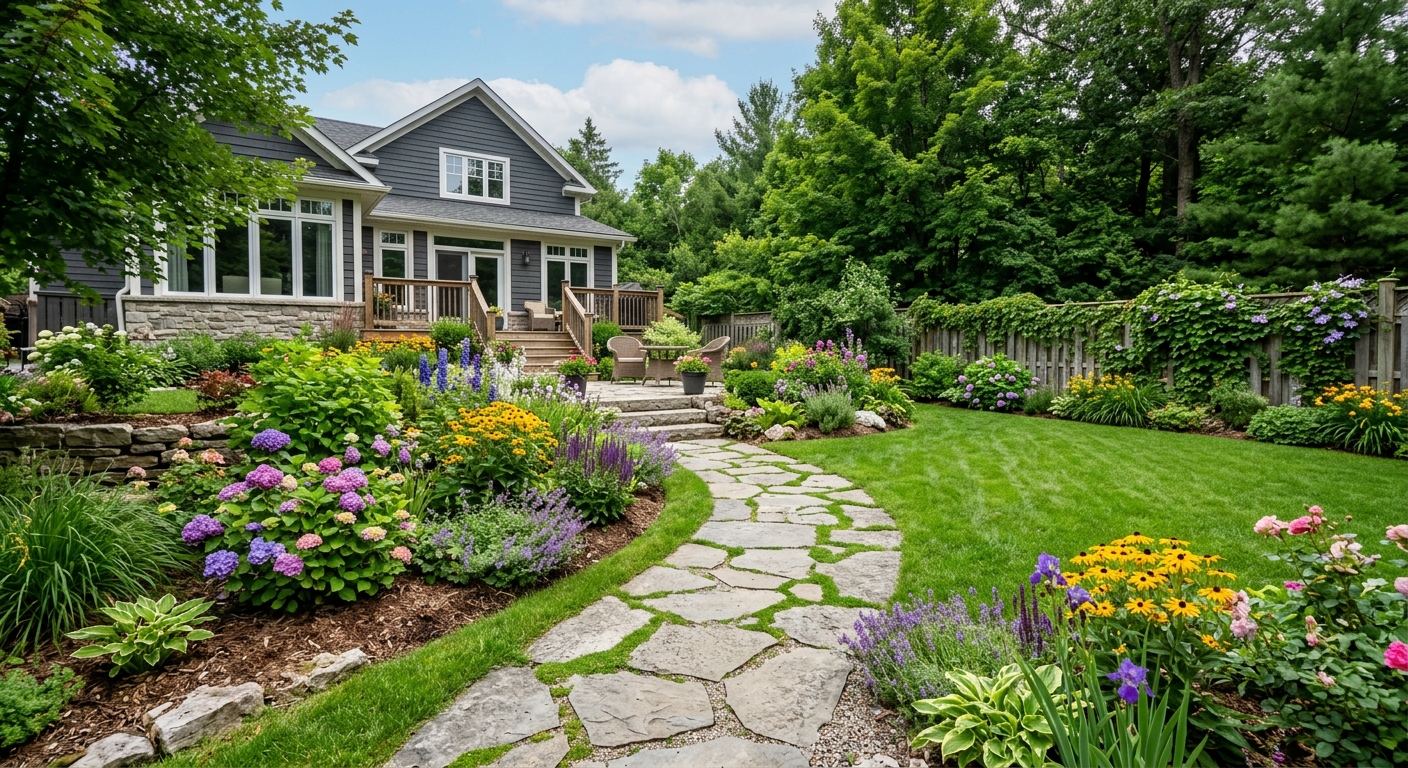
Landscaping options and costs in Baturyn
Baturyn, Alberta is the kind of community where landscaping has to perform through real chinooks, winter freezes and spring re-settlement. With a population of 5,267 (Statistics Canada, 2021 Census), demand is steady enough that homeowners often upgrade front yards first—especially on detached properties that tend to have more room for visible hardscape and softscape improvements. A lot of residents move in with older lots and established foundations, so drainage corrections and frost-safe base prep become common parts of the scope.
In the Calgary region, costs are strongly tied to our Prairie plant hardiness zones 3–4, late-spring frosts, and early fall cold snaps. That shorter working season affects scheduling and labour availability, and it also limits how many “weather-dependent” steps contractors can complete in one trip. Freeze–thaw cycles are severe, so patios, walkways and retaining walls typically require deeper, well-compacted bases and disciplined drainage to prevent heaving and settlement. Even when materials look similar across Alberta, the labour intensity to get the base right is what moves your quote.
In Baturyn, trades see especially high demand for curb-appeal projects around the residential areas where lots are more exposed to wind and where homeowners prioritize low-maintenance upgrades (mulch beds, hardy shrubs, and small patios). Once you know your target outcome, it’s easier to compare apples to apples—see the typical ranges below.
| Service |
Description |
Season |
Price Range |
| Full landscape design and installation |
Site visit, concept + grading/drainage plan, hardscape (where needed), soil prep, planting, irrigation (optional), and installation |
Late April to October (weather permitting) |
$8,500 – $35,000 |
| Sod installation (supply, grade, lay, roll) |
Topsoil/grade correction, sod delivery, rolling, starter fertilizer, light watering plan |
May to August |
$2,500 – $6,000 |
| Lawn seeding (grade, seed, starter fertilizer) |
Fine grading, seed blend, starter fertilizer, seed-to-soil contact, initial maintenance guidance |
Late April to June (or early fall seeding) |
$1,200 – $3,500 |
| Interlocking patio or walkway |
Excavation, compacted base, geotextile, leveling sand, pavers, edging, clean finish |
May to October |
$4,500 – $18,000 |
| Retaining wall (interlocking block) |
Block wall system, excavation, compacted base/cribbing, drainage gravel and weeping provisions |
May to October |
$9,000 – $34,000 |
| Tree and shrub planting |
Soil improvement, hardy planting layout, staking (as needed), mulch ring, first-season watering plan |
May to September |
$1,000 – $14,000 |
Prices are estimates only and vary by project scope, site access and material selection.
What affects the price of landscaping in Baturyn
In Baturyn and the broader Calgary region, quotes for the same “headline job” can swing by 30–50% because the real cost drivers are the invisible steps: grading, base depth, drainage details, soil amendment and how much labour time is needed to install everything before temperatures drop. Two yards can look identical on day one, but one has compacted fill, slope issues, poor topsoil, or drainage that sends water toward a neighbour’s fence line—those scenarios require more excavation, more material, and more time on compacting and testing.
Our plant hardiness zones 3–4 and the working frost calendar shape both what grows and how long crews can stay on site. In prairie conditions, you typically need cold-hardy, drought-tolerant species and wind-protection strategies; that changes the planting palette and sometimes the irrigation design. Base prep is also non-negotiable: retaining wall footings and patio bases often must be built deep and well-compacted to survive freeze–thaw cycles. Compare that with coastal BC’s long growing season (Zone 7–8), where lush palettes are easier to establish but heavy rainfall makes drainage design the priority; in that context, irrigation and drainage decisions drive costs differently. Even within Alberta, the dry, semi-arid Prairie reality usually means smarter watering (zoned controllers and drip) and soil improvement rather than “water it like grass” plans.
Here are concrete Baturyn examples that move the price. If you’re only sodding on stable grade, you may land near the lower band (about $2,500–$6,000). But if sod requires re-grading plus hauling additional topsoil and compost, you can easily stretch into the upper end of full landscaping budgets (often $8,500–$35,000) because softscape becomes a full site-prep job. Another example: a small interlocking walkway looks straightforward until we uncover frost-affected subgrade—then base reconstruction increases costs quickly. Housing age also matters; older lots may need more drainage correction and stump removal before any planting can succeed.
| Price Factor |
Why It Matters |
Cost Impact |
| Yard size in sq ft — the primary cost driver for softscape |
More area means more topsoil, more seed/sod, more mulch, and more labour time |
Low to high swing depending on square footage; often the single biggest variable |
| Grading and drainage work — slope corrections add significant cost |
Freeze–thaw and foundation moisture issues require correct slope and controlled runoff |
Can add a major portion of the budget when excavation/reshaping is required |
| Drainage bed or French drain installation |
Intercepts subsurface water to prevent pooling and soil saturation |
Moderate to high; typically increases material and excavation hours |
| Plant material tier — native shrubs vs. ornamental vs. mature specimen trees |
Large caliper trees and premium ornamentals cost more and take heavier equipment |
Small plant beds stay affordable; specimen trees can shift the budget quickly |
| Hardscape vs. softscape ratio — walls and patios cost more per sq ft than lawn |
Pavers, block, and proper bases require more material and compacting labour |
High impact when patios, walkways, or retaining walls are included |
| Irrigation system design and installation |
Zoning, controllers, backflow considerations and layout complexity drive labour/materials |
Moderate; can increase costs substantially for larger beds and lawns |
| Soil amendment and topsoil required |
Calcareous or compacted soils need compost, aeration, and correct texture for roots |
Moderate; essential for performance, especially where sod/seed struggles |
| Tree removal or stump grinding before new planting |
Stumps and roots affect excavation, drainage, and planting layouts |
Moderate to high depending on number and root mass |
Permits & regulations in Alberta
For most typical yard upgrades in Alberta, you usually don’t need a permit to plant, sod, or install most softscape elements. That said, retaining walls are a common exception. In many Alberta municipalities, retaining walls above a height threshold—often around 1.0 m (3.3 ft), depending on the local rule—can require a building permit and sometimes engineered drawings, especially if the wall supports surcharge loads or affects drainage pathways. Another area that can trigger approval is changing lot grading in a way that alters how water flows toward neighbouring property lines or toward storm sewer connections.
Before digging in Baturyn, always arrange utility locates. Even for “just planting holes,” crews should confirm underground services for irrigation, power, gas, and telecom. As a homeowner, you can also help by asking your contractor to include utility-locate timing in their schedule so nobody starts excavation prematurely.
To verify a contractor’s Alberta credentials step-by-step: (1) confirm licensing/registration where applicable and ensure you’re dealing with the correct legal entity; (2) request a current certificate of insurance showing general liability (and specific project coverage if they’ll be doing hardscape/structural-adjacent work); (3) ask for WSIB/WCB clearance (or the applicable coverage documentation) and keep it in your project file. Where you look: use the provincial registry for licensing status and request COI and clearance letter directly from the contractor (don’t accept screenshots—ask for the official documents).
Planning a landscape that thrives in Baturyn's climate
To design a yard that thrives in Baturyn, think like the climate: choose plants and building details that tolerate cold snaps, wind, and freeze–thaw movement—not just summer appearance. Start with plant selection. For Zone 3–4 conditions, favour native and zone-appropriate species, and plan for winter protection (mulch depth, proper spacing for airflow, and avoiding “tender” perennials that struggle in our shoulder seasons). Second, decide whether you want sod or seed. Sod gives instant curb appeal, but it costs more and is less forgiving if the base prep or drainage is wrong. Seeding is typically more budget-friendly and works well when soil is graded correctly and you’re patient through establishment.
Drainage and grading are critical in the Calgary market because pooling and foundation moisture are expensive to fix later. A properly built patio or walkway base needs correct slope and a deep, compacted granular layer. Retaining walls likewise depend on a stable base and drainage gravel so water can exit safely behind the wall—otherwise hydrostatic pressure can contribute to movement.
For low-maintenance design, use groundcovers, layered mulch beds, and hardy perennials to reduce annual upkeep. Consider xeriscape-style layouts: drought-tolerant plants, mulch, and efficient irrigation where needed. In Alberta, a smart controller and zoned irrigation often outperform “one-time watering” approaches, especially when water restrictions are tighter during dry spells.
Where does the price difference make sense? If you’re doing a small front lawn and you need a quick green look before photos or a sale, sod can justify the expense. If you’re planning a longer-term yard rebuild and can wait, seeding often represents better value. For example, sod installations commonly land around $2,500–$6,000, while seeding projects are often closer to $1,200–$3,500 depending on site prep—so seeding can be a smart choice when your subgrade needs time to stabilize and when budgets need breathing room.
| Element |
Climate Consideration |
Maintenance Level |
Price Band |
| Sod lawn installation |
Requires well-compacted base and good early-season watering to root before cold snaps |
Medium during establishment; low once established |
$2,500 – $6,000 |
| Native perennial garden |
Zone-appropriate plants handle cold better and recover after freeze–thaw without heavy replanting |
Low to medium (weeding and mulch refresh) |
$1,800 – $7,500 |
| Mulched shrub border |
Mulch buffers soil temperature swings and improves moisture retention through hot chinooks |
Low (seasonal pruning and topping up mulch) |
$1,400 – $6,200 |
| Interlocking stone patio |
Needs frost-safe base prep and proper slope so water doesn’t sit and freeze under pavers |
Low (occasional leveling and joint maintenance) |
$4,500 – $18,000 |
| Retaining wall (block) |
Drainage gravel and stable base prevent movement in freeze–thaw cycles |
Low (inspection for minor settling) |
$9,000 – $34,000 |
| Drip irrigation system |
Efficient watering supports drought-tolerant planting and reduces waste in semi-arid conditions |
Low (seasonal adjustments and winter blowout) |
$2,000 – $8,000 |
How to choose a landscaping contractor in Baturyn
Choosing the right contractor in Baturyn comes down to proof and process. First, verify Alberta licensing/registration where applicable for the scope, and confirm they carry adequate liability insurance—ask for the certificate of insurance and ensure the project address is covered. For WSIB/WCB, request current clearance documentation and confirm it’s active for the period they’ll be on your property. Don’t rely on “we’re covered” statements; ask to see the certificate and clearance letter before work begins.
Next, get 2–3 itemised written quotes. You want a labour + materials breakdown (not just lump sum numbers). Ask how much excavation, base depth, geotextile usage, soil amendment volume, and disposal are included. For example, if you’re getting an interlocking patio quote, confirm whether they’re including excavation to the frost-safe depth, sand bedding, and proper edging—those items are where “cheap quotes” often hide.
Read the scope carefully: what’s excluded (topsoil import, tree removal, disposal, winter shutdown, irrigation trenching, permit pulls if retaining wall height triggers it)? If permits are required for your wall, require confirmation in writing and define who submits.
Warranty matters too. Ask for a workmanship warranty length for installation and separate product/manufacturer warranty details. Finally, payment schedule: keep upfront deposits to about 10–15% maximum, and use a holdback until key completion items are verified. Request a start date and a completion estimate in writing so schedule drift doesn’t create extra charges.
- Provide proof of insurance (COI) and project-specific coverage.
- Provide WSIB/WCB clearance documentation upon request.
- Submit an itemised quote with labour and materials lines.
- Confirm excavation depth and base build-up for patios/walkways/walls.
- List geotextile and drainage gravel/weep provisions explicitly.
- Confirm soil amendments/topsoil quantities if seeding or sodding.
- Clarify disposal of excess soil/rock and stump grinding scope.
- State how irrigation (if included) will be zoned and winterized.
- Describe warranty terms for workmanship and product warranties.
- Use a payment schedule with a holdback until completion.
- Provide a timeline with weather contingency notes.
- Ask for site photos/portfolio relevant to Zone 3–4 conditions.
Red flags to watch for in Baturyn: (1) quotes that don’t specify base depth, drainage, or geotextile for hardscape; (2) refusal to provide insurance or WSIB/WCB clearance; (3) requesting large upfront payments well above 10–15%; (4) vague “permit handled” language without stating who applies and what triggers it; and (5) no written warranty terms for workmanship or plant establishment.
Frequently asked questions — landscaping in Baturyn
How much does sodding a yard cost in Baturyn?
In Baturyn, sod pricing is mainly driven by how much base prep is needed and the size of your lawn. If the grade is already close and the subgrade is solid, many projects land around the typical sod range of $2,500 – $6,000. Where costs rise is when crews must re-grade, add soil amendments, or correct drainage before laying turf—especially under freeze–thaw conditions. Timing matters too: sod needs a workable window in late spring and summer so roots can anchor before cold snaps. Contractors usually plan installation around weather and may adjust start dates if late frosts hit. If you’re comparing quotes, ask what’s included for grading, delivery, rolling, starter fertilizer, and disposal.
How do I prevent weeds in my Baturyn garden?
Weed control starts before planting. For gardens in Baturyn, focus on soil prep, spacing, and mulch depth. A weed-suppressing layer works best when you remove existing weeds first (including roots), then improve soil so new plants establish quickly. In mulch beds, keep mulch at the right thickness (typically a few inches) and refresh annually; thin mulch layers let light reach weed seeds. For sod edges and lawn borders, create a clean separation—overlapping lawn into mulch encourages weed intrusion. If you’re adding interlocking around beds, proper edging prevents grass runners from migrating. Also, choose Zone 3–4 hardy plants that fill in and shade soil; sparse plantings invite weeds.
How do I design a low-water yard in Baturyn?
A low-water yard in Alberta’s drier Prairie climate means reducing turf, improving soil, and watering efficiently. Many Baturyn homeowners start by replacing part of the lawn with mulch beds containing drought-tolerant shrubs and native perennials suited to hardiness zones 3–4. Instead of broad, frequent watering, ask about zoned drip irrigation so plants get water at the root zone without wasting it on paths. In many Calgary-area projects, a drip system (where included) often sits in the $2,000 – $8,000 band depending on coverage area and number of zones. Rain-garden concepts and swales can help manage runoff while reducing irrigation needs. Finally, amend soil with compost to improve moisture retention so plants survive chinooks and dry spells with less supplemental watering.
How do I find a licensed landscaper in Baturyn?
To find the right contractor in Baturyn, start with verification, not just reviews. Ask for their Alberta licensing/registration details where applicable, plus a certificate of insurance naming your address or project. Request WSIB/WCB clearance documentation and confirm it’s current for the work period. If a retaining wall height triggers a permit, the contractor should be able to explain who handles the approval and provide written confirmation. Next, request itemised written quotes showing labour and materials breakdown. Avoid contractors who won’t provide documentation or who quote based only on a quick look without discussing grading, drainage, and base prep. For your own recordkeeping, keep the insurance COI and clearance letter in your contract file before work starts.
How much does landscaping cost in Baturyn?
Landscaping in Baturyn typically ranges widely based on whether you’re doing basic softscape, hardscape, or a full redesign. For example, a small tree and shrub planting project is often in the $1,000 – $14,000 range depending on plant size and soil prep. If you’re adding a patio or walkway, budgets commonly fall around $4,500 – $18,000 once excavation and frost-safe base work are included. Full landscape design and installation can run from $8,500 – $35,000 for many residential projects when grading, planting, and drainage considerations are part of the scope. If you’re comparing quotes, make sure each includes the same base prep depth, drainage details, topsoil/compost quantities, and disposal—those “hidden” line items often explain the biggest differences.
What plants thrive in Baturyn's climate zone?
For Baturyn (Zone 3–4 conditions), aim for cold-hardy, wind-tolerant plants that can handle winter desiccation and recover after freeze–thaw. Many homeowners do well with native shrubs and perennials that are adapted to Alberta’s Prairie soils and shorter growing season. Typical choices often include hardy shrubs for structure, compact perennials for seasonal colour, and trees selected for cold tolerance and root performance in our conditions. To keep costs under control and reduce annual replanting, prioritize plants that match your yard’s microclimates—sheltered front beds often support slightly broader palettes than fully exposed west-facing areas. If you’re planning irrigation, drip for beds paired with mulch helps plants establish reliably without overwatering. Your contractor should suggest a plant list tied to your sun exposure, wind patterns, and drainage.