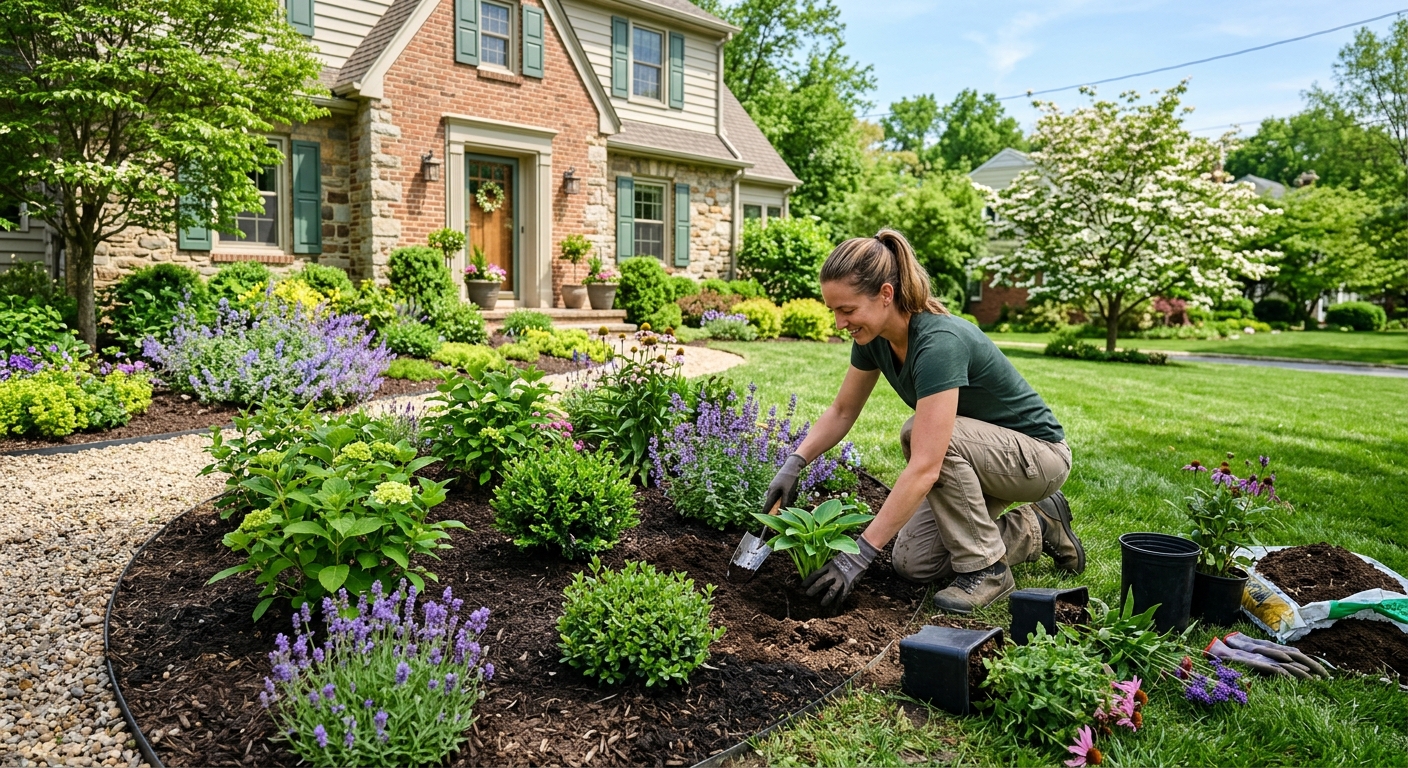
Landscaping options and costs in Spirit River
Spirit River homeowners typically have a clear choice between quick curb-boosts (sod and hardscaping) and long-term durability (grading, drainage, and cold-hardy plantings). With 84.4% of households owning their homes and 81.6% of dwellings being single-detached, many projects start with “make the yard work better,” not just “make it look nicer.” It’s also common because 63.6% of homes were built before 1981, and older properties often have drainage patterns that need correction before new topsoil, lawn, or retaining work goes in.
In the Athabasca–Grande Prairie–Peace River region, pricing is driven by the shorter working season, late spring and early fall frost risk, and a plant palette that must handle cold winters, wind exposure, and droughty stretches. Contractors also price in freeze-thaw impacts on patios and retaining walls, which means deeper base preparation and well-compacted, drained footings. Access matters too: hauling, mobilization, and labour availability can vary across northern communities, and Spirit River is no exception.
Demand is especially strong around the busier residential pockets where yards are visible from main roads—homeowners in the core of town commonly upgrade walkways, entry pads, and low-maintenance front borders first. From there, many move into lawn replacement and planting beds once drainage and grading are sorted.
Below is a practical comparison of typical project ranges you’ll see when requesting quotes in Spirit River, Alberta.
| Service |
Description |
Season |
Price Range |
| Full landscape design and installation |
Site assessment, grading/drainage plan, plant palette, hardscape layout, soil/topsoil, mulch, and installation coordination |
Late spring to early fall |
$8,000–$18,000 |
| Sod installation (supply, grade, lay, roll) |
Remove dead grass, fine grade, apply base amendments, lay sod, roll, and light initial watering guidance |
May to early August (weather-dependent) |
$4,500–$10,500 |
| Lawn seeding (grade, seed, starter fertilizer) |
Spot rake/prepare, seed blend, starter fertiliser, light cover, and establishment care |
Early spring or late summer |
$2,800–$7,500 |
| Interlocking patio or walkway |
Excavate, compact base, geotextile, leveling sand, install pavers/bricks, edge restraints, and finishing |
June to September |
$10,000–$24,000 |
| Retaining wall (interlocking block) |
Block wall with proper drainage gravel, weep holes/collector layer where needed, and base excavation |
June to September |
$12,000–$28,000 |
| Tree and shrub planting |
Cold-hardy trees, shrubs, perennials, staking/anchors if required, composted backfill, and initial mulching |
May to early June; September (when conditions allow) |
$1,800–$9,000 |
Prices are estimates only and vary by project scope, site access and material selection.
What affects the price of landscaping in Spirit River
In Spirit River and the wider Athabasca–Grande Prairie–Peace River region, two quotes for the “same” landscaping idea can differ by 30–50% because the cost drivers aren’t just labour—they’re risk, seasonality, and how much hidden work is required to make it last through winter. For example, a lawn job that looks straightforward can become more expensive when drainage problems are uncovered after old sod is removed. Similarly, planting costs rise when your plan requires cold-hardy, wind-tolerant species and correct soil prep so plants establish before frost.
Climate and working season are a major pricing factor. Northern interior conditions (often in the colder zone range) shorten the window for excavation, base compaction, and planting. In practice, this means crews may charge more per day when weather compresses timelines and frost threatens early. Retaining work and patios are especially sensitive to freeze-thaw cycles: footings and base depth must be compacted and drained, and that adds material and equipment time.
Plant hardiness and the practical “frost calendar” also change what you can install and when. Alberta’s prairie conditions generally mean you need drought-tolerant, wind-hardy species and more emphasis on drainage and soil structure. Coastal BC (Zone 7–8) supports longer, lusher growing seasons, but heavy-rainfall drainage design and irrigation adjustments can drive costs differently; southern Ontario (Zone 5–6) typically has a more forgiving season, though summer dry spells can increase irrigation needs. Those regional differences are why project budgets that “worked elsewhere” can under- or over-shoot in Spirit River.
Concrete examples from local projects: (1) a backyard grade correction that requires regrading and topsoil replacement can push a lawn upgrade from a seeding range near $2,800–$7,500 up toward sod pricing like $4,500–$10,500; (2) a small retaining wall that’s missing proper drainage gravel may force a redo, and builders price the right drainage from the start. Older housing stock is another clue—if you’re working around foundations on lots with established yard contours, expect more excavation and drainage detailing, which is reflected in retaining wall bands such as $12,000–$28,000.
| Price Factor |
Why It Matters |
Cost Impact |
| Yard size in sq ft — the primary cost driver for softscape |
More area means more soil, more prep time, and more materials (sod/seed, mulch, topsoil) |
Often the biggest swing; can move a job into a higher band quickly |
| Grading and drainage work — slope corrections add significant cost |
Pooling near foundations, uneven slopes, and soil settlement require rework before planting |
Can add major labour and trucking; frequently increases budget by 20%–50% |
| Drainage bed or French drain installation |
Freeze-thaw durability depends on moving water away from walls, beds, and walkways |
Adds excavation, pipe/gravel, and disposal; commonly pushes hardscape budgets upward |
| Plant material tier — native shrubs vs. ornamental vs. mature specimen trees |
Mature stock costs more and may require extra handling, staking, and protection |
May double planting-line items even when quantity stays the same |
| Hardscape vs. softscape ratio — walls and patios cost more per sq ft than lawn |
Pavers, blocks, compacted bases, edge restraints, and labour are more intensive |
High hardscape projects land closer to retaining/patio bands |
| Irrigation system design and installation |
Zone control, freeze-smart components, and proper coverage planning affect both survival and water efficiency |
Often adds substantial cost versus basic hand-watering or temporary hoses |
| Soil amendment and topsoil required |
Compacted native soil needs structure and nutrients for roots to establish before winter |
Trucking and placement can raise softscape budgets noticeably |
| Tree removal or stump grinding before new planting |
Stumps hinder equipment and can delay grading, plus roots affect drainage patterns |
Can add a separate mobilization cost; commonly extends timelines |
Permits & regulations in Alberta
In Alberta, most typical softscape landscaping work—such as planting trees and shrubs, sodding, seeding, mulch installation, and regular grading that doesn’t materially alter drainage conditions—generally does not require a building permit. Where permits commonly come into play is with retaining walls and with any changes to site grading/drainage that could impact neighbours or stormwater connections.
Retaining walls above a height threshold (commonly around 1.0 m in many municipalities) typically require a building permit, and sometimes engineered drawings depending on height, location, and soil conditions. Also note that changing lot grading—especially if it redirects runoff toward adjacent properties or changes how water reaches a storm sewer connection—can trigger approval requirements even if the landscaping looks “minor” from the yard.
Before digging for planting holes, tree anchoring, or wall footings, have utility locates completed so you don’t hit buried services. For irrigation, confirm local water-use expectations; while Alberta doesn’t have BC-style rain-interior restrictions everywhere, drought conditions can still tighten what’s allowed for watering timing and frequency.
To verify a contractor for Spirit River, ask for three things and confirm them in writing: (1) an Alberta business/contractor listing and trade credentials where applicable; (2) liability insurance certificate showing adequate coverage for landscaping activities; and (3) WSIB/WCB coverage proof or exemption letter (for workers). If the contractor won’t provide documentation up front, treat it as a warning sign.
Planning a landscape that thrives in Spirit River's climate
Planning in Spirit River means working with Alberta’s colder Prairie conditions—short growing seasons, winter freeze-thaw, and a need for plants that can handle wind and occasional dryness. Start with plant selection: choose hardy, zone-appropriate native and well-adapted species that require less watering and minimal winter protection. In many yards, a “winter-ready” design also looks tidy in fall because you’re not relying on soft, tender foliage that fails after early frosts.
Next, decide between sod and seeding. Sod gives instant results, but it costs more for labour, transport, and installation—and it needs reliable establishment weather. Seeding is slower to look finished but is often the smarter budget choice in a short season when done in the right window.
Drainage and grading are where Spirit River projects succeed or fail. Correct slopes and prevent pooling so foundations and bed edges stay drier through melt and freeze cycles. If you’re adding hardscape like patios or retaining walls, base preparation matters: build on compacted, well-drained foundations designed for frost movement, not just “level ground.”
For low maintenance, use groundcovers, mulched shrub borders, and perennials that return reliably. Xeriscape-style ideas work well here: group drought-tolerant plants, add 2–3 inches of mulch to reduce evaporation, and consider rain-garden style grading where runoff can infiltrate rather than stand. Even a basic curbside bed designed to intercept downspout flow can reduce hassle and weed growth.
Dollar reality check: if you’re replacing a full front lawn, sod might land near $4,500–$10,500, while seeding could be closer to $2,800–$7,500. If your priority is the fastest look for an upcoming event, sod can be justified; if curb appeal is important but you can wait a season, seeding often provides better value in Spirit River’s establishment window—especially when drainage is fixed first.
| Element |
Climate Consideration |
Maintenance Level |
Price Band |
| Sod lawn installation |
Needs dependable thaw and establishment before early fall; vulnerable if laid too close to frost |
Moderate during first 2–6 weeks; then lower than bare seed |
$4,500–$10,500 |
| Native perennial garden |
Cold-hardy selections handle winter better; mulch protects crowns through freeze-thaw |
Low after establishment; spring cleanup and occasional division |
$1,500–$8,000 |
| Mulched shrub border |
Wind exposure and dry periods favour tough shrubs plus deep mulch to reduce evaporation |
Low; weeding reduces significantly when bed edges and soil are prepared right |
$1,800–$7,500 |
| Interlocking stone patio |
Freeze-thaw durability relies on a compacted base and proper drainage to prevent heaving |
Low; occasional sand topping and joint maintenance |
$10,000–$24,000 |
| Retaining wall (block) |
Wall longevity depends on drainage gravel/collector layers and footing depth below frost influence |
Low to moderate; inspections after major thaws help catch movement early |
$12,000–$28,000 |
| Drip irrigation system |
Helps establish roots during dry stretches; freeze-smart setup is important for winter survival |
Moderate; seasonal adjustments and winterization checks |
$1,200–$6,500 |
How to choose a landscaping contractor in Spirit River
Choosing a contractor in Spirit River is mostly about proof and process. Start by verifying Alberta compliance: ask for their Alberta business/contractor registration (where applicable), a certificate of liability insurance, and confirmation of WSIB/WCB coverage for their workers. How to check: (1) request the insurance certificate and confirm the limits and effective dates; (2) ask for WSIB/WCB proof (or an exemption letter if they qualify); and (3) look up their business credentials in online registry listings and match the name/locations to the quote and invoice.
Next, get 2–3 itemised written quotes, not one-page lump sums. A good estimate shows labour and materials separately—especially for excavation, base material, drainage components, and plant supply (species and quantity). Read the scope carefully: what’s excluded (topsoil beyond a stated depth, disposal/haul-away, extra excavation for poor soil, edging, or drainage extensions)? Is permit handling included for retaining walls where required? If the crew must dispose of debris and unused materials, confirm haul-away is in the price.
Warranty matters in our freeze-thaw climate. Ask for a workmanship warranty length and whether it covers settlement, joint issues on pavers, and plant replacement policies for specified establishment periods. Also check if product/manufacturer warranties are separate and transferable to you.
For payment schedule, never pay more than 10%–15% upfront. Use a holdback until key completion points are met (base inspection, final grading, cleanup, and staking). Finally, require a written timeline with a start date and completion estimate—Spirit River projects often swing with frost risk and thaw conditions, so clarity helps.
- Request current insurance certificate before signing.
- Confirm WSIB/WCB coverage (or exemption letter) in writing.
- Ask for an Alberta-based contact address/phone, not only a cell number.
- Get itemised quotes: materials (paver/block/seed), labour hours, and excavation quantities.
- Confirm drainage provisions: French drain/collector options and who supplies gravel/pipe.
- Check plant lists by species and size (e.g., shrub height and tree caliper where relevant).
- Verify soil amendments: depth of topsoil/compost and whether they test or assess soil.
- Require a detailed scope for base prep (geotextile, compacted base thickness, compaction method).
- Clarify disposal/haul-away: where debris goes and whether it’s included.
- Ask about frost-smart practices for irrigation (winterization/valve drain-down).
- Review warranty terms: workmanship coverage and plant replacement window.
- Use a payment schedule with milestones and a final holdback of at least 10%.
Red flags to watch in Spirit River: (1) quotes that don’t state drainage/grading details for yards and hardscape; (2) “all-in” pricing with no breakdown of materials, excavation depth, or paver/block base thickness; (3) refusal to provide insurance and WSIB/WCB confirmation; (4) demanding large upfront payments (more than 15%); and (5) vague timelines that ignore frost risk and thaw/weather limitations.
Frequently asked questions — landscaping in Spirit River
When should I aerate and overseed my lawn in Spirit River?
In Spirit River, the goal is to aerate and overseed when the soil is thawed and you still have enough warmth for germination—before early fall frosts and during a period you can realistically keep the seed moist. For most yards, spring (after traffic can be done without turning soil to mud) is a common choice, and late summer overseeding can work if temperatures stay mild enough. If your lawn is thinning in high-wind areas, also check drainage and compaction first; overseeding alone won’t fix standing water near foundation edges. If you need a full replacement, pricing usually lands closer to seeding budgets like $2,800–$7,500 rather than sod, and that allows you to re-establish while upgrading soil conditions at the same time. (Statistics Canada, 2021 Census)
What trees grow best in Spirit River's climate zone?
For Spirit River (Athabasca–Grande Prairie–Peace River region), homeowners typically do best with cold-hardy, wind-tolerant tree species that can handle long winters and drying winds. Common choices include hardy conifers and select deciduous options suited to prairie interiors. Your best bet is matching species to your yard’s microclimate: open, windy front lots need more protection at establishment, while sheltered back corners tolerate more options. Because 63.6% of homes were built before 1981, many yards have established soil patterns and drainage that can affect survival—so improving soil structure and drainage before planting matters as much as the species. A typical tree-and-shrub planting budget often sits around $1,500–$10,000, depending on stock size and how much soil prep is required. (Statistics Canada, 2021 Census)
How much does sodding a yard cost in Spirit River?
Sodding in Spirit River commonly costs more than seeding because of the material supply, transport, and labour to grade and lay rolls correctly. For a typical residential lawn replacement, many projects land around $4,500–$10,500, depending on yard size, how much grading/drainage correction is needed, and whether topsoil amendments are included. The short working season also affects scheduling: if sod is laid too close to frost, establishment can fail and you’ll lose money and time. That’s why a solid prep plan—fine grading, soil amendments, and ensuring water doesn’t pond—is often bundled with a good sod quote. If your lawn is patchy rather than fully dead, seeding is usually the lower-cost alternative and may suit budgets closer to $2,800–$7,500. (Statistics Canada, 2021 Census)
How do I prevent weeds in my Spirit River garden?
Weed prevention in Spirit River starts before plants go in. First, prepare the soil correctly: remove perennial weeds and roots, then address drainage and compaction so beds don’t stay damp and weak. Second, use an appropriate bed edging to stop grass encroachment—this matters because wind and mowing lines often creep into borders. Third, apply mulch with enough depth (commonly 2–3 inches) and keep it off direct contact with plant crowns. Fourth, choose zone-appropriate, cold-hardy plants that fill space; bare soil is where weeds win. Finally, plan for realistic seasonal maintenance: a spring cleanup pass and a quick summer touch-up beat heavy weed control later. If your starting point is a tired, weedy lawn edge and you want a clean foundation, many homeowners pair soil prep and planting under typical planting ranges like $1,500–$10,000 so you’re not fighting weeds year after year. (Statistics Canada, 2021 Census)
How do I design a low-water yard in Spirit River?
A low-water yard in Spirit River is about smart plant choice, drainage design, and reducing evaporation—not about a “no watering at all” promise. Use drought-tolerant, cold-hardy perennials and shrubs, group plants by sun and wind exposure, and plan for winter survival with mulch and proper bed depth. Fix grading so water reaches roots instead of pooling then evaporating or freezing. Where irrigation is needed for establishment, consider drip irrigation with freeze-smart winterization so you’re not wasting water and risking damage. For lawn areas, compare sod versus seed: sod can be faster visually but costs more (often $4,500–$10,500), while seeding is typically a cheaper route near $2,800–$7,500 and can fit a phased low-water plan. Since 84.4% of local households are homeowners, many choose to invest upfront in drainage and soil structure to reduce ongoing watering needs. (Statistics Canada, 2021 Census)
How do I find a licensed landscaper in Spirit River?
In Spirit River and across Alberta, the best way to find a reliable landscaper is to verify credentials and coverage before you sign. Ask for an up-to-date certificate of liability insurance and confirmation of WSIB/WCB coverage (or an exemption letter if applicable). Then confirm their business details through online registry resources and ensure the company name on the quote matches their insurance and documentation. Next, request 2–3 itemised written quotes so you can compare labour and materials—especially base prep for patios, drainage components, and plant species/size. Avoid contractors who won’t provide insurance or who require large upfront payments. Also confirm warranties: workmanship coverage should be clear in writing, and plant replacement policies should specify the establishment period. If retaining work is part of your project, ask whether permits are required for the wall height and who will handle the process, since that’s where approvals commonly come up in Alberta. (Statistics Canada, 2021 Census)