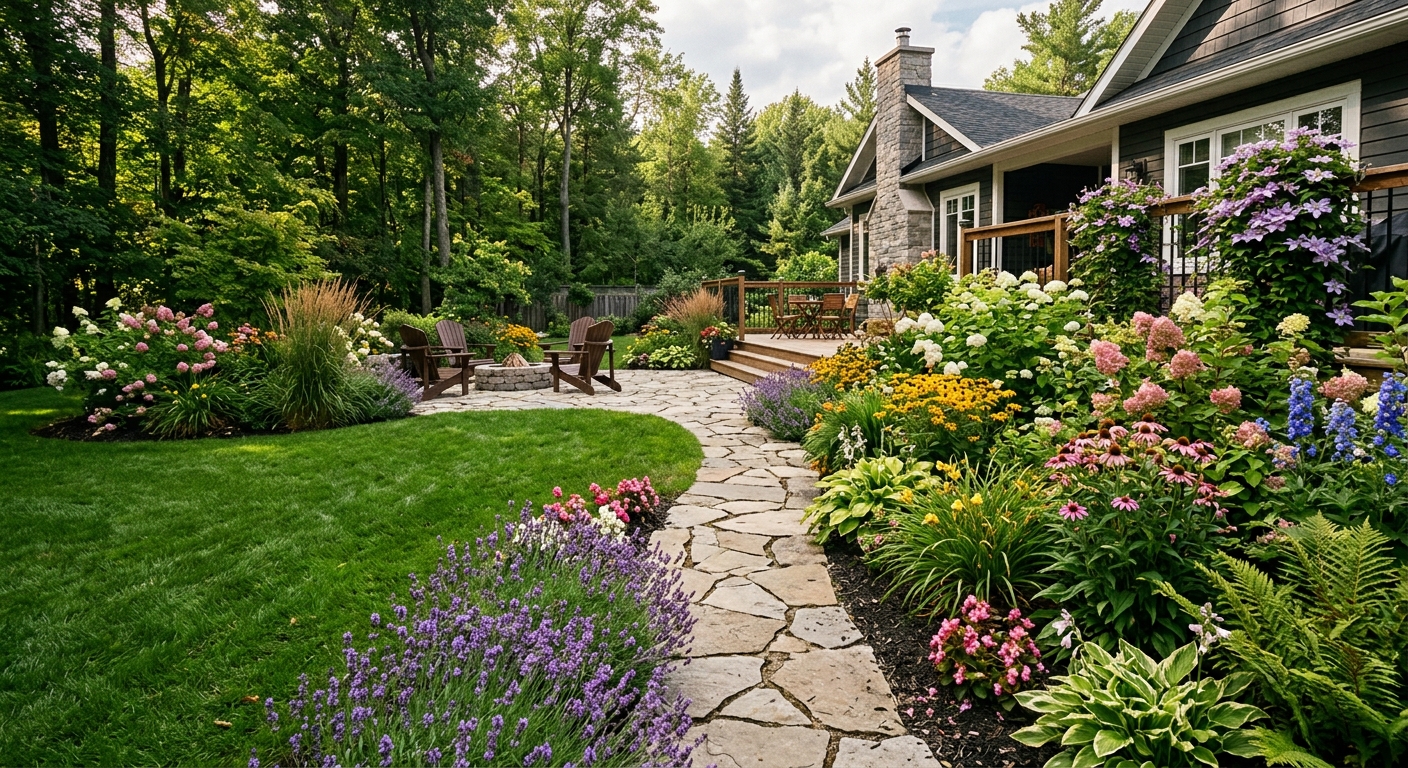
Landscaping options and costs in Ladner
Ladner homeowners typically start with one of three goals: improve curb appeal, solve drainage issues near foundations, or create usable outdoor living space for family gatherings. With Ladner’s population of 23,016 (Statistics Canada, 2021 Census), demand for contractors is steady year-round, especially in long-established neighbourhoods where lots are larger and owners want upgrades that last through our wet winters and cool summers. In the Lower Mainland–Southwest (plant hardiness zones 7–8), landscaping can be more lush than in colder provinces, but costs still reflect the same basics: labour, excavation, drainage engineering, and higher-value plant palettes.
Because last spring frost near the coast is often early March to early April and first fall frost can be as late as November, contractors can build softscape and plantings for a longer calendar window than Prairie cities. That said, the wettest stretches can slow excavation and make scheduling tighter, which can affect pricing. Areas like Ladner’s older residential pockets near the waterfront and town core (where access is often tighter and existing planting is mature) are especially busy for garden makeovers, interlocking stone updates, and drainage/soil remediation work. When you add the reality that structural projects still face freeze–thaw cycles, proper base prep for patios and wall footings becomes non-negotiable—usually increasing scope compared with “surface-level” refreshes.
Below is a practical comparison of common landscaping services and typical price ranges in Ladner, so you can benchmark quotes before you ask for site-specific details.
| Service |
Description |
Season |
Price Range |
| Full landscape design and installation |
Concept + planting plan, site grading/drainage review, hardscape/softscape installation, and finishing (mulch, topsoil, plantings) |
Mar–Nov (adjusted around wettest weeks) |
$5,000–$50,000 |
| Sod installation (supply, grade, lay, roll) |
Remove/prepare existing lawn, compact base, add topsoil/soil amendments, lay sod, roll and initial watering plan |
Apr–Jun or Sep–Oct |
$2,000–$8,000 |
| Lawn seeding (grade, seed, starter fertilizer) |
Light grade correction, seed blend selection, starter fertilizer, raking/rolling, and establishment care |
Mar–May or Aug–Oct |
$1,200–$5,000 |
| Interlocking patio or walkway |
Excavation, granular base, edge restraints, interlocking stone/asphalt alternatives, compaction, and joint sand |
Apr–Nov (weather-dependent) |
$10,000–$35,000 |
| Retaining wall (interlocking block) |
Block system installation with proper drainage layer and base, typical setback and wall alignment |
Apr–Nov |
$10,000–$80,000 |
| Tree and shrub planting |
Soil prep, proper planting depth, amendments, staking (when needed), mulching and establishment plan |
Mar–Jun or Sep–Nov |
$1,000–$15,000 |
Prices are estimates only and vary by project scope, site access and material selection.
What affects the price of landscaping in Ladner
The same landscaping job can come in 30–50% apart across the Lower Mainland–Southwest and other parts of British Columbia because the quote isn’t just “materials versus lawn.” Labour availability, equipment access, excavation needs, and risk factors like drainage quality all move the total. In Ladner’s zone 7–8 climate, you can grow a broader palette and work for longer, but that also means many homeowners choose more layered designs—adding plant quantity, grading, and staging time. In colder Prairie zones (2–4), a short growing season and more severe winters often force drought-tolerant selections and tighter, faster installs. In Southern Ontario (zone 5–6), contractors deal with a moderate season with dry spells requiring more irrigation planning, and that affects labour and watering infrastructure. Coastal BC’s long season allows lush planting palettes, but heavy-rain periods still demand careful drainage design.
Two concrete local examples where costs rise in Ladner: (1) foundation-adjacent grading—if downspout discharge or slope directs water toward the home, drainage correction and soil relocation typically push a “simple refresh” toward a full installation-level scope. (2) wall projects—freeze–thaw cycles mean bases must be dug deeper with proper compaction and drainage, so a small retaining wall can land in the $10,000–$80,000 band depending on height, length, and subsoil conditions. On the cost-lowering side, (3) choosing native shrubs and zone-appropriate perennials can reduce ongoing pruning and winter protection labour, and that can keep a design and installation closer to the $5,000–$50,000 range rather than escalating with extra plant replacement.
Finally, housing-stock reality matters: older Ladner homes often have established trees, compacted soils, and previously added fill. Stump grinding or tree removal before new planting can add measurable labour—especially when the root mass sits in saturated ground after winter storms.
| Price Factor |
Why It Matters |
Cost Impact |
| Yard size in sq ft — the primary cost driver for softscape |
More area means more excavation, soil/topsoil, plant volume, and labour hours |
Often the biggest swing; can change the total by 20–60% |
| Grading and drainage work — slope corrections add significant cost |
Pooling water, water-runoff direction, and foundation moisture risks require regrading |
Can add thousands in labour and material; commonly 10–30%+ |
| Drainage bed or French drain installation |
Under-slab/under-slope drainage reduces long-term issues but requires trenching and stone |
Frequently a major add-on; can push projects into higher bands |
| Plant material tier — native shrubs vs. ornamental vs. mature specimen trees |
Size, transplant difficulty, and warranty/establishment affect both cost and labour |
May multiply planting costs several-fold for large specimens |
| Hardscape vs. softscape ratio — walls and patios cost more per sq ft than lawn |
Interlocking requires base prep, compaction, and higher material thickness |
Hardscape-heavy plans can shift totals upward quickly |
| Irrigation system design and installation |
Efficient zones, drip/rotors, and smart controllers reduce water waste and rework |
Can add a few thousand; prevents costly hand-watering changes |
| Soil amendment and topsoil required |
Soil quality affects establishment; poor native soils need amendment depth |
Often increases excavation and material delivery costs |
| Tree removal or stump grinding before new planting |
Extra equipment, disposal, and root disruption time |
Can add significant labour; timing often affects scheduling |
Permits & regulations in British Columbia
In British Columbia, most planting and typical softscape work generally does not require a permit—so things like soil prep for planting holes, sodding, lawn seeding, mulch and shrub installation usually fall under “normal landscaping.” Retaining walls are the common exception: if the wall is above the height threshold (often 1.0 m in many municipalities), you may need a building permit and sometimes engineered drawings. Also pay attention to grading changes: if your landscaping plan alters lot drainage pathways in a way that could direct water toward neighbouring properties or storm connections, that can trigger additional approval requirements.
Before anyone digs in Ladner, always request utility locates—especially for irrigation, drainage trenches, and retaining-wall footings. Even backyard projects can hit buried services, and striking utilities is both dangerous and expensive.
For contractor verification in British Columbia, homeowners should check three things. First, confirm licensing/credentials through the appropriate online registry where applicable for the contractor type (and confirm the scope they claim to do matches your project). Second, ask for a certificate of insurance showing liability coverage with adequate limits; verify it is current and that you’re listed (where your contract requires it). Third, obtain proof of workers’ coverage (WSIB/WCB clearance letter or equivalent) before work begins—this helps confirm the contractor’s workers are covered on-site.
Finally, confirm how the contractor handles permit responsibility in their quote: whether they pull the permit (if required) or you do, and which documents they provide for compliance.
Planning a landscape that thrives in Ladner's climate
In Ladner, a thriving yard starts by designing around the local rhythm of our zone 7–8 growing season: cool, wet winters; long, mild transitions; and a frost calendar that often gives you a big window to plant and establish. For plant selection, choose native and zone-appropriate species that handle wet soil periods but also tolerate summer dry spells. This reduces winter dieback and limits extra winter protection labour.
Sod versus seeding is another key decision. Sod gives instant curb appeal, but it’s typically about 3–4 times the cost per square foot versus seeding because you’re paying for the sod harvest, transportation, and labour-intensive laying. If you have drainage problems or thin soil, sod can also “show you the problem” faster—lumps or pooling will be obvious after the roots anchor. For drainage and grading, Lower Mainland–Southwest yards often need correction to prevent foundation moisture; even a small slope adjustment can be the difference between a healthy lawn and a recurring algae/moss patch.
Hardscape requires respect for freeze–thaw cycles. Even though Ladner’s winters are milder than inland Canada, bases for patios and retaining wall footings must be dug deeper, built on proper granular layers, and compacted so there’s no frost heave or wall movement.
For low maintenance, use groundcovers, a mulched shrub border, and long-blooming perennials to reduce mowing and seasonal weeding. Rain-garden style planting pockets and smart drip irrigation can also help manage heavy rainfall while keeping watering efficient.
As a dollar example: if you’re deciding between sod and seeding for an average 1,000 sq ft lawn area, you might compare roughly “within” the $2,000–$8,000 sod band against a more budget-friendly seeding approach that often sits below the larger sod total. That difference is justified when you need quick stabilization before an event or when you’re repairing traffic-worn areas—otherwise, seeding plus proper grading often performs better long-term.
| Element |
Climate Consideration |
Maintenance Level |
Price Band |
| Sod lawn installation |
Establishes well in Ladner’s spring/fall windows; needs good drainage to avoid wet patches |
Low–moderate during establishment (watering until rooted); then moderate mowing |
$2,000–$8,000 |
| Native perennial garden |
Zone-appropriate plants handle cool seasons; mulch helps with winter protection and moisture balance |
Low after year one (spring cleanup + occasional weeding) |
$3,000–$12,000 |
| Mulched shrub border |
Dense planting reduces weed germination in our damp coastal climate |
Low (pruning as needed; replenish mulch periodically) |
$1,500–$7,500 |
| Interlocking stone patio |
Base prep must account for local freeze–thaw cycles and proper drainage away from the house |
Low (occasional joint sand top-up; weed control around edges) |
$10,000–$35,000 |
| Retaining wall (block) |
Drainage layer prevents water pressure and helps stability in heavy-rain winters |
Low (inspection of drainage outlets; cleaning) |
$10,000–$80,000 |
| Drip irrigation system |
Efficient watering supports establishment without waste; helpful if water use restrictions tighten |
Moderate (seasonal controller checks; filter maintenance) |
$1,500–$8,500 |
How to choose a landscaping contractor in Ladner
Start by verifying British Columbia coverage and credentials before you discuss design details. Ask for a valid certificate of insurance showing liability coverage and the effective dates. Then request proof of workers’ coverage through WSIB/WCB clearance paperwork or the appropriate equivalent so you know the contractor’s crew is protected on-site. If the contractor advertises they handle design, planting, hardscape, or drainage, make sure their stated scope matches what they can actually perform under their coverage.
Next, get 2–3 itemised written quotes. You want a breakdown that separates labour and materials (for example, excavation/compaction, drainage stone, interlocking supplies, topsoil/compost, plants, and installation). A lump sum can hide major substitutions—like using cheaper block, thinner base material, or omitting drainage layers. Read the exclusions line-by-line: what is not included (disposal, haul-away, permit fees, utility locate costs, site cleanup, soil amendments depth, or restoration after trenching)?
Warranty matters in landscaping. Ask for the workmanship warranty length for installation and whether it covers replanting due to planting errors versus normal weather stress. Confirm product/manufacturer warranties for irrigation components and hardscape materials, and ask whether warranties are transferable to future owners.
For payment, use a schedule that never puts you at risk: keep upfront payments around 10–15%, then hold back until the final walk-through and completion criteria are met. Always require a written start date and an expected completion timeline.
- Confirm the crew on-site is covered (WSIB/WCB clearance/proof) before work begins.
- Verify liability insurance is current and large enough for your project scope.
- Ensure quotes are itemised: labour, materials, and quantities (not only “allowances”).
- Ask if utility locates are arranged by the contractor and who pays for any repeat locates.
- Check drainage specs: French drain depth, outlets, and how runoff is handled.
- For sod/seeding, ask about grading acceptance criteria and topsoil amendment depth.
- For patios and walls, confirm base depth, compaction method, and geotextile use.
- Confirm disposal/haul-away is included (or priced separately with clear rates).
- Ask for plant size/grade details (container size, height/width, and spacing).
- Get a clear start/completion schedule tied to “weather permitting” wording.
- Review warranty terms in writing, including rework responsibilities and timelines.
- Keep payments milestone-based and never front-load beyond 10–15% upfront.
Red flags in Ladner: a quote that’s not itemised, missing proof of liability and workers’ coverage, vague wording like “builder’s choice” for drainage layers or base depth, no clear workmanship warranty, and a rushed payment schedule that asks for large deposits before any excavation or material selection.
Frequently asked questions — landscaping in Ladner
How much does professional landscape design cost?
In Ladner and the Lower Mainland–Southwest, landscape design pricing is usually tied to how detailed your plan needs to be—concept sketches only versus a full planting plan with measurements and hardscape elevations. For many homeowners, design is priced as part of the full design-and-install package, especially when the end goal is a cohesive yard (patio, drainage, planting, and grading). If you’re hiring design separately, you’ll typically see a smaller design budget than the installation itself, but the exact amount depends on the property size and scope. Practically, many Ladner projects that need both layout and implementation land within the broader $5,000–$50,000 landscape design and installation band once construction is included (Statistics Canada, 2021 Census).
How do I compare landscaping quotes?
To compare landscaping quotes in Ladner, look past the total and compare scope and line items. Confirm the quote lists quantities (sq ft for sod/patio, linear feet for retaining walls, plant counts and sizes) and states what’s included for grading, drainage, and base preparation. Ask whether disposal/haul-away is included and whether topsoil/soil amendments are specified by depth, not just “allowance.” Compare material tiers: interlocking thickness and base granular specs affect performance, and plant grade affects how fast the garden fills in. As a benchmark, a full install might fall inside $5,000–$50,000, while walls and patios often land in their own bands like $10,000–$80,000 for retaining walls depending on height and site conditions.
How long does a landscaping project take in Ladner?
Timing in Ladner is influenced by our coastal weather patterns and the winter-to-spring transition. Softscape and planting work can be done through much of the planting season (often Mar–Nov), but the wettest winter weeks and heavy rain can delay excavation and base work. A small planting refresh might take a day or two, while a sod installation is often a short, focused window once the grade is correct. Larger projects—like an interlocking patio plus planting and drainage correction—commonly take a few weeks including site prep, ordering materials, and curing/establishment steps. If a retaining wall is involved, expect additional time for base build-up and drainage layer installation. A contractor’s written start date and “weather permitting” timeline helps you avoid surprises in British Columbia.
What is the best grass type for a Ladner lawn?
For Ladner (coastal Lower Mainland), the best-performing lawns usually come from cool-season grass blends designed for moist, mild conditions—often tall fescue blends and/or perennial rye mixes used for durability and quick establishment. The “best” choice depends on sun exposure, drainage, and how much foot traffic your lawn gets. If your yard has damp areas near downspouts or low spots, improving grading and drainage usually matters more than the grass name on the bag. If you’re going the sod route, you can choose sod varieties that match local performance targets and establishment needs. If you’re budgeting, remember sod projects often sit in the $2,000–$8,000 range, while seeding is typically cheaper for larger areas once grade is corrected.
When should I aerate and overseed my lawn in Ladner?
In Ladner, the typical window for aerating and overseeding aligns with spring and early fall growth spurts. Many homeowners do spring aeration when frost is gone and daytime temperatures are starting to rise (often late March through May), and/or fall aeration when the lawn can recover before winter damp sets in (often August through October). Overseeding works best if you’ve corrected compaction and addressed drainage first—otherwise the new seed may germinate but thin out. A soil amendment plan is also important in coastal climates where thatch can build up and moisture stays higher than inland Canada. If you’re unsure, ask your contractor to assess your lawn thatch depth and soil condition during a site visit; that’s where quotes and recommendations become truly comparable in British Columbia.
What trees grow best in Ladner's climate zone?
With Ladner sitting in hardiness zone 7–8, you have a broad selection of hardy, ornamental and native-leaning trees that can handle mild coastal winters. Common choices include varieties selected for drought tolerance after establishment, plus species that perform well in moist soils if drainage is managed. The “best” tree still depends on your yard’s light, available root space, and how close the tree is to foundations and services. If mature height needs managing, consider smaller-canopy trees or plan for spacing and pruning. If you’re doing a full planting plan as part of a design and installation, tree and shrub planting projects commonly fit within the $1,000–$15,000 band, with larger specimens and more labour moving totals toward the upper end—especially where removal or stump grinding is required.