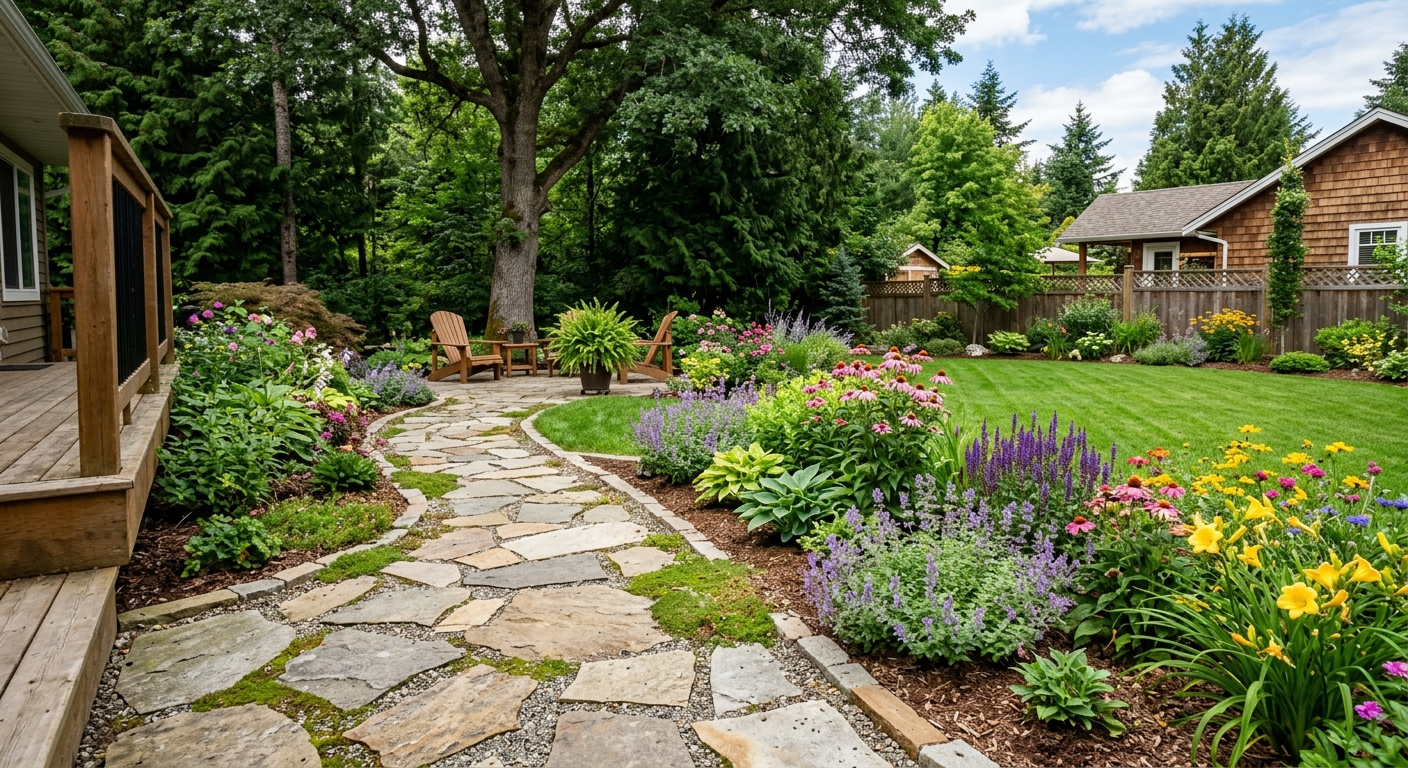
Landscaping options and costs in Shuniah Township
Shuniah Township landscaping is shaped by the practical realities of small-town scale (fewer crews than the big-city core) and the same Toronto-area weather pattern that homeowners feel every year: a roughly May-to-October working window, spring mud, and freeze–thaw winters that can move patios, steps, and wall bases if they’re not built on the right granular depth and drainage. With a population of 3,247 (Statistics Canada, 2021 Census), many properties still sit on family-sized lots with enough yard space to justify real softscape upgrades—especially where older neighbourhoods have more established trees and long-term soil structure.
In the GTA’s plant hardiness range (Zone 6a–7a), we can design with cold-tolerant shrubs and perennials that handle winter lows near –23 to –18°C, but summer humidity also means weed pressure and the value of mulch and healthy soil. Contractor availability and material lead times can affect timelines, which indirectly affects pricing when crews are booking further out. The trade is especially busy around Evergreen Park and nearby residential pockets, where homeowners commonly refresh curb appeal before summer gatherings.
Because Shuniah-area properties vary from compact front yards to deeper lots, “landscape refresh” can range from a clean walkway to a full drainage-and-planting overhaul. Use the table below as a starting point, then we can tighten scope for your driveway access, soil type, and desired look.
| Service |
Description |
Season |
Price Range |
| Full landscape design and installation |
Site walk, concept + plant plan, grading/drainage coordination, sod/seed or planting beds, mulch, edges, and hardscape coordination |
Spring–Early fall (May–October) |
$8,000–$40,000 |
| Sod installation (supply, grade, lay, roll) |
Topsoil prep, grading to fall away from foundation, sod delivery and installation, roll/compact, starter watering guidance |
Late spring & early fall (May–June, Sept.–early Oct.) |
$2,500–$8,000 |
| Lawn seeding (grade, seed, starter fertilizer) |
Rake/grade, seed/overseed, starter fertilizer, light cover/rolling as needed, watering schedule guidance |
Spring or early fall |
$1,200–$4,500 |
| Interlocking patio or walkway |
Excavation, granular base, geotextile/geogrid as needed, compaction, edge restraints, pavers/stone, polymeric sand (if specified) |
Spring–fall (best May–September) |
$6,000–$30,000 |
| Retaining wall (interlocking block) |
Excavation to proper depth, base/subdrain where required, block system, capstone, backfill and compaction |
Spring–early fall |
$6,000–$30,000 |
| Tree and shrub planting |
Soil preparation, hole excavation, planting, staking (if required), mulch rings, watering plan |
Spring–fall (and mild pockets in early winter for dormant stock) |
$800–$6,000 |
Prices are estimates only and vary by project scope, site access and material selection.
What affects the price of landscaping in Shuniah Township
For the same “basic” landscaping idea in Toronto and across Ontario, quotes can swing by about 30–50% because scope details rarely match on day one. Two homeowners may both say they want a “new backyard,” but one yard needs major grading and subdrains due to clay that holds water, while the other is mostly clean topsoil ready to plant. In southern Ontario’s Zone 6a–7a conditions, freeze–thaw cycles are a cost driver: patios and retaining walls must be built with deeper, well-compacted granular bases and correct drainage, which costs labour and sometimes engineered or geogrid reinforcement if soils are soft or slopes are steep.
Hardiness and frost timing also matter. In Prairie regions (Zone 2–4), the shorter season and drought pressure push designs toward drought-tolerant, wind-hardy species and simpler palettes; wall base depth must reach below the frost line too, which can keep pricing high even with less lush planting. Coastal BC (Zone 7–8) can support lush evergreens and longer planting windows, but heavy rainfall means drainage design still drives cost. Dry interior BC can require more irrigation infrastructure and careful selection of low-precipitation heads. Southern Ontario typically has moderate season length, but we still plan for irrigation during summer dry spells.
In Shuniah Township, two local examples often explain the biggest deltas: (1) clay/fill with poor drainage can add a French drain bed or subdrain line—raising the project from the middle of the tree & garden planting range to a broader full installation budget; (2) a modest 30–40 ft slope correction or raising a patio elevation can shift you from a typical softscape plan into the hardscape band. If your home has older perimeter beds that are compacted from decades of foot traffic, soil amendment and regrading can add hundreds to thousands of dollars even before plants arrive—especially when the goal is a level lawn that doesn’t funnel water toward foundations.
| Price Factor |
Why It Matters |
Cost Impact |
| Yard size in sq ft — the primary cost driver for softscape |
More area means more labour time, more sod/seed, and more mulch/edging |
Small lawns can fall in the low thousands; larger full-lot installs can move you into the upper $8,000–$40,000 design/install band |
| Grading and drainage work — slope corrections add significant cost |
Correct fall away from foundations and prevent pooling; also reduces future winter heaving |
Often adds substantial excavation and machinery time; can push a “planting-only” request into a full-scope install |
| Drainage bed or French drain installation |
Clay soils retain water; drains protect softscape and stabilize hardscape |
Commonly one of the biggest line items; can be the difference between staying near $800–$6,000 (planting) vs expanding toward $6,000–$30,000 (wall/hardscape scope) |
| Plant material tier — native shrubs vs. ornamental vs. mature specimen trees |
Size at install and sourcing availability control material price and install labour |
Specimens can increase costs quickly; nursery supply constraints in spring can add premium |
| Hardscape vs. softscape ratio — walls and patios cost more per sq ft than lawn |
Stone/pavers require base prep, restraints, and compaction |
Even moderate patios can move the total into retaining wall & hardscaping pricing |
| Irrigation system design and installation |
Even in Ontario, consistent watering improves establishment and reduces rework |
Simple hose bib add-ons are cheaper; full zone systems add labour, parts, and tuning time |
| Soil amendment and topsoil required |
Improves drainage and rooting; clay often needs structured amendment |
Delivery and spreading can add cost, especially when hauling is required |
| Tree removal or stump grinding before new planting |
Clearing access for machinery and eliminating regrowth |
Can be a one-day add-on or a multi-step job depending on stump size and root structure |
Permits & regulations in Ontario
In Ontario, most routine landscape work—like planting, sodding, and typical softscape installations such as mulching or laying interlocking pavers on an approved base—usually does not require a permit. However, retaining walls above a municipal threshold (often 1.0 m or 3.3 ft, depending on the local bylaw) typically need a building permit, and some projects may require engineered drawings. Changes to lot grading that could affect drainage toward a neighbour’s property or a storm sewer connection may also trigger approval requirements, because drainage control is a key risk area around foundations.
Before anyone digs, ensure utility locates are completed. Call to have underground services located before you start trenching for planting holes, subdrains, or wall footings—this is a practical safety requirement, not something to “skip because the yard looks clear.”
For homeowners in Shuniah Township, a simple verification process prevents surprises:
- Ask for the contractor’s Ontario business contact and confirm the applicable licence/registration (where required for the work type).
- Request a current certificate of insurance showing liability coverage for landscaping/hardscaping activities.
- Verify WSIB/WCB coverage status for workers (or ask how they handle compliant coverage).
- Ask whether permit pulling (if needed for the wall) is included and who is responsible for submissions.
- Confirm disposal is included for excavated soil/stone so you don’t pay to haul later.
Finally, confirm irrigation and water-use expectations. Ontario homeowners often don’t face strict seasonal limits like dry interior regions, but you should still ask how your contractor will schedule watering to reduce runoff and meet any local watering restrictions during summer dry spells.
Planning a landscape that thrives in Shuniah Township's climate
Planning in Shuniah Township means working with Toronto-area hardiness, not against it. We typically plan around Zone 6a–7a survival, seasonal freeze–thaw, and the reality that late spring frosts and early fall cold snaps can stress tender transplants. Start with plant selection: choose native, zone-appropriate shrubs and perennials that establish well in Ontario clay/fill conditions and don’t require heavy winter protection. This approach also supports lower watering needs and a more resilient yard.
Next, decide sod vs. seed. Sod gives instant coverage and helps with erosion control, but it’s usually 3–4x more per sq ft than seeding because of the material cost and installation labour. For example, on a typical mid-size lawn refresh where seeding may sit in the $1,200–$4,500 range, sod can move you into the $2,500–$8,000 band depending on grading and yard size. If your goal is “usable this summer,” sod can be worth it; if you can tolerate a slower start, seeding is often the better value.
Drainage and grading come third for a reason: Toronto yards commonly experience pooling that pushes foundation moisture into basements or undermines edges. We grade to fall away from structures and—when needed—add a drainage bed or French drain. For hardscape (patios, retaining walls), base preparation matters as much as the pavers: the granular layers and compaction must be built to handle local frost depth movement. Finally, keep upkeep low with mulch, groundcovers, and a layered perennial structure that reduces annual replanting while maintaining curb appeal.
Where water context matters, consider rain gardens in low spots or xeriscape-style planting zones using hardy perennials and deep-rooted plants—especially near downspouts—so you capture runoff instead of overwatering.
| Element |
Climate Consideration |
Maintenance Level |
Price Band |
| Sod lawn installation |
Establishes quickly before winter; needs correct grading to prevent winter heave and spring pooling |
Low–moderate (watering/establishment period, then routine mowing) |
$2,500–$8,000 |
| Native perennial garden |
Zone-appropriate plants handle –23 to –18°C lows and summer humidity better with good soil prep |
Moderate (seasonal weeding, occasional division) |
$800–$6,000 |
| Mulched shrub border |
Mulch moderates soil temperature and helps retain moisture through hot spells while protecting roots in winter |
Low (mostly topping mulch and light pruning) |
$1,200–$7,500 |
| Interlocking stone patio |
Must withstand freeze–thaw: base compaction, drainage fall, and proper edging restraint are critical |
Low (periodic joint material/top-up) |
$6,000–$30,000 |
| Retaining wall (block) |
Needs proper backfill compaction and often subdrain to prevent water pressure behind the wall |
Low (visual inspections and minor maintenance) |
$6,000–$30,000 |
| Drip irrigation system |
Improves establishment and reduces evaporation during Ontario dry spells; pairs well with rain gardens/xeric planting pockets |
Moderate (seasonal checks, winterization) |
$1,500–$7,000 |
How to choose a landscaping contractor in Shuniah Township
Choosing a contractor in Shuniah Township comes down to proof: licensing/registration where required, insurance, and worker coverage. Start by asking for their Ontario business information and what class of work they’re set up to do. For liability, request a current certificate of insurance that lists the type of work (landscaping/hardscaping) and active coverage amounts. Next, verify WSIB/WCB coverage (or ask how compliance is handled for workers and subcontractors). If they can’t provide documents, they’re not ready for a project involving excavation, retaining walls, or hardscape base work.
Then get 2–3 written, itemised quotes—not a vague lump sum. A good quote breaks labour and materials apart (excavation, base/granular, drainage stone, pavers/blocks, geotextile/geogrid, soil amendments, planting stock, disposal). Read the scope carefully: is permit pulling included for a retaining wall if it crosses the threshold? Is debris removal/disposal included? Are utility locates mentioned before digging? Confirm warranty terms for workmanship (how long) and product warranties from the manufacturer—plus whether warranties are transferable if you sell your home.
For payment, avoid heavy upfront deposits. A safe target is 10–15% maximum at start, then schedule remaining payments based on milestones, with a holdback until completion and final grading/clean-up. Finally, require a start date and completion estimate in writing, because Ontario’s freeze–thaw season and spring scheduling can affect how quickly projects can be finished without rushing base prep.
- Ask for insurance COI and confirm it’s current (not expired).
- Verify WSIB/WCB coverage and request confirmation for workers/subs.
- Request an itemised proposal with measurements (sq ft, linear ft) for all main components.
- Confirm what’s included in excavation: depth, disposal, and whether rock/soft spots are addressed.
- Ask about drainage fall: how runoff is handled away from foundations.
- For patios/walkways, confirm granular base layers and compaction requirements.
- For retaining walls, confirm backfill compaction and whether subdrain is included.
- Check the planting list: common and botanical names, plant sizes (e.g., caliper/height), and spacing.
- Confirm topsoil/soil amendment type and thickness (in inches or cm), not just “topsoil provided.”
- Require a written watering/establishment plan after sod or planting.
- Confirm winter protection measures for shrubs/perennials (mulch strategy, anti-desiccant only if needed).
- Get a timeline with dates and weather contingencies for Ontario’s spring/fall conditions.
Red flags to watch for: (1) quotes that don’t specify drainage/granular base details for patios or walls; (2) refusal to provide insurance or WSIB/WCB confirmation; (3) “lump sum only” proposals without measurements; (4) large deposits (more than 15%) before work starts; (5) no written warranty terms for workmanship.
Frequently asked questions — landscaping in Shuniah Township
Sod vs seed — which is better for a Shuniah Township lawn?
In Shuniah Township and across Ontario’s Zone 6a–7a climate, sod is usually better if you want immediate curb appeal and quick erosion control. It also helps when grading is being corrected, because the established turf anchors the surface while it roots in. The trade-off is cost: sod installation often falls in the $2,500–$8,000 band depending on yard size and prep. Seeding can be a smart value when you can accept a slower transition—especially in early fall—since seeding/lawn prep can land closer to the lower end of typical lawn refresh budgets. The best choice depends on your sun exposure, how level the base is, and whether drainage issues need fixing first.
How much does a retaining wall cost in Shuniah Township?
Retaining wall pricing in Shuniah Township is mainly driven by wall length, height, excavation depth, and whether a subdrain is required behind the wall. In the Toronto market, interlocking block retaining walls commonly land in the $6,000–$30,000 band. If your yard needs significant regrading, more base depth, or additional drainage work due to clay soils or pooling, that pushes the job toward the upper end. A contractor should explain backfill compaction and drainage design—not just the wall materials—because freeze–thaw pressure and trapped water are what shorten a wall’s lifespan when built incorrectly.
When is the best time to landscape in Shuniah Township?
For most work in Ontario, the dependable window is roughly May through October. In Shuniah Township, late spring frosts and early fall cold snaps can affect tender plants, so we typically aim for planting and sod/seed during periods when soil temperatures support rooting. Sod and seeding are often best in late spring (after the worst cold) or early fall when moisture is higher and grass can establish before winter. Hardscape like patios and walkways can usually be scheduled from spring through September, because base prep and compaction are more consistent when conditions aren’t too wet or cold. If you have drainage or a retaining wall project, earlier scheduling helps avoid spring mud and late-season freezes that can delay granular base completion.
Do I need a permit for a retaining wall in Ontario?
Often, yes—depending on the wall height and your municipality’s requirements. In Ontario, planting and most softscape work typically doesn’t require a permit, but retaining walls above a threshold (commonly around 1.0 m / 3.3 ft in many municipalities) usually do. Your contractor should confirm the specific trigger for your property and include whether permit pulling is part of the scope. Also note that changing lot grading in a way that affects drainage toward neighbours or storm systems can trigger additional approvals. Because freeze–thaw and water management are critical structurally, proper permitting helps ensure the wall design matches the site conditions.
How do I improve drainage in my yard?
Start by observing where water collects after a heavy rain: along foundations, beside fences, or at low corners. In Shuniah Township’s Toronto-area soils (often clay/fill), pooling can lead to wet spots and undermining of edges. The most effective fixes usually involve regrading to create fall away from the house and adding a drainage bed or French drain where water naturally accumulates. A good landscaping contractor will also consider downspout routing and the location of any subdrains so water doesn’t get redirected to a neighbour. If you’re planning hardscape or a retaining wall, drainage should be designed into the build, not added later, because freeze–thaw can worsen trapped water.
What is xeriscaping and does it suit Shuniah Township?
Xeriscaping is a low-water approach that uses drought-tolerant species, efficient mulching, and smart layout (like grouping plants by watering needs). In Shuniah Township and southern Ontario’s summer humidity, you might not need the same level of water restriction planning as dry interior regions, but xeriscape principles still help you reduce waste and improve resilience—especially in sunny, fast-draining areas. You can also combine xeriscape pockets with rain gardens or downspout gardens to capture runoff rather than relying entirely on irrigation. For a balanced Ontario yard, we often pair zone-appropriate perennials and shrubs with deep mulch layers and targeted drip irrigation so plants establish well without constant watering.