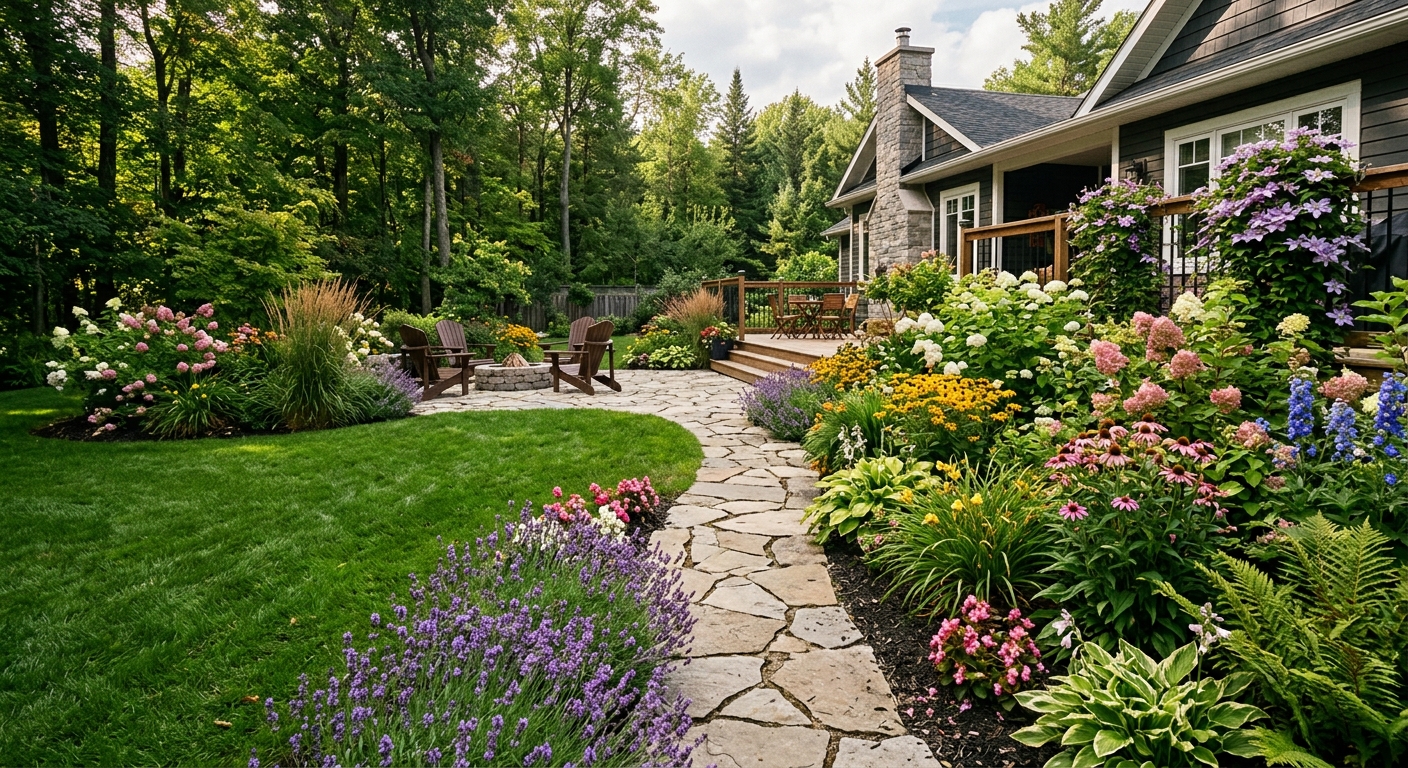
Landscaping options and costs in Smooth Rock Falls
Smooth Rock Falls homeowners typically choose landscaping upgrades because many neighbourhood yards are attached to single-detached homes (86.2% of dwellings), and most households are owner-occupied (80.2%), so investing in curb appeal and long-term hardiness is a natural fit. With 1,200 people in the community, the local contractor pool is smaller than in larger Northeastern Ontario centres, which can affect scheduling and pricing during peak spring.
In the Northeast market context, costs are driven by a cold continental climate with a short practical working season (mid-to-late spring through early fall) and aggressive freeze-thaw cycles. That means excavation for paving and retaining wall bases needs to go deeper, drainage has to be engineered more carefully, and labour mobilization can carry a premium. If your property sits in or near the more developed residential pockets—like the areas close to Main Street—you’ll often see demand spike because access is tighter, and crews must work around driveways, sidewalks, and existing services.
Below is a realistic way to compare typical scopes. Use these bands to sanity-check bids before you pay for detailed layout, soil testing, or an engineering add-on for walls.
| Service |
Description |
Season |
Price Range |
| Full landscape design and installation |
Site walk, layout plan, grading/drainage concept, plant palette, hardscape (if included), and installation coordination |
Mid–late spring to early fall |
$8,000–$30,000 |
| Sod installation (supply, grade, lay, roll) |
Minor grading, topsoil/sand adjustment as needed, delivery and installation, starter fertilizer, roll-and-press |
Late spring through summer (avoid heat stress) |
$3,000–$9,000 |
| Lawn seeding (grade, seed, starter fertilizer) |
Grading/conditioning, seed selection, starter fertilizer, light topdressing, rake/roll |
Spring or early fall |
$1,800–$6,500 |
| Interlocking patio or walkway |
Excavation, base material, compaction, geotextile, edging, block/paver installation, joint sand |
Summer working window |
$6,000–$18,500 |
| Retaining wall (interlocking block) |
Wall layout, excavation and compacted base, block system, drainage stone/weep provisions, backfill |
Late spring through early fall |
$6,000–$25,000 |
| Tree and shrub planting |
Soil prep, staking, amendments, mulch rings, and planting of hardy trees/shrubs |
Spring and fall |
$1,500–$8,000 |
Prices are estimates only and vary by project scope, site access and material selection.
What affects the price of landscaping in Smooth Rock Falls
In Smooth Rock Falls and the broader Northeast/Ontario context, quotes for the same “size” of project can swing by 30–50% because the real cost drivers are site conditions and risk management, not just the finish. A backyard that looks flat on a sketch can hide poor drainage, a high frost-line depth requirement for wall bases, or old fill that needs removal. In practice, the plant hardiness zone and frost dates govern both what can survive winter and how long crews can work before frost and freeze-thaw damage schedules. Prairie-like conditions (Zone 2–4) favour drought-tolerant, wind-resistant landscaping and often require tougher excavation and base preparation; Southern Ontario (Zone 5–6) has a longer growing window but still needs irrigation planning during summer dry spells.
Two common examples in Smooth Rock Falls: (1) if your yard needs regrading to fix slope and direct water away from the foundation, grading and drainage can add substantial labour and materials—often pushing a project closer to the upper part of the “full landscape” band (up toward $30,000) rather than the lower range. (2) if you want a retaining wall, the base depth and drainage stone requirements for freeze-thaw stability can make the job land near the higher end of the retaining wall band—around $25,000—especially when site access forces smaller equipment and more handwork.
Housing age also matters: since 87.1% of homes were built before 1981, older yards may include compromised subgrades, mature tree roots near walkways, or buried utilities that slow excavation. Those realities tie directly back to the short working season premium: fewer weeks to complete the job means crews price schedule certainty and mobilization accordingly, while design and installation scopes often land anywhere from $8,000 to $30,000 depending on the amount of hardscape and drainage engineering included.
| Price Factor |
Why It Matters |
Cost Impact |
| Yard size in sq ft — the primary cost driver for softscape |
Lawn, planting bed area, and topsoil/amendment volumes scale directly with square footage |
Minor yards may stay near the low end; larger areas can double material and labour time |
| Grading and drainage work — slope corrections add significant cost |
Freeze-thaw stability requires correct slope, and pooling water can damage foundations and lawns |
Can push a “quick refresh” into full-scope design/install pricing |
| Drainage bed or French drain installation |
Subsurface drainage reduces winter heave and summer saturation |
Often adds major excavation and disposal, increasing total cost |
| Plant material tier — native shrubs vs. ornamental vs. mature specimen trees |
Hardy, zone-appropriate native plants are more available and cost-effective than large, mature specimens |
Mature trees can shift planting totals toward the upper range |
| Hardscape vs. softscape ratio — walls and patios cost more per sq ft than lawn |
Pavers/blocks require deeper base prep, compaction, edging, and jointing materials |
More paving/walls pushes budgets toward retaining wall and patio bands |
| Irrigation system design and installation |
Efficient zoning (especially in dry spells) adds design work and components |
Switching from hand-watering to drip can increase upfront cost but reduce ongoing failures |
| Soil amendment and topsoil required |
Compacted clay or old fill may need imported topsoil and conditioning |
Haul costs can be a hidden driver when yards need full reconditioning |
| Tree removal or stump grinding before new planting |
Root disturbance affects planting layout and base preparation for walkways and walls |
Removals can add days and equipment rental, raising totals |
Permits & regulations in Ontario
For most homeowners around Smooth Rock Falls, planting, sodding, and typical softscape work generally does not require a permit. That includes things like seeding, mulch installation, shrub and perennial planting, lawn grading for planting, and installing garden edging that doesn’t involve structural retention. Where permitting commonly enters the picture is retaining walls above the local threshold height—typically around 1.0 m (3.3 ft) in many Ontario municipalities—because those projects can behave like structures, especially if they’re holding back soil near a foundation or property line.
Also confirm rules if you plan changes to lot grading that redirect drainage toward neighbouring properties or storm sewer connections. In those cases, approval requirements can apply because incorrect drainage can create property and water-damage risks. Before any digging, insist on utility locates so contractors know where services run—this matters not just for walls and patios, but also for planting holes and irrigation trenches.
To verify contractor compliance for Ontario, use a three-step approach: (1) check the contractor’s Ontario licensing/registration status through the appropriate online registry for their trade/contracting category (if applicable); (2) request a current certificate of liability insurance and ensure it matches the project address and coverage amount; and (3) confirm WSIB coverage where required—ask for clearance documentation or the contractor’s WSIB account status details. If something is unclear, ask for it in writing before the contract is signed.
Planning a landscape that thrives in Smooth Rock Falls's climate
Planning for Smooth Rock Falls starts with working with your frost calendar and winter hardiness, not against it. Choose plants that match your cold continental conditions and prioritize native, zone-appropriate species that can handle freeze-thaw cycles with less winter protection and fewer watering demands. For lawns, sod gives instant green cover and can reduce erosion right away, but it’s usually more expensive than seeding—often 3–4 times the cost per square foot when you factor grade preparation and material delivery.
Drainage and grading are critical in Northeastern conditions because pooling water can turn into winter damage and foundation moisture problems. Plan the yard so water flows away from your house, then keep it moving with proper topsoil depth, amended soil where needed, and, if required, a drainage bed or French drain. For hardscape such as patios and retaining walls, base preparation must consider the local frost line: deeper, well-compacted bases and correct drainage behind walls are what prevent heaving, settling, and premature cracking.
Low-maintenance design is about repeating reliable building blocks: mulched shrub borders, groundcovers, and hardy perennials planted at spacing that closes gaps in a few seasons. Adding a rain-garden style depression in the right location can help manage runoff, and xeriscape-style planting (layering drought-tolerant shrubs and deep-rooted perennials) reduces annual upkeep—especially during dry spells.
Example of where cost difference is justified: if you’re restoring a worn front lawn and need immediate curb appeal before a busy period, sod may be worth it because it prevents bare-soil erosion right away. If you can wait for establishment, lawn seeding typically lands closer to the lower band (around $1,800–$6,500), while sod often sits within roughly $3,000–$9,000 depending on area and prep.
| Element |
Climate Consideration |
Maintenance Level |
Price Band |
| Sod lawn installation |
Establish quickly in the short summer window; keep moisture steady through establishment, then reduce watering |
Low to moderate (watering during establishment, mow schedule afterward) |
$3,000–$9,000 |
| Native perennial garden |
Cold-hardy selections survive winter; deeper roots improve resilience through freeze-thaw |
Moderate (spring cleanup, seasonal weeding, occasional dividing) |
$2,500–$7,500 |
| Mulched shrub border |
Mulch buffers soil temperature swings and suppresses weeds during freeze-thaw cycles |
Low (annual mulch top-up and light pruning) |
$1,800–$6,200 |
| Interlocking stone patio |
Base depth and drainage control prevent heaving in winter and settling in thaw periods |
Low (occasional joint sand top-up and spot cleaning) |
$6,000–$18,500 |
| Retaining wall (block) |
Freeze-thaw stability depends on proper compacted base and drainage stone behind the wall |
Low (periodic inspection and weep/drain checks) |
$6,000–$25,000 |
| Drip irrigation system |
Efficient in dry spells; deliver water to roots when needed during short working seasons |
Moderate (seasonal adjustments and winter blowout where required) |
$1,200–$6,000 |
How to choose a landscaping contractor in Smooth Rock Falls
Choosing a landscaping contractor in Smooth Rock Falls is mostly about verifying capability and reducing risk before any soil is moved. For Ontario compliance, ask for three proof points up front: (1) licensing/registration relevant to the contractor’s trade category (where applicable); (2) liability insurance—request a current certificate of insurance and confirm it’s active for the project period; and (3) WSIB coverage (or the contractor’s WSIB clearance information) where required for worker coverage. Don’t accept “we’re covered” verbally—insist on documents before the work starts.
Next, get 2–3 itemised written quotes rather than a lump sum. You want a labour and materials breakdown that shows what’s included (excavation, geotextile, base aggregate depth, drainage stone, disposal, edging, and topsoil). Clarify scope exclusions: for example, is utility locate included? Is base preparation sized for frost conditions? Is permit assistance included if a retaining wall triggers a building permit above the local height threshold? Also confirm whether disposal and haul-away are part of the price or billed separately.
Warranty should be spelled out: workmanship warranty length (for example, base settlement or plant replacement terms) plus product/manufacturer warranty details. If they offer plant warranty, it should explain what “replacement” covers and timelines. For payment, never pay more than 10–15% upfront; hold back a portion until completion and final cleanup are verified. Ask for a written timeline with a start date, weather-dependent milestones, and a completion estimate for the short growing window.
- Request insurance certificates and confirm the address/project date range.
- Ask for WSIB clearance/coverage documentation where required.
- Require itemised pricing (labour, materials, equipment, and disposal).
- Confirm geotextile, base aggregate type, and compaction method for hardscape.
- Ask how drainage is handled behind walls and along patios/walkways.
- Check whether utility locates are included before digging.
- Get plant lists with botanical names, container sizes, and spacing.
- Clarify topsoil source quality and amendment rates (not “generic soil”).
- Confirm winter protection/water plan for newly planted material.
- Ensure a workmanship warranty is in writing with coverage duration.
- Review the payment schedule and confirm a holdback amount.
- Ask for a detailed start date and completion estimate in writing.
In Smooth Rock Falls, red flags often include: refusing to provide insurance/WSIB documentation, quoting only a lump sum without base/drainage specifics, vague scopes that omit disposal or utility locates, promising “instant” long-term results without frost-drainage engineering (especially for patios/walls), and demanding large upfront payments beyond 10–15%.
Frequently asked questions — landscaping in Smooth Rock Falls
What plants thrive in Smooth Rock Falls's climate zone?
Smooth Rock Falls (Ontario) sits in a cold, freeze-thaw-prone environment, so you’ll get the best results with hardy, zone-appropriate—and ideally native—shrubs, grasses, and perennials that can handle winter desiccation and spring thaw. In practice, many homeowners do well with cold-tough options like hardy spruce types, chokecherry varieties, and wind-resistant shrubs that don’t need complex winter wrapping. For perennials, focus on plants that return reliably after winter (local garden centres can steer you toward region-proven selections). Also plan structure: a mulched shrub border plus a perennial layer usually looks full while staying manageable. If your home is older (87.1% built before 1981), consider that some yards have compacted subgrade—amend soil and use mulch to improve establishment, which is a major factor in plant survival in a short season (Statistics Canada, 2021 Census).
Sod vs seed — which is better for a Smooth Rock Falls lawn?
In Smooth Rock Falls, sod is usually the better choice when you need immediate coverage to prevent erosion or you want a finished look quickly—especially on slopes or near high-traffic areas. The trade-off is cost and establishment water management. Sod installation typically falls in the $3,000–$9,000 band, while seeding (with grade conditioning and starter fertilizer) often lands closer to $1,800–$6,500 depending on area. Seeding can be very cost-effective if you can wait for germination and establishment and you’re ready to manage watering carefully during the early growth period. A practical recommendation: if your yard has bare patches or uneven grade, spend first on grading and soil conditioning; then choose sod for fast repair or seed for broader, budget-friendly recovery. Either way, don’t skip proper base prep—freeze-thaw damage shows up when the lawn is installed over poor soil.
How much does a retaining wall cost in Smooth Rock Falls?
Retaining wall pricing in Smooth Rock Falls commonly depends on wall height, length, soil conditions, and drainage design behind the wall. Interlocking block retaining walls typically price in the $6,000–$25,000 band. A shorter wall with good access and minimal excavation may land toward the lower portion, while longer walls that require deeper base excavation, more drainage stone, or extra handwork can approach the upper end. The freeze-thaw reality matters: contractors usually must excavate to a frost-stable base and include proper drainage provisions, otherwise you risk settling or wall movement after winter. If your retaining wall is above the local permit threshold (often around 1.0 m in many Ontario municipalities), budgeting should also consider permit-related admin time and potentially engineered drawings depending on the specifics.
When is the best time to landscape in Smooth Rock Falls?
The best time for landscaping in Smooth Rock Falls is generally when the ground is workable and frost is out—late spring through early fall for installation work. Planting is commonly scheduled for spring and fall, when temperatures are more moderate and plants focus on root establishment rather than peak heat stress. For hardscaping (patios, walkways, retaining walls), most crews prefer the summer window to avoid frost complications with base compaction and to keep schedules stable. Because freeze-thaw cycles and winter cold are real constraints, contractors often charge a scheduling premium when the season is short and crews are booked. If you’re planning a bigger project, aim to lock in design and materials early, then schedule installation for mid-to-late spring. With smaller local capacity in a community of about 1,200 residents (Statistics Canada, 2021 Census), early booking can help avoid delays.
Do I need a permit for a retaining wall in Ontario?
Often, yes—depending on the retaining wall’s height and how it’s designed. In Ontario, planting and most softscape work generally doesn’t require a permit, but retaining walls above a local height threshold typically do. Many municipalities commonly use a threshold around 1.0 m (3.3 ft), but the exact requirement can vary. If your wall changes drainage patterns, sits near a property line, or affects stormwater routing, additional approvals may apply. The safest approach is to ask your contractor to confirm whether your proposed wall height triggers a building permit locally and whether engineered drawings are required. Before digging footings or drainage trenches, contractors should also obtain utility locates to protect underground services—this is especially important when upgrading older yards where buried utilities may not be obvious.
How do I improve drainage in my yard?
Improving drainage in Smooth Rock Falls usually starts with understanding where water goes during heavy melt or wet periods. The goal is to keep water away from your foundation, reduce pooling, and manage subsurface saturation so freeze-thaw doesn’t lift and break pavements or cause lawn failures. Common solutions include regrading (correcting slope away from the house), installing a drainage bed or French drain, and ensuring downspouts discharge properly. For hardscaping, correct base prep and weep/drain provisions behind retaining walls are essential. If you’re planning new interlocking patios or a wall, drainage is often included in the $6,000–$25,000 retaining wall scope or the mid-to-upper range of full landscape installs ($8,000–$30,000) because it requires excavation depth, compaction, and drainage stone. Avoid quick fixes like burying hoses or redirecting water to neighbours—Ontario rules and practical property impacts can become an issue.