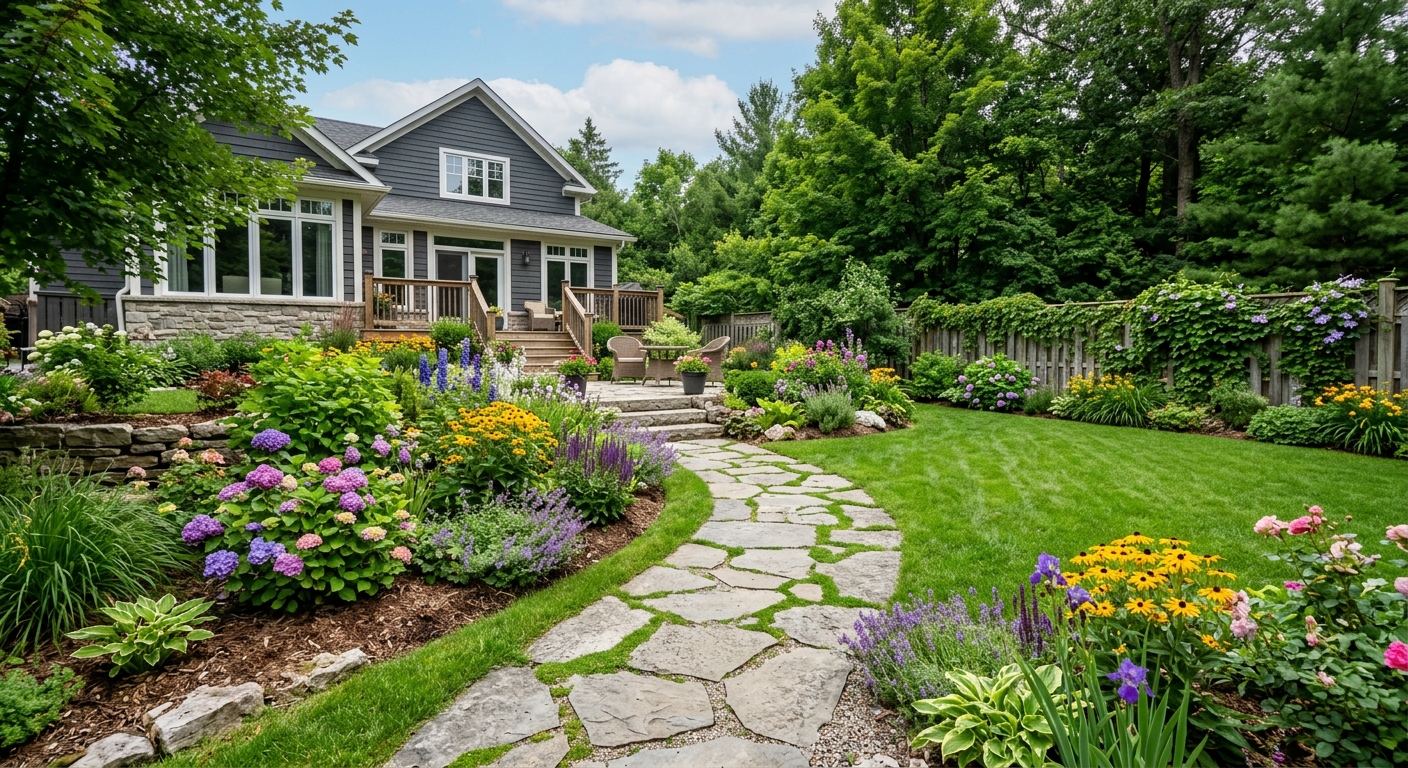
Landscaping options and costs in Fraser
Fraser, Alberta is a small community (3,276 people per Statistics Canada, 2021 Census) where many homeowners invest early in curb appeal because even modest yards can make a big visual difference on a detached property. With Alberta’s Prairie hardiness zones 3–4 and severe freeze–thaw cycles, landscaping decisions directly affect what survives winter, how fast you’ll see results, and what it costs to correct issues like heaving, pooling, or drainage against foundations.
In the Calgary economic region, the landscaping market is active but seasonal: contractors must fit work between late-spring frosts and early fall cold snaps, and that scheduling pressure can shift labour availability and pricing. Freeze–thaw also makes base preparation non-negotiable for patios and walkways, because deep, well-compacted bases and proper drainage prevent lift and cracking. The good news is that Calgary-area crews routinely build robust hardscape and cold-hardy planting beds, and they can recommend drought-tolerant palettes that fit Alberta’s semi-arid conditions.
One area where this trade often spikes in demand is around newer suburban edges in Fraser and nearby growth corridors—properties there commonly get grading, drainage adjustments, and first-time landscaping after new build timelines. If you want a reliable comparison before you request quotes, use the ranges below to match your scope.
| Service |
Description |
Season |
Price Range |
| Full landscape design and installation |
Concept + layout, grading/drainage coordination, planting plan, hardscape & irrigation, site cleanup |
May–September (weather-dependent) |
$8,500–$38,000 |
| Sod installation (supply, grade, lay, roll) |
Final grading, soil amendment, sod delivery and placement, rolling, starter fertilizer |
Late April–July (best window in spring) |
$1,800–$6,000 |
| Lawn seeding (grade, seed, starter fertilizer) |
Topdressing, seed blend for local conditions, starter fertilizer, light raking and watering plan |
April–June; light overseed in early fall |
$1,500–$4,800 |
| Interlocking patio or walkway |
Excavation, compacted base, interlocking stones, edge restraint, slope and drainage detailing |
May–October |
$8,000–$30,000 |
| Retaining wall (interlocking block) |
Layout, excavation, drainage gravel, geotextile, block installation, backfill compaction |
May–September (best for foundation stability) |
$10,000–$38,000 |
| Tree and shrub planting |
Soil improvement, planting, staking/wrapping (if needed), mulch rings and watering setup |
April–June and September (frost permitting) |
$800–$15,000 |
Prices are estimates only and vary by project scope, site access and material selection.
What affects the price of landscaping in Fraser
In Fraser and throughout Calgary’s surrounding communities, the same landscaping job can land 30–50% apart between bids. The usual reason isn’t “different tastes”—it’s differences in base prep depth, drainage scope, plant size and tier, disposal, and how much labour is required to reach stable ground. Labour often accounts for about 40–60% of a full project across Calgary, so when the schedule is busy or access is tight, costs move quickly. That’s why one crew might price a patio at a higher number but still finish with fewer change orders if they include proper drainage and deeper compaction.
Prairie plant hardiness zones 3–4 matter here. Late-spring frosts and early cold snaps shorten the window for installation, so contractors may increase labour rates to secure crews during May–September. Also, retaining wall footings must reach below the frost line for stability, which increases excavation and backfill work. Compared with coastal BC’s long growing season and lush planting palettes, Calgary’s semi-arid climate pushes homeowners toward cold-hardy, drought-tolerant species; that can lower “maintenance surprises,” but it doesn’t reduce base prep or drainage requirements for hardscape.
For concrete examples: if your yard needs regrading to stop runoff from heading toward the house, grading can add significant cost even before stone and plants arrive. If you also need a French drain or drainage bed, you’re adding trenching depth, gravel, and disposal. Conversely, if you’re planting in existing well-prepared soil, “tree and shrub planting” tends to stay near the $800–$15,000 band. A similar pattern shows up in lawns: seeding is often the lower-cost route compared with sod, which typically sits in the $1,800–$6,000 range once you include prep and starter fertility. Housing age matters too—older properties often have settled soils and drainage issues that cost more to correct (sometimes adding thousands) than new builds where grades are already more uniform.
| Price Factor |
Why It Matters |
Cost Impact |
| Yard size in sq ft — the primary cost driver for softscape |
More area means more topsoil, seed/sod, mulch, and labour hours |
Small yards can swing by 15–30% due to minimum trip and labour setup time |
| Grading and drainage work — slope corrections add significant cost |
Prevents pooling and reduces freeze–thaw heave risk |
Often adds thousands on top of base planting/hardscape plans |
| Drainage bed or French drain installation |
Manages water in clay-prone spots and under walkways |
Can materially increase excavation, rock, and disposal costs |
| Plant material tier — native shrubs vs. ornamental vs. mature specimen trees |
Size and root ball volume determine establishment time and price |
Upgrading to larger specimens can push total planting by 20–60% |
| Hardscape vs. softscape ratio — walls and patios cost more per sq ft than lawn |
Stone, base materials, labour, and compaction are more intensive than turf |
Projects shift quickly into the mid five-figure range when walls/patios dominate |
| Irrigation system design and installation |
Zoned watering and freeze-safe components reduce winter failures |
Adding irrigation commonly adds several thousand depending on layout |
| Soil amendment and topsoil required |
Calgary-area soils vary; poor drainage or low organic content affects growth |
Extra hauled soil and amendments increase material and disposal costs |
| Tree removal or stump grinding before new planting |
Impacts access, debris haul-off, and timing |
Can add a substantial line item depending on stump size and location |
Permits & regulations in Alberta
In Alberta, most planting and softscape work typically does not require a permit. That usually includes sodding and seeding, shrub and tree planting, adding mulch and soil amendments, and installing many garden edging and decorative beds. Most homeowners in Fraser can move ahead with these projects without permit delays, as long as excavations for planting holes do not interfere with regulated services and you protect existing infrastructure.
Where permits commonly come in is with retaining walls above a threshold—typically around 1.0 m (3.3 ft) in many municipalities—because the structure can affect safety and drainage. If your plan includes major grading changes (especially recontouring that directs drainage toward a neighbouring property or storm connection), approval requirements can also trigger. And if you’re digging wall footings, trenches for French drains, or any deeper excavation for bases, you must call for utility locates before digging.
To verify a contractor before they start in Fraser: (1) check they have the correct Alberta licence/registration for the work they’re claiming, using the appropriate online registry; (2) request a current certificate of insurance showing general liability coverage; and (3) confirm WSIB/WCB coverage if they use workers. For accuracy, ask for a clearance letter or proof of account standing and keep it with your contract documents.
Planning a landscape that thrives in Fraser's climate
To plan a yard that thrives in Fraser, start by working with the local hardiness reality of zone 3–4: short summers, late-spring frosts, early fall cold snaps, and hard freeze–thaw cycles. Plant selection is the foundation—choose cold-hardy, wind-tolerant trees and shrubs, ideally with native or proven Alberta-adapted varieties that need less summer stress management. For lawns, decide between sod and seed based on budget and timeline: sod gives instant coverage, but it’s usually 3–4 times the per-square-foot cost compared with seeding once you account for materials and prep.
Drainage and grading are where many Calgary-area landscapes succeed or fail. Water pooling behind walls, near foundations, or under walkways turns into freeze–thaw expansion. For patios and steps, build the base to suit frost conditions: proper excavation, deep well-compacted sub-base, edge restraint, and slope toward drains or safe discharge points. For low maintenance, use mulch, groundcovers, perennials, and repeatable shrub groupings instead of “single-feature” plants that demand constant care.
Xeriscape and rain-garden ideas can absolutely work in Fraser. Use them where runoff concentrates—downspout routes, swales, and side yard low spots—to soak and slow water into amended soil rather than sending it toward foundations. A good example: if you’re trying to establish a 600 sq ft lawn, sod may push you toward the upper end of the $1,800–$6,000 band, while seeding for the same area can often stay closer to the lower part of the $1,500–$4,800 range—money that may be better justified on a drainage-correct patio base or a drip system for beds.
| Element |
Climate Consideration |
Maintenance Level |
Price Band |
| Sod lawn installation |
Best in active growth windows; needs consistent watering during establishment to beat summer dryness |
Medium (weekly early watering + first mowing schedule) |
$1,800–$6,000 |
| Native perennial garden |
Cold-hardy selections survive frost and reduce watering pressure |
Low (mulch refresh and seasonal pruning) |
$2,500–$10,500 |
| Mulched shrub border |
Wind-tolerant, drought-tolerant shrubs with thick mulch help protect roots through freeze–thaw |
Low to medium (weed control early, then minimal) |
$1,800–$8,000 |
| Interlocking stone patio |
Requires deep, well-compacted base and slope to prevent heaving and pooling |
Low (occasional joint stone top-up) |
$8,000–$30,000 |
| Retaining wall (block) |
Freeze-resistant design depends on correct backfill compaction and drainage gravel |
Low (drainage inspection recommended) |
$10,000–$38,000 |
| Drip irrigation system |
Zoned drip supports efficient watering during periodic restrictions and reduces winter risk when winterized |
Medium (seasonal checks + winter shut-down) |
$2,500–$12,000 |
How to choose a landscaping contractor in Fraser
Choosing the right contractor in Fraser starts with proof, not promises. For Alberta work, request their licence/registration details (as applicable for the scope), and confirm general liability insurance with a current certificate of insurance listing you as an interested party if possible. If they employ workers, verify WSIB/WCB coverage—ask for a clearance letter or proof of account standing, not just a verbal statement. Also ensure they include worker safety practices for excavation and hardscape demolition.
Next, get 2–3 written, itemised quotes. The best estimates break labour and materials down by line item: excavation, base and compaction, stone/sod/seed, soil amendments, drainage components, and disposal. Avoid “lump sum with exclusions” unless the scope is extremely clear. Confirm whether permits (when needed for larger retaining walls or grading approvals) are included, and whether topsoil disposal and hauling are included too.
Warranty matters. Ask for: (1) workmanship warranty length and what it covers (settlement, cracking beyond expected curing, drainage failures); (2) product/manufacturer warranty for sod, seed, irrigation components, and interlocking stone; and (3) whether warranties are transferable if you sell the home.
For payment, never pay more than about 10–15% upfront. Use holdback—commonly tied to substantial completion—so you can enforce corrections before final payment. Finally, insist on a written start date and completion estimate that accounts for weather disruptions common in Calgary’s freeze–thaw season.
- Ask for current certificate of insurance and proof of WSIB/WCB clearance (where applicable).
- Require their Alberta licence/registration details matched to the work scope.
- Get itemised quotes: labour, materials, excavation, base, drainage, disposal, and taxes where applicable.
- Confirm what’s excluded: overhead, removal of existing turf, tree removal, or rock clearing.
- Ask who supplies compaction testing (if they claim specific base performance).
- Verify irrigation includes zoning, backflow prevention (where required), and winterization plan.
- Require drainage specs: slope direction, outlet method, and how French drains tie in.
- Check sod/seed specifications: variety, seed blend, thickness, and topdressing rates.
- Review planting sizes: container size, caliper/height, and spacing assumptions.
- Get a written timeline with milestones (rough grading, base build, set-out, planting/finishing).
- Use a payment schedule with 10–15% max upfront and a completion holdback.
- Ask about cleanup standards and debris removal at each stage.
Concrete red flags to watch for in Fraser: (1) quotes that don’t describe drainage/grading details for hardscape; (2) unwillingness to provide itemised labour/materials or proof of insurance; (3) promising “no need for base prep” or skipping compaction; (4) no written schedule or vague start dates; and (5) warranties that are only “verbal” or limited to a short period with no workmanship terms.
Frequently asked questions — landscaping in Fraser
What is the best grass type for a Fraser lawn?
For Fraser, Alberta (Calgary area, Prairie zones 3–4), homeowners usually do best with cool-season grass mixes engineered for cold winters and summer dryness. Many local contractors recommend blended tall fescue–type products or fescue-based mixes for resilience and colour, especially where water is limited during dry spells. The “best” choice depends on sun exposure, soil drainage, and whether you’re seeding or laying sod. If your lawn sits low and holds moisture, start with drainage fixes; grass selection can’t fully override pooling that causes winter damage.
When budgeting, remember that a sod approach often lands around the $1,800–$6,000 range after prep, while seeding can be closer to the $1,500–$4,800 band depending on soil work.
When should I aerate and overseed my lawn in Fraser?
In Fraser, aeration and overseeding are most reliable when you time them to avoid late-spring frosts and early fall cold snaps. For most lawns, plan aeration in spring after the soil warms (often late April through May) or in early fall when nights are cooling but the ground is still workable. Overseed right after aeration so seed contacts the soil, then apply starter fertilizer compatible with your seed blend. Keep watering light but frequent during germination—don’t flood, since soggy soil increases fungal risk and can worsen freeze–thaw lift.
If you’re starting from thin patches, overseeding is usually cheaper than replacing the entire lawn (often keeping you toward the $1,500–$4,800 seeding band), but it won’t fix a chronic drainage problem.
What trees grow best in Fraser's climate zone?
In Fraser’s Prairie zone 3–4 conditions, you want proven cold-hardy trees with wind tolerance. Common best-suited options in the Calgary market include varieties of spruce (for wind and winter structure), and hardy deciduous trees like trembling aspen or some disease-tolerant selections of poplar types, depending on your site. For a yard that gets harsh chinook winds and hail, prioritize trees known locally for hardiness and build the planting correctly: amended backfill, mulch ring (not against the trunk), and staking only when needed so the roots establish.
Tree and shrub planting typically lands in the $800–$15,000 range depending on number, size, and any soil/drainage prep required. If you need soil correction or a new drainage bed, expect the higher end.
How much does sodding a yard cost in Fraser?
In Fraser, sodding cost is driven by prep work (grading, soil amendment, and base condition) and the size of the area. If your yard needs minimal grading and the soil is decent, costs often sit near the low end of the sod band. If there are drainage corrections, more hauled topsoil, or edging adjustments, the total climbs. For most homeowners, sod installation in the Calgary region typically falls within the $1,800–$6,000 range after supply and laying.
A key point: sod is not just “grass delivery.” It’s a short-term investment that protects your soil and reduces erosion, but it still needs proper watering during establishment and careful final grading to avoid low spots that freeze–thaw.
How do I prevent weeds in my Fraser garden?
Weed prevention in Fraser is mostly about site prep and early control. Start by removing existing weeds and their root systems, then loosen soil and add compost/topsoil where needed. Use mulch appropriately: a consistent mulch layer suppresses germination and buffers freeze–thaw, but don’t bury plant crowns. For beds with shrubs and perennials, many contractors also use landscape fabric or biodegradable ground cover under mulch—especially in larger areas—though proper drainage and air circulation still matter.
Plan for the first growing season as your “control period.” Pull or spot-treat emerging weeds early rather than waiting until they seed. If your contractor is installing a new border as part of a broader project, ask whether weed barrier and mulch depth are included in the scope (a missed line item can be a low-cost omission that becomes a high-cost problem).
How do I design a low-water yard in Fraser?
A low-water yard in Fraser should be designed around efficient watering and drought-tolerant planting, not just “fewer plants.” Use zone-appropriate, cold-hardy species and group them by water needs. Add mulch to reduce evaporation and protect soil through Alberta’s freeze–thaw cycles. Where runoff collects, build a rain-garden or xeriscape pocket so water soaks in instead of streaming toward foundations. Hardscape should also be planned with drainage so your irrigation needs don’t increase because the ground never dries.
Many homeowners get the best results with drip irrigation on zones, then reduce lawn footprint by seeding or using hardy groundcovers. If you’re budgeting, compare lawn replacement to bed improvements: sod often sits in the $1,800–$6,000 range, while drip irrigation plus drought-tolerant planting can steer money toward long-term water efficiency.