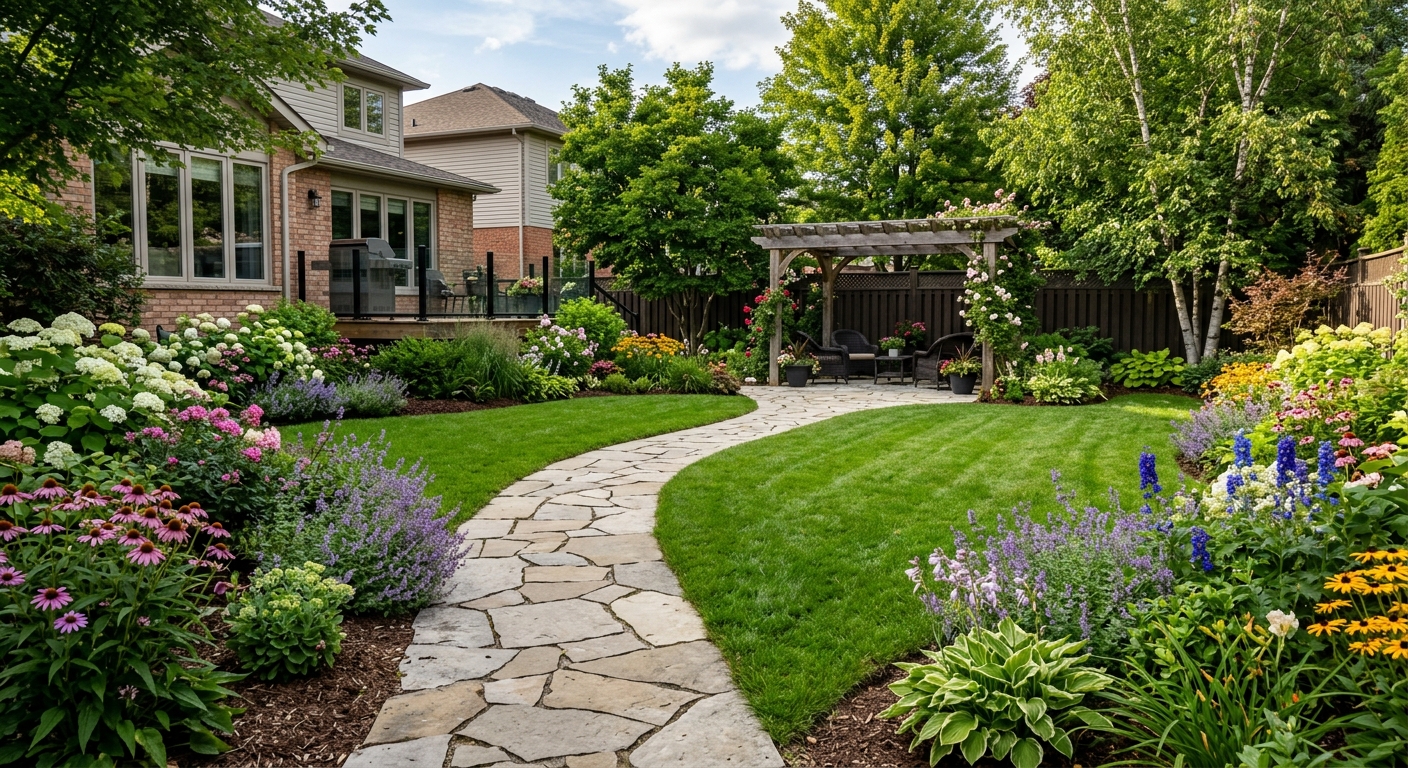
Landscaping options and costs in Grande Prairie
Grande Prairie is where landscaping decisions quickly become practical ones. With 61.6% of dwellings being single-detached homes (Statistics Canada, 2021 Census), most properties have enough frontage and backyard area to justify real curb-impact upgrades—especially for homeowners who want an attractive yard that still performs through northern winters. Just as important, 65.7% of households are homeowner households (Statistics Canada, 2021 Census), and that ownership model often shows up as longer-term value: better drainage, durable hardscape, and planting that doesn’t die back after cold snaps.
In the Athabasca–Grande Prairie–Peace River region, the “cost lever” is climate and the calendar contractors can realistically work. You’re typically designing around a shorter season, late spring/early fall frost risk, and freeze-thaw cycles that punish shallow bases. That’s why prices here often reflect excavation depth, drainage grading, and the right cold-hardy plant palette—not just material choice. Contractor availability can also shift because crews may be scheduled across several communities (Grande Prairie, Greenview, Mackenzie County), and mobilization/haul time affects final numbers.
Demand is especially strong in family-oriented areas such as Westpointe, where new builds and growing trees benefit from early soil prep, top-quality sod or seed establishment, and a clean layout for mowing-friendly edging. Use the table below to compare typical scope-and-price ranges for common projects, then we’ll unpack what moves those numbers up or down.
| Service |
Description |
Season |
Price Range |
| Full landscape design and installation |
Site walk, layout plan, grading/drainage considerations, plant selection, sod or seed, edging, and hardscape as specified |
Late spring to early fall (weather-dependent) |
$5,000–$20,000 |
| Sod installation (supply, grade, lay, roll) |
Minor grading, base prep, sod supply and installation, rolling, starter fertilization, and top-dressing as needed |
May to September (best window when temps are stable) |
$3,500–$12,000 |
| Lawn seeding (grade, seed, starter fertilizer) |
Weed control prep, grading, seed blend selection for local conditions, starter fertilizer, light top-dressing |
Spring seeding; fall seeding sometimes for specific plans |
$2,500–$8,500 |
| Interlocking patio or walkway |
Excavation, base (crush/compaction), jointing sand, pavers, edging, and drainage-aware detailing |
June to September (freeze-thaw tolerant base required) |
$8,000–$25,000 |
| Retaining wall (interlocking block) |
Footing depth planning, drainage gravel, geotextile, block installation, and ties where required by design |
Late spring to early fall |
$8,000–$30,000 |
| Tree and shrub planting |
Soil amendments, planting holes, staking if needed, mulch rings, and watering plan for establishment |
Spring and early fall |
$1,500–$10,000 |
Prices are estimates only and vary by project scope, site access and material selection.
What affects the price of landscaping in Grande Prairie
In Athabasca–Grande Prairie–Peace River, it’s common to see quotes for the “same looking” job vary by 30–50%. The spread comes from how each contractor scopes the real site work: drainage grading, excavation depth, base build-up for freeze-thaw, and how much hand labour is required for tight access. In practice, two yards can both be “about the same size,” yet one needs more excavation to daylight water safely, and the other is already well-drained.
Hardiness and frost dates directly affect both plant costs and the working season. Grande Prairie sits in colder interior prairie conditions (often treated like Zone 2–4 in hardiness planning), so you need cold-hardy, wind-tolerant, drought-capable species and you must time planting so roots can establish before early fall frosts. Retaining wall and patio bases also need to reach below the frost-impacted zone and be compacted correctly; shallow bases lead to heaving and movement. By contrast, coastal BC (Zone 7–8) typically supports a longer growing season and broader palettes, but heavy rainfall demands meticulous drainage design. In water-stressed BC interior locations, irrigation planning changes too. Southern Ontario (Zone 5–6) generally offers a longer moderate season, so lawns and planting timelines are less constrained, though summer dryness can still increase irrigation needs.
Concrete examples from local pricing: (1) If your yard requires regrading and a tie-in to a proper discharge path, you can easily move from the lower end of sod installation toward the upper range in the $3,500–$12,000 band, because prep and hauling become a major portion of labour. (2) A retaining wall that needs a deeper footing and engineered drainage detailing can push a $8,000–$30,000 budget toward the higher end, even if the block height looks similar on paper. (3) If your home was built when older landscaping practices were common—26.9% of homes were built before 1981 (Statistics Canada, 2021 Census)—it’s not unusual to find compacted soils, old fill, or drainage patterns that don’t match modern standards, which can add soil amendment and excavation cost.
| Price Factor |
Why It Matters |
Cost Impact |
| Yard size in sq ft — the primary cost driver for softscape |
Lawn and planting areas scale labour, seed/sod quantities, and topsoil depth |
Often the biggest swing factor; can change total cost by several thousand dollars |
| Grading and drainage work — slope corrections add significant cost |
Pooling water increases winter damage and foundation moisture risk |
Can add substantial excavation and labour; frequently responsible for 30–50% quote differences |
| Drainage bed or French drain installation |
Freeze-thaw performance depends on properly managed subsurface water |
Medium to high added cost, but often prevents long-term failures |
| Plant material tier — native shrubs vs. ornamental vs. mature specimen trees |
Mature plants cost more and require bigger excavation, stakes, and establishment care |
Small plant palettes cost less; mature specimens can quickly multiply the planting line item |
| Hardscape vs. softscape ratio — walls and patios cost more per sq ft than lawn |
Pavers, base materials, and compaction are labour- and material-intensive |
Shifting from lawn to patio/wall can move budgets into the upper bands |
| Irrigation system design and installation |
Proper zoning and winterisation matter in cold climates |
Raises costs, but reduces watering time and improves establishment success |
| Soil amendment and topsoil required |
Clays/compacted soils need amendments so roots grow instead of sitting in water |
Can add delivery, labour, and material costs; especially common in older yards |
| Tree removal or stump grinding before new planting |
Heavy equipment time and disposal change the work schedule |
Often adds a noticeable amount; can also delay planting if removal isn’t scheduled early |
Permits & regulations in Alberta
In Alberta, most residential landscaping work—like planting, sodding, and typical softscape installation—generally does not require a permit. That includes seeding, mulching, adding garden beds, installing steps for a walkway, and most routine excavation for planting holes or edging. The work that does more often require a permit is retaining wall construction above the local height threshold—commonly around 1.0 m (3.3 ft) in many municipalities—because those walls can affect structural safety and drainage management.
Also be careful with grading. If you’re changing lot grading in a way that alters drainage toward neighbouring properties or redirects flow to a storm sewer connection, approvals may be required. Before anyone digs, utility locates are critical: call for locates for underground services prior to digging wall footings, trenching for drainage beds, or installing irrigation lines. And while drought water restrictions are often discussed for other regions, it’s still smart to confirm Alberta water-use expectations and any municipal watering bylaws—especially when establishing sod or a new lawn.
To verify an Alberta contractor for your Grande Prairie project, do this step-by-step: (1) confirm they are properly licensed/registered for their business type through the relevant online registry; (2) ask for a current certificate of insurance and check that liability coverage is active and matches your project type (hardscapes, excavation, retaining walls); (3) request proof of WSIB/WCB coverage where applicable and look for a clearance letter or account verification—don’t accept “we’ll cover it ourselves” as a substitute.
Planning a landscape that thrives in Grande Prairie's climate
Planning for Grande Prairie means designing for frost, wind, and a shorter growing season—then choosing plants that keep looking good with less fuss. Start with plant selection. Aim for native and zone-appropriate species that can handle winter desiccation and spring thaws. In practice, a well-chosen shrub/perennial palette reduces watering and winter protection needs, which matters because Athabasca–Grande Prairie–Peace River yards often don’t get the kind of long, reliably wet growing conditions you see farther west or along the coast.
Second, compare sod vs. seed. Sod gives instant curb appeal, but it costs about 3–4x more per sq ft than seeding because you’re paying for sod production and heavier installation labour. That difference can be justified if you need a fast visual payoff or you’re repairing bare areas quickly. If you’re working on a smaller patch or you can tolerate a longer establishment, seeding is usually the more budget-friendly choice.
Third, drainage and grading are non-negotiable. Freeze-thaw cycles magnify problems when water pools near foundations or walkways. Grade to move water away, and consider a drainage bed or French drain before you install turf.
Fourth, hardscape base prep must respect the local frost line logic: deeper excavation, proper base layers, and compaction. Finally, build a low-maintenance yard with mulch, groundcovers, and hardy perennials—so annual cleanup doesn’t become a second job.
If you want a water-smart direction, consider xeriscape-adjacent beds or a small rain-garden approach in areas that naturally collect runoff. Even a modest drainage-aware planting pocket can reduce hose time and improve performance in heavy spring melt.
| Element |
Climate Consideration |
Maintenance Level |
Price Band |
| Sod lawn installation |
Needs stable establishment before early frost; choose turf that tolerates cold winters |
Medium (frequent early watering until rooted) |
$3,500–$12,000 |
| Native perennial garden |
Cold-hardy roots and wind tolerance; better long-term survival in prairie winters |
Low (mulch refresh and light spring cleanup) |
$1,500–$6,500 |
| Mulched shrub border |
Helps moderate soil temps and reduces winter desiccation; supports drainage |
Low (weed control and occasional topping) |
$2,000–$7,500 |
| Interlocking stone patio |
Freeze-thaw requires correct base depth and compaction to resist movement |
Low (occasional joint sand top-up) |
$8,000–$25,000 |
| Retaining wall (block) |
Needs drainage gravel and footing depth for cold-climate stability |
Low (periodic inspection of drainage performance) |
$8,000–$30,000 |
| Drip irrigation system |
Winterisation and smart zoning protect lines during cold snaps |
Medium (seasonal start/close and occasional adjustments) |
$1,200–$6,500 |
How to choose a landscaping contractor in Grande Prairie
Choosing a contractor in Grande Prairie is about verifying risk coverage as much as it is about aesthetics. First, confirm Alberta coverage: ask for (1) proof of liability insurance (a current certificate of insurance that matches your project scope—especially for excavation, hardscaping, and retaining walls); (2) WSIB/WCB coverage where applicable (request a clearance letter or account verification). If they can’t provide documentation promptly, that’s a scheduling and safety red flag.
Next, get 2–3 itemised written quotes. You should see labour and materials separated: sod or seed quantities, base materials for pavers, drainage components, topsoil amendments, and disposal. Avoid vague “includes grading” language—ask what’s explicitly included and excluded (permit pull, utility locates, hauling/disposal, rock removal). If permit-related work is required for a retaining wall above the typical ~1.0 m threshold, clarify whether the contractor will handle it or you will.
Warranty matters in northern climates where freeze-thaw can expose base or drainage mistakes. Ask for the workmanship warranty length and what it covers (for example, settlement, lifting, joint failure). Also ask about product/manufacturer warranty and whether it’s transferable to you as the homeowner.
Payment schedule should protect you: never pay more than 10–15% upfront. Use a holdback until completion and final grading cleanup. Timeline should be written—start date and a realistic completion estimate—so you’re not stuck waiting through weather windows.
- Ask for an itemised line-by-line quote (materials, labour, disposal, equipment).
- Confirm liability insurance and request the COI before work begins.
- Request WSIB/WCB clearance/account verification (not a verbal promise).
- Check whether utility locates are included and who calls for them.
- Verify how they handle drainage (grading plan, discharge direction, drainage beds if needed).
- For patios and walls, ask about base layers and compaction method.
- Confirm warranty terms in writing (workmanship and product coverage).
- Do not accept “one price includes everything” without exclusions listed.
- Ask how early frosts are handled (planting timing, protection, schedule priorities).
- Review payment schedule—limit upfront to 10–15% and hold back until completion.
- Ask who is responsible for permits if a retaining wall exceeds the local height threshold.
- Get a written start/completion timeline and weather contingency plan.
Red flags to watch for in Grande Prairie: (1) quotes that ignore drainage and only talk about appearance; (2) no documentation for insurance or WSIB/WCB; (3) vague scope language like “some grading included” without a plan; (4) asking for large upfront payments beyond 10–15%; and (5) no written warranty details for workmanship or materials.
Frequently asked questions — landscaping in Grande Prairie
What is the best grass type for a Grande Prairie lawn?
For Grande Prairie lawns, the “best” option is usually a cold-hardy turf that establishes well in prairie conditions and survives winter freeze-thaw cycles. Many homeowners choose blends that include Kentucky bluegrass and/or other cold-tolerant varieties suited to northern Alberta, because they hold colour and recover better after stress. If your yard gets heavy foot traffic or dries fast in wind, ask your contractor to tailor the seed blend to your sun exposure and soil drainage rather than using a generic mix. For budgeting, lawn creation often falls within the broader sod and seeding bands—sod installation commonly lands around $3,500–$12,000 depending on area and prep, while seeding is typically lower when grading is minimal.
When should I aerate and overseed my lawn in Grande Prairie?
In Grande Prairie, plan aeration and overseeding around the active growth window when temperatures support root recovery. Most homeowners get the best results with spring aeration (after the ground is workable) or early fall overseeding when the grass can germinate before early frost risk. The key is matching timing to your establishment phase: don’t aerate a lawn that’s already struggling due to poor drainage or heavy thatch—fix drainage or soil compaction first. If your contractor is quoting a full lawn refresh as part of a broader landscape plan, you’ll often see the scope tied to grading and soil amendment; those elements are a major reason pricing varies widely within local landscape budgets (Statistics Canada, 2021 Census shows many homes are older and may have compaction issues).
What trees grow best in Grande Prairie's climate zone?
In Alberta’s colder prairie interior conditions, the most reliable trees are typically those proven for northern climates and wind exposure. Many landscaping plans in Grande Prairie lean toward hardy options such as Manitoba maple, green ash (where appropriate), and certain spruce types that tolerate cold winters. That said, “best” depends on your soil drainage and how much space you have—especially because freeze-thaw can make water management critical around roots. If you’re working near a walkway or considering a privacy line, ask for the mature size and root spread, not just what the tree looks like at installation. Tree and shrub planting budgets commonly run about $1,500–$10,000 depending on plant sizes, number of specimens, and whether soil amendment is required.
How much does sodding a yard cost in Grande Prairie?
Sodding cost in Grande Prairie commonly depends on lawn area, how much grading is required, and whether the base needs topsoil amendment. For typical residential projects, sod installation often falls in the local band of $3,500–$12,000. The lower end is usually a smaller, relatively level yard with minimal prep; the higher end tends to involve larger square footage, more excavation and disposal, and careful drainage shaping to avoid pooling. Because Alberta winters can expose weak drainage during freeze-thaw, a good sod quote should explain prep and how they’ll handle water movement away from foundations and walkways.
How do I prevent weeds in my Grande Prairie garden?
Weed prevention in Grande Prairie starts before plants go in. Start with clean edging and soil prep: remove existing weeds and roots, and correct drainage so plants aren’t stressed (stressed plants open the door for weeds). Use a proper weed-control layer where appropriate—landscaping fabric can help in some bed styles, but it’s not a blanket solution for every situation. A thick, consistent mulch layer is one of the simplest wins for prairie yards; it suppresses light and reduces weed germination. Also plan plant spacing so beds fill in over time—empty soil is where weeds thrive. If you’re paying for a design that includes edging and bed build-up, expect it to influence overall pricing, but it can reduce ongoing maintenance costs compared with repeatedly spot-weeding through the season.
How do I design a low-water yard in Grande Prairie?
A low-water yard in Grande Prairie is mostly about design choices that reduce evaporation and irrigation demand, while still surviving winter. Use hardy, cold-adapted perennials and shrubs; prioritize drought-tolerant, wind-hardy species, and group plants by moisture needs. Design in mulch beds and groundcovers to limit bare soil. If your yard has slope or runoff, consider drainage-aware planting pockets (a small rain-garden concept) so you capture and slow water rather than letting it race away. For turf, many homeowners combine smaller seeded areas with targeted turf zones rather than sodding everything—sod can run $3,500–$12,000 depending on area, so use it strategically. If irrigation is desired, drip systems with winterisation and correct zoning can support establishment without constant full-coverage watering.