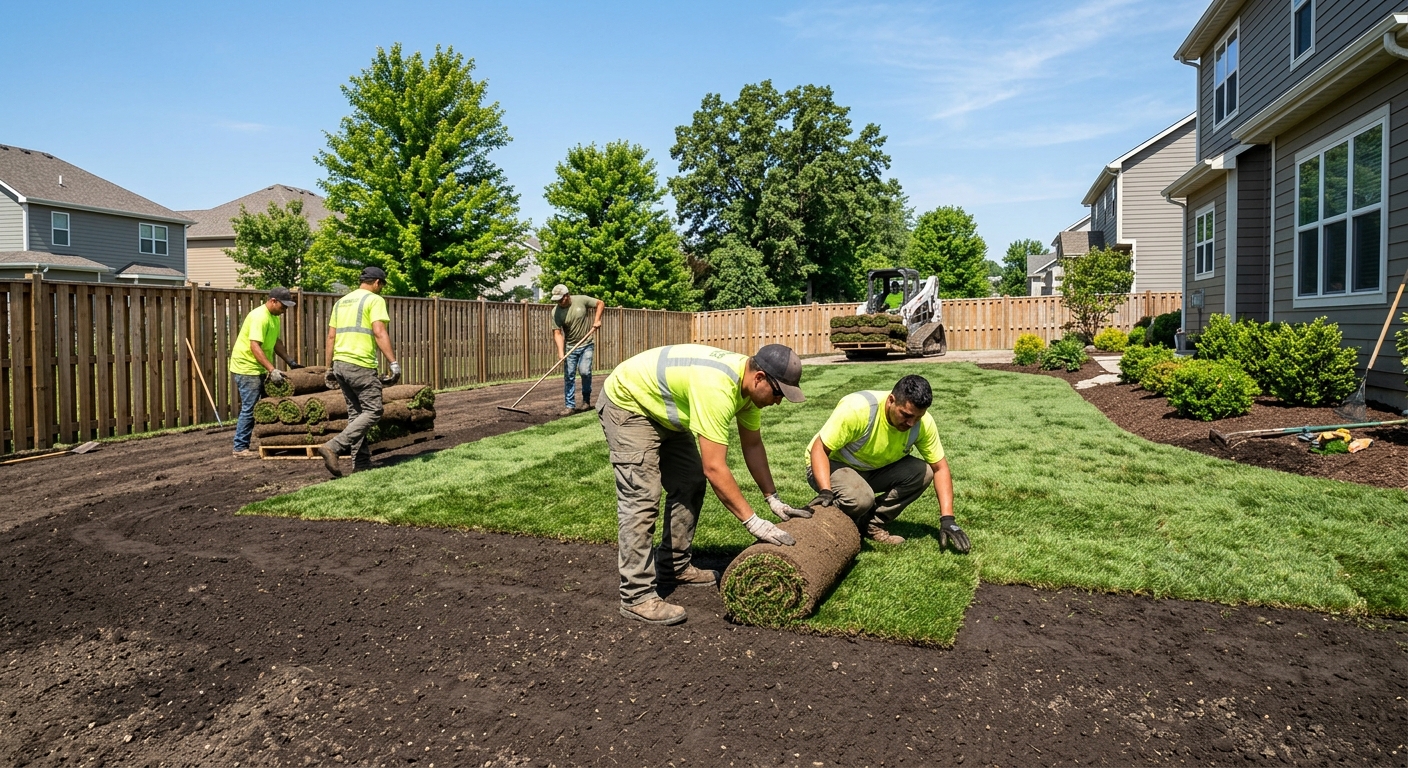
Landscaping options and costs in Valleyview
Landscaping in Valleyview usually starts with what homeowners can realistically maintain through Alberta winters and short growing seasons. With 68.9% of households in the area being homeowners (Statistics Canada, 2021 Census), many detached properties—single-detached homes make up 57.6% of dwellings—have the yard space to invest in curb appeal and long-term durability. In practice, the Athabasca–Grande Prairie–Peace River region shapes costs in two big ways: (1) a tighter working season (weather can limit grading, stone base work, and planting windows), and (2) freeze-thaw cycles that demand deeper compaction and drainage—especially for patios and retaining walls. That’s why installation budgets often swing based on how much excavation, hauling, and base preparation is required before you ever reach the visible “finishes.”
Demand tends to be especially strong around Valleyview’s newer growth pockets and along main access routes, where homeowners notice drainage issues and want modern, cold-hardy plantings that stay tidy even when the lawn goes dormant. Contractors also adjust plant selection toward cold-hardy, wind-resistant, drought-tolerant species; this avoids “pretty but fragile” installs that fail after one harsh winter. For many yards, the decision comes down to whether you’re prioritizing instant visual impact (like sod) or lower upfront cost with more seasonal patience (like seeding). Either way, you’ll typically see softscape line items (design, soil, grading, turf, planting) and hardscape line items (base, drainage, blocks, pavers) priced differently because materials and labour scale fast as square footage increases.
Below is a practical comparison of common options and typical price ranges in Valleyview so you can benchmark your next quote.
| Service |
Description |
Season |
Price Range |
| Full landscape design and installation |
Site walk, concept + layout, grading/drainage plan, topsoil + soil amendments, turf prep, planting, and hardscape coordination |
Late May to September (weather-dependent) |
$5,000–$20,000 |
| Sod installation (supply, grade, lay, roll) |
Rough grade, base prep, soil testing/adjustments as needed, sod delivery, install, rolling, and starter fertilizer |
Best: spring or early fall |
$3,500–$12,000 |
| Lawn seeding (grade, seed, starter fertilizer) |
Fine grading, seed selection for Alberta conditions, starter fertilizer, light mulch/blanket where appropriate |
Spring to early summer; touch-ups in fall |
$1,800–$7,500 |
| Interlocking patio or walkway |
Excavation, compacted granular base, edge restraints, interlocking stone, levelling, joint sand |
Typically June to September |
$8,000–$30,000 |
| Retaining wall (interlocking block) |
Footing/excavation to frost-considerations, geotextile + drain aggregate, block system, caps/finishing |
Typically June to September |
$8,000–$30,000 |
| Tree and shrub planting |
Soil loosen + amendment, planting, staking as required, mulch rings, watering plan |
Best: spring and early fall |
$1,500–$10,000 |
Prices are estimates only and vary by project scope, site access and material selection.
What affects the price of landscaping in Valleyview
Even when two homeowners ask for “the same” landscaping, quotes in the Athabasca–Grande Prairie–Peace River region can differ by 30–50%. The drivers are usually (1) how much earthwork is truly required once a contractor measures grade and drainage, and (2) what it takes to install within Valleyview’s short season and cold winter freeze-thaw cycles. A job that looks straightforward on a sunny day can become expensive after it’s clear the subgrade is soft, the slope needs correction, or water needs a proper pathway away from foundations. In a region like ours, site access and hauling distances can also swing costs, since contractors can be servicing multiple dispersed communities between Grande Prairie, Mackenzie County, and Greenview.
Hardiness and frost protection define both plant viability and the working window for labour. In most northern Prairie conditions (often mapped around Zone 2–4), choosing drought-tolerant, wind-hardy plants reduces failure risk, but correct installation still takes time—mulch, soil prep, and winterization steps. For retaining walls, base depth and drainage media need to be built to resist heaving over winter freeze-thaw cycles, which directly supports price bands in the $8,000–$30,000 range for hardscaping. Compare that to coastal BC, where Zone 7–8 allows lush palettes and longer growth periods—yet heavy rainfall and saturated soils can make drainage design the bigger cost item. Southern Ontario (Zone 5–6) typically has a moderate season and different irrigation demands than Alberta’s colder interior climate; that can shift labour allocation and material choices.
Concrete examples from Valleyview: replacing thin topsoil with amended soil can add several hundred to over a thousand dollars depending on delivery quantity; correcting a flat lawn that ponds after snowmelt can require more grading and a drainage bed, which pushes softscape budgets upward within the $5,000–$20,000 full landscape range. Homes built before 1981 make up 46.2% of the local housing stock (Statistics Canada, 2021 Census), and older lots often have established drainage patterns that need careful rework to avoid directing water toward foundations or neighbours—another reason “same size” projects price differently.
| Price Factor |
Why It Matters |
Cost Impact |
| Yard size in sq ft — the primary cost driver for softscape |
More area means more labour hours for prep, more topsoil/seed/sod, and more planting material |
Often the biggest swing; can account for the majority of variance between quotes |
| Grading and drainage work — slope corrections add significant cost |
Fixing low spots and directing water away from the house requires excavation, haul-off, and re-compaction |
Can add thousands, especially when regrading extends beyond the immediate lawn |
| Drainage bed or French drain installation |
Freeze-thaw-friendly drainage prevents water pooling and reduces winter heaving risk |
Typically adds material + trenching labour, raising project totals |
| Plant material tier — native shrubs vs. ornamental vs. mature specimen trees |
Mature trees cost more to source, transport, and install; some ornamentals have higher failure risk in harsh winters |
Lower tier may fit near the $1,500–$10,000 planting band; specimens push toward the top |
| Hardscape vs. softscape ratio — walls and patios cost more per sq ft than lawn |
Pavers and blocks require deep base prep, reinforcement/compaction, and careful subgrade |
Shifts pricing upward toward $8,000–$30,000 for many wall/patio scopes |
| Irrigation system design and installation |
Drip lines and timed zones protect new plantings during establishment while reducing water waste |
Can add notable cost if trenching and backflow/valves are required |
| Soil amendment and topsoil required |
Better soil improves seed germination and root establishment; it also improves drainage around trees/shrubs |
Delivery + spread labour can meaningfully increase totals |
| Tree removal or stump grinding before new planting |
Old roots can interfere with grading and future planting; removal is labour intensive |
Often adds separate line items; severity and access drive the final figure |
Permits & regulations in Alberta
In Alberta, most everyday landscaping and softscape work typically does not require a building permit—planting, seeding, and sodding are generally treated as regular site maintenance. You also usually don’t need permits for standard mulch, garden bed prep, and routine grading that doesn’t create a structural retaining element. The work that more commonly triggers permitting is retaining walls that exceed the local height threshold—often around 1.0 m (3.3 ft) depending on the municipality—because the wall can be considered a structural/engineered barrier. Changes to lot grading that affect drainage toward neighbouring properties or storm sewer connections can also require approval, particularly if you’re altering how surface water leaves your lot.
Before anyone digs for planting holes, French drains, or wall footings, get utility locates (e.g., underground services markings) so crews don’t strike lines. For water rules, confirm Alberta and local irrigation/water-use bylaws, because restrictions can change during dry periods.
To verify a contractor for a Valleyview project, take these steps in order: (1) confirm their Alberta business details and contractor licence information via the relevant online registry sources; (2) ask for a current certificate of insurance showing liability coverage naming you as applicable, and verify the coverage dates; (3) request proof of workers’ compensation coverage (WSIB/WCB) and/or a clearance letter where applicable; and (4) keep a copy of everything you receive with your contract. If they won’t provide insurance and coverage documentation promptly, treat it as a risk signal—especially for excavation and hardscaping.
Planning a landscape that thrives in Valleyview's climate
Planning a landscape in Valleyview is about working with Prairie realities—cold winters, frost depth, and periodic dry spells—rather than fighting them. Start with plant selection: choose cold-hardy, zone-appropriate species that can handle wind and winter exposure. Using native and proven-at-home varieties typically reduces watering and winter protection needs while keeping the yard looking intentional through the shoulder seasons. Next, decide between sod and seeding. Sod gives instant coverage and helps stabilize soil quickly, but it’s commonly 3–4 times more per square foot than seeding. In a region where the growing window is shorter, seeding can still work well when scheduled correctly, but it takes patience and follow-up for establishment.
Drainage and grading are the foundation of success in the Athabasca–Grande Prairie–Peace River region. We often see yards where water pools after snowmelt; without correction, that moisture near foundations can lead to long-term issues and increased freeze-thaw stress on pavements and wall bases. For hardscape, base preparation must consider the local frost line: deeper, well-compacted granular layers and edge restraints reduce shifting. Low-maintenance design strategies make the biggest difference over time—mulched borders, groundcovers that suppress weeds, and perennials suited to northern interiors. Xeriscape or rain-garden-inspired ideas are especially useful here: they let you manage runoff and reduce reliance on frequent irrigation while keeping a neat look.
Dollar reality check: if you’re budget-limited and your goal is a green front lawn fast, sod can push you toward the $3,500–$12,000 range depending on area. If you compare that to lawn seeding or a partial sod strategy, you may keep the turf budget closer to the lower end of the landscape spend and redirect money into drainage and soil—often the “worth it” spend in Valleyview when pooling is the real problem.
| Element |
Climate Consideration |
Maintenance Level |
Price Band |
| Sod lawn installation |
Needs proper prep and early establishment watering; winter die-off risk if drainage and grade are off |
Medium during establishment; low after roots knit in |
$3,500–$12,000 |
| Native perennial garden |
Zone-appropriate plants handle cold and wind better; fewer watering demands once established |
Low to medium (seasonal weeding + mulching) |
$2,000–$8,000 |
| Mulched shrub border |
Mulch moderates freeze-thaw impacts on shallow roots and helps conserve moisture |
Low (annual mulch refresh, occasional pruning) |
$1,500–$6,500 |
| Interlocking stone patio |
Freeze-thaw requires solid base, correct slope, and drainage for longevity |
Low (periodic joint sand top-up) |
$8,000–$30,000 |
| Retaining wall (block) |
Wall performance depends on proper footing depth and drainage aggregate behind the block |
Low after completion; keep weep/drainage clear |
$8,000–$30,000 |
| Drip irrigation system |
Targeted watering supports new plant establishment while reducing waste in dry stretches |
Medium (seasonal checks and shut-down/blowout) |
$2,000–$9,000 |
How to choose a landscaping contractor in Valleyview
For a Valleyview landscaping project, verifying coverage is non-negotiable—especially when excavation, grading, retaining walls, or trenching are involved. Start with Alberta licensing/busines identification: confirm the contractor’s legal business details and any applicable landscaping/professional credentials for the scope they’re offering. Next, request proof of liability insurance; you want a current certificate of insurance with coverage limits that make sense for your project size. Then ask for workers’ compensation coverage confirmation (WSIB/WCB) and/or a clearance letter—this protects you if a worker is injured on site. If they say they “don’t have it” or delay sharing documents, walk away.
Get 2–3 itemised written quotes. “Itemised” matters: you should see labour and materials separated, and you should see allowances for things like topsoil, drainage stone, geotextile, sod/seed rates, and disposal. Ensure the scope is explicit—what’s included and what’s excluded. Confirm whether permits are pulled if needed (commonly for retaining walls above local thresholds or where grading/draingage approvals apply), and whether waste hauling/disposal is included.
Check warranty terms carefully. Ask for a workmanship warranty length, and whether product warranties from nurseries/installers are documented and transferable to you. Finally, payment scheduling should be conservative: never pay more than 10–15% upfront. Hold back the final amount until the job is complete and cleaned up.
In your written timeline, ask for the start date and a realistic completion window based on the weather-dependent season in the Athabasca–Grande Prairie–Peace River region.
- Provide insurance and workers’ compensation documents before signing anything.
- Quote includes a site visit and measurements, not just “ballpark” square footage.
- Scope lists specific materials (block type, stone thickness, seed mix/sod variety).
- Drainage/grading method is explained (not “we’ll level it”).
- Base preparation details are included (depths, compaction approach).
- Permit responsibilities are clear for retaining walls and any approval-triggering grading changes.
- Utility locate confirmation is mentioned before digging.
- Disposal/haul-off is included or priced separately.
- Change-order process is written (what triggers extra cost, how it’s approved).
- Warranty terms are in writing: workmanship + how long + what’s covered.
- Payment schedule stays within 10–15% upfront; final payment tied to completion.
- Job start and completion dates are stated, with weather contingencies.
In Valleyview, red flags I’ve seen include: quotes that omit drainage/grade prep but still promise “no settling,” refusing to show insurance or workers’ coverage, vague “allowances” that replace actual quantities, paying large deposits up front, and workmanship timelines that don’t match the realistic June–September installation window for hardscaping.
Frequently asked questions — landscaping in Valleyview
What is the best grass type for a Valleyview lawn?
For Valleyview lawns, homeowners usually get the best results with cold-hardy turfgrass blends that tolerate northern winters and summer dry stretches. In practical installs here, we typically steer clients toward seed mixes designed for Alberta’s colder interior conditions or sod types proven to establish reliably through freeze-thaw cycles. The right choice also depends on your yard’s drainage—if water ponds after snowmelt, even the best grass will struggle. If you’re comparing budget options, seeding is often the more cost-efficient route within the $1,800–$7,500 range, while full sod installation commonly sits in the $3,500–$12,000 band. A contractor should confirm grade and soil prep first, because turf performance is less about “brand” and more about drainage and establishment.
When should I aerate and overseed my lawn in Valleyview?
In Valleyview and the wider Athabasca–Grande Prairie–Peace River region, timing is driven by frost risk and how quickly the soil warms. Typically, aeration and overseeding are best done when temperatures are consistently mild—often spring through early summer—or in early fall if you can still get germination before cold snaps. If your lawn is compacted, aeration should come first so seed-to-soil contact actually happens. After aerating, use an appropriate seed mix for northern Alberta conditions and apply a starter fertilizer recommended for turf establishment. If you’re doing work after a winter, inspect for low spots and pooling; aeration won’t fix drainage problems. For homeowners comparing costs, an overseed approach can keep you closer to the lawn seeding band ($1,800–$7,500), while sod replacement is usually higher at $3,500–$12,000 because it includes supply and installation.
What trees grow best in Valleyview's climate zone?
In Valleyview, the “best” trees are those that are reliably cold-hardy, wind-tolerant, and suited to northern interior conditions. Common choices we use successfully include varieties like hardy spruce and some cold-adapted ornamental trees, with spacing and staking based on exposure and soil drainage. If your site is windy or has shallow soils, we lean toward tough evergreens rather than delicate species that can struggle after winter stress. Tree survival also depends on planting technique: correct hole size, root flare placement, and a mulch ring that won’t trap moisture against the trunk. Because older lots (46.2% of homes built before 1981 in the local profile, Statistics Canada, 2021 Census) sometimes have entrenched drainage patterns, we often assess whether the planting area stays wet in spring. Tree and shrub planting budgets commonly fall within $1,500–$10,000 depending on how many plants and whether you’re adding any larger specimens.
How much does sodding a yard cost in Valleyview?
Sodding cost in Valleyview depends heavily on turf area size, how much grading is required, and whether topsoil and soil amendments are needed. As a benchmark, full sod installation typically falls within $3,500–$12,000 in this area. That range covers supply, grade prep, sod laying/rolling, and basic establishment inputs. If your lawn needs drainage correction or significant regrading—common when older lots have uneven fall-off toward foundations—expect the project to trend toward the upper end because earthwork is labour-intensive. Timing also matters: sod performs best when installed during the periods when roots can establish before frosts, which is why spring and early fall are usually prioritized. When you get quotes, ask what’s included (topsoil level targets, disposal, and whether irrigation is added or recommended).
How do I prevent weeds in my Valleyview garden?
Weed prevention in Valleyview is mostly about setup and maintenance habits rather than “one magic product.” Start with good soil prep: remove established weeds thoroughly (including roots where practical), loosen the soil properly, and address drainage so plants aren’t weak. Then use a thick mulch layer in beds—this moderates temperature swings and blocks light that weeds need to germinate. Groundcovers can also help fill space so weeds don’t have bare soil to colonize. Plant density matters in the first year, especially in colder Prairie climates where plants may not grow as fast as you’d expect in coastal regions. For edging and long-term tidiness, include defined bed borders so grass doesn’t invade and vice versa. If you’re investing in a shrub border, budgets commonly align with $1,500–$6,500. A solid installation plus mulch is typically cheaper than repeated weed control every season.
How do I design a low-water yard in Valleyview?
A low-water yard in Valleyview starts with plant choice and layout. Choose cold-hardy, drought-tolerant species suited to northern Prairie conditions, and group them by water need so you’re not watering everything equally. Use mulch heavily (especially around shrubs and perennials) to reduce evaporation. Improve drainage correctly so plants aren’t stressed by both drought and standing water after snowmelt. Consider xeriscape-style design: fewer thirsty turf areas, more native or zone-appropriate perennials, and some groundcovers that suppress weeds without constant re-seeding. Where runoff is an issue, a rain-garden-inspired pocket can capture and slowly release water into amended soil. If you’re building establishment-time support, drip irrigation is more water-efficient than sprinklers and can be designed to minimize waste—often within a practical range of $2,000–$9,000 for many small systems. In Alberta’s climate, the goal isn’t “no water,” it’s targeted, efficient watering during establishment and then reduced reliance in later seasons.