Landscaping options and costs in Hidden Valley
Hidden Valley is where homeowners often want a yard that looks finished quickly, but still survives southern Alberta’s freeze–thaw cycles. With a population of 11,540 (Statistics Canada, 2021 Census), the Calgary-area housing market brings steady demand for curb-appeal upgrades and family-friendly outdoor spaces. Also, because many properties in this area are detached, owners typically have yard space that invites investment in both softscape (planting and turf) and hardscape (patios, walkways, retaining walls). That mix is a big reason contractor schedules can tighten in spring and early summer.
In Prairie hardiness zones 3–4, late-spring frosts and early fall cold snaps shape what contractors can install and when. Freeze–thaw is severe, so patios, walkways, and retaining walls require deep, well-compacted bases and proper drainage to prevent heaving. At the same time, the shorter growing season means planting and sod decisions carry different risk—seed may cost less, but it takes patience; sod looks great fast, but it needs the right preparation and watering plan.
In Hidden Valley, work is especially busy around the more established residential pockets where driveways and back-yards connect to mature trees and existing drainage swales—contractors often get repeat calls to fix pooling, foundation moisture, and uneven grades. If you’re comparing directions for your project (full design, turf upgrades, or a block-wall), the price ranges below will help you benchmark the options before we break down what moves costs most.
| Service |
Description |
Season |
Price Range |
| Full landscape design and installation |
Concept + grading plan, planting, hardscape, and irrigation coordination |
May–September (some late-season planting possible) |
$12,000–$45,000 |
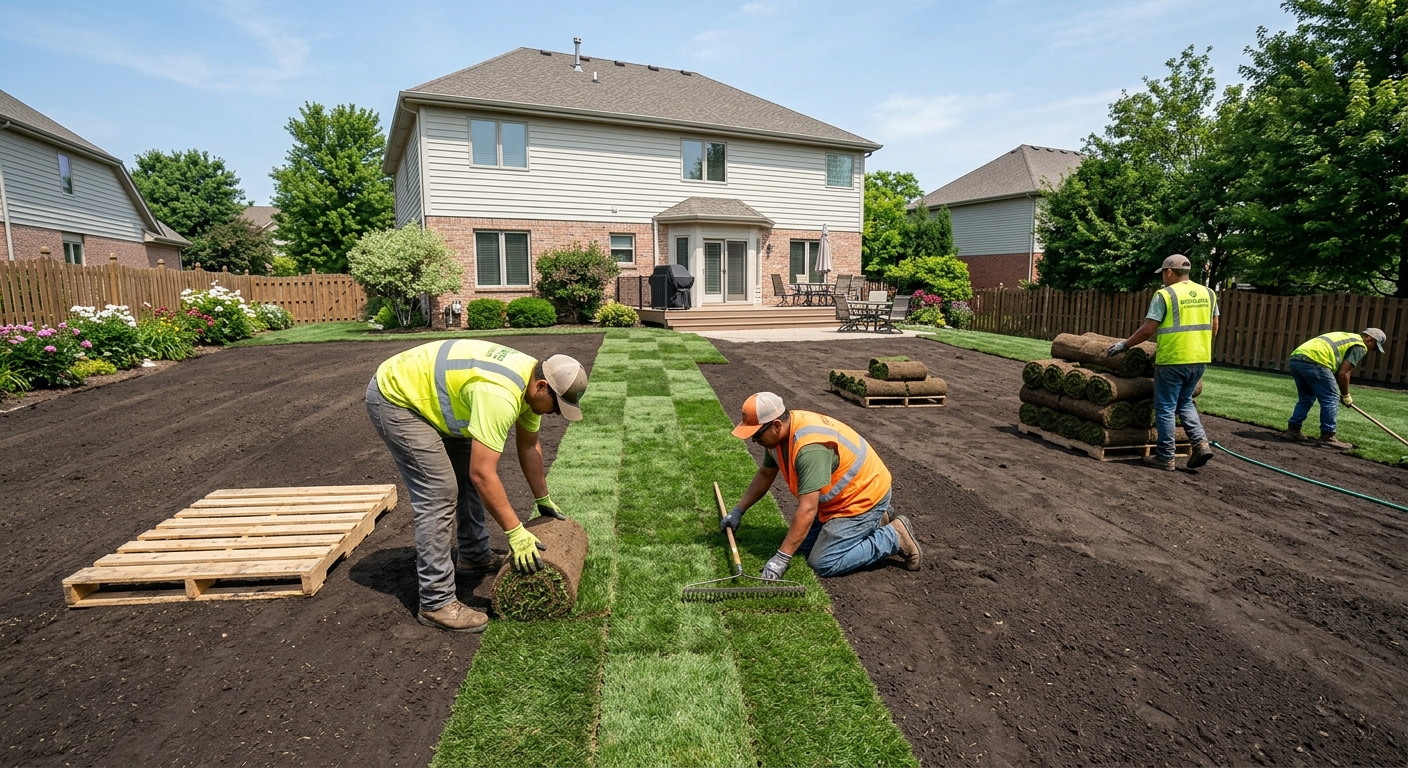
| Sod installation (supply, grade, lay, roll) |
Remove/prepare existing soil, grade to contours, supply and install sod, roll |
Late April–August (best results in warm soil window) |
$2,500–$6,000 |
| Lawn seeding (grade, seed, starter fertilizer) |
Grade, seed selection, starter fertilizer, light watering plan |
April–June or late summer (weather-dependent) |
$1,500–$3,500 |
| Interlocking patio or walkway |
Excavation, base depth, geotextile, interlocking stone, edging |
May–October |
$8,500–$26,000 |
| Retaining wall (interlocking block) |
Block wall with reinforced base, drainage rock, and weeping considerations |
May–September |
$10,000–$35,000 |
| Tree and shrub planting |
Zone-appropriate trees, shrubs, soil amendment, mulch beds |
May–September (with fall planting for hardy stock) |
$1,200–$12,000 |
Prices are estimates only and vary by project scope, site access and material selection.
What affects the price of landscaping in Hidden Valley
In Hidden Valley and the wider Calgary region, two quotes for what looks like the same job can differ by 30–50% because the “hidden work” changes—how deep the excavation must be, how much grading and drainage correction is required, and what level of plant quality you’re actually getting. Labour also matters: in southern Alberta, the installed cost is often driven by labour (typically 40–60% of full projects), and that labour can be scarce when everyone wants to work during the same frost-free window.
Calgary’s Prairie climate—zones 3–4 with freeze–thaw cycles—directly impacts both what can grow and how long contractors can work on site. Retaining wall base depth has to reach below the frost line, and patio/walkway bases need deep, well-compacted layers to avoid heaving. Because the growing season is shorter, homeowners who choose drought-tolerant, wind-hardy species (vs. water-hungry ornamentals) usually see better long-term success with less rework.
Local conditions also change your drainage profile and therefore your cost. For example: if your yard slopes toward the house or you have pooling after spring melt, grading and drainage work can push a “basic planting” job into the mid five-figure range once we add catchment and tie-ins. Conversely, if your site already has good fall and you only need shrub and tree installation, pricing may land closer to the tree/shrub band. In many Hidden Valley projects, a full installation may land in the $12,000–$45,000 range, while a hardscape add-on like an interlocking patio commonly sits in the $8,500–$26,000 band—depending on base depth, thickness of stone, and site access.
Finally, housing age can influence costs. Older yards often have compacted, mixed soils or shallow topsoil layers; soil amendment and topsoil delivery add cost. Newer builds can still need irrigation design upgrades if slopes and downspout discharge weren’t planned for long-term drainage performance.
| Price Factor |
Why It Matters |
Cost Impact |
| Yard size in sq ft — the primary cost driver for softscape |
More area means more soil prep, seed/sod, mulch, and labour hours |
$500–$10,000+ |
| Grading and drainage work — slope corrections add significant cost |
Fixing ponding and directing runoff away from foundations requires excavation and re-contouring |
$1,500–$12,000 |
| Drainage bed or French drain installation |
Proper sub-surface drainage prevents freeze damage and foundation moisture |
$1,200–$7,500 |
| Plant material tier — native shrubs vs. ornamental vs. mature specimen trees |
Hardiness and maturity affect survival, size at install, and labour to plant larger stock |
$800–$10,000 |
| Hardscape vs. softscape ratio — walls and patios cost more per sq ft than lawn |
Interlocking stone and reinforced wall systems require deeper bases and more material |
$2,000–$20,000 |
| Irrigation system design and installation |
Zoned watering and efficient layout reduce water stress during warm spells and dry winds |
$1,000–$8,500 |
| Soil amendment and topsoil required |
Improves root development for short growing seasons and tough Prairie soils |
$700–$6,000 |
| Tree removal or stump grinding before new planting |
Disposal and equipment time can add days to a schedule |
$400–$4,500 |
Prices can swing quickly when grading, drainage, or irrigation design isn’t fully scoped.
Permits & regulations in Alberta
In Alberta, most landscaping activities—planting, sodding, seeding, mulch installation, and typical softscape work—usually do not require a permit. The work that often triggers permits is retaining wall construction above the municipal threshold (commonly around 1.0 m in many areas) and, in some cases, walls that may need engineered drawings depending on height, design, and site conditions.
Another category to watch is lot grading. If your project changes drainage patterns—especially directing runoff toward neighbouring properties or adjusting how water connects to storm infrastructure—approvals may be required. Before any digging, always arrange utility locates so contractors can avoid underground lines for power, gas, telecom, and services. Even a “simple” planting hole or a wall footing can become costly if utilities are struck.
To verify your contractor for a Hidden Valley landscape project step-by-step: first, confirm their Alberta licence/registration status through the appropriate provincial registry (and ask for their licence number). Next, request a current certificate of liability insurance naming you as an additional insured if possible. For worker coverage, ask for proof of WSIB/WCB coverage—then ensure it matches the project period. If they can’t provide clear certificates up front, treat that as a serious red flag and get written assurances before work begins.
Finally, confirm water-use practices. While watering rules can be stricter in other parts of the interior during drought conditions, Calgary-area requirements still reward smart controllers, zoned irrigation, and soil improvement over high-water turf.
Planning a landscape that thrives in Hidden Valley's climate
To build a yard that thrives in Hidden Valley, plan for Prairie hardiness zone 3–4 realities: winter wind, short growing windows, and repeated freeze–thaw. Start with plant selection. Choose native and zone-appropriate shrubs and perennials that tolerate dry spells and handle cold with minimal winter protection. Then decide turf strategy: sod gives instant curb appeal, but it depends heavily on proper sub-base prep and early watering success; seeding is slower to fill in, but it often fits the budget better for full lawn areas.
Drainage and grading are the foundation of long-term success in Calgary. Pooling after spring melt or downspout discharge can stress plants and create foundation moisture. For hardscape like patios and walkways, base preparation should account for the frost line and local freeze depth, including deep, well-compacted layers. A well-built base is what prevents edge settlement and heaving—especially when chinooks trigger warm-ups followed by cold snaps.
For low-maintenance design, stack the deck with mulch beds, groundcovers, and perennials rather than thin turf everywhere. Xeriscape elements—like drought-tolerant grasses and shrubs, or a rain-garden style planting depression—help manage runoff without constant manual watering. If you want a practical budget justification: in many Hidden Valley projects, sod installation may land in the $2,500–$6,000 range for a typical lawn upgrade, while a seeding approach may come in closer to $1,500–$3,500. That difference can be justified when you need immediate usable lawn for kids or pets; otherwise, seeding plus targeted planting often delivers better value with less risk from sod stress.
Where possible, combine soil amendment with efficient irrigation zoning so plants establish during the brief warm season and still look intentional the rest of the year.
| Element |
Climate Consideration |
Maintenance Level |
Price Band |
| Sod lawn installation |
Requires warm soil window; frost heave risk if base isn’t compacted |
Medium (water early, mow, watch for settling) |
$2,500–$6,000 |
| Native perennial garden |
Zone-appropriate plants handle Alberta winters and drought better |
Low to medium (mulch refresh, light trimming) |
$800–$4,500 |
| Mulched shrub border |
Wind and dry periods are easier to manage with mulch insulation |
Low (weeding decreases with proper weed fabric and mulch depth) |
$1,200–$6,500 |
| Interlocking stone patio |
Needs deep base and drainage away from the home to prevent heaving |
Low (sweep, occasional leveling and joint maintenance) |
$8,500–$26,000 |
| Retaining wall (block) |
Freeze–thaw demands reinforced, below-frost drainage base |
Low (annual inspection of weep/drainage performance) |
$10,000–$35,000 |
| Drip irrigation system |
Efficient watering for drought-tolerant beds during short growing season |
Medium (seasonal checks, winterization) |
$1,000–$6,500 |
How to choose a landscaping contractor in Hidden Valley
Choosing a contractor in Hidden Valley is about verifying the basics before you compare design ideas. First, confirm Alberta licensing/registration and ask for the licence/registration details in writing. Next, request liability insurance documentation; you want proof the policy is active for the project timeframe. For worker coverage, ask for WSIB/WCB proof and ensure it covers their crews who will be on-site—not just “company coverage” without dates. If they won’t provide certificates when requested, that’s a serious issue.
Then collect 2–3 itemised written quotes. You’re looking for a breakdown that separates labour and materials: excavation and base prep, geotextile and drainage rock, stone/blocks, soil/topsoil and compost, plant quantities and sizes, and irrigation components if included. Avoid lump-sum quotes that don’t show scope details—those are where budget creep happens.
Read the scope carefully for inclusions and exclusions: is permit pulling included (if required for a retaining wall), is disposal/hauling included for soil and excess material, and is topsoil included versus “soil amendments only”? Ask about grading responsibilities and how they’ll protect existing landscaping during construction.
Warranty matters. Confirm the workmanship warranty length (often separate from product warranties), whether manufacturer warranties apply to plants/hardscape materials, and whether warranties are transferable to you as the homeowner. Payment schedule should protect you: never pay more than 10–15% upfront, and hold back a portion until the work is complete and walk-through items are addressed. Finally, insist on a written timeline with a start date and completion estimate—spring weather can shift schedules, but you should still have an agreed plan.
- Provide Alberta licence/registration details in writing before starting.
- Show current liability insurance certificate (active dates + coverage amounts).
- Provide WSIB/WCB proof for the workers assigned to your job.
- Include an itemised labour/materials breakdown—no “mystery allowance” lines.
- Clarify site prep depth (base depth, compaction method, and drainage approach).
- Confirm disposal/hauling for excess soil, stumps, and construction debris.
- State whether permits are included if you’re building a retaining wall above the local threshold.
- List plant varieties, sizes, and quantities; avoid “similar substitutions” without approval.
- Confirm irrigation scope (zone count, controller type, backflow prevention, winterization plan).
- Write the warranty terms: workmanship length, manufacturer coverage, and transferability.
- Set payment milestones tied to inspections (rough grading, base completion, final install).
- Get a written schedule with start/completion targets and weather contingency notes.
Red flags specific to landscaping in Hidden Valley include: (1) vague quotes that don’t specify base preparation depth or drainage layers; (2) unwillingness to show insurance and WSIB/WCB proof before you sign; (3) asking for more than 20–30% upfront without milestones; (4) “assure it’ll be fine” statements about drainage without referencing grading or weeping/drainage rock for walls; and (5) substituting plant material on site without your approval or without matching hardiness and mature size targets.
Frequently asked questions — landscaping in Hidden Valley
How do I plan a low-maintenance yard?
A low-maintenance yard in Hidden Valley starts with reducing the number of “high-effort” zones. In Calgary’s zone 3–4 conditions, that usually means limiting thin turf areas, using mulch beds with groundcovers, and choosing hardy, drought-tolerant shrubs and perennials that won’t need constant summer watering. If you want instant curb appeal without constant rework, you can still include a small sod area—often projects for sod land around $2,500–$6,000 depending on size—while most of the perimeter becomes planting beds. Pair that with smart irrigation zoning so only the active planting needs water. Finally, invest in drainage and soil prep once; poor grading creates ongoing maintenance problems after freeze–thaw cycles.
How deep should a retaining-wall base be for local frost?
For a retaining wall in Alberta, the key is that the base and reinforcement must be designed for freeze–thaw performance, not just “a shallow pad.” In Hidden Valley, that means excavating to a depth that reaches below the frost-impacted zone and building a properly compacted base with drainage rock to relieve hydrostatic pressure behind the wall. Because frost depth and wall design details can vary by site conditions, wall height, and municipal expectations, a professional should confirm the excavation depth during the design phase. If your wall is above the typical permit threshold (often around 1.0 m), permits and sometimes engineered considerations may apply, which also improves the chance the base is built to the right standard.
How much does professional landscape design cost?
Professional landscape design costs can range widely depending on whether you need concept only or a full design package tied to installation. In Calgary-area projects that include design and installation, homeowners often budget within the broader landscape range of $5,000–$50,000, with many Hidden Valley backyard upgrades landing in the mid five-figure area once grading, hardscape, planting, and irrigation are included. If you’re doing design-only, many contractors structure it as a separate fee or a credit toward installation. Practically, the more complex the grading/drainage, the more design time is needed, especially in a freeze–thaw climate where drainage decisions affect foundation moisture and long-term wall/patio performance.
How do I compare landscaping quotes?
Compare quotes line-by-line, not just the total. For Hidden Valley projects, insist that each quote specifies what’s included in base prep (excavation depth, compaction, geotextile), drainage work (French drains or drainage rock behind walls), and irrigation scope (zoning, controller, and whether heads/drip lines are included). Look at plant lists: species, size at install, and quantities. Also check disposal/hauling and whether permits are included if a retaining wall crosses the local threshold. Prices can vary 30–50% across Calgary for the same visible scope because drainage and base prep requirements change. A good quote makes the “hidden work” clear and measurable.
How long does a landscaping project take in Hidden Valley?
Timing in Hidden Valley depends on the scope and weather windows. Turf work (sod or seeding) usually needs stable conditions to establish, so contractors typically schedule installs during the late spring to summer period. Hardscape and wall projects often take several days to a couple of weeks depending on excavation volume, base depth, curing/settling time, and material lead times. Full landscape projects can stretch longer because you may coordinate grading, drainage, then hardscape, then planting and irrigation testing. Ask for a written start date and completion estimate, plus a plan for late-spring frost risk and freeze–thaw disruptions. If you’re aiming for sod, final finish often needs extra attention in the first few weeks to avoid stress while roots establish.
What is the best grass type for a Hidden Valley lawn?
In Alberta’s zone 3–4 conditions, homeowners typically do best with cool-season grasses that handle winter dormancy and shorter growing seasons. Most Calgary-area installs use sod or seed blends selected for cold hardiness, and the exact choice depends on sun exposure and how much irrigation you plan to support. If you choose sod, it can be a fast route to a finished look, and projects commonly land in the $2,500–$6,000 range for typical lawn upgrades after proper grading. If you prefer longer-term value, seeding is often less expensive (commonly $1,500–$3,500 depending on yard size and prep). Your contractor should also specify seed type and starter fertilizer so the lawn establishes before early fall cold snaps.