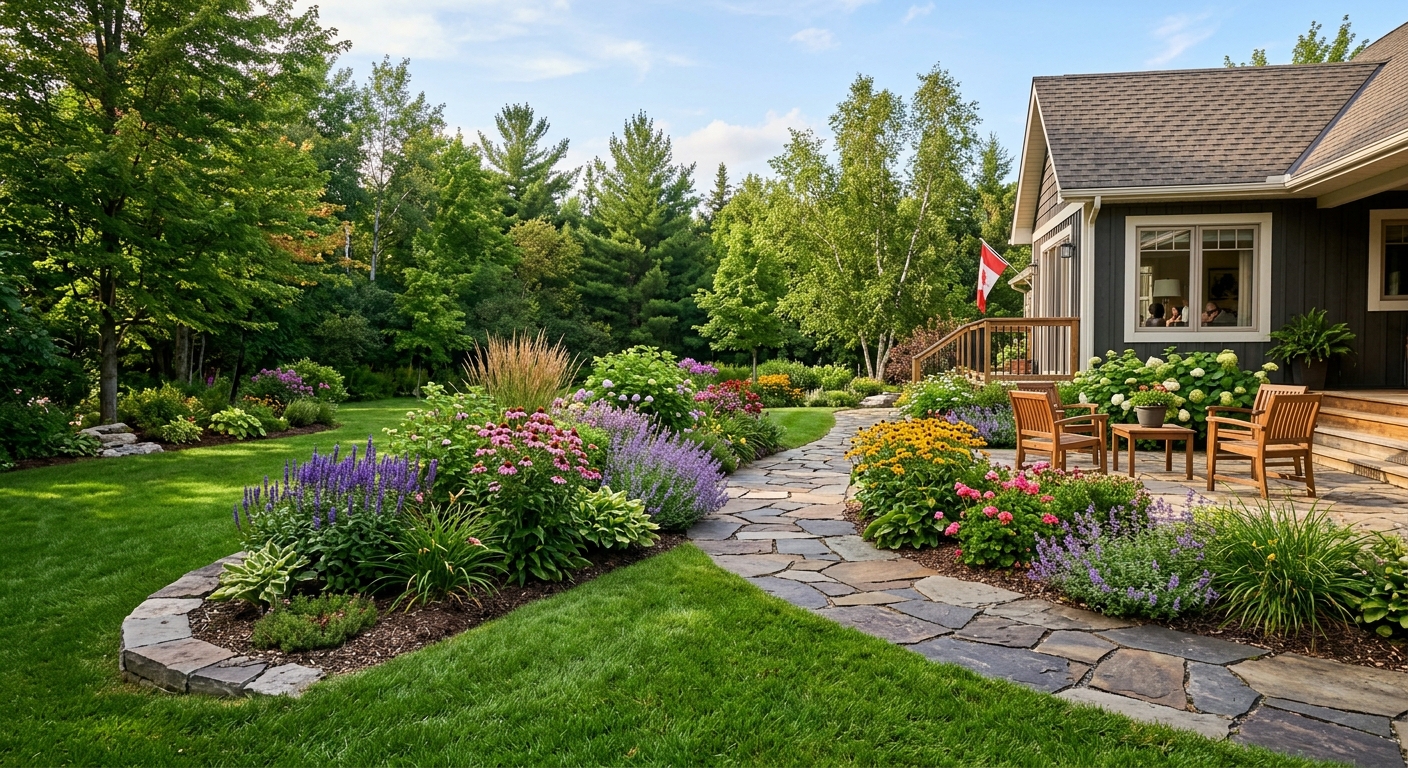
Landscaping options and costs in Evansdale
Evansdale homeowners typically have a clear set of landscaping goals—better curb appeal, firmer ground for patios, and plantings that can handle chinook winds and sharp freeze–thaw cycles. With a population of 5,645 (Statistics Canada, 2021 Census), the community is small enough that reputable crews can get booked quickly in peak weeks, especially around busy streets and back-lot access routes. In Calgary’s broader market, landscape upgrades also tend to reflect how many households are already settled and ready to invest—each detached property often has the yard space that makes full design work feel worthwhile.
In Prairie plant hardiness zones 3–4, landscaping costs are shaped by the shorter working window and the need for deep, well-compacted bases under walkways, patios, and retaining walls. Freeze–thaw heaving is a real risk when excavation depth, drainage, and base compaction are rushed, and that drives material choice and labour intensity. Contractors also price access and grading carefully: if your yard needs slope corrections or new drainage routing, you’re not just “adding features,” you’re building the ground they sit on.
In Evansdale, trades are especially in demand in areas with older housing stock near main streets where lots are being refreshed with new hardscape and low-water planting beds. If you’re comparing quotes, the fastest way to align expectations is to start with option-level ranges, then fine-tune scope. Use the table below as a baseline for what typical projects cost in this tier.
| Service |
Description |
Season |
Price Range |
| Full landscape design and installation |
Site survey, grading plan, hardscape base prep, patio/walks, retaining wall (if needed), planting layout, soil amendment, mulch, and irrigation-ready design |
Late spring to early fall (weather-dependent) |
$10,000–$45,000 |
| Sod installation (supply, grade, lay, roll) |
Minor grading/topsoil tune-up, soil prep, sod supply and placement, rolling, starter watering plan |
Late spring to early fall |
$2,000–$6,000 |
| Lawn seeding (grade, seed, starter fertilizer) |
Raking/aeration (as needed), topdressing/seed bed prep, seeding blend, starter fertiliser, light compaction |
Spring (and sometimes early fall) |
$1,500–$4,000 |
| Interlocking patio or walkway |
Excavation, compacted base layers, edge restraints, interlocking stones, jointing sand |
Mid-spring to early fall |
$8,000–$30,000 |
| Retaining wall (interlocking block) |
Wall layout, excavation and drainage behind wall, compacted base, blocks, caps, geotextile and weeping/drainage options |
Late spring to early fall |
$12,000–$40,000 |
| Tree and shrub planting |
Soil testing/basic assessment, planting plan, labour for bed prep, amendment, planting, mulch rings/beds |
Spring and fall (best survival rates) |
$1,200–$15,000 |
Prices are estimates only and vary by project scope, site access and material selection.
What affects the price of landscaping in Evansdale
In Evansdale and the Calgary region, the same “looks similar” landscaping scope can come in 30–50% apart because the hidden variables—ground conditions, access, drainage requirements, and plant quality—often aren’t visible until excavation starts. Calgary-area contractor pricing also reflects that we’re working in zones 3–4 with frost deeper than most homeowners expect, and that freeze–thaw cycles demand uncompromising base depth and compaction.
Two projects that both include a patio can diverge quickly if one yard needs significant grading corrections to redirect runoff away from foundations. Another major driver is the plant palette: Prairie drought-stress and wind exposure favour cold-hardy, drought-tolerant species, and the price difference shows up when comparing native shrubs versus ornamental varieties or larger, more established stock. If you’re aiming for a low-water look, smart irrigation design and soil improvement often cost more up front but prevent costly rework.
Concrete examples from local sites: (1) a “flat” front yard may still require undercutting and re-building the base for an interlocking walkway—if that extra excavation is 8–12 inches deeper than assumed, the hardscape quote can rise into the mid five-figure range. (2) a small retaining wall can spike in cost when adding proper drainage behind the wall (weeping tile or French drain) and geotextile—this is what keeps the structure from failing during freeze–thaw.
On the turf side, sod work is commonly priced in the $1,500–$6,000 band, while seeding usually targets the lower end of that spectrum. In Calgary’s shorter growing season, sod may be justified when you need instant coverage, but if you can wait, seeding often reduces labour and materials cost without sacrificing long-term results.
| Price Factor |
Why It Matters |
Cost Impact |
| Yard size in sq ft — the primary cost driver for softscape |
More area means more soil prep, mulch, seed/sod, and labour hours |
Typically the biggest line-item swing; can account for 30–60% of total |
| Grading and drainage work — slope corrections add significant cost |
Correct slopes prevent pooling and foundation moisture issues |
Often adds thousands when undercutting and re-contouring are required |
| Drainage bed or French drain installation |
Relieves water pressure and directs runoff away from structures |
Commonly shifts projects upward by $2,000–$8,000 depending on length/depth |
| Plant material tier — native shrubs vs. ornamental vs. mature specimen trees |
Hardiness, size at planting, and transplant survivability affect cost |
Mature stock can raise tree/shrub planting budgets by several thousand |
| Hardscape vs. softscape ratio — walls and patios cost more per sq ft than lawn |
Base prep, compaction, and stone materials drive pricing |
Switching from lawn to stone can move the project into higher five-figure totals |
| Irrigation system design and installation |
Zoned, controller-based watering supports establishment without waste |
Can add meaningful cost; “irrigation-ready” design may be lower than full install |
| Soil amendment and topsoil required |
Existing soil quality impacts drainage, root development, and long-term stability |
May increase costs by hundreds to several thousand depending on volume |
| Tree removal or stump grinding before new planting |
Clearing affects excavation access and prevents future root issues |
Often adds one additional trade line-item, especially on older lots |
Permits & regulations in Alberta
For most Evansdale landscaping, you can start with the assumption that planting, sodding, and typical softscape work generally does not require a permit. That includes laying sod, planting trees and shrubs, building mulch beds, and installing standard garden edging or small patio work. The permit triggers usually show up with structural retaining walls and with any grading changes that impact drainage pathways.
Retaining walls: if you’re building a retaining wall above the common municipal threshold—typically around 1.0 m (3.3 ft)—you should expect a building permit and, in some situations, engineered drawings. Even if you have a landscape contractor, you’re the homeowner who needs to confirm what’s required before work starts.
Grading/drainage: changes to lot grading that alter runoff direction—especially toward a neighbouring property or toward storm sewer connections—can trigger approval requirements. If your plan includes new swales, significant re-sloping, or relocating drainage tie-ins, ask the contractor to outline exactly what permits (if any) they will pull.
Utility locates: call for locates before any digging, whether you’re planting holes or setting wall footings. This is one of the fastest ways to avoid costly delays.
How to verify a contractor in Evansdale: (1) confirm Alberta licensing (where applicable for their trade/activities), (2) request a certificate of insurance showing liability coverage, (3) confirm WSIB/WCB clearance coverage for workers (or the equivalent clearance they provide), and (4) use the insurer/registry documentation to confirm dates are current. Ask for copies before you sign—don’t rely on “we can provide later.”
Planning a landscape that thrives in Evansdale's climate
Planning in Evansdale is about working with the realities of hardiness zones 3–4, not fighting them. Start by selecting plants that handle cold snaps and wind, then design your yard to manage water through freeze–thaw rather than just “looking green.” For plant selection, prioritize native and zone-appropriate species that are naturally adapted to Alberta’s temperature swings and periodic dry stretches. That reduces winter protection needs and keeps maintenance predictable.
For turf, the sod-vs-seed decision usually comes down to speed and risk tolerance. Sod gives instant coverage, but it’s typically 3–4x the cost per sq ft versus seeding because you’re paying for bulk product and installation labour. Seeding is more budget-friendly, and it’s a good fit when you can protect the seed bed through establishment. If you want a quick curb improvement and the site is properly graded, sod in the $1,500–$6,000 range can be worth it; if you’re comfortable with a longer establishment period, lawn seeding can land in the $1,500–$4,000 band.
Drainage and grading are non-negotiable in the Calgary market. We regularly see pooling and foundation moisture issues when the slope isn’t corrected and bases aren’t built with deep, well-compacted layers. For patios, retaining walls, and walkways, base prep depth should be planned for frost heave resistance, with clean drainage layers behind walls or along edges as needed.
Finally, keep maintenance low by building beds around groundcovers, mulch, and perennials instead of high-water, high-weeding turf areas. Xeriscape and rain-garden features—designed as controlled water infiltration areas—can reduce watering demands while still producing a full, landscaped look.
| Element |
Climate Consideration |
Maintenance Level |
Price Band |
| Sod lawn installation |
Needs correct grade and establishment watering; sensitive during late-spring frost variability |
Low-to-moderate during first season, then moderate |
$2,000–$6,000 |
| Native perennial garden |
Cold-hardy structure with better drought tolerance; benefits from mulch and wind-protected placement |
Low after establishment (spring tidy, occasional weeding) |
$1,800–$8,500 |
| Mulched shrub border |
Zone-appropriate shrubs reduce winter burn and wind stress; mulch moderates freeze–thaw at soil surface |
Low (annual pruning and refresh mulch) |
$1,200–$7,000 |
| Interlocking stone patio |
Requires deep, well-compacted base and proper edge restraints to prevent shifting through freeze–thaw |
Low (joint sand refresh, occasional spot leveling) |
$8,000–$30,000 |
| Retaining wall (block) |
Needs drainage behind wall and correct footing depth; prevents water pressure build-up in winter cycles |
Low (periodic inspection) |
$12,000–$40,000 |
| Drip irrigation system |
Zoned, efficient watering supports drought-tolerant planting during short summer windows |
Low (seasonal tuning, controller checks) |
$2,000–$10,000 |
How to choose a landscaping contractor in Evansdale
Choosing the right contractor matters more in Alberta than many people expect, because base prep quality and planting survivability are tied directly to workmanship. Start by verifying insurance and coverage. Ask for a certificate of liability insurance (it should clearly show active coverage and the contractor’s legal name). For worker coverage, request confirmation of WSIB/WCB coverage and clearance—contractors should be able to provide a current clearance letter or proof for their workers on request.
Next, get 2–3 itemised written quotes. You want a labour + materials breakdown, not just a lump sum. A good quote shows quantities (sq ft of sod or seeding area, patio square footage, retaining wall length, excavation amounts, drainage components, number/size of plants, and soil/topsoil volumes). Make sure it spells out what’s excluded: permit pulling, disposal, rock removal, tree stump grinding, additional excavation for poor soil, and irrigation servicing if you already have lines.
Warranty should be specific. Confirm the workmanship warranty length (for example, how long they stand behind base settlement, edging alignment, and planting establishment expectations) and whether plant warranties are manufacturer-based. If warranties are transferable to future owners, ask—some manufacturers only cover the original purchaser.
For payment scheduling, avoid paying more than 10–15% upfront. Hold back part of the payment until completion and final walkthrough. Finally, get the timeline in writing: a start date target, weather-dependent milestones, and an estimated completion date. With Evansdale’s freeze–thaw cycles, crews should also explain how they handle pauses in cold snaps.
- Provide insurance certificate (liability) with valid dates
- Provide WSIB/WCB clearance letter (or equivalent) for workers
- Show Alberta licensing/registration where applicable to their scope
- Submit an itemised quote: quantities, unit prices, and labour lines
- Clarify whether disposal, hauling, and dump fees are included
- Confirm whether utilities locates are requested before digging
- Ask who supplies soil/topsoil and what type (and how it’s amended)
- For hardscape, specify base layers and compaction method
- For retaining walls, confirm drainage components behind the wall
- Verify warranty terms for workmanship and materials separately
- Agree on milestones and a holdback amount until final walkthrough
- Get a written start date, weather pauses plan, and completion estimate
Red flags to watch for: (1) quotes that don’t specify base prep depth and drainage details for patios/walkways, (2) contractors who won’t provide insurance/WSIB/WCB proof, (3) “verbal-only” scopes with no written exclusions (especially around grading and disposal), (4) pushing for large upfront payments beyond 10–15%, and (5) promising sod/planting without acknowledging Evansdale’s short weather windows and frost risk.
Frequently asked questions — landscaping in Evansdale
Sod vs seed — which is better for a Evansdale lawn?
In Evansdale, sod is usually the better choice when you need fast, uniform coverage and you want to reduce the “bare soil” look during the season. However, it’s more expensive: many typical installs land around $2,000–$6,000 depending on how much grading is required. Seed is typically cheaper in the $1,500–$4,000 band and works well if you can protect the seed bed through establishment. Because Evansdale sits in Calgary’s prairie zone 3–4 climate, freeze–thaw and late-spring frosts can delay germination and increase patchiness if the site isn’t prepped well. If your lawn area is uneven or drainage is poor, fixing grade and compaction first matters more than whether you choose sod or seed.
How much does a retaining wall cost in Evansdale?
Retaining walls in Evansdale commonly fall into the $12,000–$40,000 range for interlocking block installations, but the final price depends heavily on wall length, height, excavation depth, and the drainage build-out behind the wall. The Alberta freeze–thaw cycle means contractors shouldn’t cut corners on footing depth and base compaction; a wall without proper drainage can fail sooner as water pressure builds in winter. Costs also rise when the site needs significant grading changes or when access is tight for hauling materials. If a permit is required (often when walls are above roughly 1.0 m (3.3 ft)), that can add time and documentation costs as well. A good contractor will explain both the wall build and the “why” behind the drainage layers.
When is the best time to landscape in Evansdale?
For most landscaping in Evansdale, late spring through early fall is the prime window for hardscape and turf work, because temperatures support base compaction and installation schedules. Sod and seeding are best when the soil is warming and frost risk is lower, while trees and shrubs generally do well in spring and fall when plants can focus energy on roots instead of peak summer growth. That said, Calgary’s chinooks and sudden cold snaps can shorten workable days, so reputable crews build weather contingencies into the schedule. If you’re planning a retaining wall or patio, aim for a timeframe when excavation and compaction can be completed without repeated freeze interruptions. Ask your contractor to put weather-dependent milestones in writing so you’re not surprised by delays.
Do I need a permit for a retaining wall in Alberta?
Often, yes—depending on the wall height and how the work affects the site. In many Alberta municipalities, retaining walls above about 1.0 m (3.3 ft) typically require a building permit, and sometimes engineered drawings are needed. Also consider grading and drainage: if your retaining wall project includes changes to lot drainage patterns that affect neighbouring properties or storm connections, additional approvals may be required. The safest approach for homeowners in Evansdale is to confirm permit requirements with your contractor before excavation. A qualified landscaper will usually ask for the permit needs early, because starting excavation without approval can lead to stop-work orders and rework. If your quote doesn’t clearly state who pulls permits (if required), ask directly.
How do I improve drainage in my yard?
Good drainage starts with correcting grading and then giving water a safe path away from foundations. In Evansdale, pooling after rain or spring melt often comes from compacted soils, low spots, or slopes that drift toward the house. Contractors typically improve drainage with a combination of re-sloping (grading), drainage beds, and sometimes a French drain system tied to an appropriate outlet. For freeze–thaw resilience, drainage layers must be built with proper materials and compaction so they don’t shift over time. If you also have a retaining wall, drainage behind the wall is essential to prevent water pressure build-up during winter cycles. Ask for a plan that explains where water goes, not just what gets added.
What is xeriscaping and does it suit Evansdale?
Xeriscaping is a landscape design approach that reduces water use by using drought-tolerant plants, mulching, and efficient irrigation strategies (often drip and zoned controllers). In Evansdale and the Calgary area, it typically suits homeowners well because the climate can be semi-arid with periodic restrictions and because zones 3–4 favour plants that can handle temperature swings and wind stress. A xeriscape doesn’t mean “no colour” or “just rocks”—it’s about layering hardy perennials, native shrubs, and groundcovers with thoughtful mulch and soil improvement. If you’re comparing budgets, switching from a high-water lawn to a planted bed can help lower ongoing watering costs, and a smart irrigation design can be a better long-term investment than repeatedly reseeding stressed grass. Many projects still include turf in small, functional areas rather than eliminating it entirely.