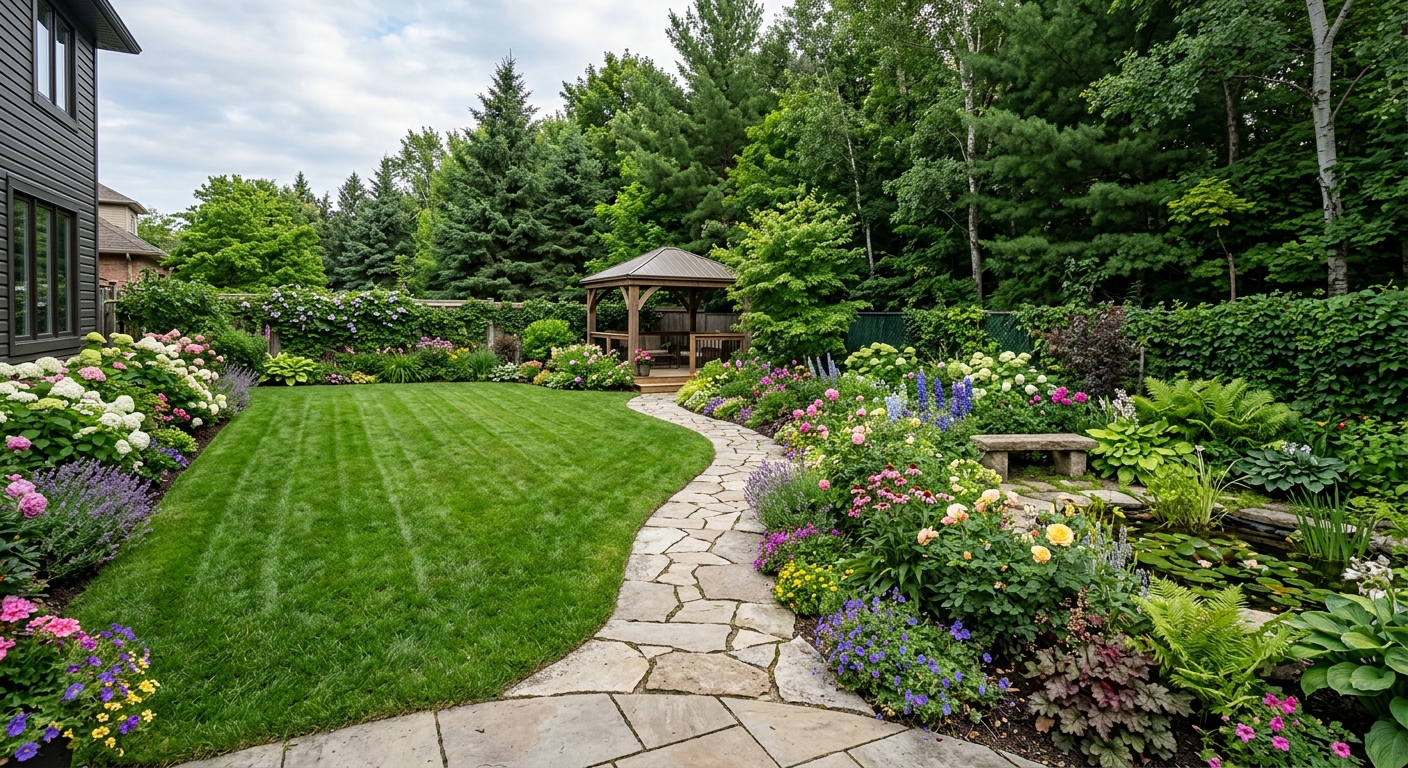
Landscaping options and costs in Highlands
In Highlands, Alberta, landscaping is one of the most valuable improvements you can make because many homes sit on typical detached lots where homeowners are already incentivized to invest in curb appeal and outdoor living. With a total population of 2,604 in the area (Statistics Canada, 2021 Census), contractor availability is competitive but still seasonal—so booking early matters if you want grading, hardscape, and planting timed to the short Prairie work window.
Calgary’s hardiness zones 3–4 and freeze–thaw severity directly affect both design and price. Retaining walls, patios, and walkways rely on deep, well-compacted bases and drainage so they don’t heave or fail when winter expands saturated soils. In a market where comprehensive projects across the Calgary region commonly land in the mid five-figure range once grading, hardscape, planting, and irrigation are included, the cost swings usually come from what’s under the surface: excavation depth, soil correction, and the complexity of drainage.
Trade demand tends to spike in neighbourhood clusters like Harvest Hills and surrounding communities where homeowners refresh older yards before entertaining season—especially for interlocking patios, drainage upgrades, and hardy shrub/tree installation. If your goal is a complete makeover, you’ll typically compare a full design-and-install approach against building block options like sod or a retaining wall. Use the table below to set realistic budget expectations for Highlands projects.
| Service |
Description |
Season |
Price Range |
| Full landscape design and installation |
Site assessment, concept-to-install design, grading/drainage planning, hardscape build, planting, and irrigation (as needed) |
Late spring to early fall (with pre-season base prep) |
$12,000–$35,000 |
| Sod installation (supply, grade, lay, roll) |
Light grading, base prep, sod delivery and placement, rolling, start-up watering plan |
May to August |
$2,500–$6,000 |
| Lawn seeding (grade, seed, starter fertilizer) |
Grading touch-ups, seed blend selection for Prairie conditions, starter fertiliser, initial care |
Spring or early fall |
$1,500–$3,500 |
| Interlocking patio or walkway |
Excavate, base compaction, edge restraints, jointing sand, lay pattern, final compaction |
Late spring to early fall |
$8,000–$22,000 |
| Retaining wall (interlocking block) |
Excavation, geotextile/base prep, drainage gravel, weeping provisions, block installation and cap |
May to September |
$12,000–$32,000 |
| Tree and shrub planting |
Soil amendment, hole excavation, planting, staking (if required), and 1–2 seasonal establishment visits |
Spring or fall |
$2,000–$10,000 |
Prices are estimates only and vary by project scope, site access and material selection.
What affects the price of landscaping in Highlands
In Highlands and across the Calgary economic region, it’s common to see quotes for the “same” landscaping job vary by 30–50% because Prairie yards behave differently than they look. Contractors price the hard parts—excavation volume, base depth, drainage complexity, and how long it takes to get soils and compaction right for freeze–thaw cycles. Two crews can quote the same patio or wall, but one may include proper drainage bedding and deeper base preparation while the other prices a faster build. Labour typically represents 40–60% of a full project in Calgary-area builds, so schedule, equipment time, and crew size also move the needle.
Zone 3–4 conditions mean short growing seasons and late frosts, so plant options must be cold-hardy and wind-tolerant rather than lush, broadleaf varieties. For retaining work, the base has to reach below frost-affected soils; underbuilt footings and inadequate drainage are a common cause of failure, which is why contractors protect themselves with correct excavation and granular drainage. If you compare to coastal BC (Zone 7–8), the long season supports broader palettes, but heavy rainfall still makes drainage non-negotiable—while Calgary’s semi-arid climate still pushes efficient irrigation design and soil improvement over high-water turf.
In Highlands, cost can rise when (1) your yard has a steeper slope that needs grading and re-contouring, (2) the existing lawn is failing because of compaction and requires soil amendment before sod, or (3) you have a mature tree removal/stump grinding step before planting. On the flip side, pricing lowers when the footprint is clear, the base is shallow, and you’re working with straightforward drainage.
| Price Factor |
Why It Matters |
Cost Impact |
| Yard size in sq ft — the primary cost driver for softscape |
More area means more grading, topsoil, seed/sod, and establishment care |
$500–$8,000 |
| Grading and drainage work — slope corrections add significant cost |
Proper fall keeps water away from foundations and prevents pooling in freeze–thaw |
$1,500–$10,000 |
| Drainage bed or French drain installation |
Relieves saturated soils and reduces heaving risk near walls and patios |
$2,000–$12,000 |
| Plant material tier — native shrubs vs. ornamental vs. mature specimen trees |
Mature specimens cost more to source, move, and establish in colder climates |
$800–$9,000 |
| Hardscape vs. softscape ratio — walls and patios cost more per sq ft than lawn |
Hardscape includes excavation, base, restraints, and stone/block installation labour |
$3,000–$25,000 |
| Irrigation system design and installation |
Zoned, controller-based irrigation improves establishment while respecting usage limits |
$1,200–$7,500 |
| Soil amendment and topsoil required |
Prairie yards often need compost, aeration, and corrected texture for root establishment |
$600–$6,000 |
| Tree removal or stump grinding before new planting |
Disposal, grinding depth, and root management affect timeline and labour |
$500–$6,500 |
Permits & regulations in Alberta
In Alberta, most planting, sodding, and routine softscape work typically does not require a permit. That includes seeding, shrub and tree planting, mulch and groundcover installation, and standard lawn work where you’re not materially altering drainage patterns. Retaining walls are the main exception: if a retaining wall is above the local threshold—commonly 1.0 m (3.3 ft) in many municipalities—it generally requires a building permit and may need engineered drawings depending on height, soil conditions, and design.
Grading matters too. If you’re changing lot grading in a way that affects where stormwater goes—such as redirecting water toward a neighbouring property or altering flow to a storm sewer—approvals may be required. Before digging for any planting holes, drainage beds, or wall footings, you should arrange utility locates (e.g., through Alberta One-Call/utility locating services) so crews know where services run.
For Highlands homeowners verifying a contractor, check the steps in order: (1) licensing/eligibility using the appropriate Alberta business information registry or trade listing the contractor holds (as applicable), (2) liability insurance certificate of insurance showing adequate coverage for landscaping operations, and (3) WSIB/WCB clearance—request a clearance letter directly from the contractor or obtain the current status from the insurer/coverage provider documentation they supply. Ask for it in writing before work starts so you’re protected if the project hits unexpected subsoil or underground-service issues.
Planning a landscape that thrives in Highlands's climate
Designing for Highlands means respecting Alberta’s Prairie plant hardiness zones 3–4, where late spring frosts and early cold snaps can damage tender growth and where freeze–thaw cycles punish sloppy drainage. Start with plant selection: choose native and zone-appropriate shrubs, grasses, and perennials that tolerate winter cold and wind. Use winter structure (conifers, hardy broadleaves) plus deep-rooted perennials to reduce watering demands and improve survival. Next decide on sod versus seed. Sod gives instant visual results and erosion control, but it’s typically 3–4x more costly per square foot than seeding because you’re paying for turf harvest and delivery.
Drainage and grading are where Calgary homeowners win or lose. Prevent pooling with correct slope away from foundations, and ensure any wall/patio bases include deep, well-compacted aggregates. For hardscape, plan base preparation for freeze conditions: more depth and tighter compaction reduce heave risk. Finally, go low-maintenance without losing curb appeal: groundcovers, mulched borders, and layered perennials keep weeds down and reduce annual upkeep.
To make the cost difference tangible: if a 1,000 sq ft lawn refresh is quoted at about $2,500–$6,000 for sod, seeding plus starter fertiliser often comes in nearer $1,500–$3,500 depending on grading needs. The higher sod cost is justified when you need fast coverage (erosion control, pets, or immediate presentation) and when drainage is already correct. If you can wait through establishment, seeding often delivers better value for Highlands budgets.
| Element |
Climate Consideration |
Maintenance Level |
Price Band |
| Sod lawn installation |
Needs strong establishment during warm months; drainage affects survival through freeze–thaw |
Medium (water management for establishment, first cuts) |
$2,500–$6,000 |
| Native perennial garden |
Zone-appropriate species handle cold snaps and windy winters with less watering |
Low to medium (spring tidy, occasional weeding) |
$3,000–$10,000 |
| Mulched shrub border |
Mulch moderates soil temperature and helps reduce winter heave risk in planted areas |
Low (top up mulch, prune as needed) |
$2,500–$8,500 |
| Interlocking stone patio |
Requires deep base compaction and proper drainage slopes to prevent movement |
Low (periodic joint sand, occasional powerwash) |
$8,000–$22,000 |
| Retaining wall (block) |
Base depth and drainage gravel are critical for frost-related movement |
Low (annual inspection of drainage outlet and weep points) |
$12,000–$32,000 |
| Drip irrigation system |
Zoned watering supports drought-tolerant planting and reduces overwatering in restrictions |
Low to medium (seasonal controller checks, winterisation) |
$1,200–$7,500 |
How to choose a landscaping contractor in Highlands
Choosing the right contractor in Highlands starts with verification. In Alberta, ask for (1) liability insurance certificate of insurance naming you as an additional insured if possible, (2) WSIB/WCB coverage status—request a clearance letter or proof of active coverage for the work crew—and (3) confirmation of any required business licensing/eligibility for the scope you’re hiring (especially for structural hardscape like retaining walls that may need permits). A reputable outfit won’t hesitate to provide documents before mobilization.
Next, get 2–3 itemised written quotes, not lump sums. You want a breakdown that separates labour versus materials (stone/block, sod/seed, soil amendment, drainage gravel/pipe, geotextile) and clarifies line items like disposal and protection of existing structures. Read exclusions carefully: Is permit pulling included where required? Is stump grinding included? Are excavation and haul costs priced? For warranty, confirm workmanship warranty length and what’s covered if settlement or movement occurs—plus manufacturer/product warranty terms and whether it’s transferable to you.
On payment schedule, keep deposits conservative: never pay more than 10–15% upfront, and hold back a portion until cleanup and final inspection are complete. Finally, insist on a written timeline with a start date and completion estimate. In Calgary-area conditions, weather can shift installation windows, but communication should be clear and scheduled around freeze–thaw and soil readiness.
- Ask for a certificate of insurance and confirm active WSIB/WCB coverage (clearance letter preferred).
- Request itemised quoting: labour, equipment, materials, drainage components, and disposal/haul.
- Clarify what’s included in grading: final slopes away from the house and foundation.
- Confirm base depth and compaction approach for patios/walkways and retaining walls.
- Ensure drainage details are described (weep systems, gravel bedding, French drains if needed).
- Ask about utility locates and how the crew protects existing services.
- Verify permit responsibility for retaining walls above the local threshold (typically around 1.0 m).
- Get a planting list with scientific names or a defined plant palette suited to Zone 3–4.
- Confirm topsoil/soil amendment type and thickness, not just “add soil.”
- Require a warranty document for workmanship and specify coverage duration.
- Discuss watering/establishment plan after installation, including controller settings or winterisation.
- Set an agreed payment schedule with a holdback until punch list items are complete.
Red flags in Highlands include: quotes that skip drainage/base detail while promising “no heaving,” no insurance/WSIB/WCB proof provided after you ask, unclear disposal responsibilities, pressure for large upfront payments, and a contract that won’t specify workmanship warranty terms and an itemised scope.
Frequently asked questions — landscaping in Highlands
How deep should a retaining-wall base be for local frost?
For retaining walls in Highlands, the base has to sit below frost-affected soils and be built on properly compacted granular material. Practically, that usually means a deeper excavation and engineered-style drainage approach than homeowners expect—especially where soils stay saturated in spring melt. While exact depth can vary based on wall height, soil type, and drainage design, reputable contractors will explain the compaction plan and the granular base/drainage layers (geotextile, drainage gravel, and weep outlets where required) rather than using a one-size estimate. Because freeze–thaw cycles in Calgary-area Prairie zones can heave under poorly prepared bases, costs often rise for proper excavation and French-drain add-ons. If your wall is a permit-triggering height (commonly around 1.0 m in many municipalities), make sure the contractor’s design and documentation align with the required approval pathway.
How much does professional landscape design cost?
In Highlands, design pricing is often bundled into a full design-and-install proposal, but standalone design can still be quoted separately depending on scope. The simplest way to compare is to look at whether the design fee is credited toward installation, and whether the quote includes grading/drainage concepts, planting plan, and an irrigation layout when needed. For budgeting, many comprehensive projects in the Calgary region land in the mid five-figure range once hardscape, planting, and irrigation are included, and base prep drives that total. If your project is closer to softscape only, you may see more modest investment. As a reference point for homeowners doing just portions: sod installations often run about $2,500–$6,000 while full design-and-install can land around $12,000–$35,000 depending on how much hardscape and drainage is involved.
How do I compare landscaping quotes?
Start by comparing apples to apples: every quote should list the same scope. For example, one contractor may price “sod” but exclude grading, soil amendment, and disposal; another may include proper base prep and drainage work that prevents future settlement. Ask for itemised breakdowns—labour, materials (stone/block, sod/seed, topsoil/amendment), drainage gravel/pipe, and irrigation components if included. Confirm whether permits are included where required (retaining walls at or above the local threshold, often around 1.0 m). Also compare warranty terms: workmanship coverage length and what happens if movement occurs. Finally, verify contractor documentation—liability insurance and WSIB/WCB coverage for the crews in Alberta. If two quotes differ by 30–50%, the difference is usually buried in drainage/base prep, not just “pricing strategy,” which is why line-item transparency matters most in Highlands.
How long does a landscaping project take in Highlands?
Timelines in Highlands depend heavily on weather readiness, excavation volume, and whether you’re building hardscape with deep bases and drainage. Most softscape-only work (like seeding or planting) can be turned around in days once soils are workable. Sod and irrigation installations usually require tight scheduling so turf establishment starts promptly after lay. Hardscape projects like patios or retaining walls typically take longer because excavation, base compaction, and curing/set times must be done correctly to survive Calgary’s freeze–thaw cycles. A complete design-and-install with grading, drainage, patio, and planting often spans multiple weeks due to ordering materials and completing steps in sequence. If you’re seeing a very aggressive schedule from a contractor without discussing base preparation depth and drainage layers, ask for their step-by-step plan in writing.
What is the best grass type for a Highlands lawn?
For Highlands and the broader Calgary area in Alberta’s Prairie zones 3–4, homeowners generally do best with cold-tolerant, drought-aware turfgrass blends designed for Northern climates. In practical terms, contractors often recommend a mix that prioritizes durable performance through winter and rebound in spring, since long dry spells plus late frost can stress lawns. The “best” choice still depends on your sun exposure, soil quality, and drainage—if the site stays wet, seed blends and sod types won’t perform well without correcting grading. If you’re choosing between seeding and sod, sod can mask site issues temporarily, but it doesn’t replace drainage correction. For budgeting, sod projects are often around $2,500–$6,000, while seeding is frequently nearer $1,500–$3,500 when grading touch-ups are included.
When should I aerate and overseed my lawn in Highlands?
In Highlands, the best window for aeration and overseeding is usually during periods when the ground is workable and temperatures support germination—typically spring after frost has passed and/or early fall when the lawn can establish before cold snaps. Aeration helps relieve compaction and improves seed-to-soil contact, which is critical on Prairie lawns that can crust or compact under freeze–thaw movement. If you’ve got drainage issues, address grading so water doesn’t pool; otherwise, overseeding can fail even with the right seed blend. After overseeding, keep watering consistent for establishment using a smart approach (zoning and controlled cycles) rather than daily heavy watering. A contractor can also recommend a schedule based on your turf type and last season’s performance. If your yard has persistent bare patches or standing water, fix drainage first, then seed—otherwise you’ll pay twice for results you can’t maintain.