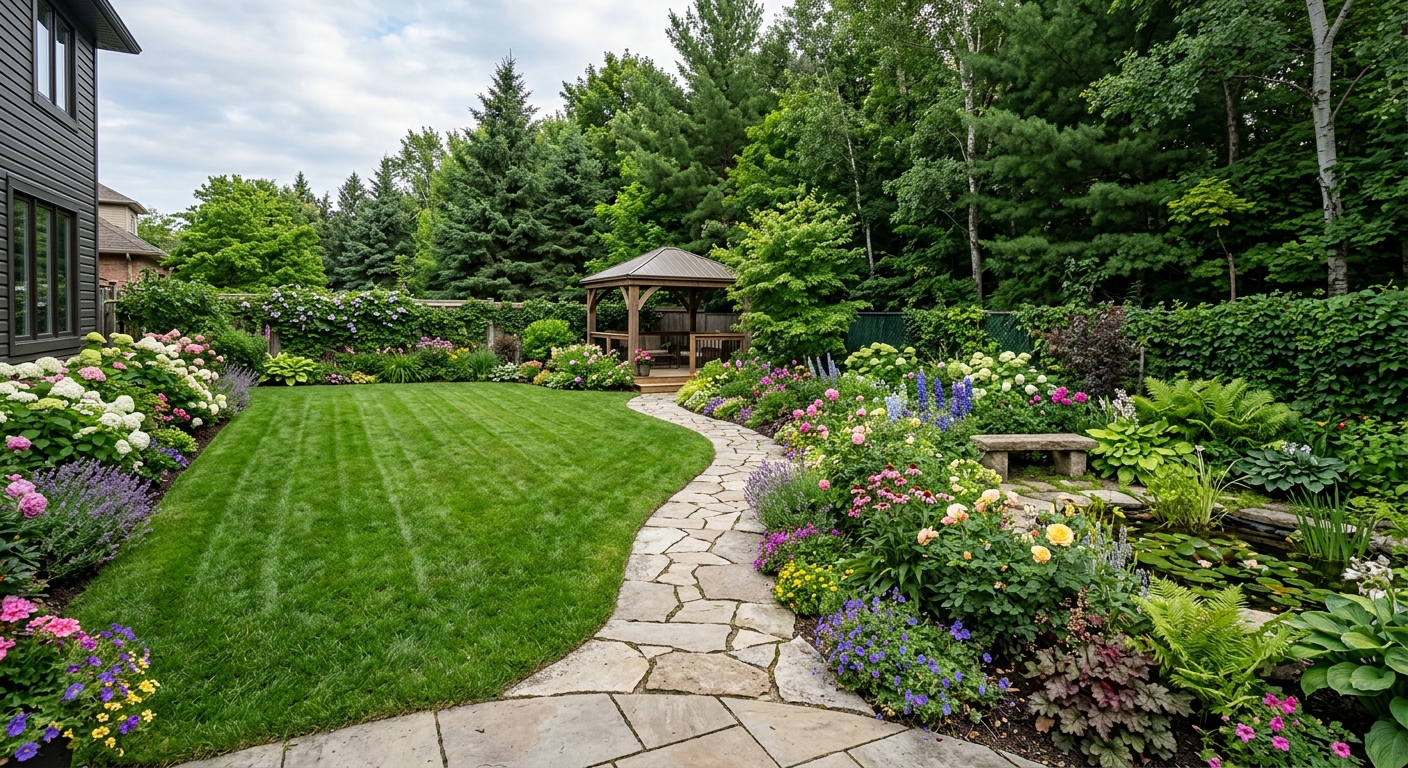
Landscaping options and costs in Black Diamond
Landscaping in Black Diamond usually comes down to how much yard you want to transform, and how much base prep and drainage work is required. With Black Diamond’s housing stock skewing toward single-detached homes (72.0% of dwellings) and a strong owner-occupant base (83.4% of households own), many homeowners do invest in “usable yard” upgrades rather than purely decorative changes. Median household income is $75,500 (Statistics Canada, 2021 Census), so most projects are designed to balance curb appeal with smart, long-life materials that handle southern Alberta’s freeze–thaw cycles.
Calgary-area conditions—Prairie hardiness zones 3–4, late-spring frosts, and early fall cold snaps—affect both what plants survive and how long crews can work. Severe freeze–thaw also drives up the importance (and cost) of deep, well-compacted bases under patios, walkways, and retaining wall footings; without that, you see heaving, settling, and premature failures. In addition, labour availability fluctuates in peak season (roughly May through September), and that can widen bids for “full scope” projects that include grading, hardscape, planting, and irrigation.
In Black Diamond, upgrades are especially in demand around areas with active family neighbourhoods close to schools and parks, where homeowners want safer walkways, better drainage, and wind-protected planting beds for curb appeal. From there, the most helpful next step is comparing typical service ranges by scope, which you’ll see in the table below.
| Service |
Description |
Season |
Price Range |
| Full landscape design and installation |
Site visit, layout, grading/drainage plan (if needed), hardscape, planting plan, supply and install |
May–September |
$5,000–$50,000 |
| Sod installation (supply, grade, lay, roll) |
Minor grading, soil prep, sod supply, layout, rolling, initial watering guidance |
Late April–June (and early fall where feasible) |
$1,500–$6,000 |
| Lawn seeding (grade, seed, starter fertilizer) |
Light grading, seed blend, starter fertilizer, raking, initial watering plan |
May–July (and early fall) |
$1,000–$4,000 |
| Interlocking patio or walkway |
Excavation, compacted base, edging, interlocking stone, final leveling and clean-up |
May–September |
$8,000–$40,000 |
| Retaining wall (interlocking block) |
Footing/base prep, drainage gravel and weeping tile (when required), block install, backfill |
May–September |
$10,000–$35,000 |
| Tree and shrub planting |
Soil amendment, planting, staking (if required), mulch rings/beds, first watering setup |
May–June and September (best survival) |
$800–$15,000 |
Prices are estimates only and vary by project scope, site access and material selection.
What affects the price of landscaping in Black Diamond
In Calgary and surrounding communities, two homeowners can get quotes for “the same” landscaping idea and still see a 30–50% difference. That’s usually because the underlying work is different: one yard needs deeper base prep and drainage corrections, while the other is relatively flat with already-healthy soil and easy access. In southern Alberta (zones 3–4), the freeze–thaw cycle forces contractors to overbuild the foundation layers for hardscape, and that labour and equipment time drives a meaningful portion of the budget.
Plant availability and survival requirements also shape costs. A short growing season means we often use cold-hardy, wind-tolerant species and plan for winter structure rather than relying on lush summer growth. Retaining wall base depth matters because the system must sit below frost influence; that requirement increases excavation, aggregate, and compaction time. By contrast, in climates like coastal BC (zone 7–8), longer growing seasons let crews work with broader planting palettes; however, heavy rainfall areas there still require strong drainage design. In the driest parts of the interior, irrigation design becomes more prominent due to watering constraints, pushing budgets toward smart controllers and zoned drip systems; in Black Diamond, you’ll still see that “efficiency-first” approach because Calgary’s semi-arid conditions and occasional watering restrictions reward soil improvement and targeted irrigation rather than high-water turf.
Concrete examples: (1) If your backyard slopes toward the house or toward a storm run-off point, grading and drainage add cost quickly—especially when the downspout and foundation moisture risks must be corrected. (2) If you want interlocking patio expansion plus new steps, the base prep and removal of existing materials can push a project from the lower end toward the higher end of the retaining wall & hardscaping band. (3) If your yard has mature trees to remove, stump grinding can add labour before you can start planting; that’s often why a tree & garden planting quote near $800–$15,000 can grow once removals and soil rehab are included.
| Price Factor |
Why It Matters |
Cost Impact |
| Yard size in sq ft — the primary cost driver for softscape |
More area means more labour hours and more materials (seed, sod, topsoil, mulch) |
High |
| Grading and drainage work — slope corrections add significant cost |
Fixing pooling or redirecting water away from foundations reduces future settlement and heaving |
Medium to High |
| Drainage bed or French drain installation |
Freeze–thaw failures often start with trapped water; proper drainage protects hardscape and soils |
Medium to High |
| Plant material tier — native shrubs vs. ornamental vs. mature specimen trees |
Specimens cost more and require careful handling, staking, and wider planting pits |
Medium |
| Hardscape vs. softscape ratio — walls and patios cost more per sq ft than lawn |
Stone, excavation depth, and base materials increase cost beyond turf |
High |
| Irrigation system design and installation |
Zoned coverage, freeze protection, and efficient layouts reduce water use but add components and labour |
Medium to High |
| Soil amendment and topsoil required |
In clay or compacted soils, amendment improves rooting; in some yards it’s essential for success |
Medium |
| Tree removal or stump grinding before new planting |
Clearing access and preparing planting beds adds equipment time |
Medium |
Permits & regulations in Alberta
In Alberta, most planting and surface softscape work—sodding, seeding, mulching, and general landscaping—typically does not require a permit. Your usual “no permit” scope includes planting trees and shrubs, installing garden borders, laying sod, and building small garden features that don’t change structural drainage to neighbouring lots. However, retaining walls above the common threshold of about 1.0 m (3.3 ft) in many municipalities often require a building permit, and in some cases engineered drawings are needed depending on height, soil conditions, and design. Also, if you plan grading changes that affect how water drains toward a neighbouring property or connections to storm infrastructure, approval requirements can come into play.
Before anyone digs, have utility locates done. That matters because a planting hole, stump grinding, or a wall footing can intersect buried lines. For watering rules, check Alberta and local bylaws during drought conditions; even where restrictions are temporary, contractors commonly design efficient irrigation and recommend zoned coverage and soil improvement to reduce water demand.
How to verify your contractor in Black Diamond step-by-step: (1) confirm they are legitimately licensed/registered where applicable via the provincial business/licensing registry and their business profile; (2) request a certificate of insurance—verify liability coverage and ask that your name/address appear as additional insured if the quote references it; (3) confirm WSIB/WCB coverage status by requesting a clearance letter or equivalent proof of workers’ compensation coverage; (4) insist on a written scope and start date in the contract so schedule and exclusions can’t shift after work begins.
Planning a landscape that thrives in Black Diamond's climate
To plan a landscape that thrives in Black Diamond, work with Prairie hardiness zones 3–4 and the realities of freeze–thaw cycles—don’t fight them with “pretty but fragile” choices. Start with plant selection: aim for native and proven zone-appropriate species that tolerate cold snaps and wind, and that can handle Calgary’s shorter growing season without constant replanting. For lawn areas, choose between sod and seed based on how quickly you need results and how much you can commit to watering and establishment. In Calgary markets, sod gives instant curb appeal but costs about 3–4 times more per sq ft than seeding because of supply and handling intensity. Seeding costs less, but you need patience through germination and early summer growth.
Drainage and grading are non-negotiable. Pooling against foundations can lead to moisture problems and frost damage over time. That’s why “base prep” is treated like a system: for patios, walkways, and retaining wall projects, contractors build a deep, well-compacted base and ensure water has a proper path. Low-maintenance design helps you avoid recurring labour: mulch rings, groundcovers, perennials with strong structure, and repeating bed layouts reduce annual upkeep while still looking intentional.
For water-wise options, consider xeriscape strategies—select drought-tolerant plants, increase soil organic matter, and use targeted irrigation with zoned drip rather than broad spray. Where your yard dips or collects water, a rain-garden can combine aesthetics with function, reducing runoff stress on hardscape.
Dollar example: if you’re replacing a small lawn area and the sod quote lands in the $1,500–$6,000 band, switching to seeding (often $1,000–$4,000 depending on area) may be justified if you can wait a season for full density. But if you need immediate access around a patio or you’re fixing a high-visibility front lawn for sale readiness, sod can be worth the premium—provided drainage is corrected first.
| Element |
Climate Consideration |
Maintenance Level |
Price Band |
| Sod lawn installation |
Needs good base and timely establishment before cold snaps; less forgiving if drainage is poor |
Medium (watering during establishment) |
$1,500–$6,000 |
| Native perennial garden |
Zone-appropriate plants winter better and handle wind; shorter season still supports structure |
Low to Medium |
$2,500–$12,000 |
| Mulched shrub border |
Mulch buffers temperature swings; shrubs handle cold and reduce bare-soil heave risk |
Low |
$800–$7,500 |
| Interlocking stone patio |
Freeze–thaw requires deep, compacted base and proper slope for shedding water |
Low |
$8,000–$25,000 |
| Retaining wall (block) |
Footing and drainage gravel must be built for frost influence to prevent bowing or settling |
Low |
$10,000–$35,000 |
| Drip irrigation system |
Targeted watering supports drought-tolerant planting and efficient use; design for seasonal freeze |
Medium (seasonal checks) |
$3,000–$12,000 |
How to choose a landscaping contractor in Black Diamond
Choosing the right contractor in Black Diamond is mainly about verifying proof and clarity. First, confirm Alberta compliance: ask for their certificate of insurance (liability coverage; ensure it’s current) and request confirmation of workers’ compensation coverage—WSIB/WCB clearance letter or equivalent proof—before any work starts. For licensing/registration, use the provincial business/licensing registry and cross-check the company name against the quote and contract. Don’t rely on a social handle or “we did work nearby.” The right contractor should also provide an itemised scope and a schedule you can track.
Get 2–3 written quotes that break down labour and materials, not just a lump sum. Make sure you understand what’s included: permit pulls (if applicable for a retaining wall), excavation depth, base materials for patios/walkways, drainage gravel/French drain components, and disposal/haul-away. If stump grinding or tree removal is needed before planting, it should be listed separately so the price doesn’t “mysteriously” change.
Warranty matters: ask for (1) a workmanship warranty length (how long for settlement/heaving issues), (2) product/manufacturer warranties (blocks, pavers, sod/seed products where applicable), and (3) whether warranties are transferable if you sell your home. For payment, keep it controlled—never pay more than 10–15% upfront, and hold back a portion until completion and final walkthrough. Finally, request start date and a realistic completion estimate in writing, because weather windows in zones 3–4 can shift timelines even with a good crew.
- Provide proof of liability insurance and workers’ compensation clearance before work begins.
- Use itemised quotes: excavation/base, materials, planting quantities, and irrigation parts listed separately.
- Confirm disposal is included (topsoil/rock/green waste/haul-away).
- Ask for base specifications for hardscape (compaction, drainage, and leveling layers).
- Clarify irrigation coverage and whether winterisation/freezing protection is included.
- Verify retention wall requirements for permit/engineering if height approaches the common threshold (around 1.0 m).
- Request a written start date, weather contingencies, and completion target.
- Ask who will be on site day-to-day and who coordinates locates and subsurface checks.
- Confirm staking/anchoring for trees and warranty process if a plant fails early.
- Review warranty coverage for settlement, heaving, and drainage performance.
- Keep payments staged: small deposit, then progress payments, final payment after walkthrough.
- Get everything in the contract: materials grade, colour/size specs, and any exclusions.
Red flags to watch in Black Diamond: contractors who won’t show insurance/clearance documents; quotes that lump “hardscape” without base prep specs; vague timelines with no start/completion date; asking for a large upfront deposit (beyond 10–15%); and promising fast “sodding anytime” without discussing drainage, frost windows, and establishment watering.
Frequently asked questions — landscaping in Black Diamond
How much does landscaping cost in Black Diamond?
In Black Diamond, landscaping costs typically run from a few thousand dollars for focused upgrades to mid five-figure totals for comprehensive makeovers. As a ballpark, sod installation (supply, grade, lay, roll) often lands in the $1,500–$6,000 band depending on area and how much base/soil correction is needed. If you’re doing a broader plan—grading, hardscape, planting, and optional irrigation—many projects fall within the $5,000–$50,000 range across the Calgary market. Pricing can swing 30–50% based on excavation depth, drainage corrections, and access for equipment. Because freeze–thaw is severe in southern Alberta (zones 3–4), contractors who build correct deep bases usually cost a bit more upfront, but they reduce long-term failures like heaving and settling.
What plants thrive in Black Diamond's climate zone?
Black Diamond sits in Prairie hardiness zones 3–4, so plants need to handle late-spring frosts, early fall cold snaps, wind exposure, and freeze–thaw cycles. Homeowners often have the best success with hardy, drought-tolerant choices—shrubs and perennials that keep structure through winter and don’t rely on long, mild seasons. A common approach is to build beds with native and zone-appropriate plants, then add mulch for soil temperature stability and moisture retention. If you’re aiming for a low-water yard, ask your contractor about xeriscape-friendly planting palettes and targeted drip irrigation. Since Black Diamond’s single-detached homes (72.0% of dwellings) often have more yard area to refine, many owners also benefit from repeating bed designs that are easy to maintain year to year. (Statistics Canada, 2021 Census)
Sod vs seed — which is better for a Black Diamond lawn?
Sod is usually better when you need instant results—like improving curb appeal right away—or when erosion control matters during establishment. However, sod costs more; it commonly lands in the $1,500–$6,000 band because supply and handling are labour-intensive. Seed is typically lower cost and can be a smart fit if you can manage watering and patience while it fills in. For Black Diamond, the decision should be driven by drainage and base prep first: if water pools or soil is compacted, both sod and seed can fail. With Calgary’s freeze–thaw and shorter growing window, ensure the contractor corrects grading so water sheds, then choose cold-hardy seed blends or sod appropriate for zone 3–4 conditions.
How much does a retaining wall cost in Black Diamond?
Retaining wall pricing in Black Diamond depends heavily on wall length, height, soil conditions, and whether a proper drainage system is included. In the Calgary region, interlocking block retaining walls often land in the $10,000–$35,000 range for typical residential projects. The biggest variable is excavation and base depth required for freeze–thaw resistance—plus the presence of drainage gravel and a weeping tile pathway when the site needs it. If permit/engineering requirements apply (often when walls are around 1.0 m or higher in many municipalities), expect additional steps that can increase cost. For the best comparison, ask your contractor for a breakdown of footing/base prep, backfill type, and drainage components, not just block materials.
When is the best time to landscape in Black Diamond?
The best window for most landscaping in Black Diamond is generally May through September, when the ground is workable and plants have time to root before cold snaps. For sod, many crews focus on late spring through early summer establishment, with early fall sometimes considered depending on conditions and frost timing. Tree and shrub planting often performs well in late spring and again in early fall, when temperatures support root recovery. Because Black Diamond is in zones 3–4, late frosts and early cold can shorten planting timelines—so a contractor should plan around realistic frost risk. The labour market also tightens in mid-summer, so if you want a full design-and-install scope, booking earlier usually helps lock in pricing and scheduling.
Do I need a permit for a retaining wall in Alberta?
Often, you may need a permit for retaining walls in Alberta when the wall is above a common height threshold—frequently around 1.0 m (3.3 ft) in many municipalities—especially if the design requires engineering based on soil and site conditions. Landscaping work like planting, sodding, and most softscape typically does not need a permit. But if your project involves changing lot grading in a way that affects drainage toward a neighbouring property or storm connections, approvals may be required. For Black Diamond homeowners, the practical step is to ask your contractor to confirm the wall height, proposed location, and drainage plan during quoting—then verify permit requirements before digging footings. Also remember to confirm utility locates are done prior to excavation and installation.