Landscaping options and costs in York
York, Alberta homeowners typically have a few clear landscaping paths to choose from, and the right one depends on how much yard you want to transform right away. With a small community population of 3,836 (Statistics Canada, 2021 Census), you’ll often notice local contractors focus on repeatable designs that work reliably across southern Alberta. Many York households also own detached homes, which usually means there’s enough outdoor space to justify improvements like patios, drainage upgrades, and layered planting beds—especially when you want curb appeal to last through chinooks, hail, and harsh freeze–thaw cycles.
In Calgary’s climate, landscaping costs are shaped by Prairie plant hardiness zones 3–4, late-spring frosts, and early fall cold snaps. That shorter working window affects scheduling and labour availability, so projects that require deep base prep (walkways, retaining walls, patios) take longer and need stronger materials. Freeze–thaw also punishes poor grading: if drainage isn’t corrected during the first season, you can see heaving, settling, and cracked edges sooner than you’d expect.
In York’s growing residential areas along neighbourhoods and newer infill pockets, demand is especially high for functional front-yard updates—interlocking walkways, compact retaining walls, and low-maintenance planting that can handle wind and periodic drought. Use the table below to compare common scopes and realistic ranges for work that contractors can deliver within southern Alberta timelines.
| Service |
Description |
Season |
Price Range |
| Full landscape design and installation |
Site visit, grading/drainage plan, irrigation concept, planting plan, hardscape + softscape build |
Late spring to early fall (typically May–September) |
$12,000–$45,000 |
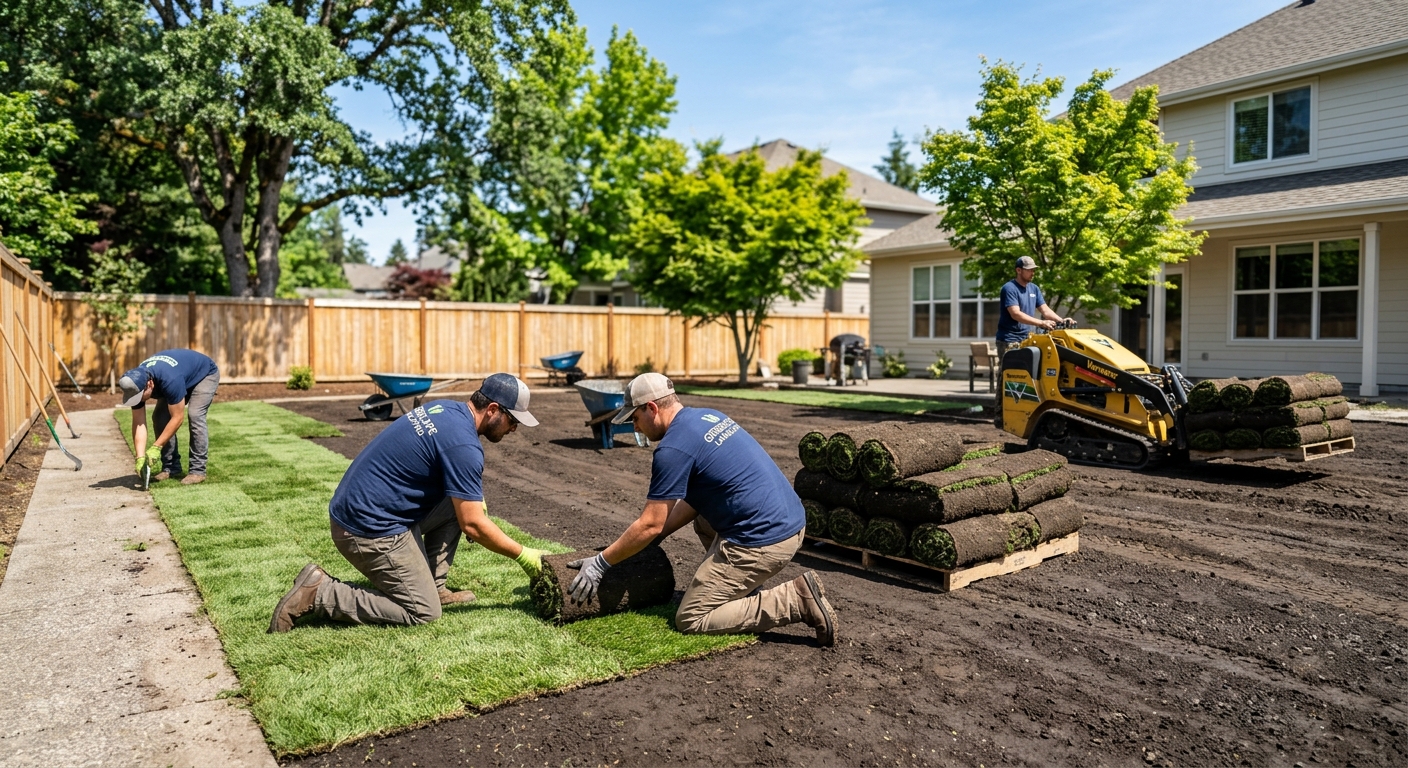
| Sod installation (supply, grade, lay, roll) |
Existing turf removal as needed, finish grading, soil conditioning, delivery and installation, initial soak |
Mid-spring to early fall |
$2,500–$6,000 |
| Lawn seeding (grade, seed, starter fertilizer) |
Final grade, seed selection for zone, light topdressing if needed, starter fertiliser and watering plan |
Spring or early fall (cooler temperatures help germination) |
$1,500–$3,800 |
| Interlocking patio or walkway |
Excavation, deep well-compacted base, bedding sand, pavers, edges, and proper slope |
May–September (base work needs stable weather) |
$8,000–$28,000 |
| Retaining wall (interlocking block) |
Block wall installation with compacted base, drainage geocomposite, and backfill |
Spring to early fall (footings and backfill timing matters) |
$12,000–$40,000 |
| Tree and shrub planting |
Soil prep, container sizes or selected bare-root/mature stock, planting, staking as needed, mulch rings |
Spring or fall for best root establishment |
$2,200–$15,000 |
Prices are estimates only and vary by project scope, site access and material selection.
What affects the price of landscaping in York
For the same overall “look,” landscaping quotes in York and across the Calgary economic region can vary by 30–50% because southern Alberta jobs are rarely identical underneath the surface. Two yards may both end up with paver patios and shrub beds, but one might need significant re-grading, deeper base excavation, or a drainage trench to protect foundations. Labour also isn’t interchangeable: crews size up the site access (gate width, driveway location, distance to unload materials) and how freeze–thaw readiness affects how quickly they can safely build.
Prairie plant hardiness zones 3–4 and York’s frost timing also tighten the working season, so contractors plan around late frosts and early cold snaps. Plant choices must be drought-tolerant and wind-hardy, which can raise material costs when you select more resilient cultivars instead of cheaper, less adapted varieties. For retaining walls, base depth must reach well below the frost-impacted zone; that means more excavation and more compacted granular layers. Coastal BC (zone 7–8) typically supports lush, long-season planting palettes, while the dry BC interior and its water constraints tends to drive drip irrigation and xeriscaping. Southern Ontario (zone 5–6) often has a moderate season, but summer dry spells still push irrigation planning—just not usually with the same severity of freeze–thaw base requirements.
Concrete examples that change pricing in York: (1) a yard with slope toward the house often needs grading corrections plus added drainage, which can move a patio job from the lower interlocking band into the higher range of $8,000–$28,000; (2) switching from seeded turf into sod increases cost substantially, often landing you closer to $2,500–$6,000 depending on area; (3) mature trees and larger caliper shrubs (plus staking and protective mulch rings) can shift a “planting day” into a full install timeline.
| Price Factor |
Why It Matters |
Cost Impact |
| Yard size in sq ft — the primary cost driver for softscape |
More square footage increases labour hours, soil amendments, and plant/turf quantities |
Often swings the estimate by 20–40% |
| Grading and drainage work — slope corrections add significant cost |
Proper slope prevents pooling and foundation moisture, and supports freeze–thaw resilience |
Can add 15–25% on top of base pricing |
| Drainage bed or French drain installation |
Intercepts subsurface water and reduces heaving risk near hardscape edges |
Commonly adds several thousand dollars depending on length/depth |
| Plant material tier — native shrubs vs. ornamental vs. mature specimen trees |
Hardy natives may cost less and establish quickly; mature specimens cost more but add instant structure |
Can double the planting line item |
| Hardscape vs. softscape ratio — walls and patios cost more per sq ft than lawn |
Pavers/blocks require deeper base prep, heavier materials, and more finishing labour |
Shifts total toward the upper bands of wall/patio projects |
| Irrigation system design and installation |
Zoned drip/sprinkler systems improve survival in zones 3–4 and during drought cycles |
Typically adds 5–20% depending on complexity |
| Soil amendment and topsoil required |
Compacted fill, clay, or poor drainage soils need conditioning for roots and turf success |
Can add 10–25% if significant replacement is needed |
| Tree removal or stump grinding before new planting |
Clearing work affects waste disposal and sometimes delays planting schedules |
Often adds a noticeable separate line item |
Permits & regulations in Alberta
In Alberta, most planting and softscape work typically doesn’t require a permit. Installing sod, seeding lawns, building most garden beds, adding mulch, and planting trees/shrubs are generally treated as landscaping rather than building work. However, retaining walls above a height threshold—commonly around 1.0 m (3.3 ft) in many municipalities—often do require a building permit, and sometimes engineered drawings depending on height, soil conditions, and where the wall is located.
Grading can also trigger approvals. If your landscaping includes changes to lot grading that significantly affect drainage toward neighbouring properties or a storm sewer connection, a municipality may require review before work starts. If you plan to re-route drainage, add larger drainage structures, or alter how surface water leaves your property, ask the contractor to confirm whether permits or inspections are needed for York-area compliance.
Before digging for planting holes, French drains, or retaining wall footings, always call utility locates to prevent damage to buried services. Also confirm local irrigation and water-use bylaws; while York is in an Alberta context, periodic drought conditions can still restrict watering schedules and push contractors toward soil improvement, smart controllers, and drip irrigation.
To verify a contractor in York, Alberta: (1) check licensing status through the appropriate provincial registry relevant to landscaping/trades (where applicable); (2) request a certificate of liability insurance naming you as additionally insured for the project period; (3) ask for WSIB/WCB clearance letters or proof of coverage; and (4) confirm the company can pull any required permits for retaining walls or significant grading changes.
Planning a landscape that thrives in York's climate
The best landscaping in York works with hardiness zones 3–4, freeze–thaw cycles, and a working season that often starts mid-spring and moves quickly toward fall cool-down. Start with plant selection: choose zone-appropriate, hardy, native-leaning perennials and shrubs that can handle winter exposure and wind. Then be realistic about sod vs. seed—sod gives instant results, but it costs more and still requires solid soil prep and consistent early watering; seeding costs less but needs patience for germination and early-season care. In Calgary’s market conditions, drainage and grading are non-negotiable: poor slope or shallow base prep can lead to pooling and foundation moisture, and that can shorten the lifespan of patios, walkways, and retaining wall caps.
Hardscape success depends on base preparation that accounts for the frost line: excavate to a depth designed for freeze resistance, compact well, and build correct slopes so meltwater and rain can move away. For low-maintenance design, use mulch, groundcovers, and perennials in repeating clusters. In Calgary’s semi-arid climate, xeriscape-style elements—like drought-tolerant ornamentals, better soil conditioning, and drip irrigation for beds—often provide more curb appeal per maintenance hour than high-water turf.
Where price differences are worth it: if your goal is a quick “finished” lawn, sod may be justified because the turf goes in immediately, often landing around $2,500–$6,000 depending on area. If budget is tighter and you’re planning a full yard rebuild, seeding is commonly a better value in the $1,500–$3,800 range—but only if you can commit to watering and weed management while it establishes.
| Element |
Climate Consideration |
Maintenance Level |
Price Band |
| Sod lawn installation |
Needs good grading and early watering to root before late-spring frosts ease |
Medium (establishment watering + first mow schedule) |
$2,500–$6,000 |
| Native perennial garden |
Hardy roots tolerate zone 3–4 winters and wind when mulched properly |
Low to medium (spring cleanup and occasional weeding) |
$1,800–$6,500 |
| Mulched shrub border |
Mulch protects crowns in freeze–thaw and helps retain moisture during dry spells |
Low (top up mulch and monitor irrigation) |
$1,500–$7,200 |
| Interlocking stone patio |
Requires deep, well-compacted base to prevent heaving and edge failures |
Low (sweep and occasional joint sand refresh) |
$8,000–$28,000 |
| Retaining wall (block) |
Footings/backfill and drainage layers must be frost-resistant for stability |
Low (inspection after spring melt; keep weep/drain paths clear) |
$12,000–$40,000 |
| Drip irrigation system |
Zoned delivery supports drought-tolerant beds and reduces waste |
Low (seasonal checks + controller adjustments) |
$1,200–$6,500 |
How to choose a landscaping contractor in York
Choosing the right contractor in York starts with verification, not marketing. In Alberta, request proof of general liability insurance (and confirm it covers the exact work period). Ask for WSIB/WCB coverage proof so you know workers are protected on-site. If a contractor is vague about coverage or can’t produce documents promptly, that’s a red flag.
Next, get 2–3 itemised written quotes. The best proposals break labour and materials separately (excavation/base prep, drainage, pavers/blocks, topsoil/soil amendment, mulch, plant quantities, and irrigation components). Avoid “lump sum only” quotes—especially for projects that combine grading and hardscape—because hidden scope differences can explain why one estimate is 30–40% lower than another. Ensure the quote states whether disposal/haul-away is included, whether permits (when required for retaining walls or certain grading changes) are included or excluded, and what’s covered under workmanship warranty.
Warranty matters: ask for the workmanship warranty length and whether it covers base settling, joint issues, and plant establishment guarantees (where offered). Product warranties typically cover defects, while workmanship covers installation failures—confirm which is which and whether the warranty is transferable.
For payment schedule, keep upfront deposits modest. A safe approach is never more than 10–15% upfront, then hold back a portion until completion and cleanup are verified. Get a start date and completion estimate in writing so weather delays don’t become budget surprises.
- Confirm insurance certificate dates match your project timeline.
- Provide WSIB/WCB clearance proof before work begins.
- Use itemised quotes with line-by-line quantities (sq ft, linear ft, plant counts).
- Ask who performs excavation and base compaction and how depth is determined.
- Confirm drainage strategy: slopes, outlets, and whether French drains are included.
- Verify disposal/haul-away is included for excavated soil and waste.
- Check irrigation scope: controller type, zoning count, and sprinkler/drip locations.
- Request a written schedule for materials delivery and hardscape curing times.
- Ask about frost-proof base specs for patios and walkways.
- Confirm retaining wall permit requirements are understood and handled.
- Review warranty terms for both workmanship and materials separately.
- Don’t accept large upfront payments; agree on holdback for final walkthrough.
Red flags in York: contractors who won’t provide insurance/WSIB documentation, quotes that omit drainage and base prep details, “universal” plant lists that ignore zone 3–4 hardiness, unclear disposal/permit responsibilities, and crews that start work without marking utilities or discussing frost timing for base and planting.
Frequently asked questions — landscaping in York
How do I prevent weeds in my York garden?
Weed prevention in York comes down to three layers: weed control before planting, a barrier that slows regrowth, and disciplined maintenance during establishment. Start by clearing roots and weeds thoroughly before mulch or soil is added—don’t just cover what’s growing. After planting, use 2–3 in (roughly 5–7.5 cm) of quality mulch, keep it off plant stems, and consider landscape fabric only where it truly fits (for example, under larger shrub borders) because it can complicate future root work. In freeze–thaw cycles, soil gets disturbed less when edging is defined with proper borders. If you’re installing turf or seeding, include a starter fertiliser and consistent watering so seedlings outcompete weeds. For patios/walkways, maintain the correct slope so pooling doesn’t create “weed zones.”
How do I design a low-water yard in York?
A low-water yard in York is usually designed around targeted watering, not just drought-tolerant plants. Use zone-appropriate, wind-hardy shrubs and perennials, and group plants by water needs so irrigation can be zoned. Instead of large areas of high-water turf, consider replacing portions of lawn with mulched borders and groundcovers. For irrigation, drip lines for beds typically outperform broad sprinkler coverage during dry spells because water goes directly to roots and reduces waste. Pair that with soil improvement—compost and proper grading—so moisture penetrates rather than runs off. If you want a quick result, sod may feel tempting, but budget at roughly $2,500–$6,000 depending on area; a seeded lawn can be less expensive at $1,500–$3,800 while you build the rest of the low-water layout. Add a smart controller so watering adjusts around seasonal changes and frost transition periods.
How do I find a licensed landscaper in York?
In York, start by asking for proof of general liability insurance and WSIB/WCB coverage before you sign anything. Licensing expectations can vary by type of landscaping work, but reputable contractors can clearly explain what they do and provide documentation for what’s required for their activities. Request an itemised quote, then verify that the contractor understands Alberta requirements such as utility locates before digging and the permit expectations for retaining walls above the typical 1.0 m threshold and for significant grading that affects drainage. For insurance, ask for a current certificate of insurance and confirm you’ll be listed as additionally insured for the project term where applicable. For coverage, request clearance proof. Finally, confirm the company has a process for warranty and workmanship follow-up, because southern Alberta freeze–thaw can reveal issues after the first spring melt.
How much does landscaping cost in York?
Landscaping cost in York usually depends on how much hardscape you add, whether drainage/grading is needed, and what plant sizes you choose. For common yard updates, full landscape design and installation projects typically run from the mid-range toward the upper bands—for example, total projects often land around $12,000–$45,000 when grading, planting, and hardscape are included. If you’re focusing on turf, sod installation commonly sits around $2,500–$6,000, while lawn seeding is often closer to $1,500–$3,800. Patios and walkways with proper base prep can fall in the $8,000–$28,000 range, and interlocking retaining walls often run higher because of excavation and drainage layers. Expect contractor labour to represent a large share of the total in Calgary-area markets, so scheduling and site access also meaningfully affect your final price.
What plants thrive in York's climate zone?
York sits in Prairie hardiness zones 3–4, where wind, winter cold, and periodic drought shape planting success. Look for shrubs and perennials that are hardy to your zone and suited to Alberta’s conditions—especially plants that tolerate freeze–thaw and recover after late-spring weather swings. In practice, that often means a mix of native-leaning shrubs, hardy ornamental grasses, and perennials with strong root systems that can handle less frequent watering once established. For trees, choose varieties known for cold tolerance and structure, and avoid overly delicate types that require extra shelter. The key is pairing plant selection with soil preparation: compost and topsoil quality help roots establish before winter. Mulch and proper spacing matter too, because dense, poorly drained beds can fail during spring melt. If you want a low-maintenance look, a native perennial garden combined with a mulched shrub border is one of the most reliable layouts in York.
Sod vs seed — which is better for a York lawn?
Neither is universally “better” in York; it depends on timing, budget, and how much care you can commit to during establishment. Sod gives instant cover and is ideal when you want results quickly, but it’s more expensive—often around $2,500–$6,000 once grading and installation are included. Seed is usually a better value—often around $1,500–$3,800—but it takes longer to look full and depends on consistent watering and weed control while germinating. With York’s freeze–thaw cycles and late-spring frosts, timing is crucial: seed generally works best in windows that let it germinate without getting hammered by cold snaps. Sod also needs the soil prepped properly; without good grading and drainage, sod can fail just as surely as seeded areas. If you’re planning a larger refresh (drainage + patio + planting), seeding can be an efficient step while the rest of the project settles.