Landscaping options and costs in 108 Mile Ranch
108 Mile Ranch is one of those Central Interior-near-coastal-feel communities where the yard can feel like an extension of the home, especially because the population is small (1,043 residents per Statistics Canada, 2021 Census) and many homeowners stick around long-term—so landscape improvements are often treated as part of the property investment. In a typical neighbourhood setup, you’ll also find plenty of detached homes with yard space, which supports bigger planting plans and more frequent requests for drainage upgrades before new turf or hardscape goes in.
In the Lower Mainland–Southwest market, most clients expect a “finished look” by the time the weather firms up, but pricing still moves based on how wet winters and cool summers affect labour availability. Contractors generally get longer workable windows than Prairie regions because plant hardiness is commonly in zones 7–8, and frost risk is managed with good base prep rather than with aggressive drought-tolerance alone. That mix can raise costs in one way (more layered, lush designs are possible) and reduce costs in another (you can often install more effectively across a longer season). Where the work is especially in demand around 108 Mile Ranch is the area near the town’s busier commercial strip and along the main arterial corridors, where curb appeal and well-drained walkways matter most.
Below is a practical cost comparison for common projects, then we’ll break down what drives each quote variation.
| Service |
Description |
Season |
Price Range |
| Full landscape design and installation |
Site visit, concept + layout, plant plan, grading/drainage coordination, soil prep, irrigation review, and installation of softscape and hardscape as specified. |
Spring–Fall (softscape often extends into shoulder months) |
$5,000–$50,000 |
| Sod installation (supply, grade, lay, roll) |
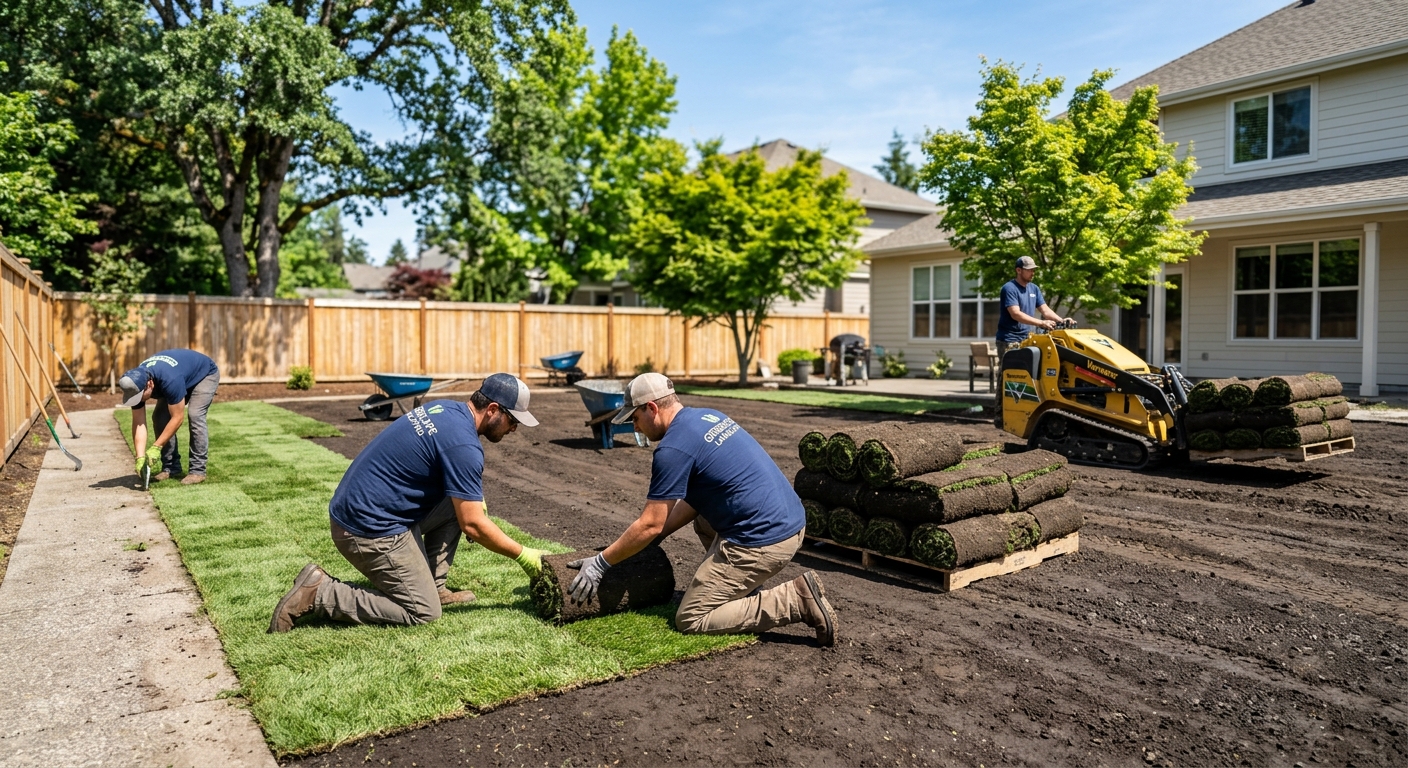
Minor grading, base preparation, sod supply, delivery and install, rolling and starter watering plan. |
Late spring–early fall |
$2,000–$8,000 |
| Lawn seeding (grade, seed, starter fertilizer) |
Grading/topdressing, seed selection and application, starter fertilizer, light raking/rolling as needed. |
Spring or early fall |
$1,200–$5,500 |
| Interlocking patio or walkway |
Excavation, compacted base, sand setting bed, edging, jointing and clean finish. |
Spring–Fall (weather-dependent) |
$7,000–$30,000 |
| Retaining wall (interlocking block) |
Terraced or straight wall build with drainage gravel/weep provisions, base excavation, reinforcement if required, and cap/finish. |
Spring–Fall |
$10,000–$45,000 |
| Tree and shrub planting |
Soil loosening, amended planting holes, staking as required, mulch rings, and first-season watering guidance. |
Spring–Early summer & Fall |
$1,000–$15,000 |
Prices are estimates only and vary by project scope, site access and material selection.
What affects the price of landscaping in 108 Mile Ranch
In 108 Mile Ranch and across British Columbia, it’s common to see quotes for the “same” job swing by 30–50%. The reason isn’t just contractor preference—each quote reflects real choices about site conditions, labour time, and material quality. In a long-growing-zone market (zones 7–8 in the Lower Mainland–Southwest), homeowners often request fuller plant palettes and more layered designs, which increases labour for planting and the number of plants required. At the same time, coastal BC scheduling is smoother than in Prairie cities, so installers may price efficiency differently depending on weather windows and demand.
Regional climate affects both what grows and how long crews can work. Prairie regions (zones 2–4) typically need drought-tolerant, wind-hardy selections and face shorter frost-free windows; retaining wall bases must be dug deeper to get below the frost line, which raises excavation time. Coastal BC (zones 7–8) supports lush growth and long-blooming perennials, but heavy rain means drainage and proper sub-base prep are non-negotiable—those requirements can add cost in wet pockets. In the dry BC Interior and parts of Alberta, irrigation design and water-efficient layouts drive expenses, while Southern Ontario (zones 5–6) often has lower winter construction risk but may still see watering-focused budgeting during summer dry spells.
Concrete examples in 108 Mile Ranch: (1) a gentle front-yard slope that needs re-grading for runoff can add several days of earthworks, pushing a mid-range sod or seeding refresh upward toward the higher end of the $2,000–$8,000 sod band; (2) replacing “just lawn” with a drainage bed plus edging and interlock can move a walkway project into the $7,000–$30,000 bracket because base prep and disposal dominate labour; (3) adding mature specimen trees instead of smaller nursery stock shifts the tree planting budget toward the $1,000–$15,000 higher tiers, especially if staking and expanded soil amendments are included. Even housing age matters—older yards in established neighbourhoods often have compacted fill, so soil amendments and topdressing become line items that newer developments may not need.
| Price Factor |
Why It Matters |
Cost Impact |
| Yard size in sq ft — the primary cost driver for softscape |
More area means more labour, soil/topsoil, seed/sod, mulch, and often more irrigation coverage. |
High |
| Grading and drainage work — slope corrections add significant cost |
Fixing ponding and directing runoff away from foundations requires excavation, re-shaping, and compaction. |
High |
| Drainage bed or French drain installation |
Adds trenching, filter fabric, perforated pipe, gravel, and cleanout considerations. |
Medium–High |
| Plant material tier — native shrubs vs. ornamental vs. mature specimen trees |
Mature trees cost more to purchase, and they take longer to plant, stake, and protect through establishment. |
Medium–High |
| Hardscape vs. softscape ratio — walls and patios cost more per sq ft than lawn |
Interlock and block require deeper base, edging, and careful finishing. |
Medium–High |
| Irrigation system design and installation |
Even “simple” drip zones include parts, trenching, backflow protection coordination (as required), and testing time. |
Medium |
| Soil amendment and topsoil required |
Compacted or clay-heavy soils need amendments to support root growth and reduce long-term settling. |
Medium |
| Tree removal or stump grinding before new planting |
Access, root conditions, and disposal time can add substantial labour beyond planting alone. |
Medium–High |
Permits & regulations in British Columbia
In British Columbia, most everyday landscaping work—planting, sodding, and typical softscape installation—usually does not require a permit. That includes tasks like laying sod, seeding a lawn, planting shrubs and trees, adding mulch and groundcovers, and building small non-structural edging. Homeowners also commonly proceed with drainage improvements such as surface grading and straightforward soil rework, as long as they don’t change lot drainage in a way that conflicts with required stormwater direction.
Where permitting often comes in: retaining walls above the local height threshold (commonly 1.0 m in many municipalities) typically require a building permit, and sometimes engineered drawings depending on the wall height, soil conditions, and structural design. Also, changes to lot grading that alter drainage toward neighbouring properties or storm sewer connections may trigger approval requirements. Because rules can vary by municipality, your contractor should confirm the applicable threshold before work starts.
For safety and legal digging: call for utility locates before digging any planting holes or wall footings. This is especially important if you’re adding irrigation later, trenching for drainage, or relocating downspout runoff.
To verify a contractor for a 108 Mile Ranch project, ask for (1) the contractor’s British Columbia licence information (confirm it via the province’s online registry or the contractor’s official registration details), (2) current liability insurance with your name/address listed as applicable, (3) clearance for worker coverage such as WSIB/WCB as appropriate for the contractor’s registration. Request a certificate of insurance and a clearance letter, then confirm expiry dates match your scheduled start date.
Planning a landscape that thrives in 108 Mile Ranch's climate
Planning in 108 Mile Ranch is about working with the Lower Mainland–Southwest pattern: cool, wet winters, a long enough growing window, and a frost calendar that rewards good prep rather than heavy winter protection. Start with plant selection for zone 7–8: choose native and zone-appropriate species that establish reliably and don’t demand constant winter wrapping or repeated interventions. Even if winters are mild, you still want roots to be stable, so drainage matters as much as cold tolerance.
Second, compare sod vs. seed. Sod gives instant coverage and helps control erosion, but it costs roughly 3–4x more per sq ft than seeding. That gap can be justified when you need immediate visual impact, when erosion control is urgent, or when children/pets require quick usable turf. For many homeowners, seeding plus proper topdressing is the better value—especially on areas that can wait for establishment.
Third, get drainage and grading right. Pooling water not only harms turf, it also risks foundation moisture and accelerates soil compaction. This region’s freeze–thaw isn’t as severe as in colder Prairie climates, but it still exists—so don’t skip base prep. For hardscapes like patios or retaining walls, excavate to a proper compacted base and design drainage so water has an exit.
Finally, build low-maintenance structure: mulch rings and borders, groundcovers, and perennials that bloom in sequence. If water costs or occasional restrictions become a concern, consider a rain garden on a downspout swale or xeriscape pockets using drought-tolerant planting and drip irrigation. A good example of “spend where it pays”: investing toward the higher end of sod installation (closer to the $2,000–$8,000 band for your lawn footprint) can be worth it when you pair it with corrected drainage. Without that, the turf spend often becomes rework.
| Element |
Climate Consideration |
Maintenance Level |
Price Band |
| Sod lawn installation |
Zone 7–8 growth supports strong establishment, but wet winters require good drainage to prevent rot. |
Low–Medium (more attention in first season) |
$2,000–$8,000 |
| Native perennial garden |
Cool-season perennials handle spring start-ups well; mulch helps during rainy shoulder months. |
Low (annual prune + occasional weeding) |
$3,000–$12,000 |
| Mulched shrub border |
Shrubs in well-amended soil reduce splashback mud and stabilize slopes in wet weather. |
Low–Medium |
$2,500–$10,000 |
| Interlocking stone patio |
Base compaction and drainage keep freeze–thaw movement from creating uneven joints. |
Low (periodic joint top-up) |
$7,000–$30,000 |
| Retaining wall (block) |
Proper drainage gravel behind the wall is critical in heavy-rain conditions to prevent hydrostatic pressure. |
Low (visual checks) |
$10,000–$45,000 |
| Drip irrigation system |
Efficient delivery fits occasional water-cost scrutiny and supports targeted watering in cool-wet seasons. |
Medium (seasonal adjustments + monitoring) |
$1,800–$7,500 |
How to choose a landscaping contractor in 108 Mile Ranch
Choosing a contractor in British Columbia comes down to proving competence, not just getting a number. Start with licensing and coverage. Ask the contractor for their British Columbia licence details (and confirm the registration online if applicable), then request a current certificate of liability insurance that covers landscaping work at your 108 Mile Ranch address. For worker coverage, ask for proof such as WSIB/WCB clearance or equivalent worker coverage documentation; don’t accept “we have it” without documents. Ensure the clearance letter and insurance dates overlap your scheduled start and install window.
Next, get 2–3 itemised written quotes. You want a labour + materials breakdown—excavation, base rock/compaction, drainage components, disposal, sod/seed costs, plant list tiers, and irrigation parts—so you can compare apples to apples. Check scope exclusions: is material disposal included, are topsoil and soil amendments included, is permit pulling included where required for retaining walls, and are winter shutdown protections described for projects that overlap wet periods?
Warranty matters. Ask for the workmanship warranty length and what it covers (settling, subsurface base failures, drainage issues). Also ask about product/manufacturer warranties for irrigation equipment, pavers/interlock product, and trees/shrubs. Find out whether warranties are transferable to future owners.
Payment schedule should be controlled: never pay more than 10–15% upfront. Hold back the remaining balance until the job is complete, inspected, and any punch-list items are finished. Finally, request a written timeline with a start date and completion estimate—especially for patios and retaining walls where rain can delay concrete and base work.
- Provide BC licence details and confirm registration/standing online.
- Show current liability insurance certificate (verify address/job site coverage).
- Provide worker coverage clearance documentation (WSIB/WCB as applicable).
- Use itemised quotes (labour, excavation, materials, disposal, irrigation parts).
- Confirm what drainage work includes (swales, French drain, gravel, pipe, outlets).
- Ask whether grading ties into downspouts and foundation clearance requirements.
- For retaining walls, confirm permit expectations before construction starts.
- Verify warranty: workmanship duration and what triggers it (and how claims are handled).
- Request a plant list with quantities, sizes, and whether substitutions are allowed.
- Confirm disposal and dump fees are included or clearly quoted separately.
- Clarify irrigation scope: drip vs. pop-up, controller type, and testing/commissioning.
- Use a written payment schedule with small upfront deposit and holdback until punch-list completion.
In 108 Mile Ranch, watch for these red flags: contractors who won’t provide insurance/clearance paperwork, quotes that are only lump sums with no drainage or base prep details, refusal to list the plant sizes/varieties in writing, withholding a clear start/completion timeline, and “cheap” retaining wall pricing with no mention of drainage gravel/weep provisions or permit responsibility.
Frequently asked questions — landscaping in 108 Mile Ranch
How much does professional landscape design cost?
In 108 Mile Ranch (and across British Columbia), landscape design pricing is often bundled with installation, or it can be a separate design fee depending on the scope. For many homeowners, a full landscape design and installation package commonly lands within the $5,000–$50,000 band because it includes site assessment, layout, and plant/hardscape planning. If you’re only looking for a concept plan or a planting layout, expect the design portion to be smaller but still based on the number of zones (front entry, side yard, slopes, and drainage areas). Because the Lower Mainland–Southwest has zones 7–8 conditions, designers may build richer planting layers than in colder regions, which affects plant quantity and design time. If you’re planning irrigation or grading changes, ask whether the design quote includes drainage coordination.
How do I compare landscaping quotes?
To compare quotes in 108 Mile Ranch fairly, line-item the work rather than comparing totals only. Ask each contractor to specify base depth and materials for hardscape, what drainage is included (swales, French drain, gravel, and outlet direction), and whether topsoil/soil amendments are part of the price. For lawn work, compare sod vs. seeding scope: sod supply plus grading and rolling should be spelled out, and seeding should name seed type and include starter fertilizer. For example, sod installation commonly falls within the $2,000–$8,000 range; if one quote is far lower without explaining reduced scope, it may be cutting drainage prep or soil amendments. Finally, confirm permit responsibility where retaining walls exceed the local height threshold, and check if disposal fees are included. The best quotes read like a checklist you could build from.
How long does a landscaping project take in 108 Mile Ranch?
Project timelines in 108 Mile Ranch typically depend on weather windows, the complexity of drainage, and how many trades are involved (hardscape, planting, and irrigation). In the Lower Mainland–Southwest, the frost/calendar generally gives a longer working season than Prairie regions, but rain-heavy weeks can slow excavations and base compaction. A simple planting-only job can take a day or two for labour plus an ordering lead time for plants. Sod installation timelines often mean site grading and laying is done in a focused block of time, but turf establishment care may continue after install. Interlocking patios and retaining walls usually take longer because base build-up, compaction, edging, and settling-time considerations stretch the schedule. Ask your contractor for written start and completion estimates, and confirm whether any wet-weather delays change the end date.
What is the best grass type for a 108 Mile Ranch lawn?
For British Columbia yards in the Lower Mainland–Southwest zone 7–8 environment, the “best” grass is usually a cool-season turf that tolerates spring conditions and performs well in shoulder-season moisture. Many homeowners choose blends that include Kentucky bluegrass or fine fescues depending on sun exposure and how much foot traffic the lawn receives. If your yard stays wet or has drainage issues, the priority is correcting runoff; grass choice can’t fully compensate for pooling. When seeding, ask for a seed mix matched to your light levels and desired wear tolerance, and ensure starter fertilizer is included in the scope. If you want instant coverage, sod is reliable but generally costs more—often within the $2,000–$8,000 range—so it’s worth confirming the soil base and drainage first for long-term results.
When should I aerate and overseed my lawn in 108 Mile Ranch?
In 108 Mile Ranch, aim for aeration and overseeding during periods when the lawn is actively growing but temperatures are moderate. That usually means early spring after soil is workable, or early fall when conditions are cool enough to reduce stress and promote root establishment. If the yard gets heavy rainfall, avoid overseeding right before long wet stretches when seed can wash or rot; good drainage and a light topdressing after seeding matter. Aeration helps when soil is compacted (common in older yards), improving water and nutrient penetration. The exact timing can shift year to year with weather, so ask your contractor to assess soil moisture and growth stage before work. If you’re considering seeding versus sod, seeding is typically more budget-friendly than sod but requires patience for full coverage.
What trees grow best in 108 Mile Ranch's climate zone?
With zone 7–8 conditions common in the Lower Mainland–Southwest market, many ornamental and native-leaning trees do well if they’re matched to your yard’s sun, soil, and drainage. The most successful plantings are typically the ones that fit your site: well-drained ground for trees that dislike standing water, and wind-appropriate species if your yard is exposed. Common homeowner choices include varieties of flowering cherries, serviceberry (often as a smaller tree), and other medium-sized landscape trees that tolerate cool-season growth cycles. For larger specimen trees, your cost can increase because planting and staking take longer, and the soil prep is more intensive; that’s one reason tree and shrub planting budgets commonly land within the $1,000–$15,000 range depending on size and number. A reputable contractor can recommend species based on your light and drainage conditions and help you avoid planting in problem runoff zones.