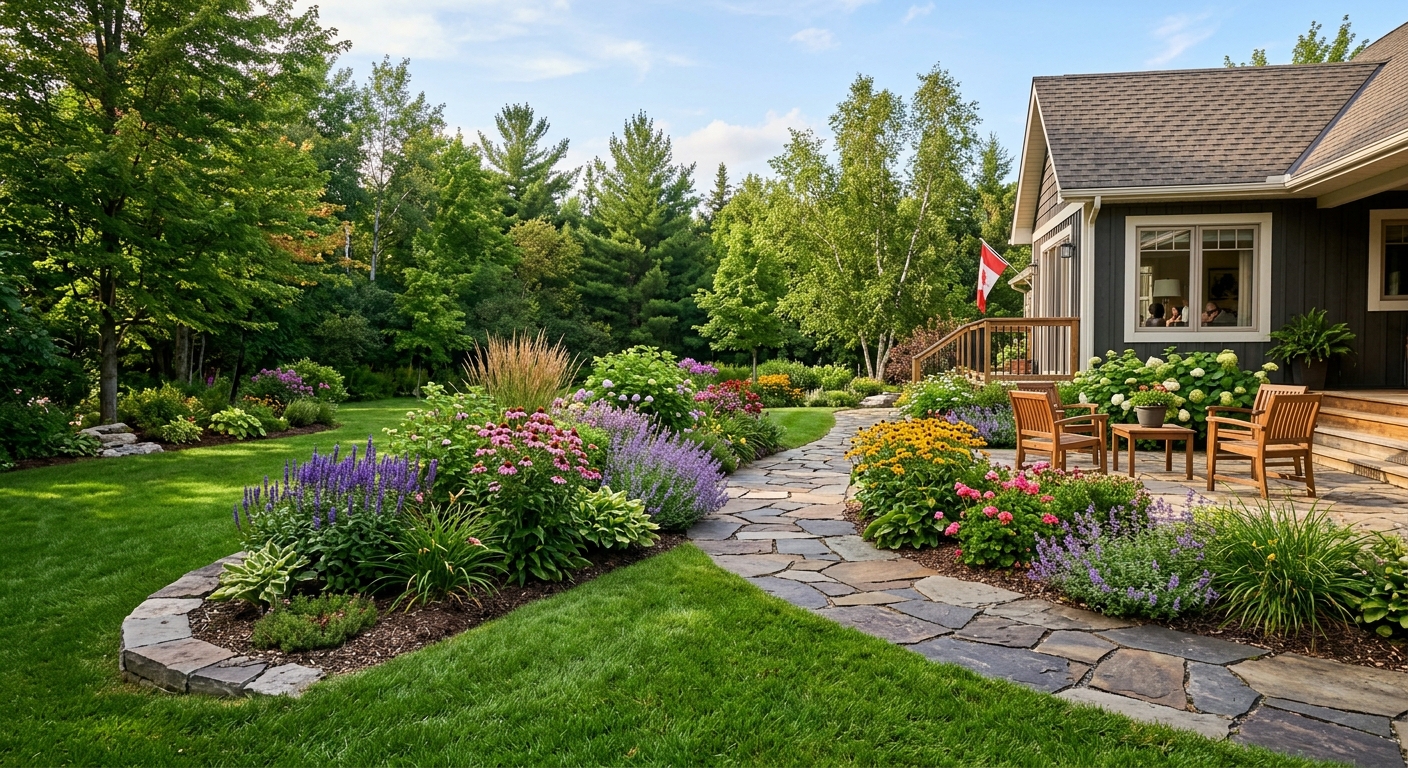
Landscaping options and costs in Cariboo
Cariboo homeowners typically have a lot of land to work with, and that makes it easier to justify a thoughtful landscape plan rather than only “patch and replace.” In 2021, the population was 22,780 (Statistics Canada, 2021 Census), and in practice that translates to a smaller local trade base than larger BC hubs—so scheduling can matter. Also, the housing stock is heavily oriented to single-detached ownership, which often means more yard area and more homeowner incentive to invest in curb appeal, drainage fixes, and long-lived planting beds.
In the Lower Mainland–Southwest market (zones 7–8), the mild, wet winters and long cool summers generally support a longer working and growing season than harsher parts of British Columbia. That can lower softscape risk compared with short frost-free areas, but it doesn’t make projects “cheap”—labour still costs, and good drainage work is still non-negotiable in heavy-rain periods. Contractors available for design + installation are often busiest around spring and early summer planting windows, which can affect turnaround times and sometimes push the cost toward the higher end of the range.
Demand is especially steady in car-centric neighbourhoods and growing pockets around the Wells area and along the highway corridor, where lots are bigger and yards are often redesigned to handle runoff and foundation moisture. With that in mind, use the comparison table below as a practical starting point for scoping your project.
| Service |
Description |
Season |
Price Range |
| Full landscape design and installation |
Site walk, concept + planting plan, grading/drainage allowances, planting, topsoil/soil amendments, mulch, and hardscape if included |
Year-round with wetter winter exclusions for structural work |
$5,000–$50,000 |
| Sod installation (supply, grade, lay, roll) |
Minor grading, soil prep, sod supply, layout, rolling and initial watering plan |
Late spring to early fall; best performance in cool months |
$2,000–$8,000 |
| Lawn seeding (grade, seed, starter fertilizer) |
Light grading, seed selection, starter fertilizer, raking/rolling, and establishment care |
Spring or early fall |
$1,000–$4,500 |
| Interlocking patio or walkway |
Excavation, base preparation, polymeric sand, pavers, edge restraints, levelling |
Spring to fall (allowing weather windows for compaction) |
$6,000–$35,000 |
| Retaining wall (interlocking block) |
Block system, base excavation, drainage gravel, geotextile, reinforcement per design |
Spring to fall; freeze–thaw awareness for footings |
$10,000–$80,000 |
| Tree and shrub planting |
Soil improvement, staking/cabling as needed, mulch rings, watering support, warranty watering schedule |
Late fall, spring, and sheltered winter planting windows when feasible |
$1,000–$15,000 |
Prices are estimates only and vary by project scope, site access and material selection.
What affects the price of landscaping in Cariboo
Even when two homeowners agree on the “same” job, Cariboo quotes can land 30–50% apart because contractors price risk differently: drainage uncertainty, soil conditions, disposal, and how much labour is needed to achieve a level, long-lasting result. In the Lower Mainland–Southwest (zones 7–8), the long growing season helps, but it also means more opportunities to specify premium plants, thicker topsoil lifts, and better irrigation—things that increase cost while improving longevity.
Hardiness zone and frost timing affect both materials and work windows. Coastal BC’s generally mild, wet winters reduce winter-kill risk for many broadleaf evergreens and long-blooming perennials, but freeze–thaw cycles still influence patios, walkways, and retaining wall footings—bases must be dug deeper and drains built to prevent frost heave and wall movement. On the other hand, Prairie regions (zones 2–4) often have compressed schedules and shorter frost-free periods, so budgets there may bias toward low-maintenance, drought-tolerant, wind-hardy planting and fewer “finicky” choices. Water restrictions in the drier BC interior and Alberta also shift irrigation design priorities. Southern Ontario (zone 5–6) typically sees a moderate season but summer dryness still drives irrigation options, which is why you’ll often see irrigation show up as an add-on there too.
In Cariboo specifically, costs can rise when you need real grading changes to stop runoff at the foundation or to correct sloped lots common along many residential streets. A small drainage bed or French drain can add labour and aggregate costs, while well-draining soils or simple regrading can keep you nearer the mid-range of $5,000–$50,000 for full design/install projects. Conversely, if your yard just needs straightforward tree and shrub planting—say within a prepared topsoil zone—you can often stay closer to the $1,000–$15,000 planting band. Older yards (with compacted subsoil or poor drainage) also tend to require thicker topsoil and more amendment, which is where budgets feel the difference quickly.
| Price Factor |
Why It Matters |
Cost Impact |
| Yard size in sq ft — the primary cost driver for softscape |
More area increases labour hours, soil/topsoil volume, edging, and seed/sod/material quantities |
High: expanding from 400 sq ft to 1,000 sq ft commonly shifts total softscape cost by $2,000–$8,000 |
| Grading and drainage work — slope corrections add significant cost |
Correct slopes for runoff and prevent pooling near foundations; may require rework and re-compaction |
High: drainage + grading can add $3,000–$15,000 depending on how far water needs redirecting |
| Drainage bed or French drain installation |
Aggregate, perforated pipe, geotextile, and tie-in depth determine performance |
Medium to High: often $2,500–$12,000+ for typical residential runs |
| Plant material tier — native shrubs vs. ornamental vs. mature specimen trees |
Mature sizes cost more and require heavier labour for planting, staking, and protection |
Medium to High: specimen trees can push planting budgets up rapidly |
| Hardscape vs. softscape ratio — walls and patios cost more per sq ft than lawn |
Pavers/blocks need excavation, base, compaction, and often engineering attention on retaining work |
High: a patio/walkway-heavy plan usually outruns lawn-only budgets |
| Irrigation system design and installation |
Drip zones, lines, timers/controller, and labour to fit with beds and grading |
Medium: commonly adds several thousand dollars depending on zone count |
| Soil amendment and topsoil required |
Compensates for heavy clay, poor organic content, or compaction to support roots |
Medium: delivery and depth of lift can add $500–$6,000+ |
| Tree removal or stump grinding before new planting |
Access, disposal, and equipment time determine labour cost |
Medium: can add $500–$3,500+ depending on size and access |
Permits & regulations in British Columbia
In British Columbia, most planting, sodding, and routine softscape work typically does not require a permit—so if your scope is beds, mulch, perennials, shrubs, sod/seeding, and standard driveway-adjacent grading, contractors can usually proceed without permit paperwork. The work that most often DOES require a permit is retaining wall construction above the common threshold—typically around 1.0 m (3.3 ft) in many municipalities—especially where the structure must be engineered or designed for load and stability. Another common trigger is significant lot-grading changes that can redirect drainage toward neighbouring properties or connect into storm systems. If your plan includes foundation-adjacent drainage tie-ins, be prepared for approval review depending on how the outlet is handled.
Regardless of permit needs, call for utility locates before digging any planting holes or wall footings. In Cariboo (and across BC), you should also confirm local irrigation and water-use bylaw requirements—rules can tighten during drought conditions, even though coastal areas generally have a longer planting season. That’s why drip irrigation with smart control is a practical approach: it supports efficiency when restrictions apply.
To verify your contractor’s credentials in BC, start by checking the contractor’s licence status via the provincial registry (when applicable for their trade category), then request a current certificate of liability insurance (confirm coverage dates and that landscaping activities are covered). For workers’ compensation, ask for proof of WSBC/WCB coverage or a clearance letter from the contractor. Finally, verify that any subcontractors working on your site carry their own coverage—don’t rely on verbal assurances.
Planning a landscape that thrives in Cariboo's climate
Planning for Cariboo’s climate means working with British Columbia’s zone 7–8 conditions: mild, wet winters, cool summers, and a frost calendar that generally allows broad planting windows, while still respecting freeze–thaw impacts on structural elements. Start with plant selection. Choose zone-appropriate shrubs, broadleaf evergreens, and hardy perennials that can handle winter wet and spring shoulder seasons with less supplemental protection. That reduces winter losses and lowers the long-term watering burden. For water-wise options, consider rain-garden pockets and xeriscape-style planting islands where runoff collects—especially in areas that stay soggy after storms.
For grass, decide early whether you want speed or value. Sod gives instant visual results but commonly costs about 3–4x more per sq ft than seeding when you include preparation and establishment care. For example, a mid-sized lawn refresh that might land near $2,000–$8,000 for sod could often be staged closer to the seeding approach (typically lower), but sod can be worth the premium if you’re reseeding right before a sale or you need immediate erosion control on a slope.
Drainage and grading are critical in the Lower Mainland–Southwest market to prevent pooling and foundation moisture. Keep beds and lawn slightly graded to drain away from the house, and build with proper sub-base and compaction where hardscape sits. For patios, walkways, and retaining walls, base preparation must account for the local frost line and freeze–thaw cycles: deeper excavation, well-draining base layers, and gravel outlets where required.
Low-maintenance doesn’t have to mean “boring.” Use mulch, groundcovers, and a layered perennial structure so weeds have less space. Add drought-tolerant species where irrigation might be limited during restrictions, and use drip irrigation with a smart controller so watering matches plant needs instead of the weather guessing game.
| Element |
Climate Consideration |
Maintenance Level |
Price Band |
| Sod lawn installation |
Zones 7–8 support fast rooting in cool seasons; avoid laying during the wettest weeks when bases can get waterlogged |
Low after establishment; needs consistent watering until rooted |
$2,000–$8,000 |
| Native perennial garden |
Handles winter wet and shoulder-season swings with less fuss; improves soil over time |
Low to medium (occasional weeding and light pruning) |
$1,500–$10,000 |
| Mulched shrub border |
Mulch buffers winter wet/cold and helps moderate soil temperature and moisture |
Low (replenish mulch 1–2x/yr depending on depth) |
$1,200–$8,500 |
| Interlocking stone patio |
Freeze–thaw requires proper base depth, compaction, and drainage to prevent heaving |
Low (periodic joint sand checks; wash as needed) |
$6,000–$35,000 |
| Retaining wall (block) |
Drainage gravel behind the wall reduces hydrostatic pressure during BC rain cycles |
Low long-term; relies on correct build to avoid future movement |
$10,000–$80,000 |
| Drip irrigation system |
Efficient watering supports occasional restriction tolerance and reduces wet foliage during cool damp periods |
Low (seasonal checks and controller tweaks) |
$2,000–$10,000 |
How to choose a landscaping contractor in Cariboo
When you hire a landscaper in Cariboo, verify credentials first—especially in British Columbia where jobsite safety and proper coverage are essential for both labourers and homeowners. Start with licensing: request the contractor’s relevant BC licence information (or trade qualification if they’re working in a regulated category). Next, ask for a current certificate of liability insurance—make sure it’s not expired and that the coverage term includes your project dates. For workers’ compensation, verify they have WSBC/WCB coverage by requesting proof or a clearance letter; if they use subcontractors, each should have their own coverage documents.
Then get 2–3 itemised, written quotes. Avoid “lump sum” only—ask for a labour + materials breakdown by scope: excavation, base prep, drainage components, plant supply, soil amendments, edging, irrigation (if included), and disposal. Carefully read what’s excluded (topsoil delivery limits, permit pull responsibility, hauling/disposal charges, and utility-locate costs). Confirm whether waste removal and compacted base materials are included or added later.
Warranty matters. Ask for a workmanship warranty length (commonly seasonal or multi-year, depending on scope) and whether plant warranty is handled by the supplier or contractor. Also ask if warranties are transferable if you sell the home.
Payment should be controlled: never pay more than 10–15% upfront. Hold back a portion until key milestones are complete and final site cleanup is done. Finally, insist on a timeline in writing: a stated start date, weather-sensitive “not earlier than” notes, and an estimated completion window.
- Ask for reference photos from projects with similar drainage or sloped grading.
- Confirm site access allowances (wheelbarrow paths vs. equipment access).
- Request itemised quotes with quantities (sq ft, linear ft, number of trees/shrubs, irrigation zones).
- Verify disposal/hauling is included for soil and excess gravel.
- Confirm utility locates are booked before digging.
- Get a written plan for how they protect lawns/bed areas during construction.
- Check they specify base depths/compaction details for patios and wall footings.
- Make sure retaining wall design includes drainage gravel and geotextile.
- Require a written planting list with plant sizes (e.g., container size or caliper where relevant).
- Ask who handles irrigation controller setup and seasonal calibration.
- Confirm warranty terms in writing: workmanship + plant material expectations.
- Set milestones and retainage: hold back until final grading, cleanup, and punch-list items are complete.
Red flags I’d treat seriously in Cariboo: (1) no proof of WSBC/WCB coverage or liability insurance; (2) vague scope language like “landscape as discussed” with no quantities; (3) no written timeline or refusal to include weather-dependent schedule notes; (4) promises of “no drainage required” near foundations on sloped or heavy-soil sites; and (5) asking for most of the money upfront (beyond about 10–15%).
Frequently asked questions — landscaping in Cariboo
How do I compare landscaping quotes?
Start by comparing quotes on scope, not just total price. For Cariboo (and across British Columbia), ask each contractor to break down labour and materials by line item: excavation, base prep, drainage components, soil/topsoil, plant list with sizes, mulch, edging, and irrigation supplies if included. Make sure the “what’s included” section matches—particularly disposal/hauling, utility locate scheduling, and whether compacted base depths are specified for patios or retaining work. If one quote includes a French drain and the other doesn’t, you can’t fairly compare totals. Finally, verify credentials: request proof of liability insurance and WSBC/WCB coverage/clearance letter, and confirm warranty terms are in writing. A cheaper quote that omits critical drainage can cost more later.
How long does a landscaping project take in Cariboo?
Typical timelines in Cariboo depend on weather, site access, and whether the project is softscape-only or includes structural work. Planting and mulching can often be completed in a few days once soil is prepped, while irrigation and bed construction may take a week or two for average lots. Sod installation usually follows grading and base prep and can be completed quickly, but establishment watering and final finishing still matter. Hardscape work like patios and walkways commonly takes longer due to excavation, base compaction, and curing/settling requirements. Retaining walls add planning and build time because proper drainage gravel and correct footing depth are essential in freeze–thaw conditions. If your budget is closer to the $5,000–$50,000 full design/install band, expect longer scheduling and coordination for multiple trades. Always get a written start date and completion window.
What is the best grass type for a Cariboo lawn?
In Cariboo and the Lower Mainland–Southwest growing conditions (zone 7–8), the “best” grass type is usually a cool-season turf that handles cool, damp periods and still grows well through spring and fall. Many homeowners do best with a perennial ryegrass mix or tall fescue blend depending on sun exposure and how often the lawn gets watered. If you have heavy shade, tall fescue often performs better, while mix blends can improve durability for mixed-use lawns. The biggest determinant isn’t only species—it’s soil prep, drainage, mowing height, and consistent establishment watering. If you’re comparing options, remember that sod (often within the $2,000–$8,000 band) gives faster visual results, while seeding supports a longer schedule but can be more budget-friendly when conditions are right.
When should I aerate and overseed my lawn in Cariboo?
For Cariboo in British Columbia’s milder coastal climate pattern (zone 7–8), timing usually targets cool growth periods when the lawn recovers quickly. Common practice is to aerate and overseed in early fall or late spring, depending on your lawn condition and how quickly you can keep the seed moist for germination. Avoid aeration during the coldest wet weeks when soils stay saturated, and avoid mid-summer heat when the lawn struggles to recover. After seeding, keep traffic off the area and follow the contractor’s watering schedule—light, frequent moisture is better than soaking once. If you’re planning sod vs. seed, sod is best when you need immediate coverage, while overseeding fits well into a maintenance plan that improves density over time.
What trees grow best in Cariboo's climate zone?
In Cariboo’s zone 7–8 conditions across British Columbia’s Lower Mainland–Southwest influence, many broadleaf trees and hardy ornamentals can work well, especially if they’re matched to your soil and drainage. The “best” choice depends on whether your yard is full sun or partly shaded and whether you have wet areas near downspouts. In practice, homeowners often do well with species like Japanese maple (site-appropriate and sheltered), serviceberry (Amelanchier) for colour and wildlife value, and other hardy small-to-medium trees that tolerate winter damp. For bigger, long-lived structure trees, choose nursery stock sized for your yard scale and ensure correct planting depth and irrigation support in the first season. A structured planting plan in the $1,000–$15,000 planting band can balance fewer larger specimens with shrubs and groundcovers for year-round curb appeal.
How much does sodding a yard cost in Cariboo?
Sodding costs in Cariboo typically land in the $2,000–$8,000 range for many residential yard refreshes, depending on lawn size, how much grading is needed, and whether soil prep includes amendment and proper base compaction. The price difference is often less about the sod itself and more about preparation: if your existing lawn is uneven, compacted, or draining poorly, you pay for corrective work. Timing also matters—install when the weather lets you keep the base stable and moisture consistent during rooting. If you only need a small patch, a smaller band might apply; if you’re rebuilding a larger lawn with drainage corrections or edging, you’ll be closer to the higher end. Ask for an itemised quote that shows grading and supply quantities so you can compare like-for-like.