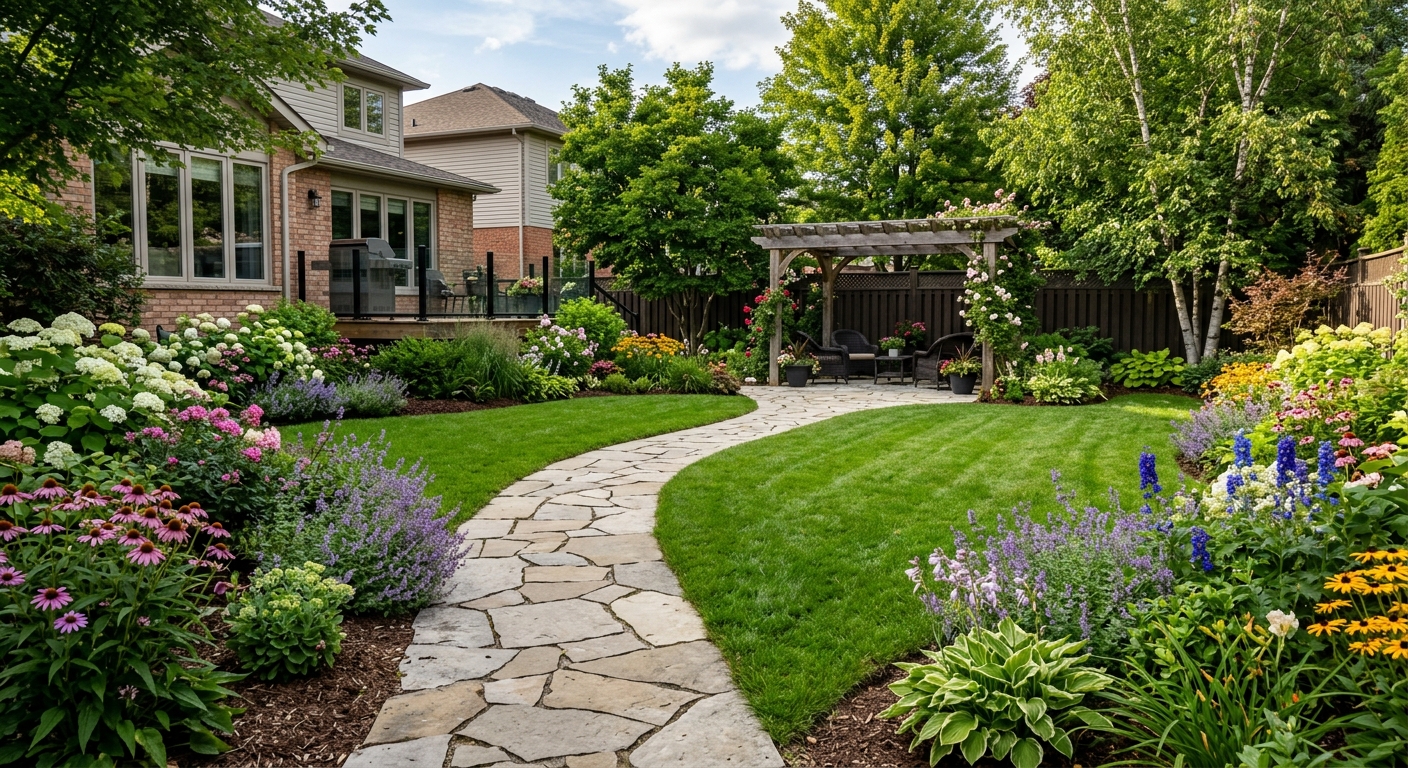
Landscaping options and costs in Chilliwack
Chilliwack homeowners often start landscape planning with the big question: what will it actually cost for a property that looks great year-round? With 93,203 residents and 72.1% of households owning (Statistics Canada, 2021 Census), many families invest in their yards—especially because single-detached houses make up 53.9% of dwellings, meaning there’s typically room for layered planting, patios, and drainage upgrades. Just as importantly, the Lower Mainland–Southwest climate (plant hardiness zones 7–8) and the region’s long, cool growing season affect labour availability and material choices. Mild, wet winters and early spring frost timing mean projects can run for much of the year, but structural work still needs freeze–thaw protection for patios and retaining walls on sloped sites. In neighbourhoods such as Sardis (and parts of Promontory), landscaping demand is especially strong because older homes and growing family lots often need both curb appeal upgrades and practical drainage fixes.
When you compare quotes, the range is wide: a simple refresh (mulch, shrubs, topsoil, grading) may land near the lower end of design & installation estimates, while a full layered plan with irrigation, hardscape, and mature specimen planting can approach the upper end. That’s why it helps to price each scope line-by-line, not as one “lump sum.” Use the table below as a realistic starting point for Chilliwack pricing by service and season.
| Service |
Description |
Season |
Price Range |
| Full landscape design and installation |
Site assessment, concept + planting plan, grading/drainage coordination, labour and materials for softscape and hardscape |
Spring to fall (winter work limited; structural may be weather-dependent) |
$5,000–$50,000 |
| Sod installation (supply, grade, lay, roll) |
Remove weeds/debris, fine-grade, soil amendments as needed, lay sod, roll, starter irrigation setup |
Late spring to early fall (best when soil temps are favourable) |
$2,000–$8,000 |
| Lawn seeding (grade, seed, starter fertilizer) |
Light grading, seed blend selection for the area, starter fertilizer, raking and establishment watering plan |
Spring (after frost) or early fall |
$1,200–$4,500 |
| Interlocking patio or walkway |
Excavate, base (crushed gravel + compaction), edging, sand setting bed, pavers, jointing sand |
Spring to fall; allow for wet-week scheduling |
$10,000–$40,000 |
| Retaining wall (interlocking block) |
Layout, excavation, geotextile, drainage/gravel, block placement, cap/finishing, tie-in to grade |
Spring to fall (wet-site drainage planning is key) |
$12,000–$65,000 |
| Tree and shrub planting |
Soil prep, amendments, layout, planting, staking (as needed), mulch ring, establishment watering guidance |
Spring and fall (best root establishment window) |
$1,000–$15,000 |
Prices are estimates only and vary by project scope, site access and material selection.
What affects the price of landscaping in Chilliwack
In Chilliwack and across the Lower Mainland–Southwest, quotes for the same “basic” landscaping idea can differ by 30–50% because contractors price risk, schedule, and site conditions differently. A full design and install can still start in the mid five-thousands, but once you add proper drainage, re-grading, irrigation, and labour-intensive hardscape, the job may approach the top end of the local market bands. The reason is simple: zone 7–8 coastal BC planting palettes can stay lush for longer, which supports more detailed, layered designs, yet heavy rain and saturated soils can slow excavation and require additional drainage work to keep foundations and slopes stable. By contrast, Prairie regions (Zones 2–4) have short frost-free windows and wind exposure, so projects often pivot toward drought-tolerant, low-maintenance options and compressed construction schedules; that changes both materials and labour pricing. In the dry BC interior and Alberta, water restrictions push irrigation toward efficient systems, and retaining wall bases must reach below the local frost depth to reduce frost heave—an engineering-and-excavation cost driver.
Even within Chilliwack, local conditions move price quickly. Example one: if your lot needs more than simple top-up grading (common on older sloped properties), the added excavation and hauling can shift a softscape plan into the next price tier inside the $5,000–$50,000 design & installation band. Example two: choosing sod can raise cost materially—sod installation is typically in the $2,000–$8,000 range—because you’re paying for turf and installation labour, not just seed and fertilizer. Example three: homes built before 1981 are a large share of housing stock in the area, and older drainage patterns often need correction; that’s where drainage bed and French drain installs can add significant cost relative to cosmetic updates.
| Price Factor |
Why It Matters |
Cost Impact |
| Yard size in sq ft — the primary cost driver for softscape |
More area means more soil prep, labour hours, mulch/seed or sod, and plant quantities |
Major; can change total by 2–4x |
| Grading and drainage work — slope corrections add significant cost |
Fixing pooling and directing water away from the foundation requires excavation and re-compaction |
High; often the biggest variable after size |
| Drainage bed or French drain installation |
Perforated pipe, gravel sizing, geotextile, cleanouts and tie-ins are labour- and material-intensive |
Medium to high; commonly adds thousands |
| Plant material tier — native shrubs vs. ornamental vs. mature specimen trees |
Mature trees and premium ornamentals cost more and require careful handling and staking |
Medium to high; can swing the budget quickly |
| Hardscape vs. softscape ratio — walls and patios cost more per sq ft than lawn |
Pavers/blocks need deeper excavation, base materials, edging, and compaction |
High; patio/wall-heavy plans rise faster |
| Irrigation system design and installation |
Drip vs. sprinkler zones, controllers, backflow needs, and trenching affect cost |
Medium; can be a major add-on |
| Soil amendment and topsoil required |
Poor native soil may need compost, aeration, and sometimes bring-in topsoil |
Low to medium; rises with rework volume |
| Tree removal or stump grinding before new planting |
Access, disposal, and equipment time increase labour and scheduling cost |
Medium; often adds time and hauling |
Permits & regulations in British Columbia
In British Columbia, most planting, sodding, and typical softscape work does not require a permit. That includes installing shrubs and trees, laying sod, seeding lawns, placing mulch, and most patio/gravel walkway builds when they don’t change structural elements of the property. Where permitting commonly enters the picture is with retaining walls above the local threshold height—typically 1.0 m (3.3 ft) in many municipalities—because these walls can be treated as structural or safety-related. You should also expect permits and/or engineered drawings for certain wall conditions (for example, higher walls, complex soil conditions, or walls that retain significant height on a steep lot).
Another permitting trigger is changes to lot grading that affect drainage—especially if it redirects water toward neighbouring properties or connects to storm systems in a way that needs approval. Before any digging for planting holes, footings, or drain lines, confirm utility locates (BC One Call) so you don’t hit buried services. Finally, check local irrigation and water-use bylaws. Even though Chilliwack can have reliable precipitation, municipal rules can still tighten during dry periods, and that influences how we design efficient systems like drip or smart controllers.
To verify your contractor in Chilliwack, ask for: (1) proof of relevant BC trade eligibility/registration if applicable to their work scope, (2) a current certificate of liability insurance naming you as an additional insured where required, and (3) workers’ coverage confirmation (WSBC/WCB) for anyone who will be on-site. Look for these in their online presence/registry entries, their insurance certificate (date-stamped), and their clear written coverage letter or policy confirmation.
Planning a landscape that thrives in Chilliwack's climate
Designing in Chilliwack is about working with zones 7–8, a wet-and-mild winter pattern, and frost timing that supports long establishment windows. Start with plant selection: choose native or well-adapted species that can handle the region’s cool winters and periodic wet spells without constant winter protection. In practice, that usually means layering shrubs and perennials with mulch, selecting plants that tolerate winter moisture, and spacing for airflow to reduce disease pressure in humid, foggy stretches.
For lawn establishment, sod vs. seed is less about preference and more about schedule and budget. Sod gives instant curb impact and quicker erosion control, but it generally costs 3–4 times as much per square foot as seeding once you include labour and material. If you want fast results and you have slope or heavy foot traffic, sod can be worth it. For example, if your lawn refresh is likely in the $2,000–$8,000 sod range, but you can tolerate a longer establishment period, seeding might fit closer to the lower band (often in the $1,200–$4,500 range), letting you redirect savings into drainage and irrigation.
Drainage and grading are non-negotiable in the Lower Mainland–Southwest. Pooling water can saturate soil and stress roots; it can also affect foundations. We typically design small slopes and swales so water moves away from buildings. For hardscape like patios and retaining walls, proper base preparation matters for freeze–thaw cycles: bases must be excavated deep enough, properly drained, and compacted so pavers and blocks don’t heave. Finish with low-maintenance strategies—groundcovers, mulch, and long-blooming perennials—plus rain-garden pockets where downspouts or yard runoff collect. If you want drought resilience for summer dry spells, consider xeriscape-style plant groupings supported by drip irrigation and efficient controllers.
| Element |
Climate Consideration |
Maintenance Level |
Price Band |
| Sod lawn installation |
Establishes quickly in Chilliwack’s cool, workable seasons; still needs good drainage so it doesn’t stay waterlogged |
Low to medium (watering during establishment; mowing) |
$2,000–$8,000 |
| Native perennial garden |
Adapts to zone 7–8 conditions and reduces winter protection needs; benefits from mulch during wet winters and cooler summers |
Low (seasonal pruning and occasional weeding) |
$2,500–$10,000 |
| Mulched shrub border |
Helps stabilize soil and reduce splash/disease; supports consistent moisture during wet months and helps regulate soil temperature |
Low (top-ups and light trimming) |
$1,500–$7,500 |
| Interlocking stone patio |
Requires proper base and drainage to resist movement from freeze–thaw and heavy winter rains |
Low (occasional cleaning; joint sand top-up over time) |
$10,000–$40,000 |
| Retaining wall (block) |
Needs drainage gravel and correct base depth; essential for slopes common in Chilliwack |
Low (visual checks; clearing weep/drain outlets) |
$12,000–$65,000 |
| Drip irrigation system |
Efficient for watering during summer dry spells and supports water-wise planting choices |
Low (seasonal adjustments; controller updates) |
$2,000–$12,000 |
How to choose a landscaping contractor in Chilliwack
Choosing the right contractor in Chilliwack usually comes down to proof, clarity, and schedule realism. First, verify British Columbia coverage and credentials that fit the scope: ask for their liability insurance certificate (current dates, policy limits, and whether you’re listed as additional insured where applicable), and confirm workers’ coverage through WSBC/WCB so you’re not exposed if a worker is injured on-site. Where relevant, ask whether their trade eligibility matches the work being proposed (especially for hardscape drainage and wall-related structural considerations). If they can’t provide documents quickly, that’s a red flag.
Next, request 2–3 itemised written quotes—broken into labour and materials (excavation, base materials, soil amendments, pavers/blocks, plants, irrigation parts, topsoil and disposal). Avoid “one-line” lump sums unless the scope is truly identical. Read what’s included: permit pull (if required), disposal of excess soil, utility locates coordination, and whether drainage tie-ins are included or only “surface grading.” For warranties, confirm the workmanship warranty length, any exclusions, and whether product warranties from suppliers transfer to you.
Finally, payment schedule matters. Don’t pay more than 10–15% upfront for materials mobilization, and hold back a portion until completion and cleanup are verified. Get a start date and a completion estimate in writing, and ask how the contractor plans around wet weeks common in the Lower Mainland–Southwest.
- Ask for licence/eligibility details relevant to the work scope and confirm they match your project.
- Request liability insurance certificate and verify it covers outdoor construction activities.
- Confirm WSBC/WCB clearance for workers who will be on-site.
- Get 2–3 itemised quotes with labour/material breakdown (not just totals).
- Verify line items for drainage: pipe size, gravel specs, geotextile, and tie-in locations.
- Ask whether utility locates are booked before digging and who coordinates them.
- Clarify what’s included in base prep for patios and retaining walls (excavation depth, compaction).
- Confirm disposal/haul-away is included for excess soil and debris.
- Check plant lists by Latin name and size (e.g., pot size/gallon size) and substitution rules.
- Review irrigation scope: which zones, head type vs drip, controller model, and testing.
- Ask for workmanship warranty terms and what qualifies under warranty service.
- Use a payment schedule with only 10–15% upfront and a holdback until final walk-through.
Concrete red flags: vague scope language (“as needed”), no itemised pricing, refusal to provide insurance/coverage documentation, change-order-heavy quoting with unclear assumptions, and crews starting before a signed agreement and site plan are finalized—especially on drainage and wall-related work that can’t be “figured out later.”
Frequently asked questions — landscaping in Chilliwack
How deep should a retaining-wall base be for local frost?
For retaining walls in Chilliwack, the base depth is determined by local frost considerations, site drainage, and soil type—not just a single “standard” number. Because the Lower Mainland–Southwest has freeze–thaw cycles, we excavate and build the base deep enough to place proper compacted material below the frost-impacted zone, then we add drainage gravel and geotextile so water doesn’t saturate the wall system. In practice, many contractor builds land in the deeper excavation range compared to shallow garden borders, especially where there’s a slope and heavier winter rainfall. The exact depth depends on wall height, soil conditions, and whether the design includes reinforcement. Get a written wall design spec from your contractor so you can confirm excavation and drainage details before work starts.
How much does professional landscape design cost?
Landscape design cost can vary widely based on whether you need design-only or design plus installation. In the Chilliwack market, a full landscape design and installation project commonly falls within the $5,000–$50,000 band depending on scope—size, hardscape, irrigation, and plant maturity. If you want design services only (plan drawings, plant list, and layout), many companies price that separately, but it still typically scales with complexity and site challenges such as drainage correction or steep grading. A key tip: ask whether your design fee is credited back toward installation. Also make sure the quote clarifies what the design includes (lighting, irrigation concept, grading notes) so the final build matches the plan—particularly important on older housing stock where drainage often differs from current expectations.
How do I compare landscaping quotes?
To compare landscaping quotes in Chilliwack, use the same checklist for each bid: itemised labour and materials, defined scope boundaries, and clear exclusions. Look for details like excavation depth, base material types, and compaction expectations for patios or retaining walls, plus drainage specifications (pipe, gravel, geotextile, cleanouts). For lawn work, confirm whether the estimate is for sod installation (often $2,000–$8,000 depending on area) or seeding with starter fertilizer. For planting, compare plant sizes and substitutions—ask for Latin names and container sizes, not “similar species.” Finally, check irrigation scope (drip vs sprinkler, number of zones, controller model). If one quote is significantly lower, it often means something major—like disposal, drainage tie-ins, or permit-related steps—has been left out.
How long does a landscaping project take in Chilliwack?
Project duration depends on weather windows, site access, and how much structural work is included. Softscape-only updates (mulch, shrub borders, planting) can often be completed faster because they’re less weather-sensitive than excavation-heavy hardscapes. Sod or seeding schedules also depend on establishing conditions after last spring frost, which near the coast is typically early March to early April. Hardscapes like interlocking patios and retaining walls need time for excavation, base building, compaction, and drainage install—plus curing or settling time where relevant. In Lower Mainland–Southwest conditions, wet weeks can extend timelines, especially when soil can’t be compacted properly. A good contractor will give you a start date and a completion estimate in writing, and will explain their plan if heavy rain delays excavation or grading.
What is the best grass type for a Chilliwack lawn?
For Chilliwack, the “best” grass type is usually a cool-season turf mix suited to zones 7–8 and the region’s cool, wet winters. Many homeowners do well with a blend of fescues for toughness and shade tolerance, often paired with perennial rye depending on sun exposure and traffic. If you’re installing sod, ask your contractor what turf variety is being used and whether it matches your light conditions (front yard sun vs shaded side yard). If you’re seeding, ensure the seed blend includes starter fertilizer and that the contractor provides an establishment watering plan—especially because consistent moisture early on improves germination and reduces patching. Regardless of type, correct grading and drainage are what prevent long-term problems like thinning and moss buildup.
When should I aerate and overseed my lawn in Chilliwack?
In Chilliwack and across the Lower Mainland–Southwest, aeration and overseeding are typically most successful in spring after the last frost window and again in early fall when temperatures are cooler and the lawn is actively growing. Aeration helps relieve compaction, improves oxygen and water movement, and allows seed-to-soil contact—especially important if your lawn has heavy foot traffic or older soil. Overseeding should be paired with starter fertilizer and a watering routine that keeps the seedbed consistently moist until germination. Avoid aeration right before extended heavy rainfall periods when drainage is poor, because saturated soil can reduce seed establishment. If your lawn is very waterlogged, fix grading/drainage first; otherwise even good seed won’t perform as expected.