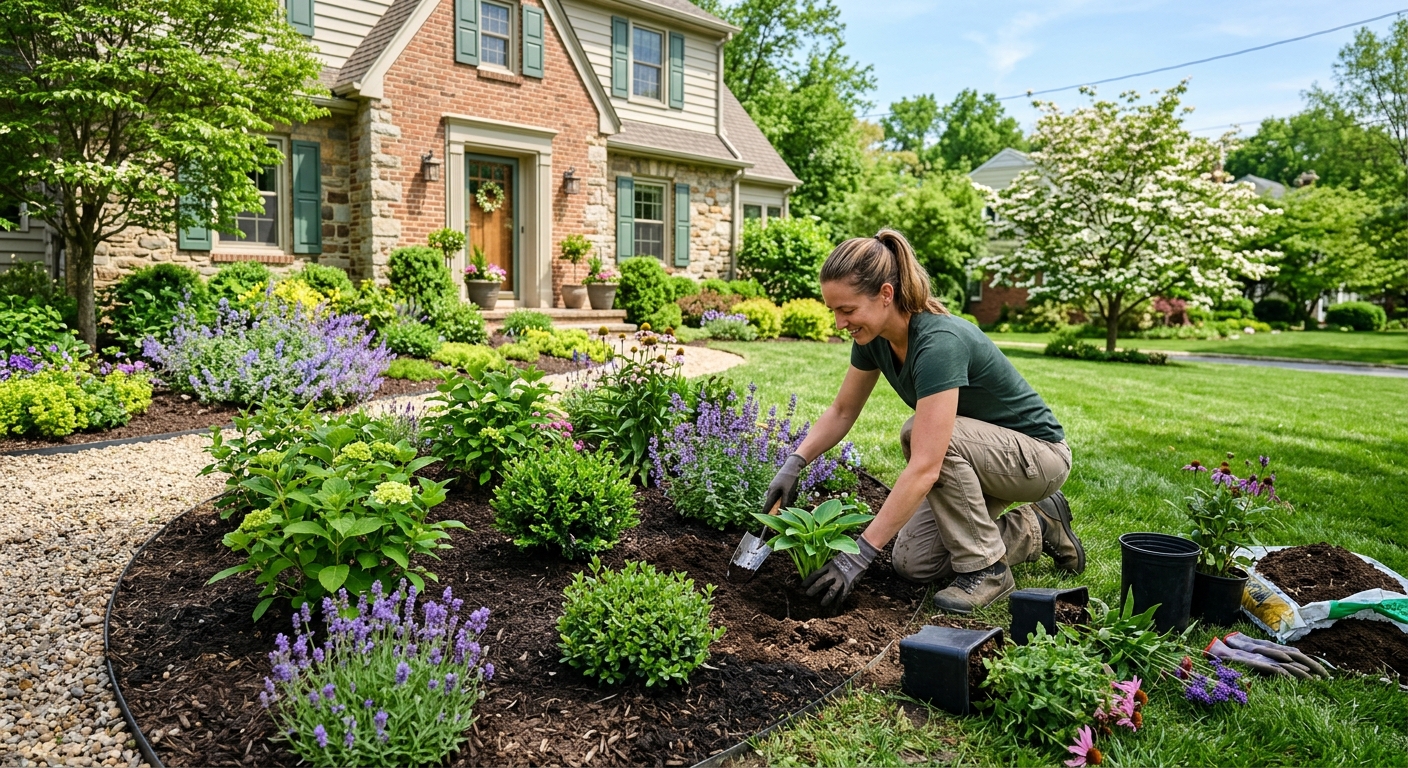
Landscaping options and costs in Brantford
Brantford homeowners typically have a lot of landscaping choices, from quick lawn renewal to full yard makeovers—especially since the city has a strong base of homeowner households (27,505, or 66.0% of households own) and many properties with the space to invest. With 60.6% of dwellings being single-detached houses, it’s common for lawns, gardens, and hardscapes to be planned together for curb appeal and everyday usability.
In the Hamilton–Niagara Peninsula region (hardiness zones 6b–7a), our season is solid but not endless. Frost-free growing usually runs from late April/early May to mid–October, so softscape installation windows (sod, planting, soil prep) strongly influence scheduling and contractor availability. Winter freeze–thaw and occasional saturated spring soils also affect pricing for patios and retaining walls, because base depth, compaction, and drainage detail aren’t optional if you want to reduce heaving and movement.
In Brantford, this work is especially in demand around West Brant, where established neighbourhoods and mature lots often need updates to drainage, tree trimming, and interlocking stone walkways. If you’re comparing options, the most useful way is to look at typical cost ranges by service level, then decide what scope matches your yard and timeline—so let’s line up the most common projects in a pricing table below.
| Service |
Description |
Season |
Price Range |
| Full landscape design and installation |
Site assessment, concept to planting plan, soil prep, grading/drainage as needed, planting, lawn/groundcover, and hardscape where included |
Late April/early May to mid–October (spring start is common) |
$5,000–$50,000 |
| Sod installation (supply, grade, lay, roll) |
Topsoil/grade correction, base prep, sod delivery, laying pattern, rolling, and starter watering guidance |
May to early July for best establishment |
$2–$7 |
| Lawn seeding (grade, seed, starter fertilizer) |
Light grading, seed selection for sun/shade, starter fertilizer, raking, and first watering schedule |
April/May and again in late summer (early September) where feasible |
$2–$7 |
| Interlocking patio or walkway |
Excavation, base and compaction, geotextile, sand setting bed, interlocking stone, edge restraints, and finishing |
May to October (weather-dependent for base work) |
$40–$150 |
| Retaining wall (interlocking block) |
Wall layout, excavation, drainage behind wall, block installation, backfill and compaction |
May to October |
$40–$150 |
| Tree and shrub planting |
Soil improvement, planting pits, amendments, staking where needed, mulch rings, and post-plant watering plan |
Spring to early fall (after frost risk) |
$50–$1,500 |
Prices are estimates only and vary by project scope, site access and material selection.
What affects the price of landscaping in Brantford
In Brantford and across the Hamilton–Niagara Peninsula, quotes for the “same” landscaping job can easily diverge by 30–50%. The difference usually comes down to what’s hidden in the scope: how much grading is required, whether drainage work is necessary, the maturity of plants, and the depth/quality of hardscape bases for freeze–thaw durability. Even labour availability can shift pricing during peak season (late spring to early summer), because crews are scheduling around the same frost dates and weather windows.
Zone 6b–7a matters because it defines both what survives the winter and how long you can install. In prairie regions (Zone 2–4), contractors often need drought-tolerant, wind-hardy species and more rigid drainage assumptions; in coastal BC (Zone 7–8), the long growing season supports lush palettes but heavy rainfall still demands excellent drainage engineering. In southern Ontario, we typically don’t face the strict irrigation limits seen in dry BC interior areas, but we do plan for summer dry spells—especially if your soil is clay-heavy or sandy.
Concrete cost examples you’ll see locally: (1) a modest grade correction for ponding behind a garage can add significant labour and trucking, pushing a small patio project toward the higher end of $40–$150 per unit pricing; (2) replacing compacted topsoil with proper topsoil and amendments can add line items even when the visible plants look the same; (3) if you’re building a retaining wall as part of a backyard regrade, wall base preparation and drainage behind the wall are where costs rise quickly, even before you buy block. With many Brantford homes built before 1981 (62.8%), older lots commonly have established drainage patterns that need updating, and that can add excavation and rework to what would otherwise be a straightforward installation.
| Price Factor |
Why It Matters |
Cost Impact |
| Yard size in sq ft — the primary cost driver for softscape |
More area means more labour time for prep, more sod/seed, and more material for mulch/soil |
Low-to-high spread depending on coverage (often the biggest swing) |
| Grading and drainage work — slope corrections add significant cost |
Fixing uneven grades reduces pooling and protects foundations |
Can add substantial labour, equipment time, and haul-away |
| Drainage bed or French drain installation |
Necessary when water won’t infiltrate or when downspouts discharge near the house |
Raises cost through trenching, pipe, gravel, and tie-in work |
| Plant material tier — native shrubs vs. ornamental vs. mature specimen trees |
Hardier natives are often more predictable; mature trees carry higher purchase and planting time |
Can shift a planting budget widely within $50–$1,500 per plant/area |
| Hardscape vs. softscape ratio — walls and patios cost more per sq ft than lawn |
Hardscapes require excavation, base aggregates, and compaction layers |
Often pushes overall project cost toward the higher landscape design & install band |
| Irrigation system design and installation |
Targets root zones and prevents winter kill from poor establishment watering patterns |
Adds equipment and controls; can materially increase softscape budgets |
| Soil amendment and topsoil required |
Clay soils need structure; sandy soils may need moisture retention improvements |
Cost increases with hauling quantity and test/verification steps |
| Tree removal or stump grinding before new planting |
Clearing impacts schedule and may be required for safe excavation |
Can add equipment and labour, especially on tight-access lots |
Permits & regulations in Ontario
For most typical yard work in Ontario, you generally don’t need a permit to plant, sod, or install standard softscape features. Turf installation, planting beds, mulch, and walkways/patio surfaces are usually handled without permits, provided you’re not making major changes to drainage that could affect neighbouring lots or stormwater systems.
What does require a permit in Ontario is commonly retaining-wall work once the wall is above the municipal threshold—often around 1.0 m (3.3 ft) in many municipalities—because it can be treated as a structural/retaining element. In some cases, engineered drawings are required, depending on height, soil conditions, and design. Also, any substantial changes to lot grading (especially where it alters drainage flow toward adjacent properties or ties into storm sewer infrastructure) may trigger approval requirements.
Step-by-step for Brantford homeowners: (1) ask the contractor what permits (if any) they pull for retaining walls and drainage tie-ins; (2) confirm utility locates are completed before digging—especially if you’re trenching for drains or installing footings; (3) check contractor insurance documentation before work starts; and (4) verify whether any water-use rules apply for your project timing (even though Brantford isn’t under BC-style rationing, contractors should still follow local bylaws and smart watering practices during drought-like conditions).
Finally, you don’t have to guess—confirm the permit requirement with the city’s planning/building info for your exact wall height and grading change, and ensure the contractor’s scope matches what’s approved.
Planning a landscape that thrives in Brantford's climate
To plan a landscape that thrives in Brantford, design around our hardiness range (zones 6b–7a), our freeze–thaw cycle, and the fact that most practical planting and sod timelines start after late spring frost risk and run to mid–October. Good plant selection is the foundation: choose native and zone-appropriate shrubs, perennials, and grasses that keep working through summer dry spells and handle winter wind exposure with less ongoing effort. Where possible, prioritize deep-rooting species and mulch to moderate soil temperature and moisture.
For turf, sod and seed serve different goals. Sod gives instant visual coverage and faster stabilization, but it’s typically about 3–4x the cost per sq ft compared with seeding when you’re budgeting at the same grade quality. If you need the yard to look good quickly for a family event or early-season curb appeal, sod can be worth it; if you’re patient and want to control costs, seed is often the better fit—especially for repairs and over-sowing.
Drainage and grading are where Brantford projects succeed or fail. Hamilton–Niagara Peninsula soils can hold water and shift with freeze–thaw, so plan gentle slopes away from foundations, and use drainage beds/French drains where water pools. For patios and retaining walls, base preparation must reach below frost-influenced movement zones and use quality base aggregates and compaction—this is why hardscape budgets can be higher per sq ft than lawn work.
Low-maintenance design strategies—mulched shrub borders, groundcovers, and perennials with staggered bloom—reduce your annual upkeep without sacrificing curb appeal. If you want to lower irrigation demand, consider rain-garden pockets or xeriscape-inspired plantings (still using hardy zone-appropriate selections), paired with efficient drip irrigation for establishment.
As a simple dollar example: if you’re refreshing a small front area, investing closer to the sod band (often budgeted around $2–$7 per sq ft depending on materials and prep) may cost far more than seeding, but it can be justified when you need immediate usability. If you don’t, seeding at the same general price band often gives you a lower-cost path to long-term improvement—so long as drainage and grading are addressed first.
| Element |
Climate Consideration |
Maintenance Level |
Price Band |
| Sod lawn installation |
Best establishment from May to early July in zones 6b–7a; protect from late frost stress and early drought |
Medium during first season; low after roots knit in |
$2–$7 |
| Native perennial garden |
Hardy winters and freeze–thaw benefit from mulch and well-drained planting areas |
Low to medium (weeding and cutbacks once per year) |
$50–$1,500 |
| Mulched shrub border |
Wind exposure and spring thaw benefit from soil structure and consistent mulch rings |
Low (pruning yearly, replenishing mulch as needed) |
$50–$1,500 |
| Interlocking stone patio |
Needs a freeze-resistant base, proper edging restraint, and drainage to prevent heave |
Low (occasional cleaning and minor joint top-up) |
$40–$150 |
| Retaining wall (block) |
Back drainage and proper base are critical under repeated freeze–thaw and spring saturation |
Low after build; higher if repairs are needed from weak drainage |
$40–$150 |
| Drip irrigation system |
Targets root zones during Brantford summer dry spells; helps with establishment timing |
Medium (seasonal checks and winterization) |
$5,000–$50,000 |
How to choose a landscaping contractor in Brantford
Choosing the right landscaping contractor in Brantford comes down to verifying credentials, matching the scope to your yard conditions, and protecting yourself with clear paperwork. First, confirm the company is properly licensed/registered for the work they’re doing in Ontario (requirements vary by activity), and ask for proof of liability insurance and WSIB/WCB coverage. How to check: (1) look up the business in Ontario’s public online registries (if applicable for their category); (2) request a certificate of insurance that lists the insured parties and coverage amounts; and (3) confirm WSIB/WCB status using the clearance/coverage letter they provide.
Next, get 2–3 itemised written quotes. You want breakdowns for labour and materials (base aggregate, geotextile, pipe/drainage stone, sod/seed, and plant quantities). A lump sum without detail makes it harder to compare contractors fairly and increases the chance of hidden exclusions. Read the scope for what’s not included: permit pulling (if required), disposal/haul-away, topsoil sourcing, what happens if excavation reveals unsuitable subsoil, and whether downspout extensions or drainage tie-ins are included.
Warranty should be in writing. Ask about workmanship warranty length (for grading, drainage performance, interlocking base settlement, and plant establishment), manufacturer warranties for products, and whether warranties are transferable if you sell. For payment schedule, never pay more than about 10–15% upfront—hold the remainder until key milestones are complete. Finally, insist on a written timeline: start date, weather contingencies, and an estimated completion date.
- Request proof of liability insurance before work begins, not after.
- Confirm WSIB/WCB clearance/coverage status in writing.
- Get itemised quotes with quantities (sq ft, linear ft, and plant counts).
- Ask who performs utility locates and whether it’s included in the price.
- Clarify haul-away and disposal for excess soil and old sod.
- Confirm topsoil source and amendment type (not “generic compost”).
- For hardscapes, require base thickness and compaction approach.
- Verify drainage details behind retaining walls (backfill + weeping/drainage plan).
- Ask about edging restraints for patios/walkways to prevent spread.
- Check whether irrigation (if planned) includes controllers and winterization.
- Confirm who is responsible for any required permits (retaining wall thresholds).
- Put warranty terms in writing, including start date and claim process.
Common red flags in Brantford: (1) a quote that doesn’t address drainage or grading at all; (2) refusing to provide insurance/WSIB documentation; (3) “savings” based on thin bases for patios/walls; (4) no written scope for what happens if excavation uncovers unstable soil; and (5) high upfront deposits (well above 10–15%) without milestone completion.
Frequently asked questions — landscaping in Brantford
What plants thrive in Brantford's climate zone?
In Brantford (zone 6b–7a), you’ll do best with hardy, zone-appropriate shrubs, perennials, and ornamental grasses that handle winter wind and repeated freeze–thaw. Common successes include native-style shrub groupings (serviceberry, smooth hydrangea types where suited, and hardy spireas), plus perennials like coneflower and daylilies, and ornamental grasses that keep structure through winter. If your home has older landscaping or established wind corridors, choose plants that tolerate drying winter winds and plan for mulch rings to protect crown areas. Since many Brantford homes were built before 1981 (62.8% per Statistics Canada, 2021 Census), yards often have mature trees and compacted soils—so prioritize soil improvement and proper planting depth for the best survival.
Sod vs seed — which is better for a Brantford lawn?
Sod is usually better when you need fast coverage and quicker stabilization—especially if kids, pets, or a social event require usable turf early in the season. Seeding is often the smarter choice when you’re budget-conscious and can manage establishment care. In pricing terms, both are commonly budgeted around the same overall “per sq ft” band you’ll see in quotes (for example, many estimates land in the $2–$7 range depending on prep and materials), but sod costs more because it includes supply and delivery and it’s labour-intensive to lay and roll correctly. Either way, lawn success depends on grading and drainage; if water pools in low spots, you’ll pay again later.
How much does a retaining wall cost in Brantford?
Retaining wall cost in Brantford depends heavily on height, linear feet, and whether drainage behind the wall is included. For budgeting, many interlocking block wall quotes are commonly positioned within the $40–$150 band as a per-unit reference, but your total can swing when excavation, base preparation, and back-drain systems are more involved. Freeze–thaw and spring saturation mean the drainage layer and proper base depth aren’t where you want to cut corners. If your wall needs permit-level work or engineered input (often when walls are around or above the typical 1.0 m threshold in Ontario municipalities), that can add to the total, so always ask for an itemised breakdown.
When is the best time to landscape in Brantford?
For most Brantford landscaping, the best window is late April/early May through mid–October, because zone 6b–7a conditions support establishment and reduce freeze risk. Spring is often ideal for planting trees and shrubs and installing most softscape work, while sod is typically best from May into early July to take root before summer stress. For seeding, some homeowners do an additional pass in early September for strong germination. Weather matters: crews may pause for saturated soil or heavy rain, and hardscaping like patios and walls depends on excavation conditions for base compaction. Planning around the frost-free stretch helps you avoid rework and improves survival rates.
Do I need a permit for a retaining wall in Ontario?
In Ontario, many standard planting and typical softscape projects don’t require permits, but retaining walls often do once they cross a height threshold—commonly around 1.0 m (3.3 ft) in many municipalities. If your wall is at or above that range, you may need a building permit and sometimes engineered drawings depending on soil conditions and design. Changes to lot grading that affect drainage toward neighbouring properties or storm sewer connections can also trigger approvals. For Brantford homeowners, the easiest path is to confirm the planned wall height and drainage tie-ins with your contractor upfront and ask whether permits are included in the scope.
How do I improve drainage in my yard?
Improving drainage starts with identifying where the water actually goes. In Brantford’s freeze–thaw conditions and with mixed clay/sandy soils, pooling often comes from low spots, compacted areas after construction, or downspouts discharging too close to the foundation. Common solutions include regrading to create a gentle slope away from the house, adding a drainage bed or French drain where water collects, and installing proper overflow paths for spring runoff. If you’re considering a retaining wall, insist on a back-drainage plan (it’s essential for performance). If you need hard numbers for budgeting, drainage and excavation work can be a key driver within broader landscape install pricing—so request an itemised quote rather than a single lump sum.