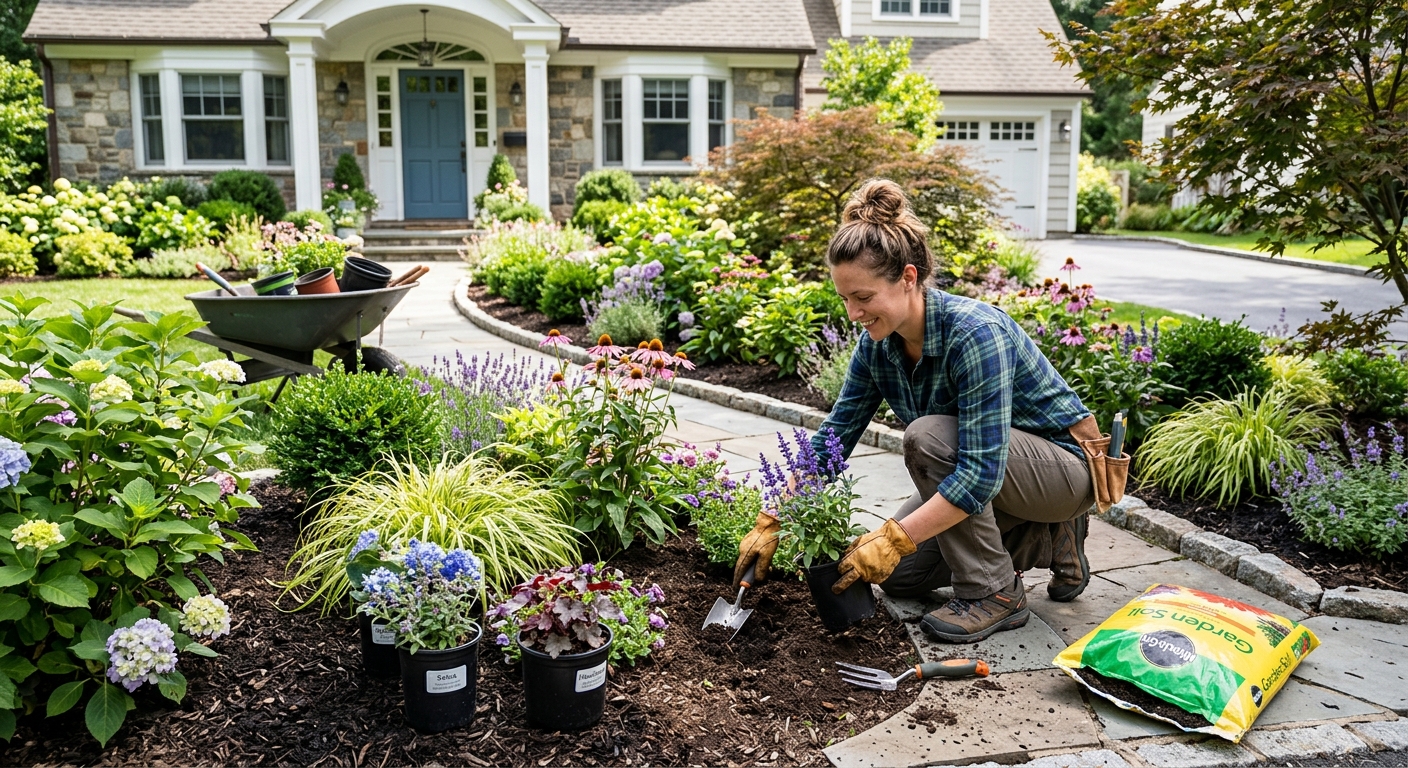
Landscaping options and costs in Parry Sound
Parry Sound is a picturesque place to live—and it’s also a place where your landscaping has to earn its keep against cold winters, freeze-thaw cycles, and a shorter practical planting window. With 53.6% of local dwellings being single-detached homes and homeowner households making up 59.8% of households (Statistics Canada, 2021 Census), many properties have the yard space to invest in more than “just grass.” That’s why you’ll see strong demand for patios, tree planting, and drainage upgrades in areas like downtown Parry Sound and the surrounding waterfront-influenced neighbourhoods, where grades and soil conditions can vary quickly street to street.
In Ontario’s Northeast region, pricing is shaped by climate reality and scheduling. Crews typically plan softscape and most planting from mid-to-late spring through early fall, and they’ll charge more for mobilization when weather compresses the calendar. In addition, Parry Sound’s older housing stock—69.6% of homes built before 1981 (Statistics Canada, 2021 Census)—often means existing grading, root systems, and foundation drainage details need extra attention. That can push projects upward into the $8,000–$30,000 design-and-install range, especially when drainage corrections are part of the scope.
Below is a clear comparison of common landscaping options and what homeowners in Parry Sound typically budget for, moving from entry-level lawn work to full-yard builds.
| Service |
Description |
Season |
Price Range |
| Full landscape design and installation |
Site assessment, grading plan, plant palette, irrigation layout (if needed), and coordinated installation of softscape and hardscape. |
Mid-late spring to early fall |
$8,000–$30,000 |
| Sod installation (supply, grade, lay, roll) |
Topsoil/grade correction, soil prep, sod supply, laying pattern, rolling, and initial watering instructions. |
Late spring to early fall |
$3,000–$9,000 |
| Lawn seeding (grade, seed, starter fertilizer) |
Minor grading, seeding mix selection, starter fertilizer, light raking/rolling, and watering guidance. |
Late spring or early fall |
$1,500–$4,500 |
| Interlocking patio or walkway |
Excavation, base compaction, leveling sand, pavers, edge restraints, and jointing sand. |
Late spring to early fall |
$6,000–$25,000 |
| Retaining wall (interlocking block) |
Block system, subbase design, drainage layer/weep holes (where required), compacted backfill, and finishing. |
Late spring to early fall |
$6,000–$25,000 |
| Tree and shrub planting |
Soil amendments, staking (as needed), planting, mulch rings, and an establishment-focused watering plan. |
Spring or early fall |
$1,500–$8,000 |
Prices are estimates only and vary by project scope, site access and material selection.
What affects the price of landscaping in Parry Sound
In Parry Sound, two contractors can quote the “same” landscaping job and still land 30–50% apart. The main reason is that Northeast Ontario work is driven by what the site forces you to do: frost-protected base depths, drainage corrections, and the compressed planting window that affects crew availability. A full backyard refresh might sound simple until you uncover poor drainage, heavy clay, shallow topsoil, or roots interfering with grading. Those factors change both labour hours and materials, and they also determine which plants can survive winter without costly replacements.
Climate influences both growth and buildability. Plant hardiness and frost timing define what you can plant and when—especially in Northeast conditions where winter cold and freeze-thaw cycles demand properly prepared bases. Prairie-like conditions in the broader Northeast market push designs toward hardy, wind-resistant, drought-tolerant choices; retaining wall base depth must reach below the frost line, which raises excavations and aggregate quantities. Coastal BC benefits from a longer season but often requires extra drainage design due to heavy rainfall—Southern Ontario, by comparison, usually has a more moderate season with irrigation needs mainly during summer dry spells. In Parry Sound, you’ll typically plan for drainage and freeze protection first, then match the planting palette.
Concrete examples from local jobs: (1) upgrading downspout routing and installing a drainage bed can shift a “nice garden” into hardscape-plus-excavation territory, often moving estimates into the $6,000–$25,000 retaining-wall/hardscape band; (2) swapping seeded lawn for sod can multiply cost even when the area is the same, commonly making budgets rise toward the $3,000–$9,000 sod band; and (3) adding mature specimen trees increases labour for handling and staking and can raise the $1,500–$8,000 planting budget. With many homes built before 1981, you also sometimes uncover older grading patterns that force rework of $1,000s in earthworks before any “pretty” elements go in.
| Price Factor |
Why It Matters |
Cost Impact |
| Yard size in sq ft — the primary cost driver for softscape |
More area means more soil prep, more material, and more labour hours for grading, laying, or seeding. |
Low to very high impact (commonly the biggest line-item change) |
| Grading and drainage work — slope corrections add significant cost |
Fixing slope to daylight or away from foundations requires excavation, rework, and verification of flow paths. |
Often +15% to +40% when major regrading is needed |
| Drainage bed or French drain installation |
Includes trenching, perforated pipe, filter fabric, clean stone, and outlet detailing. |
Frequently moves projects upward by several thousand dollars |
| Plant material tier — native shrubs vs. ornamental vs. mature specimen trees |
Hardiness, size, and transplant complexity determine product price and labour intensity. |
Mature specimens can double the planting line item |
| Hardscape vs. softscape ratio — walls and patios cost more per sq ft than lawn |
Pavers and retaining blocks require base compaction, bedding sand, and careful installation. |
Can shift the whole budget into the hardscape bands |
| Irrigation system design and installation |
Zones, backflow considerations, pipe runs, and control wiring raise both materials and labour. |
Often adds a mid-range “system” premium vs. hose-only watering |
| Soil amendment and topsoil required |
Heavy clay or poor topsoil needs amendments and depth to support roots and stable turf. |
Commonly +$1,000 to +$3,000 depending on depth and delivery |
| Tree removal or stump grinding before new planting |
Stump grinding depth, debris hauling, and root disruption affect schedule and disposal. |
Can add several thousand dollars and change planting phasing |
Permits & regulations in Ontario
In Ontario, most routine landscaping activities—like planting beds, sodding, and standard softscape work—typically do not need a permit. That said, the moment you start changing structural elements or lot drainage patterns, rules can apply. For example, a retaining wall above a local height threshold—often 1.0 m (3.3 ft) in many municipalities—can require a building permit and sometimes engineered drawings, especially if it’s retaining significant soil load. Also, changes to lot grading that affect drainage direction toward neighbouring properties or storm connections may require approval.
Here’s a homeowner-friendly way to think about it:
- Usually no permit: adding mulch, planting trees and shrubs, laying sod or seed, installing low garden edging, and building typical walkways/patios (where they don’t trigger structural grading or municipal requirements).
- Often permit-triggering: retaining walls above the local threshold, any structural excavation affecting drainage, and grading changes that redirect surface water.
- Always do this before digging: request utility locates to identify buried services before post holes, wall footings, trenching, or irrigation runs.
To verify contractor compliance in Parry Sound, ask for documentation before work starts: (1) proof of Ontario licensing where applicable to your contractor’s trade (and read their business details for accuracy), (2) a current certificate of liability insurance showing adequate coverage for your project site, and (3) proof of WSIB/WCB coverage where required. If you want extra certainty, request a clearance letter or account verification statement and make sure the certificate lists the correct legal business name and active coverage dates.
Planning a landscape that thrives in Parry Sound's climate
Planning for Parry Sound means designing for winter survival and spring recovery, not just “summer beauty.” Start by selecting plants that fit the local hardiness reality and will establish during the milder window. In practice, that usually means choosing native and zone-appropriate species, then using mulch and spacing to reduce stress in cold months and wind-exposed corners. For many homeowners, this is where the “best long-term value” shows up: fewer winter die-backs and less replanting over multiple seasons.
Next, decide between sod and seed. Sod gives instant results, but it’s often 3–4x the cost per square foot compared with seeding once you include prep and materials. In Parry Sound budgets, that means sod projects commonly land in the $3,000–$9,000 range, while seeding is frequently budget-friendlier when you can tolerate a slower timeline.
Drainage and grading are the make-or-break items in Northeast Ontario. Pooling water and foundation moisture are not “cosmetic problems”—they’re root-health and structural problems. Ensure surface water flows away from the house, and for patios and walls, prepare the base for freeze protection with properly compacted aggregates and correct thickness. If you’re adding an interlocking patio or walkway, the base construction is where crews earn their pay: freeze-thaw can heave poorly built edges.
For low-maintenance design, rely on groundcovers, a mulched shrub border, and a small, repeatable set of hardy perennials. Consider rain-garden corners where downspout water concentrates, using amended soil and robust plants to absorb and slow runoff. A concrete example: if you’re deciding between an ornamental display and a drainage fix, spending toward a French drain or improved grading often prevents repeated lawn patching and saves you money over 3–5 seasons—especially on older properties where hidden grade issues were common before 1981.
| Element |
Climate Consideration |
Maintenance Level |
Price Band |
| Sod lawn installation |
Best placed when soil is workable in spring/early fall; needs reliable establishment watering before deep freezes. |
Low to moderate (first season requires consistent watering) |
$3,000–$9,000 |
| Native perennial garden |
Hardy perennials reduce winter loss; mulch and wind-tolerant siting improves survival. |
Moderate (seasonal pruning and spring cleanup) |
$1,500–$6,000 |
| Mulched shrub border |
Evergreens and hardy shrubs handle cold winds; correct spacing improves airflow and reduces winter damage. |
Low (annual mulch refresh, occasional shaping) |
$2,000–$7,000 |
| Interlocking stone patio |
Freeze-thaw needs engineered-style base prep; proper drainage beneath prevents heaving. |
Low (sweep/weed control, periodic joint sand top-up) |
$6,000–$25,000 |
| Retaining wall (block) |
Needs compacted backfill and drainage layer below frost-affected zone. |
Low (inspection and clean-out of drainage openings as needed) |
$6,000–$25,000 |
| Drip irrigation system |
Long winters mean no watering late season; drip reduces water waste during the warmer window. |
Moderate (winter shut-down and occasional nozzle checks) |
$2,000–$8,000 |
How to choose a landscaping contractor in Parry Sound
Choosing the right contractor in Parry Sound starts with verification. For Ontario coverage, ask for proof of liability insurance (a current certificate that includes your property address if possible) and confirmation of WSIB/WCB coverage for workers. For trade licensing, request the contractor’s business details and any applicable Ontario registration information, then cross-check that it matches the company name on the quote and invoice. If they can’t provide paperwork quickly, that’s often a signal.
Next, get 2–3 itemised written quotes that separate labour and materials. You want line items for excavation and base prep, disposal/haul-away, soil/topsoil, pavers or blocks, and planting material. A lump sum can hide the real cost drivers—like whether grading and drainage corrections are included, or whether the patio base is built to a proper frost-aware depth.
Read scope carefully: does the quote include permit pull if required (for example, some retaining wall projects may require it depending on height), and is disposal included for soil and debris? Ask about warranties in two parts: workmanship warranty length and what product/manufacturer warranty covers. Also clarify whether warranties are transferable if you sell the home.
Payment schedule matters. A common best practice is never paying more than 10–15% upfront, with progress payments tied to completed stages, and a holdback until final cleanup and walk-through.
- Request an insured, dated quote with your address and scope boundaries.
- Confirm liability insurance and WSIB/WCB coverage dates are current.
- Ask what’s included for excavation depth and disposal/haul-away.
- Clarify grading goals: away from foundation and toward approved outlets.
- For patios/walkways: confirm base materials and compaction process.
- For retaining walls: ask about drainage layer, weep provisions, and backfill.
- Check plant list for hardiness suitability and spacing plan.
- Verify how irrigation (if included) will be zoned and winterized.
- Ask for start date, milestones, and estimated completion window in writing.
- Confirm warranty terms for both labour and materials.
- Ensure site protection measures (safety mats, erosion control) are described.
- Require a final walk-through checklist before final payment release.
Red flags we see around Parry Sound: quotes without drainage/base details, insisting on “payment in full” before completion, no proof of insurance or WSIB/WCB, unclear disposal responsibilities, and vague timelines (“we’ll fit it in”) without written start and finish expectations.
Frequently asked questions — landscaping in Parry Sound
What plants thrive in Parry Sound's climate zone?
In Parry Sound and much of Northern Ontario, success comes from choosing hardy, cold-tolerant plants that handle wind, snow load, and freeze-thaw. Homeowners typically do best with native or zone-appropriate shrubs and perennials, plus evergreens for structure through winter. Because many Parry Sound homes were built before 1981, you’ll also want plants that tolerate older soils and occasional drainage stress—so we often recommend mulched borders with good soil amendment and careful spacing. If you’re building a shrub border on a slope, choose strong root-forming species rather than delicate ornamentals that may struggle after winter stress. For planting budgets, many projects land in the $1,500–$8,000 tree and shrub planting band depending on how many shrubs, whether you include a few small trees, and how much soil work is required (Statistics Canada, 2021 Census).
Sod vs seed — which is better for a Parry Sound lawn?
Sod is usually the better choice when you want fast curb appeal and can commit to establishment watering right after installation. In Parry Sound, sod success depends on correct grading and soil prep, not just laying rolls. Seeding works well when you can manage a slower timeline and you’re okay with the lawn filling in gradually; it’s also often more budget-friendly for larger yards. As a price reference, sod installation commonly budgets around $3,000–$9,000, while seeding is frequently less expensive depending on prep. Where sod really pays off is on smaller front areas, uneven sections where you want a uniform surface quickly, or where erosion control is important. Where seeding can be the smarter move is when the yard needs regrading anyway and you want to minimize upfront spend while you fix drainage issues first.
How much does a retaining wall cost in Parry Sound?
Retaining wall pricing in Parry Sound typically reflects excavation volume, base preparation for freeze protection, and drainage requirements behind the wall. Interlocking block walls can range widely based on height, length, access for equipment, and whether you’re correcting an existing slope or building to a new grade line. As a realistic budget anchor, many homeowners fall into the $6,000–$25,000 retaining wall & interlocking block band. Projects with significant regrading, drainage beds/French drains, or difficult access (narrow driveways, steep yards, limited material staging) usually land toward the higher end. For older properties—many built before 1981—existing grades can be out of date, and that may require additional earthworks before the wall even goes in.
When is the best time to landscape in Parry Sound?
The best time in Parry Sound is usually mid-to-late spring through early fall. Spring is ideal for planting trees and shrubs and laying sod once the soil is workable and frost risk has eased. Early fall is also a strong window for many plantings because the ground is still warm enough for roots to establish while air temperatures cool down. Hardscape like patios and walkways also fits best during the warmer months when compaction and base moisture conditions are consistent. Winter-friendly planning matters, too: crews usually avoid heavy landscaping work right before deep freezes because base materials need time to settle and because waterlogged conditions can affect compaction quality. For most projects, scheduling early is important because the Northeast Ontario working season is shorter and weather can compress timelines.
Do I need a permit for a retaining wall in Ontario?
Often, yes—retaining wall permits are the most common permit-related landscaping item for homeowners in Ontario. In many municipalities, a retaining wall above a threshold such as 1.0 m (3.3 ft) typically requires a building permit, and some situations may call for engineered details. Even when a wall might “seem small,” the determining factor is usually height and the soil load it retains, plus how the wall affects drainage. Changes to lot grading that direct water toward neighbouring properties or connections may also require approval. Because requirements vary by location, the practical approach for Parry Sound homeowners is to ask your contractor to confirm what applies to your exact wall height and plan before work begins, and to call for utility locates before any digging for wall footings or trenches.
How do I improve drainage in my yard?
Improving yard drainage in Parry Sound usually starts with a simple inspection: where does water go after rain, does it pool near the foundation, and is the yard’s slope moving water away from the house? If pooling is persistent, drainage improvements often include regrading plus adding a drainage bed or French drain system to move water to a suitable outlet. For many older properties (including many homes built before 1981), drainage problems can be “baked in” by the original grading, so fixing the slope is as important as adding drainage. The best solutions also protect landscaping investment—poor drainage will shorten the life of sod, increase weed pressure, and stress plants. Budget-wise, drainage-including projects can shift you into the hardscape/retaining-wall bands such as $6,000–$25,000 when excavation and base work are required, especially where a wall or patio must be rebuilt or built with proper subdrainage.