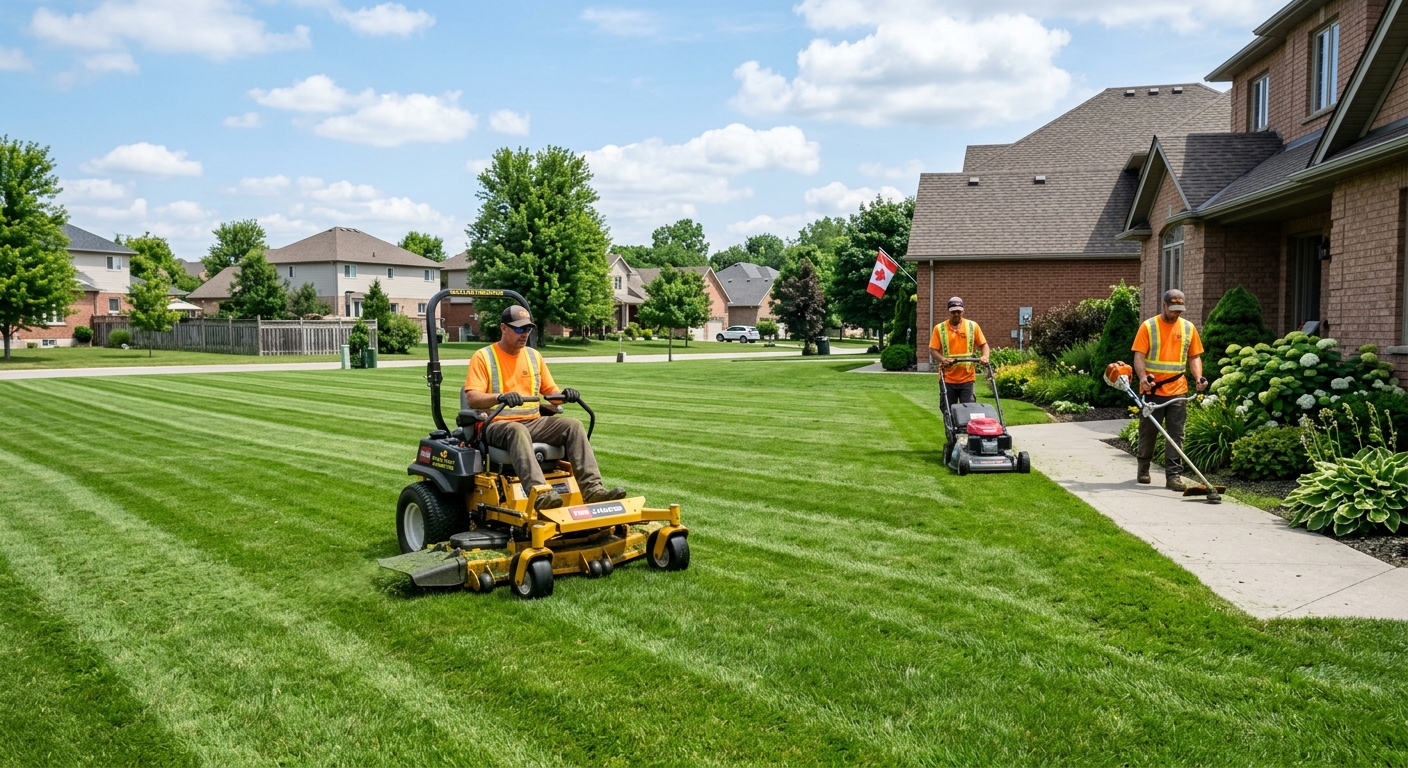
Landscaping options and costs in Rockcliffe Park
Rockcliffe Park is a small, leafy neighbourhood where landscaping decisions are visible year-round, and that usually means homeowners want both curb appeal and long-term durability. With a population of 1,888 residents (Statistics Canada, 2021 Census), you’ll also notice that contractor availability can be tighter than in larger parts of the GTA, especially during peak planting months. Many homes here are detached, and that extra yard space is a common reason people invest in full-service design and installation rather than piecemeal updates—because once you’re budgeting, it’s often worth doing grading, drainage, planting, and hardscape as one coordinated plan.
Toronto-area costs are strongly influenced by climate and soils. The region is typically planted into plant hardiness zones 6a–7a, where we design for winter lows around –23 to –18°C and for hot, often humid summers. Freeze–thaw cycles drive deeper base requirements for patios, steps, and retaining walls, and clay/fill soils frequently need excavation, soil amendment, and sometimes subdrains. Demand is especially steady in Rockcliffe Park’s residential pockets near major roads and the most accessible streets, where crews can stage materials and manage vehicle access efficiently. If your project includes interlocking or a retaining wall, labour and base prep become the cost centre quickly.
Below is a practical comparison of common landscape services so you can benchmark your quotes before we talk about the specific factors that swing pricing.
| Service |
Description |
Season |
Price Range |
| Full landscape design and installation |
Site walk, layout, planting plan, grading/drainage coordination, hardscape and softscape installation as one package |
Spring to early fall (weather-dependent) |
$8,000–$40,000 |
| Sod installation (supply, grade, lay, roll) |
Remove/prepare existing soil, final grade, topsoil/compost amendment, sod placement, rolling and initial watering plan |
Late spring to early fall |
$2,500–$8,000 |
| Lawn seeding (grade, seed, starter fertilizer) |
Minor grade correction, seed blend selection, starter fertiliser and coverage to establish new turf |
Late spring or early fall |
$1,800–$6,500 |
| Interlocking patio or walkway |
Excavation, base and geogrid (where needed), edge restraints, interlock laying, joint sand and clean-up |
Spring to early fall |
$6,000–$30,000 |
| Retaining wall (interlocking block) |
Wall layout, excavation, compacted base, drainage layer, block installation and backfill |
Spring to early fall |
$10,000–$28,000 |
| Tree and shrub planting |
Soil amendment, planting holes, staking as needed, mulch rings, initial watering plan |
Spring or fall (plus container options) |
$800–$6,000 |
Prices are estimates only and vary by project scope, site access and material selection.
What affects the price of landscaping in Rockcliffe Park
In Rockcliffe Park and across the Toronto region, it’s common to see quotes for the “same” landscaping idea come in 30–50% apart. The reason usually isn’t the labour crew alone—it’s the site conditions and how each contractor prices the hard parts of the work. In Ontario’s zone 6a–7a climate, frost dates and freeze–thaw cycles dictate what can be installed safely and how deep bases must be for hardscape. That’s different from Prairie regions (Zone 2–4), where shorter seasons and drought conditions push designs toward drought-tolerant planting and simpler palettes; in Coastal BC (Zone 7–8), the longer season can support richer planting, but you still need good drainage in heavy-rainfall areas. Dry BC interior municipalities often require drip irrigation designed for restrictions, which adds a different cost layer.
Concrete examples in Rockcliffe Park: (1) If your yard has clay or buried fill, excavation plus topsoil/compost amendment can shift a lawn project from the lower end of sod pricing (often near the mid range of $2,500–$8,000) to the upper end once we include bring-in material and proper final grading. (2) If you’re adding a retaining wall, structural base prep, drainage gravel, and geogrid/backfill requirements can move you from a basic wall estimate into the higher band of hardscaping work (often aligning with $6,000–$30,000 for smaller patios/walks and extending beyond for walls with extra excavation). (3) Limited access—narrow driveways or long walkways—can increase labour hours for material movement and staging.
On older homes or properties with established slopes, we also plan for settlement and foundation moisture control. Even small grade corrections can add cost, because proper drainage and compacted granular base are what keep patios and steps from heaving after winter.
| Price Factor |
Why It Matters |
Cost Impact |
| Yard size in sq ft — the primary cost driver for softscape |
More surface area means more material, more labour hours, and more installation/watering time |
High (often the biggest line-item swing) |
| Grading and drainage work — slope corrections add significant cost |
Proper fall away from the house and accurate contours prevent pooling and foundation moisture |
High (can add thousands) |
| Drainage bed or French drain installation |
Intercepting water protects hardscape stability and plant roots during wet cycles |
Medium to High |
| Plant material tier — native shrubs vs. ornamental vs. mature specimen trees |
Larger caliper trees, rare ornamentals, and premium natives cost more and may require staking |
Medium (low-to-high depending on plant sizes) |
| Hardscape vs. softscape ratio — walls and patios cost more per sq ft than lawn |
Excavation, base layers, and finishing details increase material and labour requirements |
High when hardscape dominates |
| Irrigation system design and installation |
Coverage mapping, trenching, valves, and controller setup ensure even watering through summer |
Medium to High |
| Soil amendment and topsoil required |
Clay improvement and proper planting depth strongly affect establishment and long-term success |
Medium |
| Tree removal or stump grinding before new planting |
Access, stump size, and disposal/logistics add time beyond “just planting” |
Medium to High |
Permits & regulations in Ontario
In Ontario, most typical landscaping and softscape work—planting, sodding, mulching, and the installation of walkways/patios—generally does not require a permit. Where permits commonly come into play is when a project affects structural safety or lot drainage. Retaining walls above a height threshold—commonly around 1.0 m (3.3 ft) in many Ontario municipalities—may require a building permit and sometimes engineered drawings, particularly for taller or complex walls. Also, major changes to lot grading that can redirect runoff toward a neighbouring property or tie into storm services may trigger an approval requirement.
Before any digging, homeowners should insist on utility locates (to mark buried services for planting holes, drainage trenches, and retaining-wall footings). Even though you’re “just landscaping,” hitting a buried service is a major risk—especially with mature properties in established neighbourhoods like Rockcliffe Park.
To verify a contractor’s legitimacy in Ontario, do this step-by-step: (1) check the contractor licence/registration in the appropriate provincial registry (or through the contractor’s own licensing number on proposals and marketing materials), (2) ask for a certificate of insurance naming you as an additional insured and confirm it covers general liability and the specific scope (excavation, hardscape, tree work), and (3) confirm WSIB coverage status (or equivalent clearance/coverage documentation if applicable). Request updated copies, not screenshots, and keep them with your contract paperwork.
When those basics are in place, you reduce the risk that “cheap” quotes become expensive change orders mid-project.
Planning a landscape that thrives in Rockcliffe Park's climate
Designing for Rockcliffe Park’s climate means working with the realities of plant hardiness and freeze–thaw cycles, not fighting them. Rockcliffe Park sits in Ontario’s typical zone 6a–7a range, with winter lows that require hardy woody plants and good winter structure (mulch depth, root protection, and drainage). In practice, that guides plant selection toward natives and proven regional cultivars that tolerate cold winters and summer humidity with less fuss.
Sod versus seed is another decision shaped by the Toronto market and the frost calendar. Sod gives instant visual payoff, but it’s usually 3–4x the per-sq-ft cost of seeding because you’re buying the turf and paying for installation logistics. Seeding is slower to look “finished,” but it often makes sense for repairing worn areas, shaded pockets, or when budgets are tighter. In Rockcliffe Park, drainage and grading are critical: pooled water can keep soils saturated, harm turf, and contribute to foundation moisture issues.
Hardscape needs proper base prep for winter movement. For patios and walkways, we excavate to a depth that allows compacted granular layers and, where needed, geogrid for stability. For retaining walls, the base depth and drainage layer are non-negotiable—this is where many “budget” quotes fall short.
For low maintenance, build in curb appeal with mulched shrub borders, perennial layers, and groundcovers that suppress weeds and reduce annual upkeep. Consider a rain garden or bioswale where runoff collects—Toronto soils and clay can benefit from designed infiltration rather than hoping water “finds a way.” A practical example: if you’re choosing between a seeded lawn at roughly the lower band of $1,800–$6,500 versus sod installation at $2,500–$8,000, the extra sod cost can be justified if you need quick results for sale timing or to stabilize a heavily used area that would be patchy for a full season with seeding.
| Element |
Climate Consideration |
Maintenance Level |
Price Band |
| Sod lawn installation |
Best installed in suitable frost-free windows; turf establishment depends on moisture management through humid summers |
Medium (watering until established, then routine mowing) |
$2,500–$8,000 |
| Native perennial garden |
Zone-appropriate plants tolerate winter lows better and handle seasonal rainfall patterns with less supplemental watering |
Low to Medium (spring clean-up, light pruning) |
$800–$6,000 |
| Mulched shrub border |
Mulch improves winter root insulation and reduces soil moisture swings during summer |
Low (weed suppression, occasional replenishment) |
$1,200–$7,500 |
| Interlocking stone patio |
Freeze–thaw demands correct base thickness, compaction, and edge restraints to prevent heaving |
Low (periodic joint sand top-up) |
$6,000–$30,000 |
| Retaining wall (block) |
Requires drainage and stable footing to move water safely away during wet seasons and winter cycles |
Low (keep weep holes/drainage clear) |
$10,000–$28,000 |
| Drip irrigation system |
Improves watering efficiency during summer dry spells; helps reduce disease risk by targeting roots |
Low to Medium (seasonal checks, winterisation) |
$1,800–$8,500 |
How to choose a landscaping contractor in Rockcliffe Park
Choosing the right contractor in Rockcliffe Park starts with proof, not promises. In Ontario, verify three things: (1) licensing/registration where applicable for the scope, (2) liability insurance, and (3) WSIB coverage (or clearance documentation where relevant). How to check each: look for the contractor’s licence/registration number on proposals, then confirm it through the correct online registry; request a current certificate of insurance (not expired) showing general liability and coverage limits appropriate for excavation and hardscape work; and ask for WSIB documentation/clearance and confirm the coverage status applies to the workers who will be on-site.
Next, get 2–3 itemised written quotes that break out labour and materials separately—no single lump sum without line items. A good quote shows quantities (sq ft for sod or patio, linear feet for wall/restrainers), disposal included or excluded, and whether permit pulls are part of the price (if required). Clarify exclusions up front: soil disposal, extra excavation for unseen clay, tree removal/stump grinding, and changes requested after the layout is approved.
Warranty matters. Ask for a workmanship warranty length (for example, for interlock base settlement and grading performance) and confirm manufacturer warranties for trees, shrubs, sod, or interlocking products. Also ask whether warranties are transferable if you sell the home.
Payment schedule should be conservative: never more than about 10–15% upfront, with a holdback until the end. Get the start date and a completion estimate in writing, tied to weather windows common to southern Ontario.
- Provides a detailed scope with quantities and unit pricing (not only a global total).
- Includes excavation depth, base build-up layers, and whether geogrid is used.
- States soil amendment type (compost/topsoil quality) and how it’s validated for your site.
- Shows an irrigation plan (coverage map) if irrigation is included.
- Lists disposal and haul-away for removed sod, soil, and construction debris.
- Confirms where downspouts and roof runoff will discharge after grading.
- Provides a written warranty for workmanship and specifies what voids it.
- Names the plant list with sizes (root ball caliper, spacing, container size) so you can compare apples to apples.
- Includes a project timeline with start date and weather-dependent milestones.
- Offers photos of recent similar projects in Toronto-area conditions (clay/fill, freeze–thaw).
- Shows insurance certificate and WSIB coverage documentation before work begins.
- Uses a contract with change-order pricing if unexpected excavation or utilities are discovered.
In Rockcliffe Park, some red flags I see too often are: (1) quotes that don’t mention drainage or base depth for hardscape, (2) refusal to provide itemised pricing (especially for excavation/disposal), (3) payment requests above 15% upfront without a clear deposit agreement, (4) vague warranty language like “best effort” or no stated workmanship warranty, and (5) no proof of insurance/WSIB coverage before starting.
Frequently asked questions — landscaping in Rockcliffe Park
How much does professional landscape design cost?
In Rockcliffe Park, professional landscape design typically runs as a flat design fee or is bundled into the installation contract. Pricing depends on how detailed the plan is (plant list only versus full grading/drainage coordination and hardscape layout). If you’re doing a comprehensive backyard refresh, many homeowners spend within the broader package range where design plus installation is coordinated, often lining up with $8,000–$40,000 for larger projects. For smaller jobs (like a planting plan for an existing patio), design can be less, but you should still expect a site walk, measurements, and a written planting/hardscape layout. Because Rockcliffe Park properties commonly have established soils and varying slopes, a good designer will prioritize drainage notes to prevent recurring pooling.
How do I compare landscaping quotes?
Start by comparing like-for-like scopes. Ask each contractor to itemise quantities and line items: excavation volume, base layers, geogrid usage, soil amendment/topsoil amounts, disposal, and whether drainage is included. Turf quotes should specify sod versus seed rate, and hardscape quotes should state base depth and edge restraint details to handle Rockcliffe Park’s freeze–thaw cycles. Compare materials tiers—native shrubs versus ornamental stock versus mature specimens can swing the price even if the yard size is the same. If one quote shows sod in the lower end of $2,500–$8,000 and another is higher, verify whether grading, soil imports, and proper rolling are included. Finally, check insurance and WSIB documentation so you’re not comparing competence against risk.
How long does a landscaping project take in Rockcliffe Park?
Timelines vary based on scope and weather, but Rockcliffe Park projects generally follow the GTA seasonal rhythm: grading and planting are best in late spring through early fall, when soils aren’t frozen and rainfall isn’t disruptive. A small planting and mulch refresh can take a day or two once materials are on-site. Sod installation is usually quicker in calendar terms (often 1–3 days for a typical residential area), but establishment watering and follow-up matter. Patios/walkways and retaining walls take longer because of excavation, base building/compaction, and curing/settling timelines—plus interlock finishing. For multi-trade jobs (design + hardscape + drainage + irrigation), it’s common to see several weeks from start to completion to coordinate deliveries, weather windows, and inspections if a permit is required.
What is the best grass type for a Rockcliffe Park lawn?
In Rockcliffe Park and the broader Toronto area, homeowners usually do best with cool-season turf grasses because winters are cold enough to require hardy root systems. Many quality lawns use a blend approach combining fine fescue (for shade and durability) with Kentucky bluegrass (for colour and density) and/or perennial ryegrass (for faster establishment). The “best” choice depends on sun exposure and how well your lawn drains after spring melt—clay areas can stay wet longer, favouring resilient blends. If your lawn needs a quick repair, ryegrass can help, while longer-term stability often comes from bluegrass/fescue components. A contractor should test your conditions and recommend seed/sod appropriate to your site, not just a generic mix.
When should I aerate and overseed my lawn in Rockcliffe Park?
For Rockcliffe Park, the most reliable windows are late spring to early summer and again in early fall—aim for periods when temperatures are mild and the lawn can recover before winter. Aeration helps reduce thatch and improves water and fertiliser penetration, which is especially useful on compacted areas near driveways or patios. After aeration, overseeding works best when you also apply starter fertiliser and keep moisture consistent until germination. If you’re deciding between seeding and sod, remember that seeding needs time to establish density—so it’s often easier to plan overseeding for shoulder-season growth. If your quote included lawn seeding in the band of $1,800–$6,500, ask whether the contractor included grade correction and starter fertiliser, not just seed spreading.
What trees grow best in Rockcliffe Park's climate zone?
Rockcliffe Park sits in Ontario’s zone 6a–7a growing conditions, so trees need to tolerate winter lows and spring temperature swings while handling humid summers. Many homeowners do well with native or locally proven options such as serviceberry, Amelanchier (for early-season interest), and shade trees like native maples depending on site conditions. If your site has wet spots after snowmelt, choose trees with better tolerance for heavier soils and make sure drainage is addressed first—planting into persistently wet clay is a common reason trees decline. For smaller yards, columnar forms or understory trees can fit without conflicting with foundation or utility lines. A good contractor will match the tree’s mature size to setbacks and will plan planting depth and mulching so roots aren’t stressed during freeze–thaw cycles.