Landscaping options and costs in Thorold
Thorold homeowners typically have the space (and motivation) to upgrade their yards: with 69.3% of households owning their homes and 69.1% of dwellings being single-detached, most lots can support a true curb-appeal plan rather than just patchwork. It also helps explain why we see consistent demand in family-oriented pockets like the south and east sides near Port Robinson Road, where properties often have mature trees and established beds that benefit from staged refreshes.
In the Hamilton–Niagara Peninsula (plant hardiness zones 6b–7a), pricing is shaped by a reliable but finite working window—roughly late April/early May through mid–October—so labour and scheduling are tight when spring is wet. That frost-free season supports a broader plant palette than prairie regions, but we still plan for freeze–thaw and occasional saturated spring soils. The result is that drainage design, base depth, and compaction matter as much as plant choice—especially for patios and retaining walls where heaving can occur if aggregate and footing depth aren’t right.
Because many Thorold properties were built before 1981 (55.1%), it’s common to encounter older drainage patterns, compacted clay, and narrower access routes for excavation. Those site realities can swing a quote substantially even when your vision looks similar. Use the table below to compare typical scopes and budget ranges, then we can narrow it to your lot size, soil conditions, and the level of landscaping you want.
| Service |
Description |
Season |
Price Range |
| Full landscape design and installation |
Concept + site plan, grading/drainage allowances, softscape and hardscape build-out, planting, edging and cleanup |
May–Oct |
$5,000–$50,000 |
| Sod installation (supply, grade, lay, roll) |
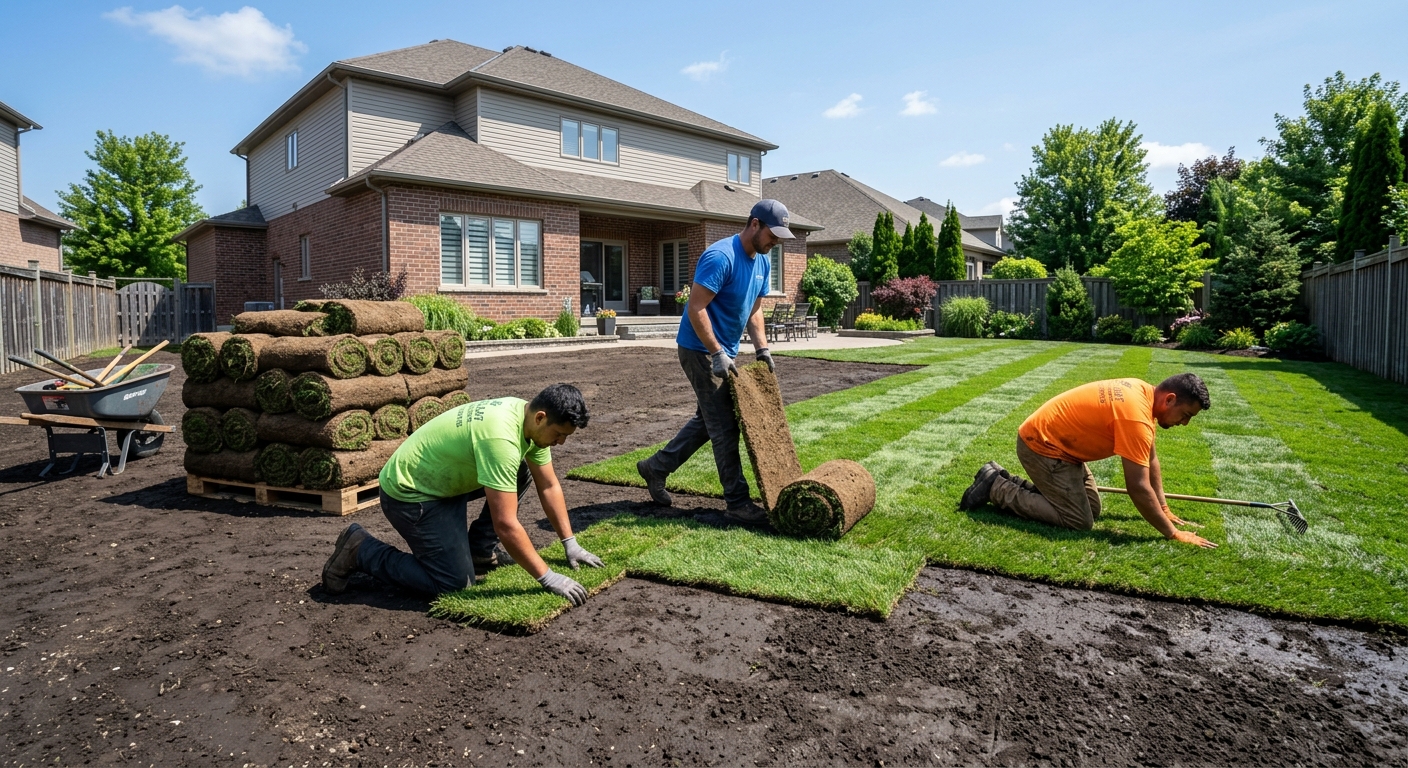
Soil prep, raking/leveling, base correction, sod delivery and installation with starter fertilizer and roll/settle |
May–Sep |
$2–$7 |
| Lawn seeding (grade, seed, starter fertilizer) |
Light topdressing (as needed), seed selection, starter fertilizer, and establishment care plan |
Apr–Jun or late Aug–Sep |
$2–$7 |
| Interlocking patio or walkway |
Excavation, compacted base, geotextile, paving stones, restraints/edge, and jointing sand |
May–Oct |
$40–$150 |
| Retaining wall (interlocking block) |
Wall layout, block installation, reinforced backfill, drainage stone and weep provisions, base preparation |
May–Oct |
$40–$150 |
| Tree and shrub planting |
Soil amendment, digging, staking (as needed), mulching, and initial watering strategy for establishment |
Apr–Oct |
$50–$1,500 |
Prices are estimates only and vary by project scope, site access and material selection.
What affects the price of landscaping in Thorold
In Thorold and across the Hamilton–Niagara Peninsula, it’s common to see quotes for the “same” landscaping idea land 30–50% apart. The differences usually come down to scope details (grading, drainage, and disposal), soil conditions, how contractors manage the short working season (labour availability May through October), and the plant/hardscape tier you select. Even when your design is similar, a crew that includes drainage correction and proper base prep will price differently than one that assumes the yard is already ready.
Climate drives cost because plant survival depends on what zone-appropriate species you can install, and frost dates determine how long crews can work before freeze-up. In zone 6b–7a, we can install softscape from late April/early May to mid–October, but freeze–thaw still affects base preparation and drainage for patios and retaining walls. Prairie regions (zone 2–4) often need more drought-tolerant, wind-hardy choices and deeper earthwork planning for shorter seasons; coastal BC (zone 7–8) typically supports faster growth but demands extra drainage discipline in heavy-rainfall zones. In the dry interior parts of BC and Alberta, irrigation design is heavily influenced by restrictions, while Southern Ontario usually relies on good irrigation where summer dry spells occur—so you may pay more for an efficient drip setup than for a basic hose-end approach.
Concrete examples in Thorold: first, an older lot (built before 1981 in 55.1% of cases) may have compacted clay and uneven fall-to-drain, which turns a “small” lawn renovation into a grading-and-drainage job. Second, moving from seeding to sod can feel minor until you account for the higher installation material demand—sod typically costs more per square foot than seeding. Third, adding a retaining wall base with properly prepared granular layers pushes cost toward the retaining wall/hardscaping band, not the softscape one. For budgeting, many homeowners start by anchoring on lawn work in the $2–$7 range and walls/patios in the $40–$150 per-unit band, then adjust once we confirm yard size and soil.
| Price Factor |
Why It Matters |
Cost Impact |
| Yard size in sq ft — the primary cost driver for softscape |
More area means more labour hours for grading, soil prep, and more material for sod/seed/topsoil |
Larger lots can move you from a “small refresh” budget into full installation pricing |
| Grading and drainage work — slope corrections add significant cost |
Proper grading prevents pooling and foundation moisture; it requires excavation, re-compaction, and sometimes haul-away |
Often the biggest swing factor in final cost |
| Drainage bed or French drain installation |
Captures groundwater and redirects it safely; requires trenching, perforated pipe, and stone |
Can add substantial cost when extensive drainage is needed |
| Plant material tier — native shrubs vs. ornamental vs. mature specimen trees |
Mature stock costs more and takes more labour for handling, staking, and planting depth |
Switching tiers can create a wide budget gap |
| Hardscape vs. softscape ratio — walls and patios cost more per sq ft than lawn |
Patios/walkways require base aggregate, compaction, stone/pavers, and tighter workmanship |
Increasing hardscape drives pricing quickly into the $40–$150 band |
| Irrigation system design and installation |
Drip/rotor layout, routing, and testing require design time and additional materials |
Basic setups cost less than zone-based drip with controls |
| Soil amendment and topsoil required |
Thorold lots can vary from clay-heavy to sandy pockets; amendment needs depend on test/assessment |
Haul and material costs increase when more than “thin topdressing” is required |
| Tree removal or stump grinding before new planting |
Extra equipment, hauling, and debris cleanup affect labour and scheduling |
Can add cost and delay planting timelines |
Permits & regulations in Ontario
For most landscaping work in Ontario, you don’t need a permit—planting beds, sodding, and typical softscape installations (like seeding, mulching, and most yard improvements) are usually straightforward. Retaining walls are the common exception. In many Ontario municipalities, retaining walls above a height threshold—often around 1.0 m (3.3 ft)—require a building permit and, in some cases, engineered drawings depending on wall height, soil conditions, and design. If your plan involves changes to lot grading that alter drainage direction (for example, diverting water toward a neighbour or toward storm sewer connections), permits or approval may also be required.
Before digging in Thorold, always call for utility locates so you know where hydro, telecom, gas (if applicable) and any buried services run. Even if you’re only planting or putting in small wall footings, locates protect both safety and your property.
To verify a contractor before work starts, ask for three things and check them in writing: (1) Ontario licence/registration details (where applicable) and the contractor’s business information; (2) a current certificate of liability insurance naming you as an additional insured for the project; and (3) WSIB/WCB clearance coverage evidence. For checking, use the contractor’s provided certificate documents and request clearance/coverage letters directly—reputable landscaping firms provide these without pushing back.
Planning a landscape that thrives in Thorold's climate
Planning in Thorold means designing for zone 6b–7a, working around our frost calendar, and managing water through freeze–thaw. If you pick plants that suit the climate and you get drainage and base prep right, the yard stays attractive with less ongoing repair. The best results start with plant selection: choose native and zone-appropriate shrubs, perennials, and hardy grasses that establish reliably and don’t require excessive winter protection. In our region, winter wind and repeated freeze–thaw can be harder on poorly sited plants than cold alone.
Sod versus seed is another key decision. Sod gives instant curb appeal and can be worth it for smaller areas or high-traffic zones, but in practice it costs roughly 3–4x more per square foot than seeding when you compare typical supply and installation. That doesn’t mean sod is “always wrong”—it can be justified when you want to avoid weeks of bare ground during a sale, or when you need quick erosion control on a sloped lawn. If your budget is tighter, seeding plus a solid soil prep and a good establishment plan often gives excellent value.
Drainage and grading should be treated as part of the landscape, not an afterthought. Pooling in spring can lead to muddy footing and poor plant performance, while for patios and retaining walls you must plan base preparation for frost movement and provide proper drainage layers to prevent water pressure. Finally, keep maintenance low by using mulch, edging, groundcovers, and well-chosen perennials—so you’re not fighting weeds every week. Rain-garden elements and efficient irrigation (or targeted drip) can also make sense on spots that tend to stay damp, while xeriscape-style planting is best where summer dryness is consistently an issue.
As a simple budget example: if you’re restoring a patchy lawn, seeding can be a smarter move when you’re targeting the lower $2–$7 range, whereas installing sod across the same area can push you toward the high end of lawn budgets and should be reserved for areas where “instant” results are truly valuable to you.
| Element |
Climate Consideration |
Maintenance Level |
Price Band |
| Sod lawn installation |
Needs reliable early-season establishment; protect from late spring wet soils and summer dryness with proper watering schedule |
Medium during first season, then lower after rooting |
$2–$7 |
| Native perennial garden |
Zone-appropriate plants handle winter wind and freeze–thaw better when placed with mulch and good drainage |
Low to medium (mulch refresh and occasional weeding) |
$50–$1,500 |
| Mulched shrub border |
Mulch insulates roots through freeze–thaw and reduces evaporation; choose shrubs that tolerate Ontario winters and periodic spring saturation |
Low (pruning yearly and top-up mulch) |
$50–$1,500 |
| Interlocking stone patio |
Base must be built for frost movement; proper compaction and drainage prevent heaving and water pooling |
Low (periodic joint sand top-up) |
$40–$150 |
| Retaining wall (block) |
Requires drainage stone and backfill provisions to manage freeze–thaw and water pressure |
Low after build (only inspection/cleanup as needed) |
$40–$150 |
| Drip irrigation system |
Efficient water delivery helps during summer dry spells; freeze precautions and winter shutoff matter |
Medium (seasonal care and occasional adjustments) |
$5,000–$50,000 |
How to choose a landscaping contractor in Thorold
Choosing the right contractor in Thorold starts with verification. For Ontario work, ask for their business details and confirm they’re in good standing for any applicable registration. Next, request a certificate of liability insurance for the project; check the policy is active, the dates cover your job window, and that it clearly identifies the worksite and coverage. For WSIB/WCB, ask for proof of clearance/coverage before work begins—this typically comes as documentation from their insurer/provider. If a contractor can’t provide clear evidence quickly, treat that as a red flag.
Then get 2–3 itemised written quotes. You want labour and materials broken out (excavation, base aggregate, drainage components, stone/paver supply, geotextile, soil amendment, and plant counts/sizes). Don’t accept a “lump sum” that doesn’t show what’s included, especially for drainage and disposal. Read exclusions carefully: is permit handling included (where required), is topsoil hauling/haul-away included, and are site cleanup and final grading included?
Warranty matters for both workmanship and products. Ask for the workmanship warranty length (for example, settlement/heaving-related issues) and whether product/manufacturer warranties apply to plants, hardscape materials, and irrigation components. Also confirm if warranties are transferable to future owners.
For payment, never pay more than 10–15% upfront. Hold back a portion until key milestones are complete and the site is cleaned up. Get a start date and completion estimate in writing so scheduling stays predictable in our May–October window.
- Provide a written, itemised quote (no vague line items).
- Show proof of active liability insurance and project coverage dates.
- Provide WSIB/WCB clearance evidence before starting.
- Confirm whether permits are required and whether they pull/handle them (where applicable).
- Detail drainage scope: French drains, grading, drainage stone, and where discharge goes.
- List base build-up specs for patios/walls (aggregate layers and compaction approach).
- Include disposal/haul-away of excavated soil and debris.
- Specify plant sizes (e.g., container size) and quantities—avoid “allowance” plants only.
- Confirm soil amendment/topsoil depth and product type.
- Provide an irrigation plan if included (zones, controller/controls, and winterization approach).
- State workmanship warranty duration and what it covers.
- Agree on payment schedule and milestone holdbacks in writing.
Red flags in Thorold: (1) quotes that skip drainage and base prep details yet price as if they’re included, (2) unwillingness to provide insurance/WSIB/WCB documentation, (3) “cash-only” pressure or demands for large upfront payments, (4) no start/completion timeline in writing, and (5) missing plant specs (sizes/types) or relying on broad allowances that can inflate costs later.
Frequently asked questions — landscaping in Thorold
When is the best time to landscape in Thorold?
The best time in Thorold is generally from late April/early May through mid–October, aligned with our zone 6b–7a conditions and the region’s frost patterns. For lawns, sod is most successful when installed in stable spring to early summer weather; if your goal is budget efficiency, seeding can also work well in spring or late summer/early fall for better establishment. For planting shrubs and perennials, aim for periods when the soil is workable and not waterlogged—wet springs can slow excavation and delay base compaction for patios and walls. If you’re comparing quotes, lock in scheduling early because labour demand increases quickly once weather firms up.
Do I need a permit for a retaining wall in Ontario?
In Ontario, many landscaping tasks (like planting, sodding, and most softscape work) don’t require permits, but retaining walls often do depending on height and design. In many municipalities the threshold is typically around 1.0 m (3.3 ft), and taller or complex walls may require a building permit and sometimes engineered drawings. Grading changes that affect drainage direction can also trigger approval requirements. For your Thorold project, the safest approach is to ask the contractor to confirm what your wall height and layout require before construction. A reputable contractor should be able to outline whether permits are needed and who handles the process.
How do I improve drainage in my yard?
Drainage improvements usually start with observation: where water pools after rainfall, which direction the slope naturally falls, and whether spring saturation lingers near foundations or along fence lines. In Thorold’s Hamilton–Niagara Peninsula context, freeze–thaw makes poor drainage more problematic because water expands and contracts under freeze conditions. Common solutions include re-grading to direct surface water away from structures, adding a drainage bed, or installing a French drain with proper discharge. The cost varies widely—projects with drainage correction can push you toward hardscape/regrading budgets, especially if a wall or patio needs reconstruction. If you’re pricing, compare quotes that describe the drainage scope item-by-item, not just a “grading allowance.”
What is xeriscaping and does it suit Thorold?
Xeriscaping is landscape design that reduces irrigation needs by using drought-tolerant plants, mulches, and smart placement. In Thorold, it can suit parts of a yard—especially sunny areas where summers dry out—but it’s not identical to water-restriction-driven approaches used in drier regions like the BC interior. Because we’re in zone 6b–7a with a moderate growing season (roughly late April/early May to mid–October), you can still grow a broader mix of hardy plants than in much more arid climates. If you choose xeriscape-style planting, pair it with good soil amendment and correct drainage so plants don’t suffer from winter waterlogging. For yards that stay damp in spring, a rain-garden approach can be more practical than “dry garden” planting.
How do I plan a low-maintenance yard?
A low-maintenance yard in Thorold comes from three choices: plant selection, structure, and weed control. Start with zone-appropriate shrubs and perennials, then use a mulched shrub border and groundcovers to suppress weeds. Add reliable edging to separate beds from lawn so trimming stays easy. For lawns, sod can provide fast results, but if you’re stretching a budget, seeding is often the lower-cost route (frequently aligning with the $2–$7 per-unit pricing band). For hardscape, correctly built interlocking patios and walls are typically “set it and forget it” when the base and drainage are done properly, usually landing in the $40–$150 per-unit band range. Keep annual tasks simple: mulch refresh, light pruning, and a quick irrigation check if you install drip.
How deep should a retaining-wall base be for local frost?
For a retaining wall in Ontario, the base depth is about more than a number—it’s about building the wall on compacted granular layers that reduce frost-related movement and control drainage. While exact depth depends on wall height, soil, and engineering requirements, the principle is consistent in Thorold: the foundation and base layers must be prepared so water can drain properly and freezing doesn’t push materials out of position. This is why good contractors describe their base build-up in layers (excavation, geotextile, compacted aggregate, drainage stone, and reinforced backfill where needed) rather than giving a single quick estimate. If your wall is near or above the common 1.0 m threshold, confirm permitting and design requirements before finalizing the build.