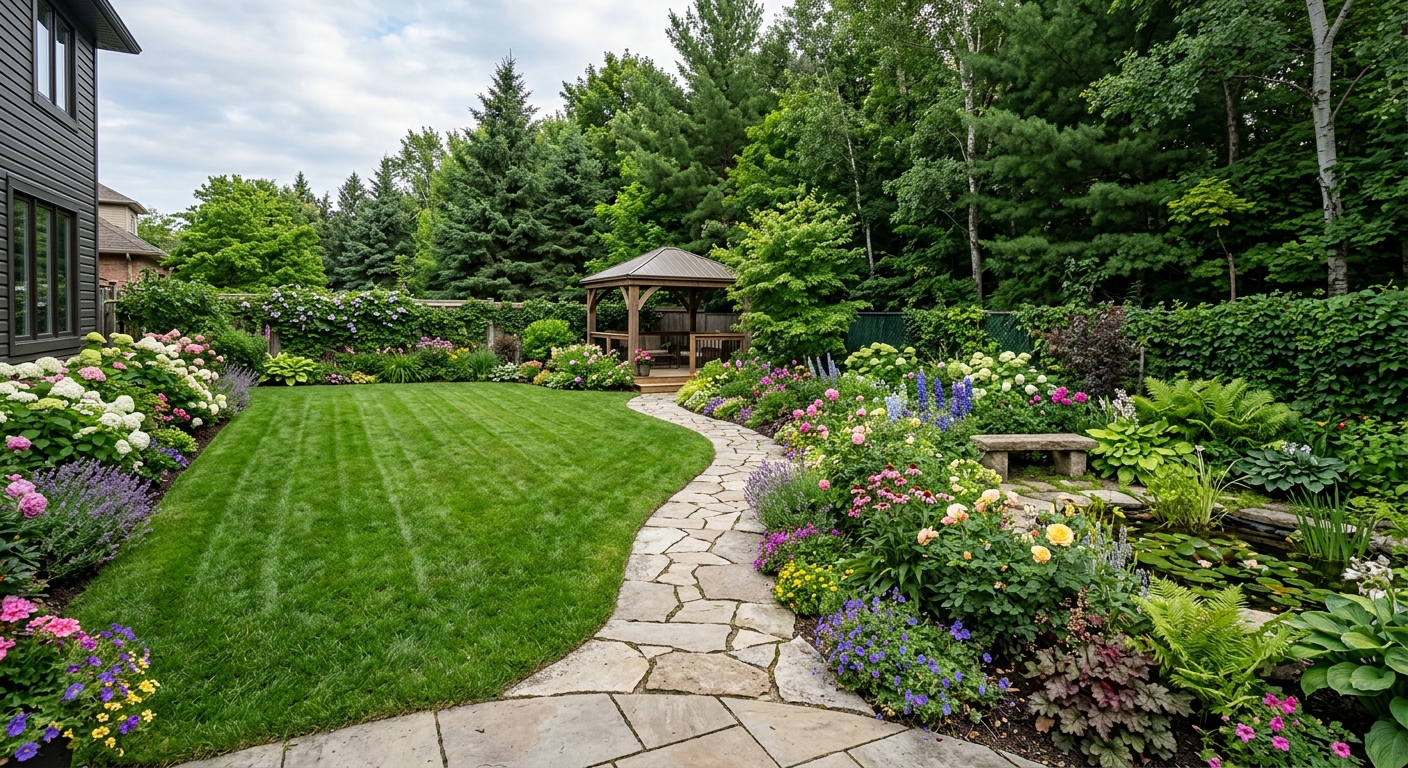
Landscaping options and costs in Yonge-St.Clair
Landscaping in Yonge-St.Clair comes with a unique mix of older, established neighbourhood lots and today’s high demand for curb appeal close to transit and amenities. With a population of 12,528 (Statistics Canada, 2021 Census) concentrated across this part of Toronto, many homeowners are working within smaller, often already-developed yards—so we tend to prioritize designs that improve drainage, define usable outdoor space, and refresh planting without requiring major property disruption. In these detached-heavy pockets, owners typically have the yard space to invest in upgrades like patios, planting beds, and perimeter trees, and that’s why we see steady demand for full redesigns as well as hardscape-led refresh projects.
Cost in the Toronto market is strongly shaped by climate and soil. The GTA sits in hardiness zones 6a–7a, so we can grow a broad palette of woody plants and perennials that handle winter lows roughly in the –23 to –18°C range, and we install during the longer May-to-October frost-free window. At the same time, frequent freeze–thaw cycles drive higher structural standards: patios, steps and retaining walls need deeper, well-compacted granular bases and proper drainage to stay stable over time. Clay and fill soils common in older Toronto areas often require excavation, soil amendment, and sometimes subdrains, which increases both labour and material costs.
We see particularly high activity in the Lawrence Park area of Yonge-St.Clair, where homeowners commonly update walkways, create family-friendly terraces, and add mature screening shrubs for privacy. The options below show typical price bands and help you compare contractor quotes before you dig into details.
| Service |
Description |
Season |
Price Range |
| Full landscape design and installation |
Site assessment, layout and planting plan, grading/drainage as needed, softscape + hardscape build-out, and cleanup |
Spring to early fall (often May–September) |
$8,000–$40,000 |
| Sod installation (supply, grade, lay, roll) |
Remove old turf (if needed), fine-grade, amend soil where required, lay sod, roll and initial watering |
Late spring through early fall |
$2,500–$8,000 |
| Lawn seeding (grade, seed, starter fertilizer) |
Light grading, seed selection, starter fertilizer, mulching/blanket where appropriate, and initial watering plan |
Spring or early fall |
$1,800–$5,000 |
| Interlocking patio or walkway |
Excavation, base/granular compaction, geotextile/geogrid as needed, edge restraints, interlocking stone install |
May–October |
$6,000–$30,000 |
| Retaining wall (interlocking block) |
Wall layout, excavation, compacted base, block installation, backfill and drainage provisions |
May–October (freeze conditions limit late-fall work) |
$6,000–$30,000 |
| Tree and shrub planting |
Planting layout, digging, soil amendment, staking for trees, watering plan and initial mulch |
Spring or fall planting windows |
$800–$6,000 |
Prices are estimates only and vary by project scope, site access and material selection.
What affects the price of landscaping in Yonge-St.Clair
Even when two homeowners ask for the “same” job in Toronto and across Ontario, quotes can diverge by 30–50% because the visible scope usually hides the variables that drive labour and material—soil condition, excavation depth, drainage strategy, plant size, access constraints, and how much restoration is included. In Yonge-St.Clair, those variables can be amplified by older fill soils, tight property lines, and the need to build correctly for freeze–thaw. The result is that a contractor’s approach to grading, base prep and drainage can make a similar-looking end product cost dramatically more.
The plant hardiness zone and frost timing define both what can be installed and what must be engineered. In the GTA’s zones 6a–7a, we still plan around winter lows and spring emergence, but we also have a robust growing season from roughly May to October. Prairie regions (zone 2–4) typically see a shorter season and more frequent drought stress, so designs skew toward drought- and wind-hardy species and simpler palettes—often with less emphasis on labour-intensive ground cover establishment. Coastal BC (zone 7–8) supports lush growth and longer installation windows, yet it demands careful drainage in heavy-rain areas, which can raise excavation and water-management costs. Dry BC interior areas also face irrigation limits, so drip zoning and xeric planting layouts often become part of the budget. Southern Ontario is more moderate, but summer dry spells still require irrigation planning.
In Yonge-St.Clair specifically, you can see cost swing from three common conditions. First, a backyard with poor drainage or low spots may need regrading and a drainage bed, pushing a “basic” softscape into full landscape design territory within the $8,000–$40,000 band. Second, clay and fill may require extra soil amendment/topsoil and more granular base for patios and steps to avoid settlement—often aligning that portion with the $6,000–$30,000 retaining wall or hardscaping range. Third, the timing and size of plants matter: mature specimens and larger-caliper trees (versus smaller starters) can shift tree-and-shrub planting from closer to $800 toward $6,000.
| Price Factor |
Why It Matters |
Cost Impact |
| Yard size in sq ft — the primary cost driver for softscape |
More area means more labour for grading, soil prep, edging, and topsoil or sod/seed coverage |
Can swing the job from a few thousand to the upper end of lawn/softscape budgets |
| Grading and drainage work — slope corrections add significant cost |
Toronto-area freeze–thaw punishes incorrect drainage; proper slope protects foundations and pavement |
Often adds a large premium versus “plant-only” scopes |
| Drainage bed or French drain installation |
Requires excavation depth, pipe/gravel, fabric, and routing to a suitable outlet |
Frequently moves a project into a higher $8,000–$40,000 full build range |
| Plant material tier — native shrubs vs. ornamental vs. mature specimen trees |
Smaller nursery stock is cheaper; mature specimens cost more and need proper staking and soil volume |
Tree/shrub budgets can vary widely (roughly $800–$6,000) |
| Hardscape vs. softscape ratio — walls and patios cost more per sq ft than lawn |
Stone and block require excavation, base layers, restraints and compaction |
Pushes the project toward retaining-wall/hardscaping pricing ($6,000–$30,000) |
| Irrigation system design and installation |
Zoning, backflow preventers where required, trenching, and head placement increase labour/material |
Can add meaningful cost, especially where complete coverage is specified |
| Soil amendment and topsoil required |
Clay/fill often needs improvement for rooting; more amendment means more delivery and labour |
Raises overall softscape cost even when plant lists look similar |
| Tree removal or stump grinding before new planting |
Removal changes access, disposal, and soil rehab; roots can affect drainage and base prep |
Common reason for higher-than-expected quotes |
Permits & regulations in Ontario
In Ontario, most planting, sodding, and typical softscape work generally does not require a permit. If you’re simply installing sod, seeding, mulch beds, shrubs, or doing routine landscaping within an existing grade, you usually can proceed without a permit. The area where permits often come up is with structural retaining features and any work that alters drainage patterns.
Work that commonly DOES require a permit includes retaining walls above a municipal threshold—often 1.0 m (3.3 ft) in many Ontario municipalities—where a building permit and, sometimes, engineered drawings are required. Also, changes to lot grading that affect stormwater flow (for example, re-directing runoff toward a neighbouring property or tying into a storm connection) may require approval. Utility locates are important before digging for planting holes, drainage runs, or wall footings—calling to mark underground services helps prevent costly damage.
Work that typically DOES NOT require a permit includes tree and shrub planting, mulching, lawn seeding/sodding, installing non-structural garden edging, and building patios/walkways when they don’t create regulatory structural changes. Even then, contractors should confirm local requirements during the site visit.
To verify a contractor in Yonge-St.Clair, start by confirming they carry WSIB (or the applicable coverage for their business) and have current liability insurance. Next, ask for their certificate of insurance showing your project is covered, and request a clearance letter or equivalent proof of standing where applicable. Finally, verify any relevant Ontario business registrations and licensing details via the appropriate online resources, and keep copies of all documents with your contract and invoices.
Planning a landscape that thrives in Yonge-St.Clair's climate
To plan a landscape that thrives in Yonge-St.Clair, design around Toronto’s hardiness zone, moisture behaviour, and frost timeline rather than expecting the yard to “adapt.” The GTA is usually in zones 6a–7a, so you can select zone-appropriate shrubs and perennials that tolerate winter lows down around –23 to –18°C, while also handling hot, sometimes humid summers. Start with plant selection: choose native or well-adapted species, prioritize deeper-rooted perennials, and keep winter protection realistic (for example, mulch depth and spacing for perennials). This reduces annual watering and improves survival.
Next, decide between sod and seed. Sod gives instant results but costs roughly 3–4x more per sq ft than seeding, mostly because it’s more material and labour to lift/handle and keep it alive during establishment. Seeding, by contrast, can be a better value when you can manage watering during germination. A practical example: if a full lawn refresh would land you near the $2,500–$8,000 sod band, you might instead choose seeding and regrade for a lower cost within the typical seeding range, then invest the savings into drainage or a nicer edge for the flower beds—often a better return for long-term curb appeal.
Drainage and grading are the foundation of most Toronto yards. Pooling water can lead to soft soil, winter heaving, and foundation moisture risk, so we commonly correct slopes away from the house and build drainage beds where required. For hardscape (patios and retaining walls), proper base preparation—using well-compacted granular layers—matters because freeze–thaw cycles can shift poorly built stone. Finally, low-maintenance strategies help you keep it looking sharp: mulch, groundcovers, and perennials reduce weekly upkeep while maintaining structure and colour. In places where summer dryness or runoff is an issue, we also recommend rain-garden features or limited xeriscape elements (especially around downspouts) to manage water naturally.
| Element |
Climate Consideration |
Maintenance Level |
Price Band |
| Sod lawn installation |
Establishment window May–early fall; needs consistent watering to root before winter |
Moderate (watering + first-cut timing) |
$2,500–$8,000 |
| Native perennial garden |
Zone-appropriate plants handle winter lows; mulch helps with freeze–thaw and moisture retention |
Low to moderate (spring cleanup + seasonal weeding) |
$800–$6,000 |
| Mulched shrub border |
Improves soil stability and reduces evaporation through humid summers and cold winters |
Low (annual refresh of mulch) |
$1,200–$5,500 |
| Interlocking stone patio |
Freeze–thaw protection depends on base prep and edge restraints for long-term stability |
Low (occasional cleaning and weed control at joints) |
$6,000–$30,000 |
| Retaining wall (block) |
Backfill and drainage reduce pressure during freeze cycles; proper base depth is critical |
Low (surface inspections and joint care) |
$6,000–$30,000 |
| Drip irrigation system |
Targeted watering supports drought tolerance and helps reduce waste in summer dry spells |
Low (seasonal adjustments and checks) |
$2,000–$7,500 |
How to choose a landscaping contractor in Yonge-St.Clair
Choosing the right contractor in Yonge-St.Clair starts with proof: in Ontario, verify liability insurance and WSIB coverage (or the applicable coverage for their operations). Ask for a current certificate of insurance showing you as the certificate holder where appropriate, and request their latest WSIB clearance letter to confirm their standing. Don’t rely on verbal statements—ask to see the paperwork before work begins.
Then get 2–3 itemised written quotes that separate labour and materials. A solid quote lists excavation/grading steps, base preparation specs for patios or walls, quantities for topsoil/compost, plant counts and sizes, and what’s included in disposal and site cleanup. Look closely for exclusions: is there allowance for additional excavation if hidden clay or poor fill is encountered? Is geotextile/geogrid included when needed? Is sod kept alive and covered if weather changes? Confirm whether a permit pull is included (when required), and whether demolition, hauling, and curb/sidewalk protection are part of the price.
Warranty matters. Ask for the workmanship warranty length and whether it covers settlement, heaving, or drainage performance after completion. Product/manufacturer warranties should be documented separately, and you should ask whether they’re transferable to you as the homeowner. For payment, never pay more than 10–15% upfront; hold back a portion until the job is complete and inspected. Finally, request a start date and a completion estimate in writing—Toronto projects can shift with weather, but timelines should still be specific and realistic.
- Provide WSIB clearance and liability certificate with your quote package
- Itemise labour vs. materials (no single “lump sum” line without breakdown)
- Confirm disposal/hauling included for sod removal, old stone, or excess soil
- Ask what geotextile/geogrid and drainage components are included (if any)
- Get exact plant quantities and sizes (e.g., caliper for trees, plant heights for shrubs)
- For hardscape, request base build-up details and compaction methods
- Clarify whether irrigation is included or capped/left for later connection
- Ask how they manage rain and freeze risk during shoulder-season work
- Written warranty for workmanship (and what failures it covers)
- Payment schedule capped at 10–15% deposit; holdback until final walkthrough
- Site protection plan (walkway covers, dust control, protection for existing lawns/edges)
- Schedule with milestones (demo/rough-in/planting/final grade/cleanup)
Red flags I see in Yonge-St.Clair include: contractors who won’t show WSIB/liability documents, quotes that omit base prep specifications for stone work, vague warranty language, refusing to break down materials and quantities, and payment requests that ask for a large deposit before any drafting, layout, or site protection is confirmed.
Frequently asked questions — landscaping in Yonge-St.Clair
How do I plan a low-maintenance yard?
A low-maintenance yard in Yonge-St.Clair usually starts with three moves: simplify the plant palette, build drainage correctly, and choose “right plant, right place” species for Ontario’s zone 6a–7a conditions. If you want instant curb appeal without constant reseeding, sod can work, but it’s typically in the $2,500–$8,000 band; many homeowners reduce maintenance costs by seeding where appropriate and investing the difference into mulch beds and durable edging. For drainage, we often regrade gently away from the house and add a drainage bed or French drain where pooling occurs. Use groundcovers, thicker mulch layers, and perennials with good winter structure to reduce spring clean-up and keep weeds down.
How deep should a retaining-wall base be for local frost?
In Yonge-St.Clair, the retaining wall base needs to be designed for Ontario’s freeze–thaw conditions—not just a shallow “surface” pad. Most failures happen when walls don’t have adequate excavated, compacted granular base and proper backfill/drainage, allowing water to freeze and shift the structure. A contractor should base depth on wall height, frost considerations, and the specific soil conditions (often clay/fill). Expect excavation deeper than you’d think for aesthetics-only blocks, with geotextile/geogrid and well-compacted granular layers. If the wall approaches or exceeds typical permit thresholds (often around 1.0 m in many Ontario municipalities), engineering requirements may further dictate base and reinforcement.
How much does professional landscape design cost?
Professional design in the Yonge-St.Clair/Toronto area is commonly bundled with installation for most full yard projects, and the overall “design + build” budget often lands in the $8,000–$40,000 range depending on scope. If you’re doing smaller projects—like a planting plan with a limited hardscape element—design-only pricing varies, but it still depends on whether it includes grading/drainage concepts, plant take-offs, and a written materials list. In older Toronto neighbourhoods, grading and drainage notes can add value fast because soil and freeze–thaw issues drive long-term performance. Ask your contractor whether the design fee is credited toward construction when you proceed.
How do I compare landscaping quotes?
Compare quotes item-by-item, not by total price alone. For Yonge-St.Clair jobs, insist on line items for excavation, base prep (for patios/walkways), drainage provisions (French drains or drainage beds when needed), soil amendment quantities, and specific plant counts and sizes. Verify inclusion of disposal/hauling and site protection. Ask whether permits are included if a retaining wall meets typical thresholds (often around 1.0 m in many Ontario municipalities). Also compare assumptions: one quote might assume “good soil,” while another accounts for clay fill removal and subdrains. If one contractor lands much lower than the others, it’s often because key drainage/base steps are missing—not because the work is simpler.
How long does a landscaping project take in Yonge-St.Clair?
Timing depends on scope and weather, but most Toronto-area installs work within the May–October frost-free window. A planting-only project may take a few days (often less if access is straightforward), while full landscape builds can take several weeks because they include layout, grading/drainage rough-in, hardscape base prep, stone/block installation, planting lead times, and final cleanup. Seasonal constraints matter: patios and retaining-wall work are sensitive to freeze risk and base compaction conditions, so late-fall schedules can shift. If sod is included, the timeline includes establishment watering and careful sequencing to reduce heat stress during summer dry spells common in southern Ontario.
What is the best grass type for a Yonge-St.Clair lawn?
For most Yonge-St.Clair homes, the “best” grass depends on sun exposure, traffic, and whether you prefer sod or seeding. In practice, many homeowners choose cool-season turf because Ontario winters and growing conditions suit it. Contractors typically match the mix to your yard’s light (full sun vs. shade) and your maintenance level. If you want a faster, uniform look, sod is often the route, and those installs commonly fall into the $2,500–$8,000 band depending on yard size and prep. If budget is the priority and you can follow watering during establishment, seeding with a starter fertilizer can be a strong option. Either way, proper grading and soil readiness matter as much as the seed variety.