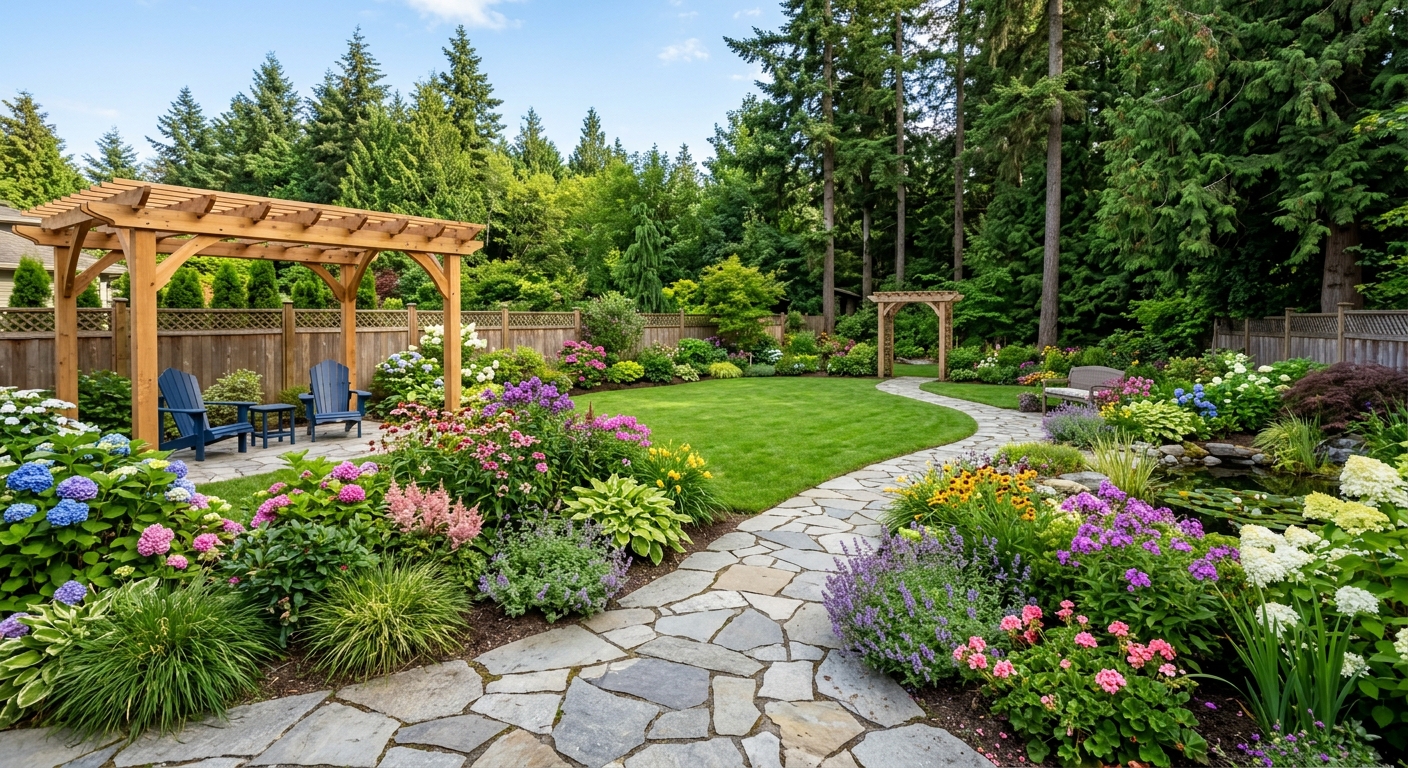
Landscaping options and costs in Kitchener
Kitchener homeowners often compare landscaping quotes side by side because the city’s housing stock and lot sizes make exterior improvements a common investment. With 47.5% of dwellings being single-detached homes, many properties have enough frontage and yard depth to justify upgrades like new sod, interlocking patios, and foundation planting. It also helps that 59.7% of households own their homes (Statistics Canada, 2021 Census), which tends to translate into longer-term yard planning instead of short-term fixes.
In the Kitchener–Waterloo–Barrie region (Zone 5b–6a), costs are shaped by cold winters, defined frost timing, and freeze–thaw cycles that can heave poorly built patios, walks, and retaining-wall footings. Most planting and installation work runs roughly from mid-April through October, but heavier structural work—grading, drainage, and bases—needs the drier windows so crews can achieve proper compaction. That seasonal rhythm can also influence contractor availability and pricing during spring surges when crews are booked for both new builds and older “pre-1981” properties (48.6% of homes built before 1981, Statistics Canada, 2021 Census) that are due for drainage and curb-appeal refreshes.
Demand is especially strong in mature, established areas like the Beechwood and Doon South corridors, where homeowners often renovate aging landscaping, add hardscape for entertaining, and replace tired turf. Next, here’s a practical comparison of common project types and typical Kitchener price bands so you can interpret quotes quickly.
| Service |
Description |
Season |
Price Range |
| Full landscape design and installation |
Site walk, concept + planting plan, grading/drainage coordination, topsoil, seed/sod/planting, mulch, and hardscape coordination |
Mid-April to October |
$8,000–$60,000 |
| Sod installation (supply, grade, lay, roll) |
Remove dead turf, fine-grade, compact, add topsoil where required, install sod, roll, starter fertilizer, and initial watering guidance |
Late April to September (best window) |
$5–$10 |
| Lawn seeding (grade, seed, starter fertilizer) |
Soil prep, raking/aeration where needed, seed blend selection for Zone 5–6, starter fertilizer, light mulch, and establishment plan |
April/May and early fall |
$2–$5 |
| Interlocking patio or walkway |
Excavation, compacted granular base, edging, interlocking pavers, joint sand, and slope/drainage corrections |
May to September |
$35–$120 |
| Retaining wall (interlocking block) |
Layout, excavate and compact, engineered-style base/behind-wall drainage, geotextile, block system, cap/finishing and planting strip (optional) |
May to September |
$120–$300 |
| Tree and shrub planting |
Soil amendment, planting holes sized for root balls, mulch rings, staking (as needed), and winter protection for hardy stock |
Late April to October |
$500–$15,000 |
Prices are estimates only and vary by project scope, site access and material selection.
What affects the price of landscaping in Kitchener
In Kitchener–Waterloo–Barrie, the same “basic” landscaping scope can land 30–50% apart depending on site conditions, materials, and how much is included in the quote. Ontario market pricing also reflects how concentrated crews are in peak months, and how quickly a contractor can mobilize when frost timing and weather windows align. The result is that two neighbours with similar yards can see very different totals—especially when one property needs significant drainage correction and the other is already well-drained.
The Zone 5b–6a hardiness reality sets the rules: plant selection must handle cold winters and freeze–thaw, and the working season limits when soil can be properly prepped. By comparison, Prairie regions (Zone 2–4) typically demand drought- and wind-hardy choices and deeper, well-built bases because the ground can heave differently under colder conditions; coastal BC (Zone 7–8) can support a longer growing window and lush palettes, but heavy rainfall means drainage systems become non-negotiable. In the dry BC interior, water restrictions shape irrigation design—while here in Southern Ontario, we’re usually not under the same strict bans, but dry spells still drive the need for efficient, zoned systems rather than “spray and hope.”
Concrete cost examples from Kitchener jobs: (1) A steep front-yard slope that needs regrading often pushes hardscape budgets toward the higher end of patio/interlocking pricing because crews must excavate deeper and add base material; (2) adding a French drain behind a retaining wall or along a downspout run increases costs, but it can protect foundations from persistent dampness; (3) older pre-1981 properties often have compacted fill or poor topsoil layers, so adding topsoil and compost can add thousands, but skipping it can lead to patchy turf and higher long-term labour.
As a result, a straightforward sod refresh might start in the lower band (while full design + installation frequently sits in the mid to upper ranges like $8,000–$60,000 depending on scope), and projects with retaining walls can quickly move toward the $120–$300 per-unit hardscaping band once base depth and drainage are included.
| Price Factor |
Why It Matters |
Cost Impact |
| Yard size in sq ft — the primary cost driver for softscape |
More square footage means more labour hours, more seed/sod, and more mulch or topsoil |
Softscape totals can swing by thousands as coverage area increases |
| Grading and drainage work — slope corrections add significant cost |
Proper slopes prevent pooling and foundation moisture; it requires excavation, re-fill, and compaction |
Often increases the project cost by 10%–30%+ |
| Drainage bed or French drain installation |
Collects and redirects water; reduces freeze–thaw damage risk behind walls and under slabs |
Can add a noticeable mid-project “turn” in total cost (material + labour) |
| Plant material tier — native shrubs vs. ornamental vs. mature specimen trees |
Hardier natives cost less and establish reliably; mature specimens and specialty varieties cost more |
Tree/shrub budgets can vary from modest installs up to several thousand |
| Hardscape vs. softscape ratio — walls and patios cost more per sq ft than lawn |
Paver work needs deep base, edging, and careful compaction; walls require footings and drainage |
Shifts most budgets toward higher interlocking/retaining-wall bands |
| Irrigation system design and installation |
Zoning, coverage mapping, and seasonal winterization add complexity; efficient systems reduce long-term watering |
Can add “significant but worthwhile” cost depending on lawn size and needs |
| Soil amendment and topsoil required |
Poor existing soil delays turf establishment and stresses shrubs; amendments support roots through winter freeze |
May add material and trucking costs that move totals upward |
| Tree removal or stump grinding before new planting |
Clearing impacts schedule and adds machinery and disposal; stump grind also affects base stability |
Can add several hundred to over a thousand depending on access and size |
Permits & regulations in Ontario
In Ontario, most landscape planting and softscape work typically does not require a permit. That usually includes tasks like sodding, seeding, installing garden beds, laying mulch, and planting trees and shrubs. For homeowners in Kitchener, this means you can typically proceed with standard landscape upgrades without municipal approvals—provided the work does not change drainage in a way that impacts neighbours or storm connections.
Where permits do become important: retaining walls above a common height threshold (often around 1.0 m / 3.3 ft in many municipalities) may require a building permit, and in some situations engineered drawings. Also, changes to lot grading that redirect water flow toward neighbouring properties or toward storm sewer connections can trigger approval requirements—especially when drainage patterns are materially altered.
Before digging, always arrange utility locates (for example, through Ontario One Call) before installing footing-level bases for walls or digging planting holes and drain trenches. This protects gas, power, and communication lines.
To verify a contractor in Kitchener step-by-step: 1) check the business’s Ontario licence status through the appropriate Ontario registry listing (and ensure the company provides a contract/workscope); 2) request a certificate of insurance and confirm liability coverage is current and lists you as an additional insured where possible; 3) ask for proof of WSIB/WCB coverage (or a valid exemption if applicable), then verify the clearance information supplied by the contractor. With freeze–thaw, drainage is critical—so you should expect the contractor to describe how they’ll manage water flow and compacted bases, not just “lay pavers.”
Planning a landscape that thrives in Kitchener's climate
Planning for Kitchener’s climate means designing for Zone 5b–6a realities: cold winters, periodic freeze–thaw, and a growing season that’s active mainly from mid-spring to early fall. The goal is to work with frost timing and moisture cycles rather than against them. Start with plant selection—choose native or zone-appropriate shrubs and perennials that can handle winter dieback and rebound, reducing watering and winter protection needs. In Ontario yards, this also helps curb long-term upkeep because plants are more likely to survive without constant replanting.
Sod vs. seed is another common decision point. Sod gives instant visual results, but it typically costs about 3–4x more per sq ft than seeding because you’re paying for the turf supply and higher install labour. In many Kitchener situations, seeding is the better value if you can accept a short “establishment” period—while sod is justified for functional spaces like entry areas where you need stable, usable turf quickly.
Drainage and grading are non-negotiable in the Kitchener–Waterloo–Barrie market. Even small surface swales can pool near foundations, especially after spring thaws. For patios, retaining walls, and walks, proper base preparation—adequate depth, well-compacted granular layers, and correct slope toward drains—helps protect the work from frost heave.
For low-maintenance curb appeal, combine mulch, groundcovers, and staggered perennials so you’re not relying on constant mowing and weeding. Consider a rain garden or bioswale concept in downspout discharge zones: it can reduce standing water while supporting hardy plants. As a dollar example, switching from full sod to a mixed approach (seeded lawn with targeted sod patches at the front walk) can bring your lawn spend closer to the lower lawn bands while still delivering a clean look near entry paths. Retaining walls, meanwhile, can be worth the added investment when they solve real grade issues and improve drainage reliability.
| Element |
Climate Consideration |
Maintenance Level |
Price Band |
| Sod lawn installation |
Needs consistent establishment in spring/early summer; roots must take hold before cold snaps |
Low short-term once established, moderate during first 4–6 weeks |
$5–$10 |
| Native perennial garden |
Hardy survival through winter; benefits from mulch and good drainage to avoid freeze–thaw stress |
Low to moderate (weeding and spring tidy) |
$2,500–$8,000 |
| Mulched shrub border |
Zones 5–6 plants thrive with winter protection via mulch; prevents frost lifting of exposed soil |
Low (mulch refresh and occasional pruning) |
$500–$5,000 |
| Interlocking stone patio |
Requires deep base and correct slope to prevent water infiltration and frost heave |
Low (sweep joints, occasional weed control) |
$35–$120 |
| Retaining wall (block) |
Needs drainage behind the wall so freeze–thaw doesn’t lift materials |
Low after build (monitor drainage outlets) |
$120–$300 |
| Drip irrigation system |
Helps handle summer dry spells with targeted watering; design must include winterization approach |
Moderate (seasonal check and controller adjustments) |
$1,800–$6,500 |
How to choose a landscaping contractor in Kitchener
Choosing the right landscaping contractor in Kitchener is mostly about verification and clarity. First, confirm Ontario licensing status where applicable for the scope you’re hiring for, and request liability insurance documentation—ask for an up-to-date certificate of insurance before work begins. Next, verify WSIB/WCB coverage. In practice, you want to see proof of coverage (or a valid exemption where appropriate) and a clearance letter or equivalent documentation provided by the contractor. Don’t rely on verbal assurances; paperwork protects you if a worker is injured or materials are damaged on-site.
Get 2–3 written quotes that are itemised (labour + materials breakdown). Avoid “lump sum only” proposals because landscape work is a chain of dependencies: grading affects drainage, which affects paver performance, which affects plant health. Read the scope carefully for what’s excluded—topsoil supply limits, disposal/hauling, stump grinding, tree removal, erosion control, and whether permits (where required) are included. For many projects, proper disposal and site clean-up are where budget surprises hide.
Warranty matters twice: ask for a workmanship warranty length (for bases, grading, and installation), and separate product/manufacturer warranties for trees, plants, sod, or irrigation components. If a contractor offers a short workmanship warranty but includes expensive materials, the imbalance can cost you later.
For payment schedule, never pay more than 10%–15% upfront. Hold back a portion until key milestones are complete (sub-base inspections, wall completion, turf establishment). Timeline should be written with a start date and completion estimate—especially important in spring when Kitchener’s frost window can delay early grading.
- Provide a site-walk checklist and measurements (sq ft of turf, patio dimensions, wall length/height).
- List specific materials (paver thickness/type, block system, soil/topsoil sources, seed blend names).
- Show drainage intent: slopes, downspout routing, and whether a French drain is included.
- Confirm compaction specs (base depth and compaction steps) for patios/walks/walls.
- Include a disposal/hauling line item (and where debris will go).
- State whether utility locates are organized by the contractor or the homeowner.
- Provide an erosion/silt control plan for grading days.
- Spell out irrigation scope: zones, coverage mapping, and winterization responsibility.
- Document plant sizing and quantities (e.g., # of shrubs, caliper size for trees).
- Warranty in writing: workmanship period and exclusions (freeze damage, misuse, drought, etc.).
- Payment milestones tied to completed tasks, not just “percent of total.”
- Schedule realism: confirm weather contingencies and when rework will be addressed.
Concrete red flags in Kitchener: insisting they can “skip the base” for pavers; giving only a vague lump sum without itemisation; refusing to show insurance or WSIB/WCB documentation; quoting sod or seed without discussing topsoil/grade and establishment watering; and asking for a large deposit (more than 15%) before any measurable work starts.
Frequently asked questions — landscaping in Kitchener
How long does a landscaping project take in Kitchener?
Most Kitchener landscaping projects follow the same seasonal reality: work is concentrated from mid-April through October due to cold winters and freeze–thaw conditions. A lawn refresh is often quick—seeding can be a 1–3 day installation depending on soil prep, while sod installs in roughly 1–2 days for small to medium yards. Interlocking patios and walkways depend on excavation, base building, compaction, and drainage; many projects are finished in about 3–7 working days once materials arrive. Retaining-wall jobs often take longer because they require proper behind-wall drainage and staged work. Full-service design + installation can span several weeks, mainly because plant lead times, hardscape curing/settlement checks, and scheduling crews affect the calendar. (Statistics Canada, 2021 Census)
What is the best grass type for a Kitchener lawn?
For Kitchener (Ontario, Zone 5b–6a), many contractors recommend cool-season turf types that stay dense through summer and can recover after winter dormancy. In practice, you’ll most commonly see blends based on perennial ryegrass and fine fescues for durability and colour, with selection tuned to sun exposure and traffic. If you’re seeding a shady backyard, fine fescues often perform better long-term than “one-size-fits-all” mixes. If you’re considering sod, ask what turf variety is being supplied and how it was grown for Ontario conditions (not a random off-season product). While sod is often priced per sq ft, Kitchener projects typically see sod labour/supply in the $5–$10 range, and seed jobs are usually budgeted lower—if the soil and grading prep are done correctly.
When should I aerate and overseed my lawn in Kitchener?
In Kitchener, the best timing is usually early spring or early fall, when soil is workable and grass can recover before winter. Aeration helps relieve compaction and improves seed-to-soil contact, which matters because freeze–thaw can stress lawns that are already thin or compacted. A practical approach is: aerate when temperatures are mild and moisture is reasonable, then overseed immediately and lightly cover as specified by the seed plan. Avoid aerating in deep cold or during peak summer drought without irrigation, because young seedlings can fail to establish. If you want a “quick visual jump,” sod is an option, but for long-term lawn health many homeowners choose overseeding/repair first, especially when budget matters—seed jobs are often positioned below sod, with sod commonly falling within $5–$10 per sq ft for installed work.
What trees grow best in Kitchener's climate zone?
Zone 5b–6a supports a wide range of hardy trees in Kitchener, but the “best” choice depends on sun, soil drainage, and mature size. Common favourites include serviceberry, little-leaf linden, and hardy ornamental options for smaller spaces, plus larger shade trees like maples when you have the room. For wet spots, choose species that tolerate periodic moisture rather than forcing drought-tolerant trees into drainage problems—this is one reason grading and drainage can affect plant survival costs. If your yard has older grading issues (many homes in Kitchener were built before 1981), addressing water flow first can prevent root stress and replanting later. Tree and shrub planting is typically budgeted broadly, and many Kitchener projects land somewhere within the overall tree/planting band of $500–$15,000 depending on how many trees, their sizes, and whether soil amendment is required.
How much does sodding a yard cost in Kitchener?
In Kitchener, sod cost depends on both turf area and how much prep is needed (fine grading, removing old turf, adding topsoil, and ensuring proper drainage). As a budgeting benchmark, sod installation in the Kitchener market commonly falls around $5–$10 per sq ft for supply and install, with higher outcomes when additional soil work is required or when access is tight. If you only need to replace thin patches, expect the labour to be smaller—but if you’re converting a rough lawn to a new grade, costs rise because base and topsoil requirements increase. Ask for an itemised quote so you can see what portion is prep versus material versus labour, rather than a single lump sum that hides the real drivers.
How do I prevent weeds in my Kitchener garden?
Weed prevention in Kitchener comes down to soil prep, mulch strategy, and plant spacing. Start by removing existing weeds thoroughly (including roots where possible), then install a weed-suppression layer only where appropriate (some homeowners choose landscape fabric, but many prefer thick mulch over it to improve long-term soil health). Use mulch depth consistently—typically a few inches—because winter freeze–thaw can lift exposed soil and bring weed seeds to the surface. Choose dense, native perennial groupings and groundcovers so sunlight reaches less bare soil. Watering matters too: water at the base and avoid overspraying, which can encourage weed seed germination. Finally, plan for seasonal maintenance: an early spring tidy and light hand-weeding prevents weeds from establishing before they compete with your shrubs and perennials. In Kitchener, this timing aligns well with the mid-April through October installation/maintenance window.