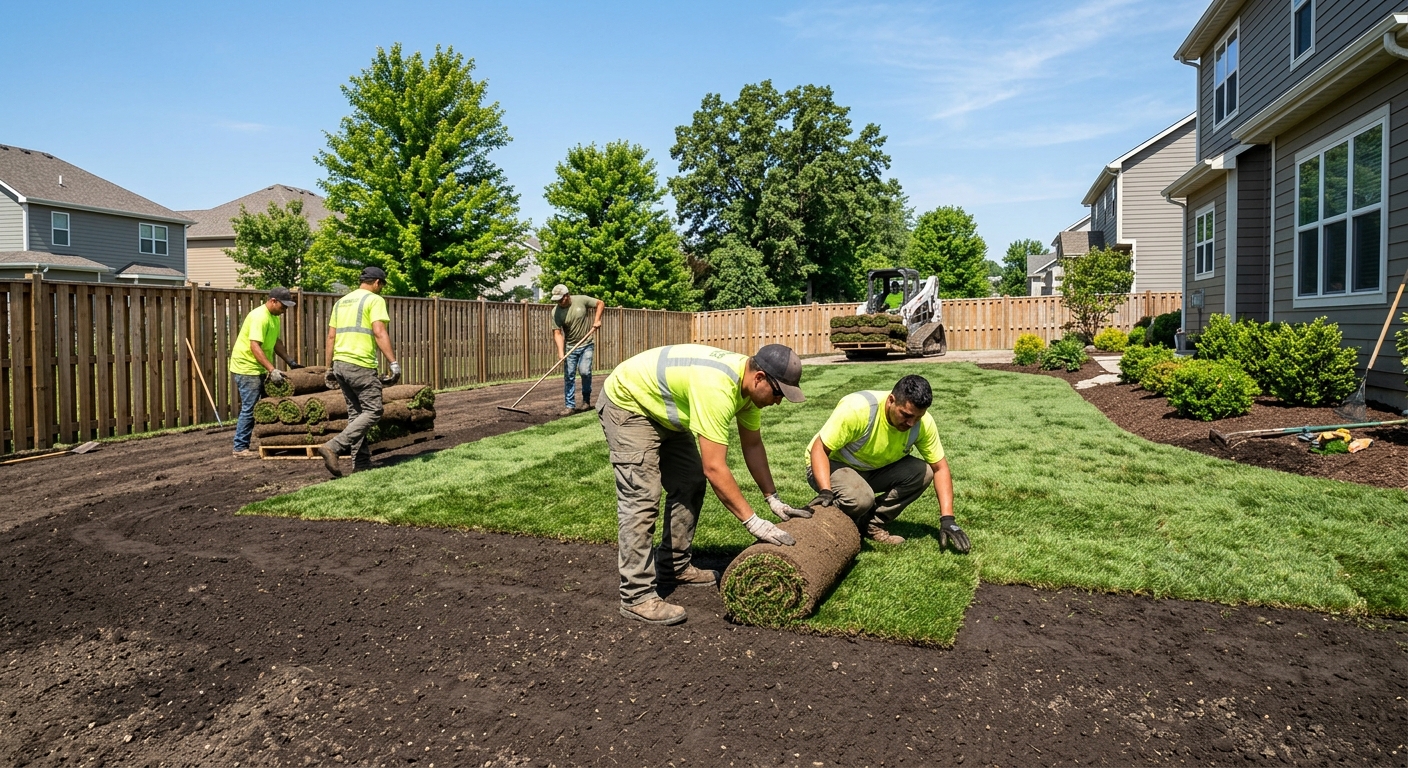
Landscaping options and costs in Canyon Meadows
Canyon Meadows, Alberta has a lot going for it—tree-lined streets, families investing in long-term curb appeal, and plenty of single-detached homes that come with yard space to improve (Statistics Canada, 2021 Census). With a local population of 7,435 people (Statistics Canada, 2021 Census), the area also benefits from steady contractor availability—though summer demand can still tighten schedules when crews are booked in adjacent Calgary communities.
In Calgary’s Prairie plant hardiness zone 3–4, your landscaping costs are shaped by late-spring frosts, early fall cold snaps, and aggressive freeze–thaw cycles. That means contractors must plan deeper, well-compacted base work for patios, walkways, and retaining walls to prevent heaving. It also affects planting choices: we typically steer homeowners toward cold-hardy, drought-tolerant, wind-sturdy species, and that planning work is part of the “design” cost, not an afterthought.
In Canyon Meadows, trade demand is especially consistent around the LRT-adjacent and main thoroughfare corridors where homeowners want practical upgrades—snow-friendly walkways, durable edging, and low-maintenance planting beds that look good even when the growing season shortens. If you’re comparing options, it helps to think of the project as three layers: site prep and drainage, hardscape foundations, and the plant/grass package matched to zone 3–4.
Below is a quick comparison of common landscaping scopes and the typical price bands homeowners budget for, so you can line up quotes with apples-to-apples expectations.
| Service |
Description |
Season |
Price Range |
| Full landscape design and installation |
On-site visit, measurements, concept + final plan, grading/drainage allowance, planting layout, hardscape coordination, installation and cleanup |
Spring to early fall (best work window varies with thaw and frost) |
$15,000–$45,000 |
| Sod installation (supply, grade, lay, roll) |
Subgrade/grade prep, soil conditioning, sod delivery, laying pattern, rolling, first watering guidance |
Late spring through early fall |
$2,500–$5,500 |
| Lawn seeding (grade, seed, starter fertilizer) |
Light grading, topdressing/seedbed prep, seed mix, starter fertilizer, first-season watering plan |
Spring or early fall |
$1,500–$3,800 |
| Interlocking patio or walkway |
Excavation, compacted base (often deeper for freeze–thaw), edging, pavers/interlocking stone, setting sand |
Late spring to fall |
$8,000–$28,000 |
| Retaining wall (interlocking block) |
Wall layout, geogrid/compaction plan allowance, drainage gravel + weep provisions, block installation |
Spring to early fall (weather and cure times matter) |
$10,000–$35,000 |
| Tree and shrub planting |
Planting holes, soil amendments, staking (as needed), mulching, initial watering plan, seasonal planting guidance |
Spring and fall (with frost-aware scheduling) |
$1,500–$12,000 |
Prices are estimates only and vary by project scope, site access and material selection.
What affects the price of landscaping in Canyon Meadows
In Canyon Meadows and across the Calgary region, quotes for the same “look” can swing by 30–50% because landscaping is heavily driven by site conditions and labour intensity, not just materials. Two homeowners might both want a patio, but one lot may need extensive grading correction and deeper base prep due to drainage patterns and freeze–thaw exposure, while the other is relatively flat. Calgary’s tight seasonal window also affects availability—late-spring frost delays and early fall cold snaps can shift crews and equipment, which increases scheduling pressure and change orders.
Hardiness zone 3–4 is a major pricing driver because it determines what survives and how we build for it. Prairie-region landscaping needs drought-tolerant, wind-hardy plants, and retaining wall footings and base layers must reach below the frost line to reduce heaving risk. In contrast, coastal BC clients often enjoy a longer growing season (Zone 7–8) and lush planting palettes, but they typically pay for drainage solutions designed around heavy rainfall—so the cost emphasis changes. Water-use restrictions in dry BC interior regions often push drip irrigation and xeriscaping design; southern Alberta still commonly uses smart controllers and zoned irrigation, but it’s the freeze–thaw depth and compacted bases that tend to make your hardscape and grading line items costlier.
Concrete examples from Canyon Meadows: (1) a sloped backyard that requires moving several truckloads of soil or regrading to daylight to a safe discharge point often pushes a project closer to the higher side of the $8,000–$40,000 retaining wall & hardscaping band; (2) adding a drainage bed or French drain beneath a patio can add meaningful labour and disposal, even if the visible surface area looks unchanged. With many area homes from earlier build cycles, mature trees and older turf may require selective removal and stump grinding before new planting—those prep steps can add hundreds to thousands depending on volume and access.
| Price Factor |
Why It Matters |
Cost Impact |
| Yard size in sq ft — the primary cost driver for softscape |
More area means more excavation, base material, soil conditioning, turf seed/sod, and plant quantities |
Often the biggest swing; can change total cost by several thousand dollars |
| Grading and drainage work — slope corrections add significant cost |
Fixing pooling and directing runoff affects compaction, topsoil depth, and rework risk |
Can add several thousand dollars on top of hardscape/planting |
| Drainage bed or French drain installation |
Freeze–thaw performance improves when water is managed under paving and beds |
Commonly moderate-to-high add-on depending on length/depth |
| Plant material tier — native shrubs vs. ornamental vs. mature specimen trees |
Size at install (root ball diameter) and species hardiness drive labour and material cost |
Can move planting scopes from the low thousands to mid five figures |
| Hardscape vs. softscape ratio — walls and patios cost more per sq ft than lawn |
Pavers/blocks require deeper base, bedding sand, edging, and compaction |
Higher “hardscape density” increases total cost quickly |
| Irrigation system design and installation |
Zoning, head placement, controller setup, and freeze protection affect lifespan |
Can add a large chunk to full projects where sod is involved |
| Soil amendment and topsoil required |
Calgary soils often need conditioning for turf establishment and healthy root growth |
Usually noticeable when base depths or re-topsoiling are required |
| Tree removal or stump grinding before new planting |
Root disturbance and disposal affect access, scheduling, and safety |
Variable but can add hundreds to over a thousand per feature |
Permits & regulations in Alberta
In Alberta, most planting and typical softscape work (including sodding, lawn seeding, mulch, and shrub/perennial planting) usually does not require a permit. Where permits commonly come into play is hardscape and grading that changes how water moves, especially near foundations or property lines. For example, retaining walls above a height threshold—often 1.0 m (3.3 ft) in many municipalities—typically require a building permit, and sometimes engineered drawings depending on height, design, and site conditions. Also, significant changes to lot grading that redirect runoff toward neighbouring properties or storm connections may trigger approval requirements.
Before any digging, call for utility locates. This matters for fence lines, irrigation lines, and any wall footings or drainage trench work because hitting buried services is both dangerous and costly to fix. Then confirm irrigation and water-use expectations for your specific neighbourhood plans—Calgary-area homeowners often use smart controllers and zoned irrigation schedules to manage semi-arid conditions, even when restrictions vary by year.
Here’s how a Canyon Meadows homeowner should verify a contractor step-by-step: (1) confirm the contractor’s Alberta licence status and whether they operate under the correct legal entity; (2) request a certificate of insurance and check that general liability limits are appropriate for excavation and hardscape work; (3) verify WSIB/WCB coverage where applicable for their workers; and (4) ask for a clearance letter or proof of coverage showing their current status. If they can’t provide documentation promptly, that’s a red flag for scheduling and accountability.
Planning a landscape that thrives in Canyon Meadows's climate
To build a yard that thrives in Canyon Meadows, plan around zone 3–4 realities: short growing season, late freezes, and severe freeze–thaw cycles. Start with plant selection—choose native and zone-appropriate species that handle cold snaps and winter desiccation, and favour wind-tolerant shapes and tough root systems. Pair that with drought-smart landscaping because watering is never just “more is better” in southern Alberta; it’s about efficiency, correct soil depth, and root establishment before winter.
Next, decide sod versus seed. Sod gives instant curb appeal and faster coverage, but it costs about 3–4x more per sq ft than seeding and depends heavily on immediate watering and good base prep. If your budget is tighter, seeding after proper grading can still produce a strong lawn by next season when done with the right timing and starter fertiliser. For drainage and grading, don’t treat pooling as cosmetic—Calgary patios, walks, and beds fail when water migrates incorrectly. Build with deep, well-compacted bases and slope away from foundations, and protect your hardscape with drainage measures that move meltwater safely.
For low-maintenance design, layer in mulched shrub borders, groundcovers, and perennials that don’t demand constant replanting after freeze events. Consider xeriscape-leaning ideas such as rock mulch and drought-tolerant grasses, or a rain-garden style depression where feasible to capture roof runoff. A good example: if a 300 sq ft lawn area has uneven subgrade, it may be wiser to spend more on grading/topsoil and seed in the $1,500–$3,800 band than to rush sod in the $2,500–$5,500 band—because the base quality is what keeps the lawn from thinning or slipping through the next freeze–thaw season.
| Element |
Climate Consideration |
Maintenance Level |
Price Band |
| Sod lawn installation |
Establishment relies on warm days, quick root take, and careful watering before frosts |
Medium during first season (watering + monitoring) |
$2,500–$5,500 |
| Native perennial garden |
Cold-hardy structure with better winter resilience and less watering once established |
Low to medium (spring cleanup, light feeding) |
$2,500–$9,000 |
| Mulched shrub border |
Mulch insulates roots from temperature swings and reduces moisture loss |
Low (weed suppression + seasonal topping) |
$1,800–$7,500 |
| Interlocking stone patio |
Needs deep, well-compacted base and proper slope to prevent heaving and pooling |
Low (occasional joint sand replenishment) |
$8,000–$28,000 |
| Retaining wall (block) |
Requires frost-aware depth and drainage gravel to manage water behind the wall |
Low (visual checks; avoid blocked weep/drainage points) |
$10,000–$35,000 |
| Drip irrigation system |
Zoned, freeze-aware design supports efficient watering in a semi-arid climate |
Low (set-and-check controller; seasonal adjustments) |
$2,000–$9,000 |
How to choose a landscaping contractor in Canyon Meadows
Start by confirming the contractor’s Alberta credentials and job-readiness. Ask for proof of insurance (certificate of general liability) and verify workers’ coverage under WSIB/WCB where applicable. If they use subcontractors for excavation, hardscape, or irrigation, request evidence for those trades as well. For the documentation, the practical “where to look” is: their online registry listings (for business status where available), a current certificate of insurance, and a clearance letter or coverage confirmation showing their status is active.
Next, get 2–3 itemised written quotes. You want a breakdown that separates labour and materials, including quantities (sq ft of base/pavers, linear ft of edging, number/sizes of trees and shrubs), and any site prep scope like grading, topsoil, drainage beds, and disposal. A lump-sum quote can hide gaps—especially where freeze–thaw prevention matters.
Read the scope carefully: What is excluded? Is permit pulling included for retaining wall work where thresholds require it? Is material disposal and haul-off included? Will the contractor protect existing lawns, fences, and foundation areas? Confirm warranty terms—workmanship warranty length, product/manufacturer warranty details, and whether warranties transfer if you sell your home.
Payment schedule matters. Never pay more than 10–15% upfront. Hold back remaining funds until key milestones are complete (base inspection, drainage verification, and final grading/cleanup). Finally, get a start date and completion estimate in writing, tied to seasonal weather realities in Canyon Meadows.
- Request proof of Alberta licence/registration status and current business details.
- Get a certificate of insurance and confirm coverage limits for excavation/hardscape.
- Verify WSIB/WCB coverage (or subcontractor coverage) before work begins.
- Ask for 2–3 references from nearby Calgary-area projects with similar scope.
- Insist on itemised quotes: labour vs. materials, and quantities with units.
- Confirm what’s included in grading, base depth, and compaction for freeze–thaw.
- Clarify drainage scope: French drains, drainage rock, and discharge plan.
- Check whether excavation debris/disposal is included in the quote.
- Verify irrigation scope: controller type, zoned coverage, and winterisation approach.
- Confirm warranty: workmanship duration, exclusions, and product warranty transfer.
- Agree on a payment schedule with milestone-based holdback (no large upfront).
- Get timeline in writing: start date, completion target, and weather contingency.
Concrete red flags I commonly see in Canyon Meadows when comparing contractors: (1) quotes that don’t specify base prep depth/compaction or drainage provisions for pavers and walls; (2) refusal or delay to provide proof of insurance and WSIB/WCB coverage; (3) “all-in” pricing with no quantities or exclusions listed; (4) large upfront payments (beyond about 10–15%) without milestones; and (5) vague timelines that don’t account for thaw and early-fall frost risk.
Frequently asked questions — landscaping in Canyon Meadows
How much does professional landscape design cost?
In Canyon Meadows, professional landscape design usually ties directly into the overall project scope. Many contractors apply the design fee toward your installation when you proceed, which helps reduce upfront cost. For budgets, design-and-install totals commonly land in the mid five-figure range once grading, hardscape, planting, and irrigation are included, and pricing commonly references the broader $5,000–$50,000 landscape design & installation band for the Calgary tier. If you’re only getting a concept plan for a small planting area, it can be lower, but the price difference is really about how many revisions, drawings, and plant lists you need—especially in zone 3–4 where frost-hardy selection matters. (Statistics Canada, 2021 Census)
How do I compare landscaping quotes?
To compare quotes in Alberta (including Canyon Meadows), insist that each quote breaks down labour and materials rather than providing one lump sum. Compare scope items like grading/drainage corrections, base prep depth for patios/walkways, disposal/haul-off, and whether drainage rock or French drains are included. Also compare planting quantities and sizes (for example, the difference between small nursery stock and mature specimens is where costs can jump quickly). For price anchoring, if one company quotes sod near the $2,500–$5,500 range and another is significantly lower without detailed base and watering steps, ask what they’re cutting. The same applies to hardscape: retaining walls and interlocking stone often fall within $8,000–$40,000 when proper freeze–thaw base work is included.
How long does a landscaping project take in Canyon Meadows?
Timing in Canyon Meadows depends on weather and the work type. Spring start dates often hinge on thaw—crews can’t excavate or compact properly until soils are workable, and early fall frosts can pause above-ground tasks. A small planting upgrade can be completed in a day or two, while sod or seeding plus irrigation adjustments may take several days including prep and establishment steps. Patios and walkways generally require more time because base construction, compaction, and surface setting must be sequenced correctly for freeze–thaw durability. Retaining walls take longer because drainage gravel placement, block set-up, and curing/finishing steps can’t be rushed. For full landscapes, mid five-figure projects commonly take multiple weeks from first site prep to final cleanup—especially if drainage and irrigation are included.
What is the best grass type for a Canyon Meadows lawn?
For Canyon Meadows, homeowners typically do best with cool-season, hardy turfgrass mixes selected for Calgary’s zone 3–4 winters and summer dry spells. In practice, the “best” choice depends on whether you’re seeding or installing sod and what sun/shade conditions you have. Seed mixes often prioritize quick establishment and drought tolerance, while sod typically provides faster coverage and reduces erosion during the establishment period. Regardless of variety, success depends more on grading, seedbed prep/topsoil quality, and watering discipline than the label on the bag. If you’re choosing between seeding and sod, remember that sod installation commonly budgets around $2,500–$5,500, while seeding is often closer to $1,500–$3,800—and the “best” grass is the one supported by correct base prep for freeze–thaw.
When should I aerate and overseed my lawn in Canyon Meadows?
In Canyon Meadows, aeration and overseeding are usually best done during active growth periods—typically spring once the lawn is waking up and the soil is workable, or in early fall before cold snaps restrict rooting. If your lawn is thinning in high-traffic areas or compacted zones, aeration improves oxygen and helps seed contact the soil. Overseeding works best when paired with topdressing or a light soil amendment so seeds aren’t trapped above a crust. After aeration/overseeding, watering needs careful timing: keep the seed zone consistently moist at first, then reduce frequency as roots establish. If you’re comparing approaches, you can still keep costs sensible by choosing targeted aeration and overseeding rather than full replacement—full lawn installs are typically budgeted higher, such as sod in the $2,500–$5,500 band.
What trees grow best in Canyon Meadows's climate zone?
For Canyon Meadows (zone 3–4 conditions), many homeowners do well with cold-hardy, wind-tolerant trees that tolerate winter desiccation and brief temperature swings. Common “works-in-Calgary” options often include hardy species like Manitoba maple, lilac tree (when suited to your site), and certain ornamental varieties depending on sun, soil moisture, and available space. The best results come from matching the tree’s mature size to your yard setbacks and from planting correctly—at the right depth with good backfill and mulch placement—so roots are protected through freeze–thaw cycles. If you’re budgeting for the whole planting package, tree and shrub planting commonly sits around $1,500–$12,000 depending on the number of plants and whether any removals are needed first. A contractor should also flag wind exposure along fence lines or open backyards, because that can determine spacing and staking needs.