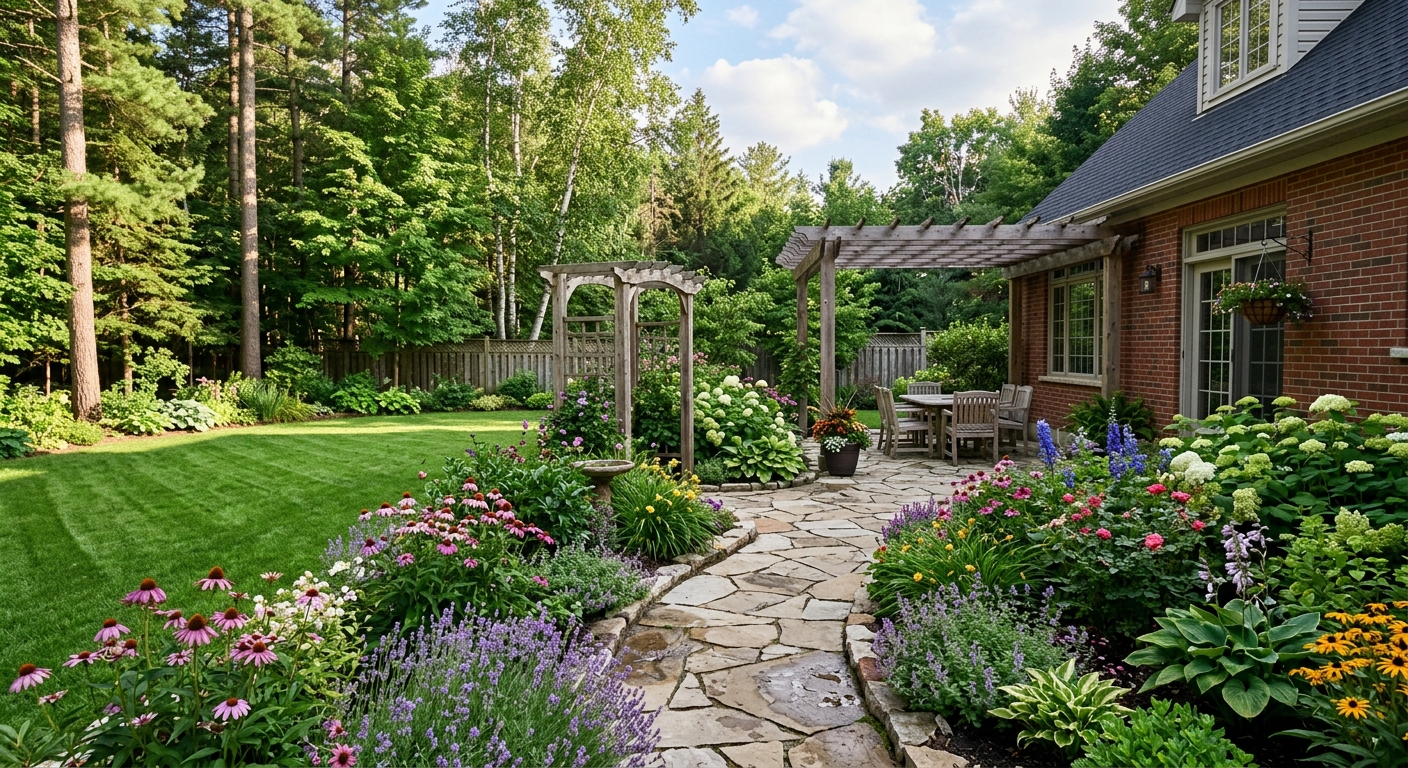
Landscaping options and costs in Hollick-Kenyon
Hollick-Kenyon, Alberta homeowners often want a yard that looks sharp year-round, but the build cost is shaped by our Prairie conditions and by how quickly contractors can safely work around freeze–thaw cycles. With a local population of 5,189 (Statistics Canada, 2021 Census), demand is steady and projects are typically planned in tight seasonal windows. Most detached properties in the area have the yard space to invest in proper grading, drainage, and cold-hardy planting, which is exactly what drives pricing up or down.
In Calgary’s Prairie plant hardiness zones 3–4, late spring frosts and early fall cold snaps influence both what survives and what we can install on-site. Freeze–thaw cycles are severe, so walkways, patios, and retaining wall bases need deep, well-compacted work and proper drainage to avoid heaving and failure. Labour is also a major part of the total; across Calgary, landscaping labour commonly represents about 40–60% of a full project, and comprehensive builds (grading, hardscape, planting, and irrigation) often land in the mid five-figure range when scope is complete.
In Hollick-Kenyon, work is especially in demand around the busier residential corridors near schools and main access routes, where homeowners prioritize curb appeal and walkability. If you’re comparing options, the table below gives realistic price bands to help you budget before you request itemised quotes.
| Service |
Description |
Season |
Price Range |
| Full landscape design and installation |
Site visit, concept to plan, grading/drainage, hardscape build, planting, mulch, and optional irrigation & soil amendments |
Spring to early fall (foundation and base work start as soon as ground thaws) |
$12,000–$38,000 |
| Sod installation (supply, grade, lay, roll) |
Minor grading, topsoil blend, sod laying, rolling, and initial watering plan |
Late spring to early fall (after frost risk and before heat stress) |
$2,500–$5,800 |
| Lawn seeding (grade, seed, starter fertilizer) |
Grade correction, seed selection, starter fertilizer, light cover, and follow-up care guidance |
Spring or early fall |
$1,500–$3,400 |
| Interlocking patio or walkway |
Excavation, deep compacted base, geotextile, interlocking stone, edge restraints, and joint sand |
Late spring to fall (weather-dependent base compaction) |
$8,000–$22,000 |
| Retaining wall (interlocking block) |
Retaining block, drainage rock, weep/collector system (as needed), and reinforced base prep |
Late spring to fall |
$10,500–$30,000 |
| Tree and shrub planting |
Cold-hardy selection, soil improvement, staking (if required), mulch ring, and watering-in plan |
Spring and fall (cooler establishment window) |
$900–$12,500 |
Prices are estimates only and vary by project scope, site access and material selection.
What affects the price of landscaping in Hollick-Kenyon
In Hollick-Kenyon, two homeowners can receive quotes for a similar yard and see a 30–50% difference because the “hidden work” changes: grading depth, base compaction, drainage requirements, haul-away, and the level of plant material (including how mature and hardy the stock is). In Calgary’s market, labour availability can also tighten during peak windows, which affects scheduling and crew efficiency—especially when frost restrictions limit when we can excavate and compact.
Our plant hardiness zone (3–4) and the reality of frost dates directly influence both what grows and how long the working season is. Prairie winter dieback means we often choose drought-tolerant, wind-hardy species rather than broad, soft landscaping palettes that perform better in coastal climates. For retaining walls and any structure that must resist freeze–thaw pressure, the base depth has to extend to below frost influence, and that’s labour- and material-intensive.
For example, if your yard has a low spot, adding a drainage bed or French drain may add cost, but it can prevent future settlement and heaving. Conversely, if your site is already relatively flat and drains well, we can sometimes keep your project closer to a lawn range like $1,500–$3,400 for seeding rather than stepping into a full topsoil-and-grading rebuild that pushes closer to the low end of sod installs at about $2,500–$5,800. Another cost swing comes from plant size: a native shrub border with smaller starts is far less than planting mature specimens that require larger holes, better soil prep, and often extra staking.
Finally, housing-stock age affects what we uncover—older lots can have compacted subsoil or uneven grades. Fixing that with soil amendment and regrading can change a “simple” refresh into a proper base rebuild that’s necessary for safety and longevity.
| Price Factor |
Why It Matters |
Cost Impact |
| Yard size in sq ft — the primary cost driver for softscape |
Softscape quantities (seed/sod, topsoil, mulch, labour hours) scale directly with area |
Large lots can add thousands even with the same design |
| Grading and drainage work — slope corrections add significant cost |
Correcting ponding and redirecting runoff requires excavation, re-compaction, and rework of finished surfaces |
Often the #1 reason quotes differ by 30–50% |
| Drainage bed or French drain installation |
Helps manage saturated subsoil that worsens heaving and foundation moisture risk |
Can add substantial material and labour costs |
| Plant material tier — native shrubs vs. ornamental vs. mature specimen trees |
Hardiness is one part; mature size affects price, handling, and establishment requirements |
Mature specimens can multiply planting costs |
| Hardscape vs. softscape ratio — walls and patios cost more per sq ft than lawn |
Interlocking stone and retaining systems require deep bases, edging restraints, and compaction |
Shifting from turf to stone commonly adds several thousand |
| Irrigation system design and installation |
Zoned, efficient irrigation (often drip) supports establishment while managing water budgets |
Improves results but adds labour, trenching, and controls |
| Soil amendment and topsoil required |
Calgary soils are frequently compacted or low in organic matter; amendment improves rooting |
May significantly affect total if subsoil is poor |
| Tree removal or stump grinding before new planting |
Impacts access, disposal, and scheduling; stumps can disrupt grading and equipment |
Can add days and extra equipment charges |
Permits & regulations in Alberta
For most Hollick-Kenyon backyard work in Alberta, planting, sodding, and typical softscape installations generally do not require a permit. However, retaining walls are where permitting questions usually start. In many Alberta municipalities, retaining walls above a threshold—commonly around 1.0 m (3.3 ft)—typically need a building permit, and in some cases engineered drawings are required depending on height, location, and site conditions.
Also watch grading: changes to lot grading that affect how water drains (especially toward neighbouring properties or connections to storm infrastructure) may trigger approvals. Before anyone digs, ensure utility locates are arranged for the area—this matters both for planting holes and for wall footings, because buried services can be present even in residential yards.
Homeowners should also confirm local irrigation and water-use rules during drought conditions. While Calgary rules can be updated seasonally, the safest approach is to design an efficient system (zoned controls and drip where appropriate) and schedule watering to established plant needs rather than creating a calendar-based routine.
To verify a contractor, follow a simple step-by-step process: (1) confirm the company’s Alberta licence/registration details using the relevant online registry access they provide; (2) request a current certificate of insurance that lists the correct named insured and coverage limits for general liability; (3) confirm WSIB/WCB coverage clearance in writing (ask for the clearance letter and verify it matches the legal business name). If they cannot provide documentation before scheduling excavation, treat that as a major red flag.
Planning a landscape that thrives in Hollick-Kenyon's climate
Designing for Hollick-Kenyon means working with Calgary’s Prairie rhythm: cold winters, late spring frosts, and short establishment windows that punish plants that aren’t zone-appropriate. Start with plant selection—choose native and zone-appropriate shrubs and perennials that handle dry spells and wind, and that are known to be hardy in zones 3–4. For lawns, the sod-vs-seed choice should be intentional: sod gives immediate coverage, but seeding can be more cost-effective and often establishes well when timed for spring or early fall.
Drainage and grading are non-negotiable in Calgary. Pooling around foundations can creep into wall bases and raise heaving risk during freeze–thaw cycles. Any hardscape—especially patios and walkways—should be built on deep, well-compacted bases to reduce settlement. Retaining walls require drainage rock and a collector/weep arrangement so water doesn’t build pressure behind the wall.
For low-maintenance appeal, use mulch and groundcovers to suppress weeds, add resilient perennials for seasonal colour, and select shrubs that don’t require constant pruning. Xeriscape principles can still look polished: group plants by water need, use drip irrigation for establishment, and consider a rain-garden style depression in appropriate locations to manage runoff instead of forcing it through narrow grass channels.
Here’s where the money difference makes sense: if you want instant curb appeal and have a smaller area, sod may be justified—sod installs are often in the $2,500–$5,800 band for typical backyard sizing. If budget is tighter or the lawn can be allowed to develop over one season, seeding is usually the better value at about $1,500–$3,400, especially when combined with soil improvement and proper grading.
| Element |
Climate Consideration |
Maintenance Level |
Price Band |
| Sod lawn installation |
Needs careful watering-in and timing around late frosts and hot, dry snaps |
Medium during establishment, lower after roots fully knit |
$2,500–$5,800 |
| Native perennial garden |
Cold-hardy, better drought tolerance; mulch helps protect crowns through freeze–thaw |
Low to medium (spring cleanup, occasional divide/reseed) |
$2,000–$7,500 |
| Mulched shrub border |
Wind-hardy spacing and winter protection for first 1–2 seasons |
Low (weed control via mulch, minimal pruning) |
$1,400–$6,800 |
| Interlocking stone patio |
Base prep must account for frost heave; proper drainage joints matter |
Low (periodic joint sand top-up) |
$8,000–$22,000 |
| Retaining wall (block) |
Drainage behind wall prevents freeze pressure and water-related movement |
Low (visual inspections after major thaws) |
$10,500–$30,000 |
| Drip irrigation system |
Zoned watering supports establishment while fitting semi-arid conditions |
Low (seasonal adjustments; winterisation as advised) |
$2,200–$7,000 |
How to choose a landscaping contractor in Hollick-Kenyon
Choosing the right contractor in Hollick-Kenyon starts with documentation and details. For Alberta work, verify licensing/registration (ask for their company details and confirm the entry matches the legal business name), request a certificate of insurance with general liability coverage, and confirm WSIB/WCB status by asking for a clearance letter. Don’t accept “we’re covered” without proof—call the numbers listed on the certificate if anything looks off or expired.
Next, get 2–3 itemised written quotes. You want a labour + materials breakdown, not just a lump sum. The scope should list excavation depth, base type (and compaction), geotextile use, drainage features, and what exactly is included for soil amendments, topsoil, mulch, and irrigation (if any). Confirm whether permits are included where they apply (notably for taller retaining walls), and whether disposal of excess soil and rock is included in the price.
Warranty matters for both workmanship and products. Ask for workmanship warranty length and whether it covers settlement, heaving, or plant replacement. Also check if the product/manufacturer warranty is transferable to you as the homeowner.
For payment schedule, never pay more than 10–15% upfront. Hold back a portion until key milestones are complete and final grading and clean-up are done. Finally, insist on a start date and completion estimate in writing. In Calgary-area work, weather can extend timelines—your quote should still state what happens if frost or heavy rain interrupts.
- Provide proof of Alberta registration/licence before scheduling equipment
- Current certificate of insurance (and verify expiry date)
- WSIB/WCB clearance letter that matches the legal entity
- Itemised quote with excavation/base specs, not “allowance” blanks
- Clear list of inclusions/exclusions (topsoil quality, mulch type, edging)
- Compaction method and depth stated for patios/walks/walls
- Drainage plan documented (French drain/weep/collector as needed)
- Irrigation design details if installing systems (zones, controller, drip vs spray)
- Plant list with quantities, container sizes, and substitutions policy
- Workmanship warranty terms and what triggers service
- Payment schedule with milestone-based payments and holdback
- Seasonal schedule that accounts for late frosts and early fall cold snaps
Concrete red flags to watch in Hollick-Kenyon: (1) quotes that ignore grading/drainage details or assume “water will find its way”; (2) no written compaction/base specs for patios or walkways; (3) refusing to provide insurance/WSIB/WCB clearance documentation; (4) asking for large upfront deposits (beyond 10–15%); (5) vague wording like “lawn will be fine” without a watering-in and soil plan for our frost-and-dryness conditions.
Frequently asked questions — landscaping in Hollick-Kenyon
What plants thrive in Hollick-Kenyon's climate zone?
Hollick-Kenyon landscaping in Alberta (Prairie zone 3–4 conditions) does best with hardy, wind-tolerant plants that handle dry spells and cold snaps. In practice, we commonly recommend native and zone-appropriate shrubs, such as compact spruces and hardy potentilla-style shrubs, along with perennials that come back reliably after winter. Mulching is a big part of success: it protects crowns during freeze–thaw cycles and reduces moisture loss. Because your local population is 5,189 (Statistics Canada, 2021 Census), many yards here favour practical, low-maintenance beds rather than labour-heavy annual colour. When you get a plant list, ask the contractor to explain winter protection, expected mature size, and whether the species are proven for Alberta winters rather than “general Canada” stock.
Sod vs seed — which is better for a Hollick-Kenyon lawn?
For Hollick-Kenyon lawns, seed is often the better value when your budget is tight or you can wait through the establishment period. Seeding typically runs about $1,500–$3,400 for many standard backyard scopes, assuming grading is addressed and starter fertilizer is used. Sod costs more—often around $2,500–$5,800—but it delivers instant coverage and faster curb appeal. In Calgary’s freeze–thaw environment, the biggest determinant isn’t just sod versus seed; it’s base preparation and watering-in timing. If your soil is compacted, sod can still fail without proper grading and topsoil blend. For best results, match the method to the size of the area and your willingness to manage watering during establishment.
How much does a retaining wall cost in Hollick-Kenyon?
Retaining walls in Hollick-Kenyon usually fall in the $10,500–$30,000 range depending on height, length, access, and whether drainage behind the wall is required. In Calgary-area projects, cost jumps when the site needs more excavation, deeper base preparation, or a proper collector/weep arrangement to handle water—especially because freeze–thaw cycles can punish walls that trap moisture behind them. If your slope correction is complex or materials need to be hauled in, that also affects pricing. Always ask for an itemised quote that includes base depth, drainage rock, geotextile (if specified), and how they’ll compact the wall footprint. Cutting corners on base and drainage is one of the fastest ways to see movement or heaving later.
When is the best time to landscape in Hollick-Kenyon?
In Alberta, the best time to landscape around Hollick-Kenyon is generally late spring through early fall, when the ground is workable and frost isn’t actively biting into your schedule. We typically plan earthworks—grading, bases, and any trenching—for periods when soil is thawed and crews can compact properly. Planting is often successful in spring (once soil warms slightly) and in fall (while temperatures still allow roots to settle before deep cold). Sod can be installed in the same window, but watering-in has to be managed carefully around hot, dry snaps. If you’re doing patios, walkways, or retaining walls, weather consistency matters; heavy rain can delay compaction and base work. A good contractor will give you a written timeline tied to seasonal realities rather than a vague “sometime this summer.”
Do I need a permit for a retaining wall in Alberta?
In Alberta, retaining walls may require a permit depending on height and location. Many municipalities commonly treat retaining walls around 1.0 m (3.3 ft) and above as permit-worthy, and engineered drawings may be requested in certain situations. In contrast, planting, sodding, and most typical softscape work generally do not require permits. For grading changes that impact how water drains toward neighbouring properties or storm connections, approvals can also be triggered. The practical approach for homeowners in Hollick-Kenyon is to ask your contractor to confirm whether your wall meets the threshold and whether permit work is included. Also ensure utility locates are done before excavation for wall footings. A reputable contractor will address these items in the written scope before work begins.
How do I improve drainage in my yard?
Improving drainage in Hollick-Kenyon starts with locating where water actually goes during spring thaw or after heavy rain. If you see pooling near foundations or low spots that stay wet, the solution is often a combination of regrading and sub-surface drainage. Common fixes include correcting slope, adding topsoil in the right depth, and installing a drainage bed or French drain where water collects. In Calgary’s freeze–thaw conditions, drainage rock, proper geotextile separation, and correct outlet/collector routing matter because trapped water can contribute to heaving and movement. Once drainage is addressed, you can protect the surface with mulched beds and drought-tolerant groundcover rather than relying on turf alone. Ask your contractor to include drainage details and base prep specs in your quote—if it’s vague, it’s hard to hold anyone accountable later.