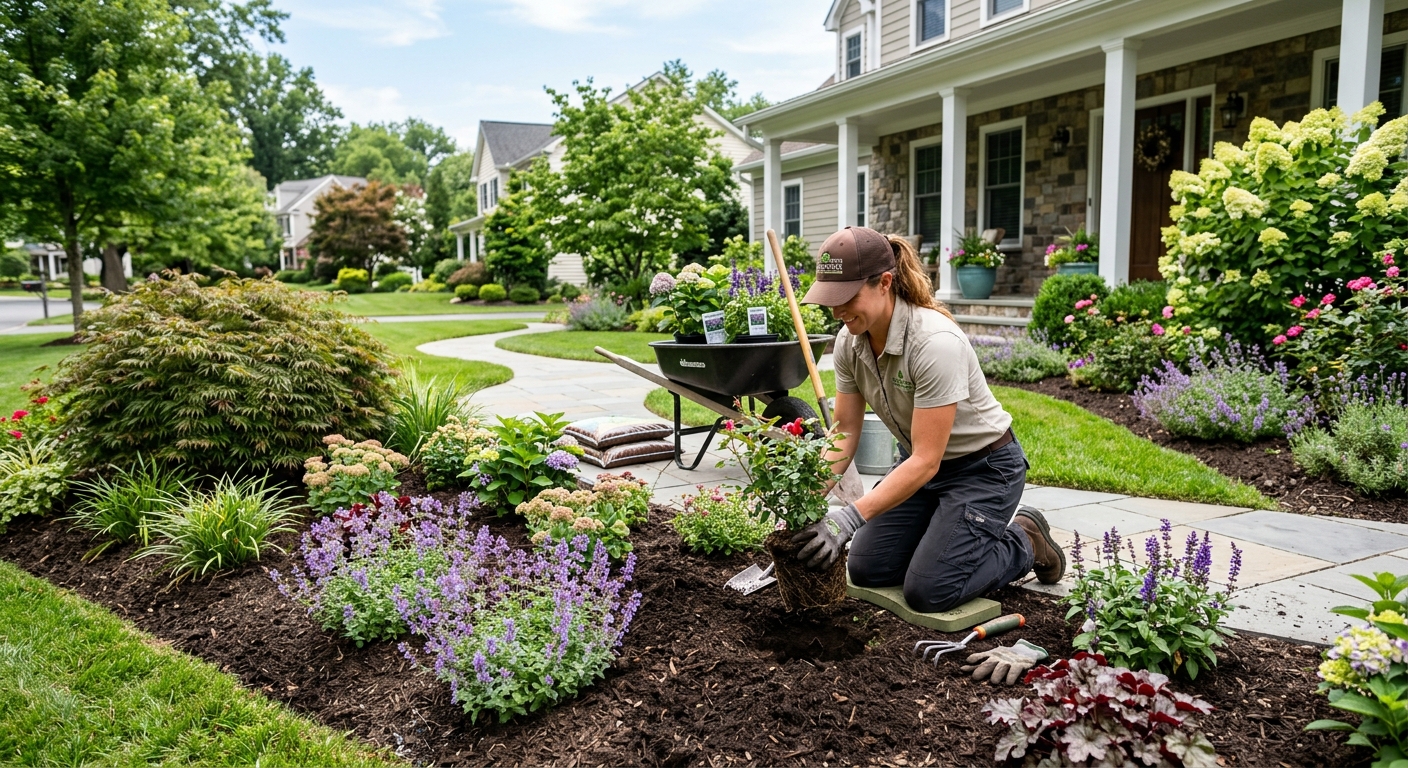
Landscaping options and costs in Falconer Heights
Falconer Heights, Alberta is a great place to upgrade curb appeal—but the cost of landscaping there reflects how fast builders must work around freeze–thaw cycles, late-spring frosts, and early fall cold snaps. With a population of 2,079 (Statistics Canada, 2021 Census), the area has enough local demand to keep crews busy, especially around the busier installation months. In a community like this, landscaping investment is also common because many homeowners plan around their property’s outdoor living potential; each detached household typically has room for softscape, hardscape, or both, which drives scope and pricing decisions.
In the Calgary region (Prairie Zone 3–4), severe freeze–thaw means patio bases, walkways, and retaining wall footings must be built on deep, well-compacted material with proper drainage. That technical base prep is a major reason quotes can move even when the visible design looks similar. Labour availability can also affect timing and price; when the weather breaks and crews are scheduled back-to-back across Calgary and nearby communities, faster turnarounds often require more coordination on site.
Demand is especially high along the Falkoner Heights—Rocky View area perimeter, where lots often need grading adjustments and where homeowners want wind-protected planting and durable hardscape. If you’re comparing options, the table below gives realistic Alberta price bands you’ll see for common Falconer Heights projects; use it as a starting point before contractors measure your yard and confirm access, slope, and drainage needs.
| Service |
Description |
Season |
Price Range |
| Full landscape design and installation |
Site visit, design plan, grading/drainage coordination, planting, hardscape and/or irrigation as specified |
Late spring to early fall (typically May–September) |
$5,000–$50,000 |
| Sod installation (supply, grade, lay, roll) |
Fine grading, soil prep, sod supply, laying and rolling for immediate green-up |
May–August (or when soil is workable) |
$1,500–$6,000 |
| Lawn seeding (grade, seed, starter fertilizer) |
Light grading, seed blend, starter fertilizer, and early-season soil conditioning |
Late spring to early summer; sometimes early fall reseeding |
$900–$3,500 |
| Interlocking patio or walkway |
Excavation, base course, edge restraint, pavers with joints and compacted bedding |
May–September (best before heavy fall freeze) |
$8,000–$30,000 |
| Retaining wall (interlocking block) |
Block wall installation with proper base, compaction, and drainage backfill |
May–September (base prep depends on site conditions) |
$8,000–$40,000 |
| Tree and shrub planting |
Digging, amendments, soil backfill, planting, staking where needed, and first watering setup |
Spring and fall are strongest; light work in early summer |
$800–$15,000 |
Prices are estimates only and vary by project scope, site access and material selection.
What affects the price of landscaping in Falconer Heights
In Falconer Heights and across the Calgary economic region, two homeowners can receive quotes that differ by 30–50% for the “same” landscape idea because the underlying site conditions and installation depth drive labour, base materials, and risk. The most common surprises are grading and drainage complexity, the need for deeper bases under hardscape, and plant selection that must survive Prairie Zone 3–4 winters. In Calgary’s market, comprehensive projects often land in the mid five-figure range once hardscape, irrigation, and soil improvement are included, even before you add upgrades like extra wall height or mature specimen trees.
The plant hardiness zone and frost dates affect both what grows and what contractors can do onsite. In Prairie regions, the working window can be short, and severe freeze–thaw cycles mean retaining wall bases and patio walkways must be built to reach below frost-impacted zones. A job that requires extra excavation and proper drainage bedding can move costs quickly—particularly when foundations are close or where downspouts must be managed away from footing moisture.
By contrast, coastal BC (Zone 7–8) typically allows a longer planting period and broader palettes, but heavy rainfall there makes drainage design and permeable detailing critical, which shifts costs into other line items. Southern Ontario (Zone 5–6) has a moderate season but often still needs irrigation planning during dry spells. In Alberta, irrigation design and soil amendments are still key, but the bigger driver is often freeze management and drought tolerance after installation.
Concrete examples you’ll see in Falconer Heights: (1) a lawn upgrade that starts near the lower end of $1,500–$6,000 can climb when grading and topsoil hauling are required to fix low spots; (2) interlocking patio work that may feel like a straight materials job often ends up closer to $8,000–$30,000 once you factor in deep base prep and drainage correction.
| Price Factor |
Why It Matters |
Cost Impact |
| Yard size in sq ft — the primary cost driver for softscape |
More area means more topsoil, seed/sod, mulch, and planting—plus extra labour hours |
Can increase total cost by 20–60% depending on scope |
| Grading and drainage work — slope corrections add significant cost |
Proper pitch protects foundations and prevents standing water |
Often one of the largest adders when site is out of grade |
| Drainage bed or French drain installation |
Manages water movement under patios, near downspouts, and around walls |
Typically adds substantial labour, pipe, and aggregate costs |
| Plant material tier — native shrubs vs. ornamental vs. mature specimen trees |
Mature trees cost more and require careful digging, staking, and sometimes rewiring of irrigation |
Material pricing swings widely from budget to premium tiers |
| Hardscape vs. softscape ratio — walls and patios cost more per sq ft than lawn |
Hardscape requires excavation, base layers, compaction, and restraint systems |
Shifts pricing quickly toward the retaining wall/hardscape band |
| Irrigation system design and installation |
Zoned irrigation and freeze-aware components reduce winter risk and summer water waste |
Can move a project from “planting-only” to “mid five-figure” |
| Soil amendment and topsoil required |
Calgary-area soils may be sandy, rocky, or compacted—amendments improve root establishment |
Costs rise with additional trucking and larger amendment volumes |
| Tree removal or stump grinding before new planting |
Removing obstacles is labour-intensive and affects how you stage excavation |
Often adds a separate line item and affects timelines |
Permits & regulations in Alberta
For most residential landscaping in Alberta, you generally don’t need permits for planting, sodding, and typical softscape work (like seeding, mulching, and shrub/flower bed installation). However, permitting can apply when you build structures or change how water moves across the lot. In particular, retaining walls above a height threshold—commonly around 1.0 m (3.3 ft) in many municipalities—often require a building permit, and sometimes engineered drawings depending on height, location, and site conditions. Additionally, if your project includes grading changes that affect drainage patterns toward neighbouring properties or storm connections, that may trigger approval requirements.
Before any excavation for planting holes, trenching for irrigation, or wall footings, always have utility locates completed. That’s not a “nice to have”—it’s essential to protect your service lines and to avoid dangerous surprises in the dirt.
To verify a contractor in Falconer Heights step-by-step, start with their Alberta licence (and scope) and ask for current liability insurance. Then request proof of WSIB/WCB coverage (or the applicable coverage status for their business type). For workmanship and safety, ask for a clearance letter where applicable, and ensure the policy dates cover the work period. Finally, confirm in writing what will be handled for permits (if required), including who pulls them and when.
Planning a landscape that thrives in Falconer Heights's climate
Planning for Falconer Heights means working with Prairie Zone 3–4 realities: wind exposure, late-spring frosts, and severe freeze–thaw cycles. Start with plant selection—choose zone-appropriate, hardy species and build in winter protection through mulch depth, sheltered placement, and smart spacing. Native and well-adapted shrubs and perennials generally require less watering and are more resilient through chinook swings followed by cold snaps. For lawn areas, Calgary’s climate also rewards the right establishment method: sod gives instant cover, while seeding can better fit budget goals if you can accept a longer “green-up” timeline.
Drainage and grading are the make-or-break items in Calgary. Even if your design looks good, poor slope away from foundations can lead to pooling and foundation moisture. If you’re adding a patio, walkway, or any retaining wall, base preparation must be built for freeze conditions using deep, well-compacted layers and correct drainage backfill—otherwise heaving and settlement can show up after the first harsh winters.
For low-maintenance curb appeal, use groundcovers, mulched shrub borders, and repeat plant patterns so you spend less time weeding and more time enjoying the yard. Xeriscape-inspired layouts (mulch, drought-tolerant plants, and targeted irrigation) help where watering is restricted at times, and a simple rain-garden or swale can manage downspout runoff without turning the yard into a constant watering project.
A quick pricing reality check: upgrading a small lawn section with sod may start in the $1,500–$6,000 range, but that cost is often justified when you need instant coverage. If your priority is budget and long-term resilience, seeding can be a smarter fit—provided drainage is corrected first and the soil is prepped properly.
| Element |
Climate Consideration |
Maintenance Level |
Price Band |
| Sod lawn installation |
Needs proper base grade and consistent watering during establishment; freeze-thaw can lift weak bases |
Medium during establishment, then lower once established |
$1,500–$6,000 |
| Native perennial garden |
Hardy perennials tolerate Prairie winters; mulching supports root protection through cold swings |
Low to medium (spring cleanup and occasional weed control) |
$800–$6,000 |
| Mulched shrub border |
Mulch helps retain moisture and moderates soil temperature during freezes; wind protection matters for young shrubs |
Low (occasional topping up mulch) |
$2,500–$10,000 |
| Interlocking stone patio |
Requires compacted base and drainage detailing to resist heaving and movement |
Low (occasional joint sand top-up and cleaning) |
$8,000–$30,000 |
| Retaining wall (block) |
Backfill and drainage are essential; wall base must be built for freeze conditions |
Low after build (routine inspection of drainage outlets) |
$8,000–$40,000 |
| Drip irrigation system |
Targets roots and reduces waste; zoned design helps manage freeze risk and watering efficiency |
Medium (seasonal checks and controller setup) |
$2,000–$12,000 |
How to choose a landscaping contractor in Falconer Heights
Choosing the right contractor in Falconer Heights comes down to verification, transparent scope, and realistic scheduling. First, ask for proof of current Alberta licensing (where applicable to the work), plus liability insurance and WSIB/WCB coverage. You can check licensing and standing through official provincial channels, but also confirm directly by requesting policy certificates. For insurance, look for coverage that matches your project type (hardscape excavation, tree work, irrigation trenching) and dates that include your start and completion window. For WSIB/WCB, request documentation that shows active coverage or clear status for subcontractors.
Next, request 2–3 itemised written quotes. The best quotes break down labour and materials separately: excavation, base prep depth, pipe/aggregate sizes, plant quantities and sizes, and irrigation components if included. Avoid lump-sum quotes that don’t specify what’s in or out. Carefully review exclusions—disposal, topsoil hauling, utility locates, permit pulls (if a retaining wall triggers one), and any restoration of turf after work.
Warranty matters: ask for a workmanship warranty length, what it covers (settlement, lifting pavers, plant replacement rules), and whether product warranties are transferable. For payment, keep deposits low—generally no more than 10–15% upfront—and use a holdback until the job is fully complete and cleaned. Finally, get a start date and a completion estimate in writing, tied to realistic weather windows for Calgary-area freeze risk.
- Provide Alberta licence details and a contactable business address.
- Show current liability insurance certificate for the work period.
- Confirm WSIB/WCB coverage and that any subcontractors are covered.
- Use itemised pricing with line-by-line quantities (sq ft, plants, linear feet).
- Specify base prep depth and compaction method for patios/walkways.
- Clarify drainage responsibility (French drain, weeping tile, outlets).
- State whether utility locates are booked or your responsibility.
- List topsoil/amendment type and how many yards are included.
- Include plant sizes (e.g., height/spread) and replacement policy.
- Confirm sod/seed type, fertilizer, and watering instructions for establishment.
- Explain disposal: hauling away spoil and debris vs. “leave as-is”.
- Provide written timeline with start date and weather contingency.
In Falconer Heights, red flags include: quotes that are not itemised (only lump sums), refusing to show insurance or WSIB/WCB documentation, vague base prep language for patios/walls, “instant start” claims that don’t account for site locates and freeze timing, and warranties limited to “materials only” with no workmanship coverage.
Frequently asked questions — landscaping in Falconer Heights
How much does landscaping cost in Falconer Heights?
Landscaping in Falconer Heights typically depends on whether you’re doing softscape only (planting/lawn) or a combined design that includes grading, irrigation, and hardscape. For a full design-and-install project, many Calgary-area homeowners land anywhere from $5,000–$50,000 depending on yard size, access, and how much drainage or base prep is required. If you’re looking specifically at lawn work, sod installs commonly fall in the $1,500–$6,000 band, while more complex sites with grading corrections can push higher because of added soil and compaction work needed to withstand freeze–thaw. Labor often makes up a large share of cost in Southern Alberta, so timing and scheduling also matter.
What plants thrive in Falconer Heights's climate zone?
Falconer Heights sits in Prairie hardiness zones 3–4, so the best performers are cold-hardy, wind-tolerant plants that can handle winter freeze cycles and periodic dry spells. In practice, we favour native or well-adapted shrubs and perennials that establish quickly and don’t require constant watering. Mulched borders, proper spacing, and sheltered placement help young plants through late-spring frosts and cold snaps. For lawn edges, consider drought-tolerant grasses and blends rather than water-hungry species. If you’re planning a mixed yard, your contractor should propose plant sizes that match your soil and exposure, and they should include soil amendment if your site is compacted or rocky. (Statistics Canada, 2021 Census)
Sod vs seed — which is better for a Falconer Heights lawn?
In Falconer Heights, sod and seed both work, but they’re best for different homeowner priorities. Sod gives instant coverage and can look great quickly; however, it usually costs more—often within the $1,500–$6,000 range for typical small-to-mid lawns—because you’re paying for the product, careful grading, and consistent establishment watering. Seeding is more budget-friendly and can be a good option if you can accept a longer green-up period while the roots establish. Whichever you choose, drainage and correct grading are critical so the lawn doesn’t heave or thin during freeze–thaw. In Calgary-area weather, seeding success also depends on soil prep and timing around late-spring frosts.
How much does a retaining wall cost in Falconer Heights?
Retaining wall pricing in Falconer Heights generally depends on wall height, total linear feet, site access, and whether drainage backfill and weepage solutions are required. In the Calgary region, most interlocking block retaining walls commonly fall in the $8,000–$40,000 range. A smaller, straight run with straightforward excavation will sit closer to the lower end, while walls with complex grading, limited access, or additional drainage work push toward the higher end. Also consider that retaining walls above a typical threshold of about 1.0 m often require a permit and sometimes engineering, which can add to the overall timeline and cost.
When is the best time to landscape in Falconer Heights?
The best window is usually late spring through early fall in Falconer Heights, because crews need workable soil and enough time for plants and bases to settle before the deeper cold sets in. Seeding and sod are typically done when temperatures and soil conditions support germination and root establishment—often from May through August, with careful planning around late-spring frosts. Hardscape base work (patios/walkways and retaining walls) should be installed when you can achieve proper compaction and avoid frost-affected excavation. Tree and shrub planting is strongest in spring and fall, when plants can focus energy on roots. If you’re planning a larger project, lock in scheduling earlier so weather doesn’t force delays into November.
Do I need a permit for a retaining wall in Alberta?
Often, yes—depending on the wall height and local municipal rules. In Alberta, most typical softscape work (planting, sodding, and lawn installation) typically doesn’t require permits, but retaining walls above a common threshold of around 1.0 m (3.3 ft) usually do require a building permit, and sometimes engineered drawings. Before you build, your contractor should confirm whether your specific wall location and height triggers approval. If the wall includes major grading changes or affects storm drainage flow, additional review may apply. For safety and compliance, ensure utility locates are completed before digging footings. It’s also smart to keep your contractor’s permit responsibility clear in the contract, especially when you’re budgeting in the $8,000–$40,000 retaining wall range.