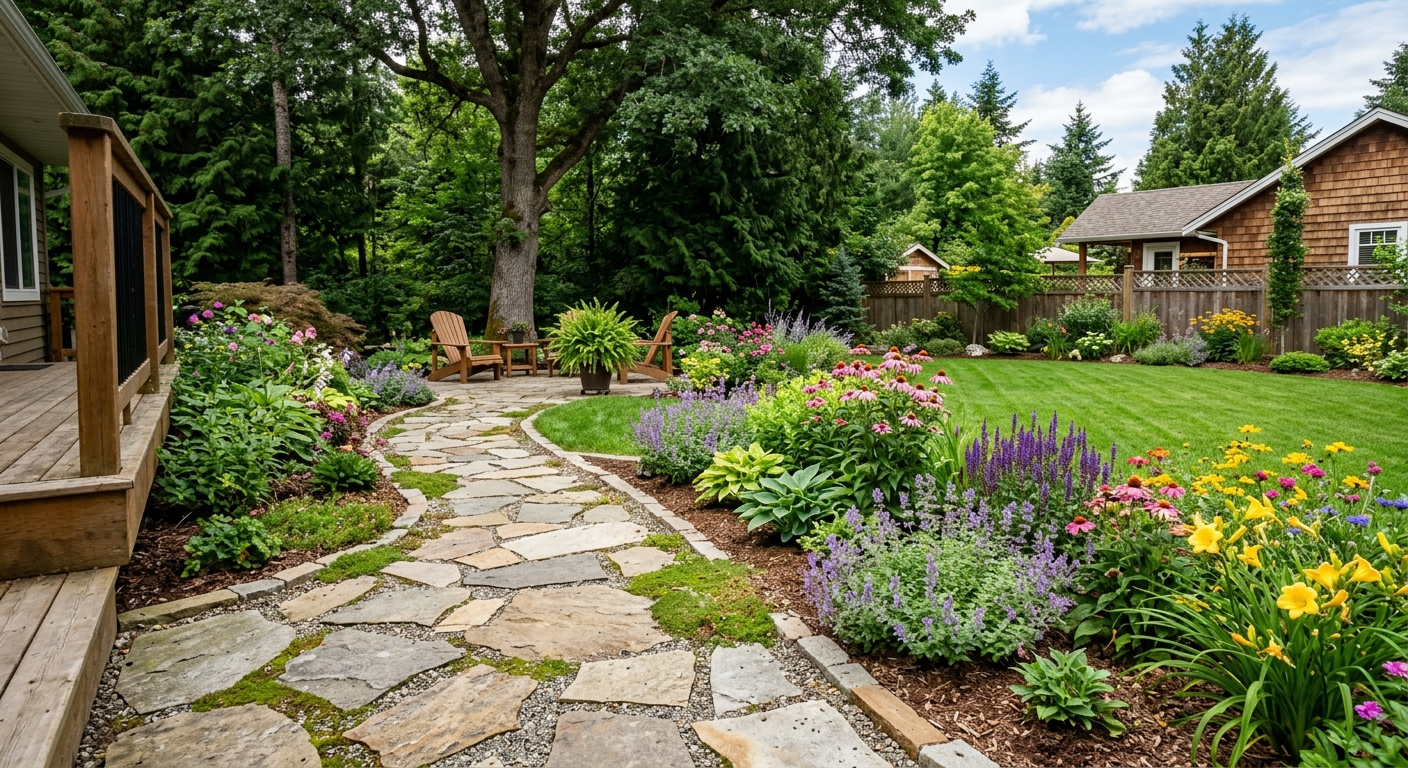
Landscaping options and costs in Deer Ridge
Deer Ridge homeowners typically start with one of three paths: softscaping (lawn/planting), hardscaping (patios/walkways/retaining walls), or a full-package yard refresh. With a population of 3,795 (Statistics Canada, 2021 Census), Deer Ridge is small enough that contractors often get booked fast during spring warm-up, especially when crews are mobilized between Calgary and nearby communities. Most detached properties in the area create a real incentive to invest, because you’re working with more yard surface and longer-term curb-appeal returns than you’d get in a tighter lot.
In Calgary’s Prairie zone (3–4), landscaping costs are shaped by late-spring frosts, early fall cold snaps, and harsh freeze–thaw cycles. Those cycles drive up the importance of deep, well-compacted bases and proper drainage—otherwise patios can heave and retaining-wall footings can fail. Labour typically represents 40–60% of a full project, and comprehensive packages across the Calgary region commonly land in the mid five-figure range once grading, hardscape, planting, and irrigation are included. In Deer Ridge, trade demand is especially strong around the more developed residential pockets where access is straightforward and families want a quick “usable yard” before winter.
Below is a realistic pricing comparison so you can match the option to your budget and timeline.
| Service |
Description |
Season |
Price Range |
| Full landscape design and installation |
Consultation, concept + layout, grading plan, hardscape, planting, and irrigation (where needed) |
Late April to October (best results in May–September) |
$8,000–$35,000 |
| Sod installation (supply, grade, lay, roll) |
Site prep, topsoil or base correction, seeding/leveling as needed, sod supply and installation |
May to early September (soil temps must support rooting) |
$2,000–$6,000 |
| Lawn seeding (grade, seed, starter fertilizer) |
Light grading, seed blend selection for Alberta conditions, starter fertilizer, initial watering guidance |
April/May or August (depending on frost risk and moisture) |
$1,500–$4,000 |
| Interlocking patio or walkway |
Excavation, deep base, edge restraint, interlocking stone, compaction, joint sand |
May to September (fast cure for bases and bedding) |
$8,000–$28,000 |
| Retaining wall (interlocking block) |
Layout, excavation, geogrid/base, block installation, backfill + drainage provisions |
May to September (foundation work must be protected from wet freezes) |
$10,000–$40,000 |
| Tree and shrub planting |
Soil improvement, staking, mulching, spacing, and establishment care plan |
Spring and fall planting windows |
$800–$15,000 |
Prices are estimates only and vary by project scope, site access and material selection.
What affects the price of landscaping in Deer Ridge
In the Calgary region, it’s common to see quotes for the same “look” vary by 30–50%. That spread usually comes from differences in base depth, drainage scope, labour hours, and how much of the work is truly included (excavation, disposal, soil amendment, irrigation, and establishment care). Even when you’re comparing the same general deliverable—like sod replacement or a retaining wall—two contractors can price very differently if one includes the deep, well-compacted sub-base required for freeze–thaw conditions and the other doesn’t.
Deer Ridge sits in Prairie plant hardiness zones 3–4, where late spring frosts and early fall cold snaps tighten the working season. Contractors need cold-hardy, wind-tolerant, drought-tolerant species, plus efficient irrigation design. If you compare this to coastal BC (zone 7–8), you’d expect richer planting palettes but also heavy emphasis on drainage under rainfall—whereas in Calgary you’re designing for fewer rainfall events and severe freeze–thaw. Water restrictions in the dry BC interior push drip irrigation and soil improvement; in Alberta, the same design logic applies because establishment is still costly if watering is inefficient.
Concrete cost examples: (1) If your yard requires significant regrading to direct runoff away from the foundation, drainage corrections can move a “basic” project into the next price band (often pushing a simple planting job toward the upper end of the $5,000–$50,000 design-and-install range). (2) If you want an interlocking patio with a proper deep base, expect the excavation and compaction effort to dominate labour and drive you into the $8,000–$40,000 retaining-wall and hardscaping-type pricing tier. Lastly, older homes or established yards can require extra soil conditioning—adding topsoil and amendments can mean hundreds to thousands more depending on how much is being corrected for drainage and rooting depth.
| Price Factor |
Why It Matters |
Cost Impact |
| Yard size in sq ft |
Impacts materials, excavation, and plant quantities (softscape is largely area-based) |
Can change total cost dramatically; larger areas often push projects into higher bands |
| Grading and drainage work |
Slope corrections prevent pooling and foundation moisture; freeze–thaw punishes poor drainage |
Often adds substantial cost via labour + hauling + re-compaction |
| Drainage bed or French drain installation |
Manages water movement where downspouts and low points create wet spots |
Increases excavation scope; can be a major line item |
| Plant material tier |
Native shrubs typically cost less than ornamental replacements or mature specimens |
Can swing thousands depending on whether you’re starting small or installing instant height |
| Hardscape vs. softscape ratio |
Patios, walkways, and walls require deeper bases and more time-consuming installation |
Walls and patios usually cost more per sq ft than lawn |
| Irrigation system design and installation |
Zoned, efficient systems improve establishment and reduce overwatering in Prairie conditions |
Adds equipment + labour; cost rises with complexity and number of zones |
| Soil amendment and topsoil required |
Improves rooting and water holding; important where compacted soil affects drainage |
Higher if you need to replace significant depth or bring in screened topsoil |
| Tree removal or stump grinding before new planting |
Prepping access and root zones can be necessary for new beds, walks, or lawn |
Can add costs quickly, especially where stumps are large or near hardscape |
Permits & regulations in Alberta
In Alberta, most day-to-day landscaping work—like planting trees/shrubs, seeding, sodding, mulching, and constructing small ground-level garden beds—typically does not require a permit. Where you need to slow down is for retaining walls and any work that affects drainage and utilities. In most municipalities, a retaining wall above a height threshold (commonly 1.0 m / 3.3 ft) may require a building permit and sometimes engineered drawings, particularly if the wall is supporting significant surcharge loads or sits near property lines. Also, any changes to lot grading that alter where stormwater flows—especially toward neighbouring properties or connecting to storm sewer infrastructure—can trigger approval requirements.
Step-by-step for homeowners in Deer Ridge: (1) Confirm your contractor will locate buried utilities before digging. Ask if they book utility locates and show proof that they requested them before wall footings or planting holes. (2) Ask whether the retaining wall work will be above the permit threshold and, if so, whether they include permit support in their scope. (3) Verify the contractor’s Alberta licence/registration (where applicable for their work type), then review liability insurance and coverage for workers. (4) Look for proof of WSIB/WCB coverage via certificate of insurance or clearance letter; the certificate should list the correct legal entity name and coverage period. (5) Keep documentation—quotes, scope, and any permit coordination—so you’re protected if the project is delayed or revised.
Planning a landscape that thrives in Deer Ridge's climate
Planning in Deer Ridge means designing with Alberta’s freeze–thaw reality, not against it. Deer Ridge sits in a cold, Prairie growing environment where harsh winter cycles demand strong base prep, and short growing seasons mean you want plants and materials that establish quickly. Start with zone-appropriate selection: native and hardy shrubs/perennials handle Alberta winters with less fuss, and they reduce winter die-back compared with marginal ornamentals. Pair that with smart irrigation—zoned drip where possible—because water management costs less than replacing struggling plantings after cold-weather setbacks.
For turf, consider the sod-versus-seed decision carefully. Sod gives instant cover and improves erosion control right away, but it typically costs about 3–4 times more per sq ft than seeding once you include supply and installation. In a yard where you want usable grass quickly, that premium can be justified; if you’re renovating in spring and need immediate coverage, sod can hold the line against late-season washouts. If you can wait for a gradual green-up, seeding is usually the better value, especially when paired with starter fertilizer and follow-up watering guidance.
Drainage and grading are non-negotiable in Calgary to prevent foundation moisture and pooling. Any patio, walkway, or retaining wall needs base preparation that reaches below the frost-impacted zone, with proper compaction and edge restraint. Finally, build low-maintenance structure: mulch, groundcovers, and repeatable perennial groupings can reduce annual upkeep while still delivering curb appeal. If you’re aiming for xeriscape, think drought-tolerant plants plus a rain-garden style capture where downspouts can be directed—this supports establishment without relying on constant summer watering.
As a quick budget sanity check: if an interlocking patio pushes you into the hardscape range, it’s often smarter to invest in proper base + drainage under the patio first; then spend the saved budget on hardy planting that will actually survive the winter.
| Element |
Climate Consideration |
Maintenance Level |
Price Band |
| Sod lawn installation |
Needs soil warmth for rooting and consistent moisture during establishment; freeze–thaw requires solid base |
Moderate during first season, then low |
$2,000–$6,000 |
| Native perennial garden |
Zone-appropriate survival with less watering; handles cold snaps and wind exposure better |
Low to moderate (spring cleanup, occasional weeding) |
$2,000–$8,000 |
| Mulched shrub border |
Mulch buffers temperature swings; hardy shrubs reduce winter burn and die-back |
Low (mulch refresh and light pruning) |
$1,500–$7,500 |
| Interlocking stone patio |
Requires deep compaction and drainage to prevent heaving during freeze–thaw cycles |
Low (periodic joint sand top-up) |
$8,000–$28,000 |
| Retaining wall (block) |
Backfill and drainage prevent hydrostatic pressure; base must extend below frost-impacted movement |
Low (visual inspections and drainage checks) |
$10,000–$40,000 |
| Drip irrigation system |
Efficient watering for semi-arid conditions and establishment; zoned control helps during restrictions |
Moderate (seasonal checks, winter shut-down) |
$1,200–$6,000 |
How to choose a landscaping contractor in Deer Ridge
Choosing a contractor in Deer Ridge starts with confirming they can legally and safely do the work, and that their quote matches your site realities. For licensing/registration, check the contractor’s standing for the type of work they’re advertising (and ensure the legal business name on their paperwork matches the quote and invoice). For liability insurance, request a current certificate of insurance that shows adequate coverage and lists you or your property appropriately as a certificate holder where required by your contract terms. For workers’ coverage, ask for proof of WSIB/WCB coverage—ideally through a clearance letter or policy documentation. If they can’t provide documentation promptly, treat it as a major quality and risk signal.
Next, get 2–3 itemised written quotes. You want labour and materials broken out: excavation/disposal, base materials (gravel type and depth), pavers or blocks, soil amendment, plant list, and irrigation components. Avoid lump sums that don’t explain what’s included. Read exclusions carefully: is sod disposal included? Is topsoil supply included? Does the price include permit support if a retaining wall is above the local threshold? Confirm warranty wording for workmanship (length and what’s covered), and separate product/manufacturer warranties from install warranties—also confirm whether warranties are transferable if you sell your home.
Finally, payment schedule matters. Never pay more than 10–15% upfront, and hold back a meaningful portion until completion and final cleanup. Get a written start date and a completion estimate that accounts for frost risk and material lead times—especially for hardscape bases and irrigation parts.
- Ask for a detailed plant list (common name + size at install) and replace/upgrade policy.
- Request base depth specs for patios/walks/walls (and confirm drainage layers are included).
- Confirm soil amendments (type and thickness) instead of “topsoil supplied” only.
- Verify irrigation zoning, controller model, and winter shut-down approach (if applicable).
- Check that disposal/haul-away is clearly listed (stumps, rocks, excess soil).
- Get a start date, material delivery window, and weather contingency plan.
- Require a written warranty for workmanship and clarity on what counts as a defect.
- Ensure the scope covers edging, restraint, joint sand, and final grading checks.
- Ask who owns materials if the job pauses—so you’re not billed twice.
- Confirm cleanup standards: sodding/seed areas should be free of stone/weed debris.
- Request references from similar Prairie-zone projects (Zone 3–4 conditions).
- Confirm their insurance documentation and coverage dates before work starts.
Red flags in Deer Ridge: a quote that ignores drainage or base preparation details, vague “permit included” language for retaining walls, refusal to provide insurance/WSIB/WCB proof, payment requests above 10–15% upfront, and a warranty that only covers materials (not workmanship or installation). If any of these show up, pause and ask for corrections in writing.
Frequently asked questions — landscaping in Deer Ridge
Do I need a permit for a retaining wall in Alberta?
In Alberta, most landscaping work like planting and lawn installation typically doesn’t require a permit, but retaining walls can be different. In most municipalities around Deer Ridge and the Calgary area, a retaining wall above a threshold—often 1.0 m (3.3 ft)—may require a building permit, and some situations may involve engineered drawings. The trigger can also depend on wall location, how much it’s holding back (including surcharge loads), and how close it is to property lines. Before you sign a contract, ask your contractor to confirm whether your proposed wall height is above the permit threshold and whether they will support permit coordination. If you’re budgeting, retaining-wall projects commonly start around the $10,000–$40,000 range because drainage and base engineering are usually included.
How do I improve drainage in my yard?
Drainage improvements in Deer Ridge usually start with observing where water pools after snowmelt and heavy rain, then correcting the slope so runoff moves away from your foundation. For freeze–thaw-heavy Calgary conditions, drainage can’t be an afterthought: soft soils that stay wet can heave, and water against foundations can raise long-term moisture issues. Typical fixes include regrading (often with a labour-heavy slope correction), installing a drainage bed or French drain, and adjusting downspout discharge points so water isn’t fed into low spots. A good contractor will also specify what base and bedding depth they’re using under walkways/patios, since poor bases can fail even if plants look fine. If you’re comparing budgets, ask whether your drainage scope is included in the overall plan, because it’s one of the biggest drivers behind quote differences (often shifting you up toward the mid five-figure project tier).
What is xeriscaping and does it suit Deer Ridge?
Xeriscaping is a design approach that reduces water use by using drought-tolerant, zone-appropriate plants, improving soil so it holds moisture efficiently, and reducing or eliminating high-water turf. In Deer Ridge, xeriscaping typically suits the climate well because you’re in a Prairie zone with cold winters and relatively limited summer moisture. It also aligns with how efficient irrigation pays off during establishment. Instead of a “rock-only” yard, good xeriscape looks like mulch beds, hardy perennials, shrubs, and groundcovers with drip irrigation or carefully zoned watering. If watering restrictions tighten during dry periods, a smart controller and zoned system help you keep plants healthy without overwatering. If you’re deciding between seeding and sod, xeriscaping usually favours seeding only where needed for function, then focusing budget on resilient planting.
How do I plan a low-maintenance yard?
A low-maintenance yard in Alberta starts with the right plant palette and a structure that limits recurring labour. In Deer Ridge, choose plants that are winter-hardy for Zone 3–4 and avoid “high-diva” species that struggle with wind, cold snaps, and freeze–thaw cycles. Use mulch shrub borders and native perennial groupings so you spend less time weeding and replanting. For turf, decide whether you truly need sod: sod can cost more than seeding (often 3–4 times per sq ft) but gives instant cover, which can reduce erosion. For hardscape, investing in a properly compacted base under patios/walkways lowers the chance of shifting and reduces repair calls. Finally, plan irrigation smart: drip for beds, targeted watering schedules, and winter shut-down procedures. If you want a budget anchor, many homeowners spend roughly $1,500–$6,000 for sod or $800–$15,000 on planting—then reduce ongoing costs by focusing on durable plants and drainage first.
How deep should a retaining-wall base be for local frost?
For Deer Ridge and the broader Calgary area, freeze–thaw can move poorly built walls, so the base depth and compaction matter as much as the block itself. While the exact depth depends on wall height, soil conditions, and engineering requirements, the principle is consistent: the wall’s base and drainage layers must extend below the frost-impacted movement zone and include properly designed backfill and drainage (often with geogrid where required). Because municipalities may require permits above the common ~1.0 m (3.3 ft) threshold, the contractor should follow the approved design and base specs for your site. If you’re getting quotes, ask for the stated base build-up: excavation depth, compacted aggregate layers, and the drainage provisions behind the wall. Don’t accept vague answers—this is where cost differences hide, and where you protect your investment in the $10,000–$40,000 retaining-wall price range.
How much does professional landscape design cost?
Professional landscape design cost varies based on how detailed the plan is and whether it’s tied to an installation contract. In Deer Ridge, a design process may be included as part of a full landscape design and installation, where comprehensive projects often fall into the mid five-figure range once grading, hardscape, planting, and irrigation are included. If you’re pricing only design, many homeowners still feel it’s worth it when the yard has drainage challenges or you want a unified plan for patios, beds, and irrigation. A practical way to compare quotes: look at whether the contractor provides a layout with measurements, a plant schedule, and a grading/earthworks outline. If you only receive a mood board, you may end up paying later for revisions. For installation budgets, many projects land around $5,000–$50,000 depending on scope, site access, and the hardscape versus softscape mix.