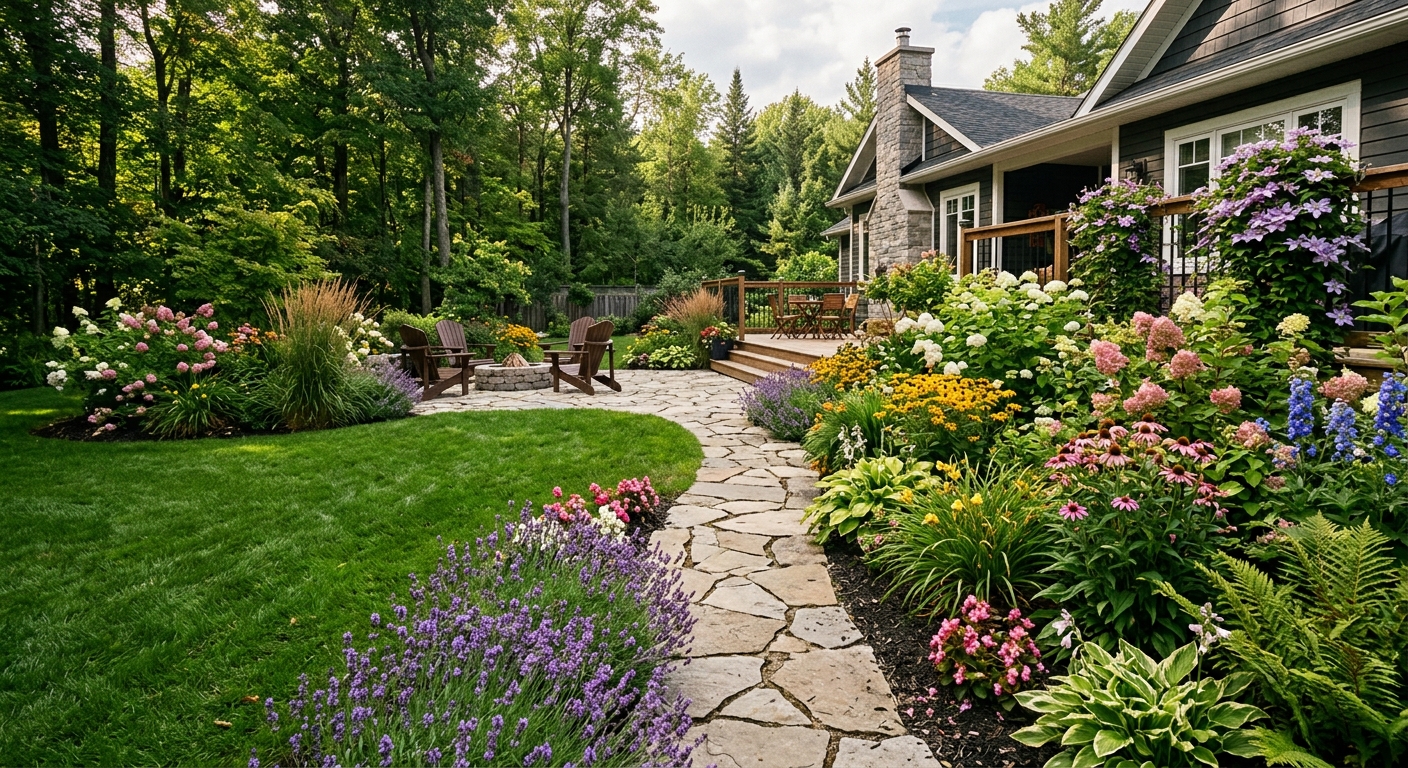
Landscaping options and costs in North Haven
North Haven, Alberta is a small community (population 2,365 in 2021) where landscaping decisions usually start with one practical question: will it hold up through chinooks, late-spring frosts, and early fall cold snaps? Most homes here include outdoor space that makes softscaping and hardscaping feel worth the investment—especially since single-detached ownership patterns typically mean more yard area to improve (Statistics Canada, 2021 Census). In the Calgary economic region, pricing is driven by how much base preparation, drainage, and frost-proofing a project needs, plus the labour available to build in a short working season. Freeze–thaw cycles are severe, so patios, walkways, and retaining walls almost always require deep, well-compacted bases and proper drainage to prevent heaving.
You’ll also see a pricing difference based on whether you’re aiming for “instant curb appeal” (sod and larger canopy plantings) or “seasonal value” (seeding, staged planting, and targeted soil improvement). Around older residential pockets of North Haven, trade demand can spike for drainage fixes and walkways upgrades because existing slopes and subgrade often don’t drain well after winter. That’s especially true when crews are busy across the broader Calgary area, where comprehensive projects commonly land in the mid five-figure range once grading, hardscape, planting, and irrigation are included.
To help you compare quotes apples-to-apples, the table below lays out common North Haven options, typical seasons, and price bands before you decide what level of design and materials you want.
| Service |
Description |
Season |
Price Range |
| Full landscape design and installation |
Site walk, concept + plan, grading/drainage plan, hardscape, planting, and irrigation coordination |
Late spring to early fall |
$10,000–$45,000 |
| Sod installation (supply, grade, lay, roll) |
Remove debris, grade for drainage, topsoil/seedbed prep, sod delivery and install, light rolling |
May to early July (best results) |
$2,500–$6,000 |
| Lawn seeding (grade, seed, starter fertilizer) |
Grade correction, seedbed prep, seed selection for sun/shade, starter fertilizer, light mulch |
Spring or early fall |
$1,500–$4,000 |
| Interlocking patio or walkway |
Excavate, deep base, compacted sub-base, bedding sand, stone/brick laying, cutting, edging |
Late spring to September |
$8,000–$30,000 |
| Retaining wall (interlocking block) |
Footing prep, drainage gravel, geotextile, block install, cap stones, clean backfill |
June to early October |
$12,000–$40,000 |
| Tree and shrub planting |
Soil improvement, planting holes, staking, mulch rings, water plan, seasonal plant selection |
May to early June; September |
$2,000–$12,000 |
Prices are estimates only and vary by project scope, site access and material selection.
What affects the price of landscaping in North Haven
In North Haven and across the Calgary market, two quotes for the “same” landscaping idea can swing by 30–50% because the big cost drivers rarely match on paper: excavation depth, drainage complexity, how much topsoil/soil amendment is required, and the amount of prep needed to prevent freeze–thaw movement. Prairie hardiness zones 3–4 mean plants must tolerate cold and wind, while the working season is shorter—late-spring frosts and early cold snaps affect scheduling, crew productivity, and when crews can safely compact bases and set stone. That’s why a full project might start in the $10,000–$15,000 range for a smaller scope, but can move into the $30,000–$45,000 range once grading, drainage bed work, and hardscape quantity increase.
Hardiness and frost timelines also control what you can plant and how long it takes to install. Prairie regions (Zone 2–4) need cold-hardy, drought-tolerant species, and retaining wall base depth must reach below the frost line for stability. By contrast, coastal BC clients (Zone 7–8) often have more weeks to plant and grow, which can reduce replacement costs—but they still need good drainage because heavy rainfall can saturate soils. Dry BC interior conditions can also push irrigation design toward drip and zoned controllers, raising the level of design. Southern Ontario (Zone 5–6) can have a moderate growing season, but summer dry spells still require irrigation planning, so costs shift toward water management rather than deep frost-proof base prep.
Concrete examples you’ll feel in North Haven: (1) a small patio that needs 12–18 inches of base correction after soft subgrade will cost notably more than a straight install; (2) adding a drainage bed or French drain is often the difference between a “one-week hardscape” and a multi-day excavation and gravel build; (3) replacing a lawn area with sod typically costs more per square foot than seeding, yet it can be justified where you need instant results before winter.
| Price Factor |
Why It Matters |
Cost Impact |
| Yard size in sq ft — the primary cost driver for softscape |
More area means more material, labour hours, and more base/soil prep time |
Often drives the largest spread in final totals; can move $1,500–$6,000 lawn jobs into the mid five-figure range when combined with hardscape |
| Grading and drainage work — slope corrections add significant cost |
Fixing ponding or redirecting water toward storm connections requires excavation and re-compaction |
Commonly adds thousands; can increase a $5,000–$10,000 scope by 30%+ if subgrade is poor |
| Drainage bed or French drain installation |
Prevents freeze–thaw heaving and foundation moisture by moving water away |
Can add $3,000–$12,000 depending on length, depth, and discharge routing |
| Plant material tier — native shrubs vs. ornamental vs. mature specimen trees |
Mature stock costs more and needs larger excavations, stronger staking, and careful backfill |
Can shift tree/shrub planting budgets from ~$800–$15,000 into the upper band |
| Hardscape vs. softscape ratio — walls and patios cost more per sq ft than lawn |
Stone work requires base depth, compaction passes, and precision cutting/edging |
Replacing lawn with patio/steps can double project cost for the same “looks” area |
| Irrigation system design and installation |
Zoned heads and proper coverage reduce water waste and winter risk to lines |
Often adds $1,500–$6,000+ depending on complexity and controller type |
| Soil amendment and topsoil required |
Thin or compacted soils need engineered amendments and adequate topsoil depth for roots |
May add hundreds to several thousand, especially on clay-heavy or disturbed lots |
| Tree removal or stump grinding before new planting |
Stump removal affects excavation depth, equipment needs, and root flare access |
Often adds $500–$3,000 depending on size and disposal logistics |
Permits & regulations in Alberta
For most landscape work in Alberta, you typically don’t need a permit—planting beds, sod, and standard softscaping are usually treated as maintenance or landscaping, not structural changes. That said, permitting can apply when you’re building something that changes structures, drainage patterns, or nearby services. In most municipalities, retaining walls above a threshold of about 1.0 m (3.3 ft) commonly require a building permit and sometimes engineered drawings, particularly if the wall is tall, supports surcharge loads, or is near a property line. Additionally, changes to lot grading that affect drainage toward neighbouring properties or storm sewer connections may trigger approval requirements.
Before any digging for planting holes, footing trenches, or wall bases, arrange utility locates. Call for utility marking so crews can dig safely and avoid gas, power, and telecom lines—this is essential for both compliance and avoiding costly delays. Also confirm water-use rules in your area and ask how the contractor will handle irrigation timing and freeze risk during shoulder seasons.
To verify your contractor in North Haven: (1) confirm licensing status using the appropriate Alberta online registry sources available for their trade/firm; (2) request a certificate of liability insurance and ensure it matches the project scope; and (3) confirm WSIB/WCB coverage (clearance letter or direct proof) before work starts. A reputable contractor should provide these documents proactively and on request, not only after you ask.
Planning a landscape that thrives in North Haven's climate
Planning for North Haven is about working with the local frost pattern and Prairie growing window rather than fighting it. With Calgary-area freeze–thaw cycles and typical Prairie Zone 3–4 conditions, start by choosing cold-hardy, wind-tolerant plants that can handle dry periods between waterings. Use native and zone-appropriate species where possible, then design winter resilience into the yard with proper spacing, mulch depth, and reliable watering during establishment. If you’re deciding between sod and seed, think about your timeline: sod gives instant curb appeal but can be more sensitive to heat waves during late spring and costs about 3–4 times per square foot versus seeding in most Alberta pricing scenarios. Seeding, on the other hand, is often a better fit when budgets are tighter or you can accept a slower “green-up” period.
Drainage and grading are the make-or-break details in Calgary: prevent pooling away from foundations, and don’t bury problems under topsoil. For patios and walkways, base preparation needs to be deep and well-compacted to reduce heaving. For retaining walls, the drainage layer and proper backfill aren’t optional—water pressure and frost movement are what lead to failures.
Here’s a practical dollar example: if you have a lawn area in the 1,000–2,000 sq ft range, sod installed might land in the $2,500–$6,000 band, while seeding and starter fertiliser might come in closer to $1,500–$4,000. The higher sod cost is justified when you need immediate cover to control erosion or you want a finished look before winter. If you can wait and you’re willing to overseed once, seeding often stretches your budget without sacrificing long-term results.
| Element |
Climate Consideration |
Maintenance Level |
Price Band |
| Sod lawn installation |
Needs good grading for drainage and careful watering to root before cold snaps |
Low to moderate during first season; then seasonal mowing and light fertilising |
$2,500–$6,000 |
| Native perennial garden |
Better drought tolerance and winter survival; reduces need for repeat irrigation |
Moderate: weed control first year, then lighter maintenance with mulch |
$3,500–$12,000 |
| Mulched shrub border |
Mulch buffers soil moisture swings and protects root crowns from cold winds |
Low: occasional trimming and refresh mulch |
$2,000–$9,000 |
| Interlocking stone patio |
Requires deep compacted base to handle freeze–thaw and drainage to avoid lift |
Low: sweep, occasional weed control in joints, no routine watering |
$8,000–$30,000 |
| Retaining wall (block) |
Needs drainage gravel and proper backfill to prevent frost-related movement |
Low: periodic inspection and joint/edge clean-up |
$12,000–$40,000 |
| Drip irrigation system |
Zoned, freeze-aware design supports efficient watering in semi-arid summers |
Moderate: seasonal inspection and winter shut-down |
$1,500–$6,000+ |
How to choose a landscaping contractor in North Haven
Choosing the right contractor in North Haven starts with proof, not promises. First, verify Alberta licensing for the contractor’s trade/firm (if applicable to their scope), and ask for liability insurance documents before any shovel hits the ground. Confirm WSIB/WCB coverage with a clearance letter or direct proof—don’t accept “we’re covered” without paperwork. Next, get 2–3 itemised written quotes so you can compare the labour and materials breakdown, not just a single lump sum. The best quotes separate items like excavation, base depth, drainage bed/french drain work, geotextile, stone/blocks, soil amendments, plant counts/sizes, and irrigation components (heads, lines, controller).
Read the scope line-by-line. Ask what’s excluded: topsoil haul-away, disposal, utility locate costs, stump grinding, or any permit pull for retaining walls above local thresholds. Confirm workmanship warranty length (for example, grading/base settlement, stone edging alignment, or planting replacement timelines) and whether the warranty is transferable if you sell the home. Also confirm manufacturer warranties for specific products (irrigation components, stone/brick colour integrity, and plant material guarantees when offered).
For payment schedule, never pay more than 10–15% upfront. Use staged payments tied to milestones (base prep complete, stone set, planting completed). Keep a holdback until the job passes a final walk-through. Finally, get start date and completion estimate in writing, along with weather constraints and what will happen if late frost affects planting timing.
- Provide insurance and WSIB/WCB proof before signing.
- Use an itemised quote with quantities (sq ft, linear ft, plant counts/sizes).
- State base depths and compaction requirements for patios/walkways.
- Specify drainage routing, outlet point, and how water is managed away from the foundation.
- List the exact product sizes for blocks/stone and the bedding sand spec.
- Clarify soil amendment type and topsoil depth (and whether it’s delivered/compacted).
- Confirm how irrigation lines are winterized and whether shut-off/drain design is included.
- Include disposal/haul-away details for sod, rubble, and excavation.
- Confirm utility locate responsibilities and timing.
- Ask for planting details: species, size (caliper/height), spacing, and mulch depth.
- Verify warranty terms for workmanship and planting replacement (duration and conditions).
- Define payment milestones and the final holdback amount.
In North Haven, common red flags include: quotes that don’t mention base depth or drainage, vague “allowances” for stone/plant quantities, contractors asking for large upfront payments, no written start/completion dates, and refusal to provide insurance/coverage documentation before work begins.
Frequently asked questions — landscaping in North Haven
How deep should a retaining-wall base be for local frost?
In North Haven and the wider Calgary region (Prairie Zone 3–4), retaining wall stability depends on going below the frost-affected zone and building the drainage layer correctly. A typical approach is to excavate and build a compacted granular base that extends below frost reach, then install geotextile and drainage gravel behind the wall so water doesn’t build pressure. The exact depth should be confirmed by your contractor after assessing soil type, wall height, and how the wall is loaded (especially if there’s a slope above the wall or a patio/walkway tied into it). If your wall is tall enough to require a permit (often around 1.0 m or 3.3 ft in many municipalities), engineering expectations usually tighten around footing depth and drainage design. Ask your contractor to spell out base depth, backfill spec, and drainage discharge in writing.
How much does professional landscape design cost?
Professional design in Alberta is usually priced either as a flat design fee or a design package that credits toward installation, but many homeowners feel the value when they’re investing mid five-figure totals. For North Haven projects, a full landscape design and installation typically falls in the $10,000–$45,000 band depending on grading, hardscape, planting density, and whether irrigation is included. If you’re only doing partial work (like a patio plus planting refresh), you may still benefit from a clear grading/drainage concept to avoid freeze–thaw issues. When comparing estimates, make sure you’re not mixing “design-only” with “design + build.” A strong contractor will show a plan that accounts for sun exposure, wind, and drainage paths—not just plant names.
How do I compare landscaping quotes?
Comparing quotes in North Haven works best when you standardise scope and unit pricing. Ask each contractor for an itemised breakdown: excavation, base thickness, compaction passes, drainage bed/French drain length, stone/block material specs, edging, topsoil depth, soil amendments, plant quantities and sizes, and irrigation components (if included). Then compare like-for-like totals rather than a single number. It’s also important to note season: installing sod is typically priced and scheduled for the best rooting window, while seeding often suits spring or early fall. As a reference, sod projects commonly land in the $2,500–$6,000 band, while lawn seeding can be closer to $1,500–$4,000 depending on prep needs. If one quote is much lower, ask what they’ve removed—often drainage base prep or disposal.
How long does a landscaping project take in North Haven?
Timelines in North Haven are driven by weather windows, excavation volume, and how much work is tied to frost risk. Smaller projects—like planting refreshes—can be completed in a day to a few days when materials are ready. Hardscapes such as patios and walkways often take longer because base prep, compaction, and stone setting require careful scheduling; multi-day work is common. Retaining walls typically take several days, especially if drainage gravel layers, geotextile placement, and proper backfill are included. Full landscape builds may stretch across multiple weeks due to staging (grading first, then base/hardscape, then planting and irrigation). A reliable contractor will give you a written start date, completion estimate, and a weather plan—particularly important in Calgary where late spring frosts and early fall cold snaps can delay plant establishment.
What is the best grass type for a North Haven lawn?
In North Haven and the Calgary area, the “best” grass is one that handles cold winters, dries out between waterings, and maintains density under Prairie sun and wind. Many homeowners do well with cold-tolerant turfgrass blends suited to Alberta conditions (often fine fescue and/or drought-tolerant mixes for sun and shade). If you’re seeding, the contractor should recommend a seed blend based on your sun exposure and foot traffic, and include starter fertiliser and a light mulch layer to protect seed during establishment. Sod can work if installed in the right window and kept properly watered to root, typically priced in the $2,500–$6,000 range depending on area and prep. If you have existing lawn that’s thinning from compaction or poor drainage, fixing grading and soil first can matter as much as grass selection.
When should I aerate and overseed my lawn in North Haven?
For North Haven lawns, aeration and overseeding are usually best in spring or early fall—timed so the grass can establish strong roots before cold weather slows growth. If you’re aerating to relieve compaction and improve water/air movement, do it when soil isn’t frozen and the lawn can recover quickly. Then follow with overseeding using the same type of grass (or the contractor’s recommended blend) so the new seedlings knit in evenly. In a lot of yards here, failure isn’t the seed choice—it’s poor drainage or thin soil, so aeration works best when grading and topsoil depth are adequate. If you’re comparing budgets, overseeding fits well with lawn seeding projects that often sit around the $1,500–$4,000 band (depending on prep). A local contractor can also advise on whether dethatching is needed before aeration.