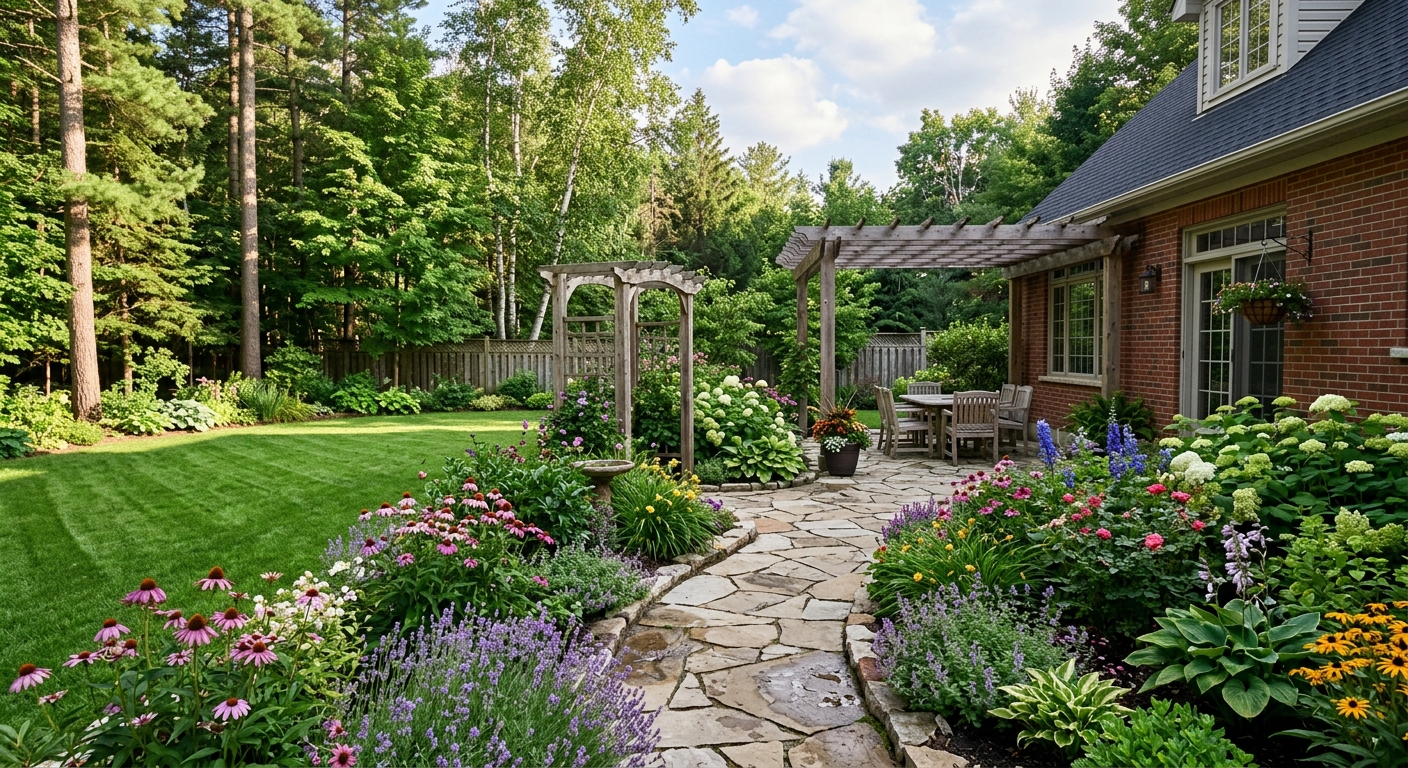
Landscaping options and costs in Westlock
Westlock homeowners typically have good yard space to work with, especially since 67.7% of dwellings are single-detached homes and many households are owner-occupied (68.6% of households own). That combination—landownership plus the ability to change sightlines, drainage, and curb appeal—makes front-yard and backyard upgrades one of the most common landscaping projects in town.
In the Edmonton region, landscaping costs are shaped by a short prairie growing season, freeze-thaw cycles, and generally drier conditions. Practically, that means contractor schedules tighten around frost windows, and plant choices must be hardy enough to handle winter lows and summer moisture stress without heavy replacement. It also affects hardscape: retaining walls and patios require a properly built base and drainage so they don’t shift when the ground expands and contracts.
Demand is especially noticeable in established pockets like Westlock’s older residential areas where many homes were built before 1981 (63.3% of dwellings). Those lots often need grading corrections, upgrades to soil, and reworked drainage before new planting can succeed.
Below is a realistic “typical scope” comparison of the most requested landscape services in Westlock, so you can benchmark your next quote before you book a site visit.
| Service |
Description |
Season |
Price Range |
| Full landscape design and installation |
On-site layout, grading plan, planting palette, hardscape/softscape coordination, and full build |
May to September |
$8,000–$45,000 |
| Sod installation (supply, grade, lay, roll) |
Remove debris, fine grade, soil amendments as needed, roll and water-in to establish |
Late April to early September (best spring/early fall) |
$3,000–$8,000 |
| Lawn seeding (grade, seed, starter fertilizer) |
Grade correction, seed mix selection for prairie conditions, starter fertilizer, light rolling |
May to early June or late August to September |
$1,800–$5,500 |
| Interlocking patio or walkway |
Excavation, compacted base, edging, interlocking stone, jointing sand |
Late spring to early fall |
$7,000–$22,000 |
| Retaining wall (interlocking block) |
Block wall build with proper base, drainage layer, and weeping/aggregate as required |
May to September |
$45–$120 |
| Tree and shrub planting |
Soil prep, planting, staking (if needed), mulch rings, establishment watering guidance |
Spring and fall (container plants available in summer) |
$500–$5,000 |
Prices are estimates only and vary by project scope, site access and material selection.
What affects the price of landscaping in Westlock
In Westlock (Edmonton region), it’s common to see quotes for the “same” landscaping project swing by 30–50%—even with similar square footage. The difference usually comes down to site conditions, how much prep work is required, and whether the contractor is building for durability in freeze-thaw rather than just surface appearance.
First, Edmonton’s plant hardiness and frost timing define what can be installed and how fast plants establish. Prairie regions typically need drought-tolerant, wind-hardy species because establishment watering is critical on new sod and plantings. That impacts both material costs (for proven cultivars) and labour time (for correct spacing, soil amendments, and watering plans). Second, frost line depth and freeze-thaw cycles matter structurally for retaining walls and any subgrade work—base depth and drainage layers can add meaningful labour, but they’re what prevent shifting.
Local examples in Westlock often look like this: if your lot has a low spot that collects runoff toward the foundation, you may need grading corrections and a drainage bed (pushing the project toward the higher end of the hardscape/installation band). If your yard is accessible by a truck and skid-steer, costs tend to be lower; if equipment must be carried across a narrow gate or through a mature hedge, hauling and labour time increase quickly. Also, older homes built before 1981 frequently have denser, compacted soils near foundations, which can raise the cost of topsoil and soil amendments before seeding or sod can be successful.
Budgeting tip: sod can look “fast,” but if you’re comparing options, the real decision point is whether you want the instant result or the lower-cost path. For many yards, seeding ranges can land well below full design scopes (while full landscape design and installation sits in the wider $8,000–$45,000 band depending on hardscape and drainage complexity).
| Price Factor |
Why It Matters |
Cost Impact |
| Yard size in sq ft — the primary cost driver for softscape |
More area means more excavation, soil amendments, and material |
Higher totals; typically scales linearly |
| Grading and drainage work — slope corrections add significant cost |
Freeze-thaw amplifies pooling and shifts when drainage isn’t corrected |
Can add several thousand dollars on problem lots |
| Drainage bed or French drain installation |
Underdrains need correct depth, pipe slope, and clean-out planning |
Often pushes projects toward higher band pricing |
| Plant material tier — native shrubs vs. ornamental vs. mature specimen trees |
Mature stock costs more and takes more time to set and secure |
Major swing factor for planting quotes |
| Hardscape vs. softscape ratio — walls and patios cost more per sq ft than lawn |
Stone, base materials, and compaction are labour- and material-intensive |
High-impact on total project cost |
| Irrigation system design and installation |
Zoning, trenching depth, and head placement affect both performance and cost |
Can move a yard from “basic” to “fully established” |
| Soil amendment and topsoil required |
Edmonton-area soils often need structure and organic content for rooting |
Can add cost even if planting area stays the same |
| Tree removal or stump grinding before new planting |
Access, stump size, and disposal determine time and equipment needs |
Frequent mid-project add-on risk |
Permits & regulations in Alberta
In Alberta, most planting, sodding, and typical softscape work generally does not require a permit. You can usually replace turf, install mulch beds, plant trees and shrubs, and build small landscape features without formal approval.
Where permits often come into play is hardscape that changes structure and drainage risk. Retaining walls above a typical municipal threshold—commonly around 1.0 m (3.3 ft) in many Alberta municipalities—often need a building permit and, in some cases, engineered drawings, especially if the wall is designed to retain significant soil pressure. Also, changes to lot grading that redirect runoff toward neighbouring properties, or any modification that affects storm connections, may trigger approval requirements.
Even when permits aren’t required, safe digging matters. Call utility locates before installing any planting holes, trenching for drainage, or excavating for wall footings—this reduces the risk of damage to buried services. If you’re considering irrigation, confirm your local water-use rules and how watering is expected to be managed during drought conditions. In practice, Edmonton-area landscaping still relies on establishment watering (new sod and newly planted materials need consistent moisture early on), but efficient zoning and smart scheduling help keep costs and water use under control.
To verify a contractor for Westlock work, homeowners should: (1) check for the correct Alberta business licensing/registration (where applicable for the scope), (2) request a current certificate of liability insurance, (3) confirm clearance/coverage for required worker protection coverage (WSIB/WCB coverage depending on classification), and (4) keep copies of these documents with your contract. A reputable crew will provide proof promptly and in writing.
Planning a landscape that thrives in Westlock's climate
To design a yard that thrives in Westlock, build around the reality of prairie-style seasons, freeze-thaw cycles, and a growing period that isn’t as forgiving as wetter climates. Start with plant selection: choose zone-appropriate, native or well-adapted shrubs and perennials that tolerate wind and winter desiccation. In Edmonton-region conditions, “low watering requirements” doesn’t mean “no watering”—it means plants can survive once established, with less intervention during dry stretches and better recovery after winter.
Sod vs. seed is another key decision. Sod gives instant curb appeal and reduces erosion quickly, but in the Edmonton market it commonly costs about 3–4 times more per sq ft than seeding because of supply, handling, and labour-intensive installation and water-in. If your priority is getting your lawn looking complete for a specific date, sod can be worth it. If your priority is budget and you can wait a season for uniform coverage, seeding is often the better value.
Drainage and grading are critical in this area. Pooling near foundations can cause foundation moisture issues and increases plant stress. For hardscape—patios and retaining walls—base preparation must be built for freeze-thaw, with compacted base and drainage details that sit beyond the frost impacts. Low-maintenance design strategies (mulch layers, groundcovers, and durable perennials) reduce annual upkeep while keeping the yard attractive.
Where water efficiency matters, consider xeriscape-style planting with layered textures and mulch, and add a rain-garden or swale planting in areas that naturally collect runoff. A straightforward dollar example: if a small lawn area is costing you in the $3,000–$8,000 range for sod, a seeding approach may fit closer to the mid-to-lower end of seeding budgets, and those savings can be redirected into drainage improvements that protect the whole yard investment.
| Element |
Climate Consideration |
Maintenance Level |
Price Band |
| Sod lawn installation |
Needs establishment watering; winterkill risk if improperly graded |
Medium early (watering), lower after establishment |
$3,000–$8,000 |
| Native perennial garden |
Hardy species handle prairie stress; mulch helps winter performance |
Low to medium (spring clean-up, occasional weeding) |
$1,200–$4,500 |
| Mulched shrub border |
Wind and winter moisture can affect young shrubs; spacing improves airflow |
Low (mulch refresh, prune once per year) |
$800–$3,200 |
| Interlocking stone patio |
Freeze-thaw requires correct base depth and compaction to prevent heaving |
Low (sweep, occasional joint sand refresh) |
$7,000–$22,000 |
| Retaining wall (block) |
Base depth and drainage layer protect wall integrity through seasonal movement |
Low (periodic inspection of drainage weep points) |
$45–$120 |
| Drip irrigation system |
Efficient watering during establishment; helps manage moisture stress in dry spells |
Low (seasonal checks, winterisation) |
$2,000–$9,000 |
How to choose a landscaping contractor in Westlock
Start by verifying that the contractor is set up to work responsibly in Alberta. Ask for a certificate of liability insurance and confirm it’s current for the project period and that your address is included or endorsed as required. Next, confirm worker coverage through WSIB/WCB clearance documentation (the appropriate coverage type depends on the contractor’s structure). In practice, you’ll usually see clearance letters or evidence of coverage provided before work begins—don’t accept “we’ll get it later.” Also confirm the crew’s ability to support your scope: if you’re dealing with drainage, ensure they’ve done underdrains or grading corrections—not just surface planting.
For pricing, get 2–3 itemised written quotes. You want a labour + materials breakdown (excavation, base materials, drainage components, plants, topsoil, hauling/disposal), not only a single lump sum. The scope should state what’s included: permit pull (if required), disposal of excess material, topsoil depth/grade, and whether watering-in is included for sod and new plantings. Watch for exclusions like “weather permitting” clauses that can shift your timeline without clear communication.
Warranty matters. Ask for workmanship warranty length, and separate it from product/manufacturer warranties. Confirm whether warranties transfer to future owners if you ever sell. Finally, protect your cash flow: don’t pay more than 10–15% upfront; use staged payments tied to milestones and keep a holdback until the job is complete and cleaned up.
Timeline clarity is just as important as price. Get a written start date and a completion estimate, including key weather-dependent steps like grading, sod installation windows, and final planting.
- Request proof of liability insurance and verify coverage dates.
- Ask for WSIB/WCB clearance or evidence of worker protection coverage.
- Confirm the contractor is insured for equipment and understands excavation safety.
- Get itemised quotes with quantities (sq ft, lin ft, plant counts, soil/topsoil amounts).
- Require explicit scope inclusions for disposal/hauling.
- Confirm whether site locates (utility locate tickets) are ordered before digging.
- Ask who handles any required permits if your retaining wall exceeds typical height thresholds.
- Check workmanship warranty details in writing (length, what’s covered, exclusions).
- Ask about soil specifications (topsoil depth, amendment type, and compaction approach).
- Confirm sod watering-in plan and who is responsible for establishment watering.
- Use a payment schedule with a holdback until completion and final walkthrough.
- Get a written timeline with weather allowances and communication expectations.
Red flags I see in Westlock: vague quotes that don’t list quantities, no written scope for drainage/grade correction, refusing to provide proof of insurance or worker coverage, promising “any time” start dates without a schedule, and asking for large upfront payments beyond 10–15%.
Frequently asked questions — landscaping in Westlock
How do I improve drainage in my yard?
In Westlock and the broader Edmonton region, drainage problems usually show up after spring melt or heavy rain, then worsen through freeze-thaw cycles. The first step is identifying where water is actually going: toward your foundation, into a low lawn pocket, or toward a neighbour’s side. A reliable fix is typically a combination of grading (sloping soil away from the house), a properly built drainage bed or French drain where pooling occurs, and sometimes downspout extensions that discharge safely. If you’re doing sod, drainage is even more important—lawn won’t establish if the subgrade stays wet and cold. For budgeting, drainage-focused work often shifts you upward within the project bands because excavation and base materials take time. A good contractor will walk you through the proposed depth, slope, and how they’ll protect foundations during construction.
What is xeriscaping and does it suit Westlock?
Xeriscaping is a water-smart landscaping approach that uses drought-tolerant plants, mulch, and efficient design to reduce watering demands while keeping a tidy look. In Westlock, it can suit very well because prairie conditions are prone to summer moisture stress and winter plant loss if you choose the wrong species. That said, xeriscaping isn’t “no water ever.” New plantings still need establishment watering during the first growing season, particularly if you’re transitioning from lawn to beds. The Edmonton-area climate also rewards designs that reduce wind exposure and use mulch to moderate soil temperatures. When done right, xeriscaping can cut ongoing watering labour and help you avoid repeated replanting. If you’re budgeting, remember that full design and installation projects commonly land in a wide range like $8,000–$45,000 when grading and hardscape are included, but simple planting-focused xeriscape phases can be staged more economically.
How do I plan a low-maintenance yard?
A low-maintenance yard in Westlock usually comes from three choices: durable plants, smart soil preparation, and reducing the “bare soil” areas that invite weeds. Start with zone-appropriate shrubs and perennials (native or proven hardy cultivars), use 2–3 inches of mulch in beds, and avoid planting too sparsely—gaps become weeding work. For lawns, decide whether sod or seeding fits your maintenance tolerance and schedule; sod gives fast coverage but requires careful water-in during establishment, while seeding needs patience but can be more forgiving on cost. Drainage matters too: if water pools, plants struggle and you end up maintaining stressed areas instead of enjoying them. If you’re adding hardscape, build it correctly for freeze-thaw so it doesn’t heave and turn into a repair cycle. Many homeowners in Westlock’s older neighbourhoods—where lots can have compacted soils—find that spending on base prep and soil amendments reduces long-term upkeep across the whole yard.
How deep should a retaining-wall base be for local frost?
For a retaining wall in Westlock, the right base depth isn’t a guess—it depends on wall height, soil conditions, and the wall system requirements. Because Edmonton-region freeze-thaw can move unprotected subgrades, the base typically must extend below frost-affected movement zones and include compacted granular layers. In practice, many block-wall builds are designed with a properly engineered base and a drainage layer (often aggregate and weeping provisions) so water doesn’t build up behind the wall. If your wall exceeds a common threshold (often around 1.0 m in many Alberta municipalities), you may need a permit and possibly engineered drawings; that’s where base depth is formally specified. The safest path is to have your contractor submit the wall plan and show the proposed base build-up and drainage details. That’s what prevents shifting after freeze-thaw rather than cosmetic issues like minor bulges.
How much does professional landscape design cost?
Professional landscape design cost in Westlock can vary depending on whether you’re doing a simple planting plan or a full design-and-build package. In many cases, design is bundled into the overall installation project when you choose a contractor that handles both. If you’re looking for budget benchmarks, full landscape design and installation often ranges broadly in the Edmonton tier, commonly around $8,000–$45,000, because it can include grading, drainage coordination, hardscape build-out, and plant installation. For planting-only upgrades, costs usually sit much lower, since labour time and material quantities are smaller (tree and garden planting is commonly in the $500–$5,000 band depending on counts and sizes). Ask for a written scope that lists what the design includes—measurements, CAD layout (if used), planting lists, and whether irrigation or grading is designed or just installed.
How do I compare landscaping quotes?
To compare landscaping quotes in Westlock, insist on apples-to-apples scopes. Request itemised written quotes with labour and materials breakdown, including quantities like sq ft of sod, lin ft of walkway, cubic yards of topsoil, and the exact plant counts/sizes. Make sure drainage/grading is described clearly (what they’re correcting and how) and check whether disposal/hauling is included. Confirm warranty terms for workmanship and whether manufacturer warranties apply to plants and materials. In Alberta, also verify permitting expectations: retaining walls above typical height thresholds may require permits, so your quote should state who pulls permits if needed. Don’t automatically choose the lowest number—if one bid excludes drainage base prep or watering-in for sod, you may pay later for failure. Finally, compare payment schedules: reputable contractors keep upfront payments around 10–15% and hold back until completion and a final walkthrough.