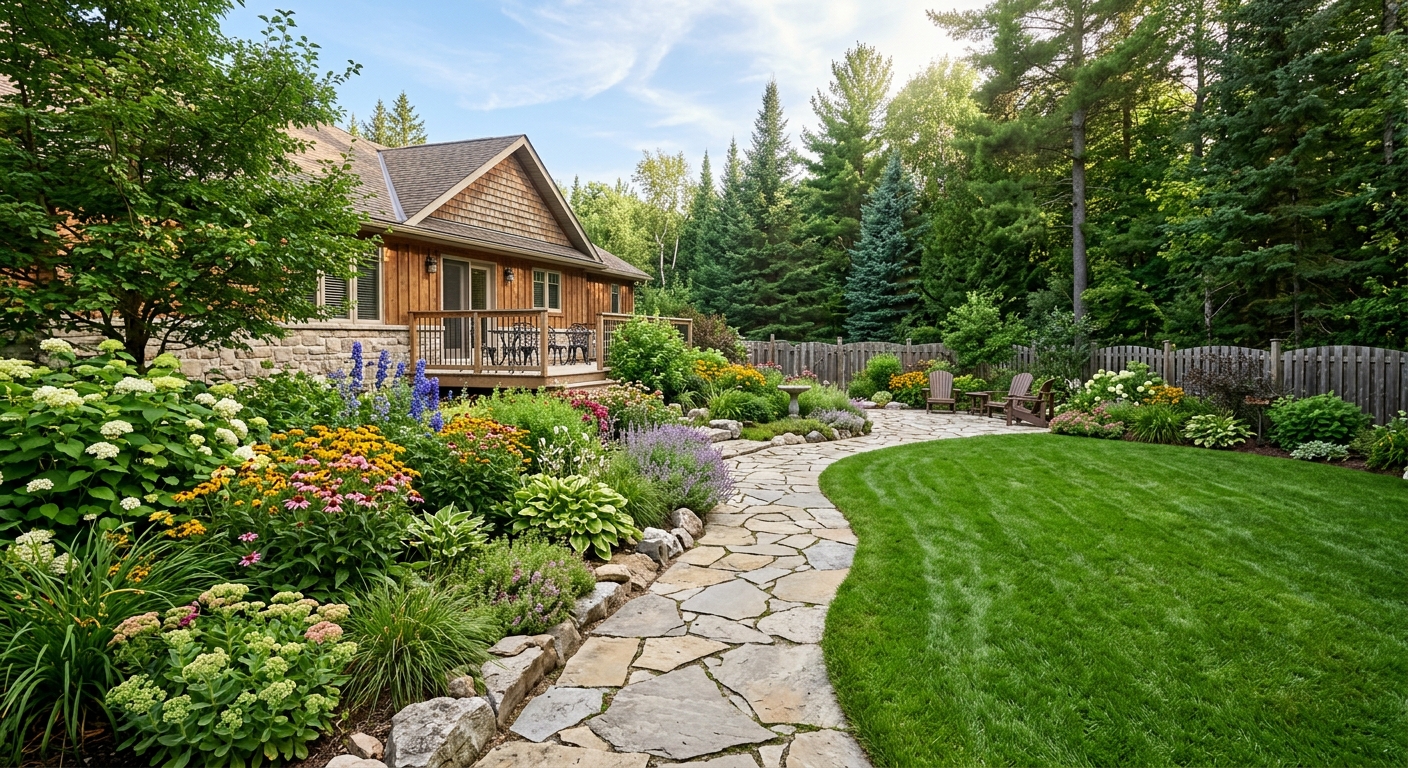
Landscaping options and costs in Aberdeen
In Aberdeen, BC, homeowners typically invest in their yards because the area is large enough for visible curb appeal improvements, and the city’s overall population of 12,437 (Statistics Canada, 2021 Census) supports a steady base of tradespeople and material suppliers. That matters for pricing: when more contractors are operating locally, you can often get tighter scheduling and more competitive labour rates for landscape installations. In Aberdeen’s housing mix, you’ll also find many detached and semi-detached properties where owners want layered gardens, walkways, and functional outdoor living areas—so design + installation demand is consistent, especially in established residential pockets.
Lower Mainland–Southwest conditions (plant hardiness zones 7–8, mild wet winters, and a long cool growing season) usually reduce the cost of “winter protection labour” you’d expect elsewhere. However, the same climate can increase time spent on drainage corrections, because heavy rainfall events and freeze–thaw cycles still affect patios, retaining wall footings, and basement-adjacent grades. Contractors remain busiest in spring through early fall, with weather delays concentrated in the wettest winter weeks. In Aberdeen, work is often in especially high demand around the older neighbourhoods near local commercial corridors where residents want refreshes to existing walkways and shrub beds rather than full rebuilds—then transition into a new, easier-care planting plan.
If you want a fast way to compare typical budgets, use the table below as a starting point for estimating a full-scope landscape versus focused upgrades.
| Service |
Description |
Season |
Price Range |
| Full landscape design and installation |
Site visit, concept + planting plan, grading as needed, soil prep, hardscape and softscape installation |
Mar–Nov (most work); structural work adjusted around rain |
$10,000–$50,000 |
| Sod installation (supply, grade, lay, roll) |
Minor grading, soil amendment, sod supply + delivery, lay/roll, starter fertilizer and first watering plan |
Mar–Oct (best window before peak summer heat) |
$3,000–$7,500 |
| Lawn seeding (grade, seed, starter fertilizer) |
Final grade, seed blend selection, starter fertilizer, light raking, mulch where required |
Mar–May or Sep–Oct |
$1,500–$5,500 |
| Interlocking patio or walkway |
Excavation, base (compaction, bedding), edging, interlocking stones, basic detailing at edges |
Mar–Nov (rain-managed) |
$6,500–$35,000 |
| Retaining wall (interlocking block) |
Wall layout, proper base depth, compacted drainage layer, geotextile, block installation, backfill |
Apr–Oct (wettest periods avoided) |
$12,000–$55,000 |
| Tree and shrub planting |
Soil amendments, planting, mulching, staking (if needed), light pruning at install |
Mar–Jun and Sep–Nov |
$2,500–$15,000 |
Prices are estimates only and vary by project scope, site access and material selection.
What affects the price of landscaping in Aberdeen
Even when two homeowners in the Lower Mainland–Southwest want the “same” landscaping project, quotes can vary by 30–50% across the wider BC market because labour productivity, drainage complexity, and material sourcing differ by site conditions and timing. In Aberdeen specifically, the zone 7–8 climate supports more lush planting palettes and a longer softscape window, but it doesn’t eliminate structural requirements: freeze–thaw cycles still mean retaining wall and patio bases must be built for long-term stability, with drainage and compaction that add labour and materials. That’s why your design may feel straightforward, yet the final budget trends toward the higher end of the $10,000–$50,000 design-and-install band if there’s grading and base work.
Zone and frost timing directly influence both what grows and what contractors can physically complete. In Prairie regions (zone 2–4), short growing seasons push clients toward drought-tolerant planting and narrower installation windows; retaining walls also require careful frost-line base depth. Coastal BC like Aberdeen (zone 7–8) allows more planting types and reduces the winter damage risk, but heavy rainfall still raises the cost of drainage bed creation. Meanwhile, water-cost concerns and municipal watering guidelines can shape irrigation design; when drip and smart controllers are added, your upfront cost rises, but you often avoid ongoing lawn failure and rework. Southern Ontario (zone 5–6) has a more moderate season, but summer dry spells can increase irrigation demand—again affecting cost.
Concrete examples from Aberdeen: (1) a sloped front yard that needs re-grading for foundation runoff can push you from the $6,500–$35,000 patio range into the mid-to-upper end due to excavation and disposal; (2) choosing a mature 2.5–3.5 m specimen tree typically raises the planting budget within the $2,500–$15,000 band because of heavier equipment and a more complex planting/staking plan; and (3) adding a French drain alongside a retaining wall often increases the hardscape total more than homeowners expect, because it’s not “just pipe”—it’s a drainage system plus bedding, geotextile, and tested fall.
| Price Factor |
Why It Matters |
Cost Impact |
| Yard size in sq ft — the primary cost driver for softscape |
More area means more labour hours, soil amendments, and materials (seed/sod, mulch, edging) |
Can move a lawn-only job by several thousand dollars |
| Grading and drainage work — slope corrections add significant cost |
Fixing ponding, redirecting runoff, and correcting slope takes excavation and re-compaction |
Often adds a major “hidden” surcharge to patios and planting |
| Drainage bed or French drain installation |
Proper sub-drain layers, geotextile, and correct fall prevent foundation moisture and wall movement |
Frequently increases totals by thousands, especially near walls |
| Plant material tier — native shrubs vs. ornamental vs. mature specimen trees |
Size and sourcing affect price, plus install time and required equipment |
Can double the planting line item within the same “planting plan” |
| Hardscape vs. softscape ratio — walls and patios cost more per sq ft than lawn |
Block walls and interlocking stone require base build-up, compaction, and skilled finishing |
Shifts budgets quickly toward the higher bands |
| Irrigation system design and installation |
Drip lines, zones, controller/smart timers, and trenching add labour but reduce future maintenance |
Can raise the project cost, but limits ongoing watering failures |
| Soil amendment and topsoil required |
Heavy clay or poor fill needs quality amendment and correct depth, not just “a little topsoil” |
Can add material delivery and labour days |
| Tree removal or stump grinding before new planting |
Debris handling, stump grinding depth, and protective measures for existing structures |
Often adds several thousand depending on access and root condition |
Permits & regulations in British Columbia
In British Columbia, most landscaping and planting work does not require a permit. Typical examples that usually do not require permits include: planting trees and shrubs, sodding and lawn seeding, mulching and installing garden beds, and installing most softscape work. Most homeowners in Aberdeen focus on improving drainage and curb appeal with those elements because they’re generally straightforward from a permitting standpoint.
Work that does more commonly require a permit includes retaining walls above a height threshold—often around 1.0 m (3.3 ft) depending on the municipality—and cases where the municipality expects engineered drawings for safety and stability. Also, changes to lot grading that materially affect drainage direction (for example, pushing water toward a neighbour’s property or connecting it to a storm sewer without approvals) can trigger a review. Before digging for planting holes or wall footings, arrange utility locates (call-before-you-dig) to avoid buried services.
Homeowners can also reduce risk by confirming the contractor’s standing. First, verify the company is properly licensed for the work they’re advertising (check the provincial licence requirements and the contractor’s name/business number). Next, request a current certificate of insurance showing liability coverage. Finally, confirm Canadian worker coverage: in BC, that’s typically addressed through the worker’s compensation clearance letter from the appropriate provincial system—ask for documentation and keep a copy in your project folder.
Planning a landscape that thrives in Aberdeen's climate
Planning for Aberdeen means designing with the grain of zone 7–8 growing conditions: long cool summers, mild wet winters, and a fall frost that gives you breathing room for planting through much of the shoulder seasons. Start with plant selection—choose native or zone-appropriate species that handle occasional wet periods without demanding constant watering. In the Lower Mainland–Southwest, drainage and grading matter as much as plant lists, because standing water encourages root stress and makes foundations feel the impact of wet seasons.
For lawn establishment, sod gives an instant, clean finish for busy homeowners, but seeding is often the smarter choice when budget matters. A practical way to decide: if sod-only placement is in the $3,000–$7,500 band for your lawn area, seeding may land in the $1,500–$5,500 band depending on grade and seed selection. That difference can be justified when you’re also investing in better soil prep and drainage—otherwise you’re paying to replace what the ground isn’t ready to support.
Hardscape base preparation is where projects succeed or fail. For patios and retaining walls, build bases to handle freeze–thaw cycles and ensure proper sub-drainage; this reduces heaving, cracking, and wall movement on sloped sites. Finally, use low-maintenance design strategies: layered mulch beds, groundcovers, and perennials that fill in without constant trimming. If you want a “low-water” feel without sacrificing curb appeal, consider a rain-garden or xeriscape-inspired zones using drought-tolerant plants paired with drip irrigation—especially where you’ll see irrigation restrictions or higher water costs.
| Element |
Climate Consideration |
Maintenance Level |
Price Band |
| Sod lawn installation |
Instant coverage in a long growing season; still needs good grading and drainage so roots don’t sit wet |
Low-to-moderate (mostly watering during establishment) |
$3,000–$7,500 |
| Native perennial garden |
Zone-appropriate plants handle coastal BC winters better with less winter protection; tolerates wet-to-dry swings |
Moderate (seasonal trimming and occasional weeding) |
$2,500–$12,000 |
| Mulched shrub border |
Mulch buffers moisture swings and suppresses weeds during Aberdeen’s wet periods, reducing stress on roots |
Low (refill mulch and light pruning) |
$2,000–$10,000 |
| Interlocking stone patio |
Base must manage freeze–thaw; use edging and proper fall so water doesn’t pond near foundations |
Low (periodic cleaning, occasional stone reset) |
$6,500–$35,000 |
| Retaining wall (block) |
Needs drainage layer and correct base depth to reduce wall movement on sloped lots common in the region |
Low (inspection after winter, minor maintenance if required) |
$12,000–$55,000 |
| Drip irrigation system |
Helps manage efficient watering in a region that still sees periods of restriction and higher water costs |
Moderate (seasonal check-ups and occasional emitter maintenance) |
$1,800–$7,500 |
How to choose a landscaping contractor in Aberdeen
Choosing the right contractor in Aberdeen starts with documentation. First, confirm British Columbia licensing: ask for their business details and verify the licence/registration that matches the scope (especially if they’re doing hardscape work that requires particular trade credentials). Second, request liability insurance and make sure the certificate is current and shows adequate coverage for landscaping job sizes. Third, confirm worker coverage through the provincial worker’s compensation clearance letter (BC worker’s compensation system). A reputable contractor will provide documents promptly and will be transparent about subcontractors.
Next, get 2–3 itemised written quotes—not just a lump sum. Look for labour + materials lines (excavation, disposal, base rock, geotextile, edging, sod/seed, topsoil, plant material sizes) and clarity on what’s included. Read the exclusions carefully: is permit handling included if required for a retaining wall? Is disposal included for excess soil? Are tree removal, stump grinding, and root barriers included or treated as add-ons? For warranty, ask for the workmanship warranty length and whether it covers restoration if settlement occurs after installation; also ask about product/manufacturer warranties and whether they’re transferable to you as the homeowner.
Finally, keep the payment schedule safe: never pay more than 10–15% upfront; hold back the final portion until the job is complete and the area is cleaned and top-dressed as promised. In the timeline, insist on a start date and a completion estimate in writing, including allowances for rain days in Lower Mainland–Southwest.
- Provide a written scope with measurable quantities (sq ft, linear ft, wall height).
- Include site access notes (gates, driveways, street frontage) that affect equipment use.
- Ask who pulls permits if a retaining wall needs approval.
- Confirm disposal/recycling of excess soil and broken asphalt/stone.
- Require a drainage plan if you have ponding near foundations.
- Request plant lists with mature sizes (not just “shrubs”).
- Verify irrigation details if drip lines are proposed (zones, controller type).
- Check insurance and worker coverage before work begins.
- Get a start date and weather contingency schedule.
- Confirm warranty length for workmanship and how it’s handled after winter.
- Keep photos of the grade/base before planting and before stones are set.
Red flags we see in Aberdeen include: refusal to provide insurance/worker coverage documents, quotes that don’t break down base preparation or drainage, “sod included” pricing that ignores grading corrections, vague timelines with no weather plan, and payment demands beyond 10–15% upfront.
Frequently asked questions — landscaping in Aberdeen
When should I aerate and overseed my lawn in Aberdeen?
In Aberdeen (Lower Mainland–Southwest, zone 7–8), the best aeration and overseeding windows are typically early spring through early summer, and again in early fall when soils are still warm enough for germination. If your lawn is thin or compacted, aerate first to relieve soil that’s holding moisture too long, then overseed with a starter fertilizer designed for establishment. Because Aberdeen winters are wet and mild, avoid aerating right before long rainy stretches where seed can wash or mould. If your goal is speed and a uniform look, some homeowners choose sod installation (often budgeted around $3,000–$7,500) instead of repeated overseeding cycles. For best results, match your seed blend to the sun pattern in your yard and ensure the grade doesn’t pond after rain.
What trees grow best in Aberdeen's climate zone?
With Aberdeen sitting in plant hardiness zones 7–8, many broadleaf evergreens and hardy deciduous trees perform well when they’re matched to light and soil drainage. In practice, we see strong results with species like Japanese maple varieties (in well-drained spots), Amelanchier (serviceberry) for structure and seasonal colour, and several conifers that handle coastal moisture. The key isn’t just species—it’s drainage and planting depth. If you have clay or areas that stay wet, choose trees that tolerate periodic wetness and improve the planting site with proper soil amendment and a drainage-aware layout. Mature specimens cost more upfront, but they can anchor a design faster; many installs land within the broader tree and shrub planting range of $2,500–$15,000. A good contractor will also account for wind exposure near streets and the yard’s microclimates created by fences and house walls.
How much does sodding a yard cost in Aberdeen?
Sodding cost in Aberdeen depends mostly on lawn area and the prep needed to make the grade correct. For typical residential projects, budgets commonly fall around $3,000–$7,500 once you include supply, delivery, grade adjustments, and proper laying/rolling. If your lawn needs more than light touch-up—like drainage correction, heavy topsoil replacement, or significant re-grading—your sodding total can climb because base prep is labour-intensive. That’s why comparable quotes can vary. In Lower Mainland–Southwest, contractors also manage rain windows, which can affect scheduling and labour timing rather than the overall material costs. If you’re comparing “cheaper now” versus “better long-term,” seeding can sometimes fit the $1,500–$5,500 range, but it takes longer for a full, even lawn.
How do I prevent weeds in my Aberdeen garden?
Weed prevention in Aberdeen is about stopping the problem early and controlling moisture conditions. Start with proper soil prep: remove existing weeds with roots, correct grade so water doesn’t pool, and use a weed-suppressing approach under mulch beds. In practice, a mulched shrub border works well because mulch buffers wet winters and cool summers, reducing both germination opportunities and moisture swings. Use a quality landscape fabric only where appropriate (many gardeners prefer weed barrier under rock or in specific bed types, while mulch alone can work better for perennial borders). Add a layer of composted mulch at the correct depth and refresh it annually. If you’re installing shrubs or perennials, spacing matters—dense planting reduces open soil where weeds establish. For a fuller refresher that includes bed reconstruction, many homeowners budget within the broader tree and shrub planting band of $2,500–$15,000 depending on plant quantities and soil amendment.
How do I design a low-water yard in Aberdeen?
A low-water yard in Aberdeen works best when you combine plant selection, efficient irrigation, and smart layout. Choose zone-appropriate natives and drought-tolerant plants where they’ll get the right sun; then keep the planting zones mulched so soil stays cooler and evaporation drops during warm, humid stretches. Instead of trying to make the entire yard lawn-only, consider shifting some area to mulched shrub borders or native perennial gardens, which can look lush even without constant watering. Where you need irrigation, drip systems paired with proper zoning typically reduce wasted water and make it easier to comply with any local restrictions. Drip installs commonly fall in the $1,800–$7,500 range depending on yard size and complexity. If you want to limit watering further, a rain-garden strategy can capture roof runoff and let plants access periodic rainfall—especially helpful in a region where wet winters are normal and foundation-adjacent drainage is a frequent concern.
How do I find a licensed landscaper in Aberdeen?
To find a licensed (and insured) landscaper in Aberdeen, start by asking for their BC licensing details that match the scope of work they’re proposing. Then request current liability insurance documentation and confirm worker coverage through the worker’s compensation clearance letter—this is important before any excavation for patios, retaining wall footings, or drainage work. In your first call, ask for proof of documentation, not just promises. Next, request 2–3 itemised quotes with labour and materials broken out: base rock quantities, disposal, sod/seed type, drainage components, and any permit-related tasks if a retaining wall exceeds the threshold (often around 1.0 m, depending on the municipality). Finally, verify their workmanship warranty terms in writing and confirm the payment schedule stays within safe limits (generally no more than 10–15% upfront). A contractor who’s organised with paperwork is usually organised with construction details too.