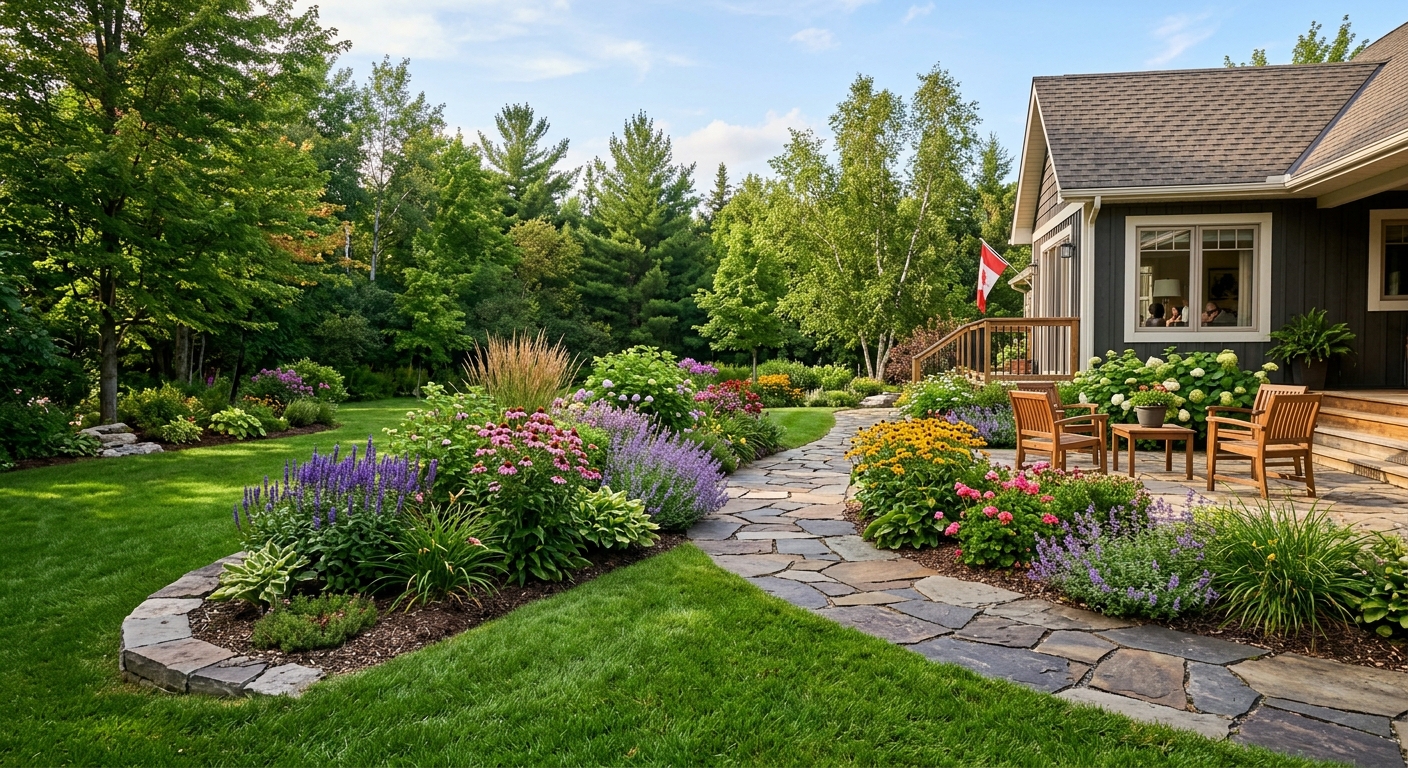
Landscaping options and costs in Heritage Mountain
Heritage Mountain is a community where landscaping pays off quickly: with about 4,664 residents (Statistics Canada, 2021 Census), many homeowners prioritize curb appeal and practical yard function as properties change hands. In this part of the Lower Mainland–Southwest, most builds sit on lots with enough exterior space for real softscape and layering—so a thoughtful plan (not just “plant a few things”) is what keeps long-term maintenance manageable. Lower Mainland winters are mild and wet, and the long growing window near plant hardiness zones 7–8 means contractors can schedule more work compared with colder regions, but labour and disposal still cost real money during the busiest spring and early-summer periods.
Because Heritage Mountain falls within a coastal BC climate pattern, you can use broaderleaf evergreens, layered perennial beds, and lush shrubs with less winter-damage risk than in Prairie provinces. Cost is shaped by site conditions common in this area—shallow soils, heavy rain events, and the need for proper grading to prevent pooling near foundations. Demand is especially strong around Heritage Mountain’s west-side residential corridors, where many homeowners refresh front yards to improve presentation and drainage as weather patterns intensify.
Below is a realistic quick-comparison of common services so you can line up apples-to-apples when you review quotes.
| Service |
Description |
Season |
Price Range |
| Full landscape design and installation |
Site visit, concept + final design, grading plan, plant list, hardscape/softscape installation, and cleanup |
Year-round (best value spring to early fall) |
$12,000–$45,000 |
| Sod installation (supply, grade, lay, roll) |
Soil prep, grading, topsoil placement (if required), sod delivery, laying, rolling, and initial watering guidance |
Late March to October (avoid the wettest frozen/waterlogged stretches) |
$4,000–$8,000 |
| Lawn seeding (grade, seed, starter fertilizer) |
Light soil conditioning, seeding, starter fertilizer, and turf establishment care |
April to September |
$2,000–$5,500 |
| Interlocking patio or walkway |
Excavation, base and bedding materials, edge restraint, pavers/stone, compaction, and final leveling |
April to November (allow for weather windows) |
$10,000–$35,000 |
| Retaining wall (interlocking block) |
Block wall layout, excavation, drainage gravel, geotextile, base prep, and block installation |
April to November |
$18,000–$60,000 |
| Tree and shrub planting |
Soil improvement, planting holes, amendments, mulching, staking (when needed), and initial care |
Spring and fall (best survival window) |
$1,500–$12,000 |
Prices are estimates only and vary by project scope, site access and material selection.
What affects the price of landscaping in Heritage Mountain
Even when two homeowners ask for “the same” landscape upgrade, quotes can swing by 30–50% across the Lower Mainland–Southwest and the rest of British Columbia. The biggest reason is that design and site conditions don’t stay identical after crews measure: in coastal BC (often zones 7–8), contractors can build more complex layered gardens and keep working longer into the year, but drainage, excavation depth, and material logistics still determine cost. In colder Prairie regions (zones 2–4), crews lean heavily on drought-tolerant, wind-hardy species and must respect shorter frost-free windows, while retaining wall bases often require deeper frost-proofing. In Heritage Mountain specifically, crews benefit from the longer growing season, yet structural work still needs proper freeze–thaw planning and drainage—so the labour that protects your foundation moisture isn’t optional.
Cost differences also show up in real line items. For example, a sod refresh can look simple, but if grade correction is required, sod becomes part of a broader softscape scope (often pushing the project toward the $4,000–$8,000 band). Similarly, a modest block wall may start within the lower end of typical retaining wall & hardscape budgets, but if you add a proper drainage bed, geotextile, and more excavation, it can climb into the $18,000–$60,000 range. Heritage Mountain homes include a mix of older lots and newer builds—on older properties, compacted soils and older drainage patterns can mean extra soil amendment and re-grading, and that work adds up quickly.
Finally, material tier matters in coastal BC: native shrubs and smaller nursery stock can keep tree & garden planting nearer the $1,500–$12,000 band, while larger specimen trees or ornamental varieties naturally increase labour and crane/hoisting needs.
| Price Factor |
Why It Matters |
Cost Impact |
| Yard size in sq ft — the primary cost driver for softscape |
More area means more excavation, topsoil/topdressing, and materials (seed/sod/mulch) |
Often the largest variable; can change labour and materials by 20–60% |
| Grading and drainage work — slope corrections add significant cost |
Fixing ponding, redirecting water, and setting proper slopes protects foundations |
Can add major excavation/compaction costs; commonly 10–30%+ depending on site |
| Drainage bed or French drain installation |
Trenches, gravel, piping, and tie-ins reduce water pressure and seepage |
Typically increases hardscape/softscape budgets by 15–40% for affected areas |
| Plant material tier — native shrubs vs. ornamental vs. mature specimen trees |
Higher-tier plants cost more and require more labour for spacing and planting depth |
Can shift tree & shrub planting by several thousand dollars |
| Hardscape vs. softscape ratio — walls and patios cost more per sq ft than lawn |
Pavers/blocks require thicker bases, compaction, edging, and careful finishing |
Switching 200 sq ft of lawn to patio can increase total cost substantially |
| Irrigation system design and installation |
Smart controllers, zones, and drip lines raise upfront cost but improve efficiency |
Often adds a noticeable mid-project cost; can range widely by coverage |
| Soil amendment and topsoil required |
Heavy clay or sandy spots may need conditioning for root health and drainage |
May add truckloads; can add 5–20% depending on base soil |
| Tree removal or stump grinding before new planting |
Clearing access and preventing regrowth avoids later failure of new beds |
Can add significant labour and equipment time; often a few thousand dollars |
Permits & regulations in British Columbia
In British Columbia, most routine landscape work—planting, sodding, and typical softscape installation—does not require a permit. That usually includes planting beds, mulch and groundcovers, seeding, and most lawn conversions, because you’re not changing structural grades in a way that threatens neighbouring drainage or infrastructure.
Retaining walls are different. In many municipalities, retaining walls above about 1.0 m (3.3 ft) typically require a building permit, and some cases call for engineered drawings (especially on steeper slopes or where structural stability is a concern). Also, if your project involves lot grading changes that redirect drainage toward a neighbour, or that affect how water connects to storm sewer infrastructure, approvals may be required—particularly if the work alters established drainage patterns.
For any excavation—whether for planting holes, drain trenches, or wall footings—arrange utility locates before digging. Don’t rely on old knowledge of underground services, especially for irrigation lines and electrical conduit.
To verify a contractor in Heritage Mountain, BC: (1) confirm their provincial contractor licensing where applicable for the scope; (2) request a certificate of liability insurance and ensure it’s current and for an adequate liability limit; (3) confirm coverage for workplace injury through their appropriate workers’ compensation plan documentation (often referred to as WCB). Ask for documentation before work begins and keep copies for your records.
Planning a landscape that thrives in Heritage Mountain's climate
To plan a yard that thrives in Heritage Mountain, the goal is to work with the local frost calendar and the coastal BC moisture pattern—rather than battling it with fragile plants or shallow bases. Heritage Mountain sits in plant hardiness zones commonly associated with coastal BC performance (often zones 7–8), and that means you can choose lush, layered planting palettes with fewer winter-kill issues than colder provinces. However, heavy wet periods mean drainage and soil structure matter as much as plant selection.
1) Plant selection: choose zone-appropriate, preferably native or well-adapted species that tolerate wet winters and cool summers with less fuss. 2) Sod vs. seed: sod gives instant curb appeal, but it typically costs about 3–4 times more per sq ft than seeding once you include prep for a level base. 3) Drainage and grading: ensure slopes carry water away from foundations; in the Lower Mainland–Southwest, pooling is a common cause of recurring foundation moisture complaints. 4) Hardscape base preparation: even though winters are mild, freeze–thaw cycles still exist—so patios and wall footings must be built on correctly compacted, properly drained bases for stability. 5) Low-maintenance design: use mulch, groundcovers, and long-blooming perennials to reduce yearly upkeep without losing visual richness.
For water-smart options, consider rain gardens or bioswale-style planted swales in areas that naturally collect water—this can reduce runoff stress and add a beautiful seasonal texture. A practical dollar example: if you want a 500 sq ft lawn refresh, seeding often sits closer to the $2,000–$5,500 band, while sod commonly trends toward the $4,000–$8,000 band after proper grading. That premium is justified when you need immediate results for events, pets, or erosion control—but if timing is flexible, seeding usually offers better value.
| Element |
Climate Consideration |
Maintenance Level |
Price Band |
| Sod lawn installation |
Needs level base to handle wet seasons and establish roots before heavy rains or dry snaps |
Medium (initial watering/rolling and first-season care) |
$4,000–$8,000 |
| Native perennial garden |
Better tolerance of local rainfall swings and cool-summer growth rhythms |
Low to medium (spring tidy and occasional weeding) |
$3,000–$12,000 |
| Mulched shrub border |
Mulch moderates soil moisture through the wet winter and cool growing months |
Low (refresh mulch 1x/year) |
$2,500–$9,000 |
| Interlocking stone patio |
Requires proper base drainage and compaction to resist movement from freeze–thaw cycles |
Low (periodic joint sand checks) |
$10,000–$35,000 |
| Retaining wall (block) |
Stability depends on correct drainage gravel and below-grade base preparation |
Low (visual checks after wet winters) |
$18,000–$60,000 |
| Drip irrigation system |
Efficient water delivery supports planting during occasional restrictions and cost spikes |
Low to medium (seasonal programming and minor adjustments) |
$2,000–$7,500 |
How to choose a landscaping contractor in Heritage Mountain
Start by verifying the contractor’s credentials for work in British Columbia. Ask for their licence details relevant to the scope, then check their certificate of liability insurance (it should name you correctly as applicable, list the policy dates, and clearly cover landscaping/hardscape operations). For workplace coverage, confirm their workers’ compensation coverage documentation—contractors should be able to provide current proof. You can also request a clearance letter where that’s applicable to their coverage status, and keep the documents in your records.
Next, get 2–3 itemised written quotes—not just a lump sum. The best proposals break down labour and materials: excavation, base materials, geotextile, drainage components, pavers/blocks, soil amendments, and planting quantities. Make sure you understand what’s excluded (for example: tree removal, disposal, temporary fencing, or changes required for additional grading).
Warranty matters: ask for a written workmanship warranty length and whether it covers settlement, heaving, or plant failures that are not attributable to weather extremes or improper care. Separate that from product/manufacturer warranties for specific plants or hardscape components, and clarify if warranties are transferable to a future buyer.
Payment schedule: never pay more than about 10–15% upfront. Use progress payments tied to milestones (e.g., base compaction complete, drainage installed, planting done). Also request a start date and completion estimate in writing, since weather windows affect scheduling in coastal BC.
- Use a written scope with dimensions (sq ft, linear feet, wall height, plant counts).
- Confirm who pulls permits (if required for retaining walls or grading approvals).
- Require a disposal plan for soil, old sod, or removed trees/stumps.
- Check insurance policy dates before work starts.
- Ask for proof of utility locates responsibility for digging.
- Confirm base build-up specs for patios/walkways (depth, compaction, geotextile).
- Request drainage details in writing (slope direction, drain bedding, tie-ins).
- Verify irrigation design if you have controllers/zones—don’t guess coverage.
- Ask for plant list substitutions rules (who approves changes and pricing impact).
- Get warranty terms in plain language and ask for what triggers claims.
- Holdback: keep final payment pending walkthrough acceptance.
- Timeline: schedule weather contingencies and confirm re-visit plans for re-seeding.
In Heritage Mountain, red flags include: (1) quotes that exclude grading/drainage but later blame “unexpected site conditions” for extra costs; (2) no written scope or no unit quantities; (3) refusing to show insurance proof or coverage status; (4) requiring large upfront payments (well beyond 10–15%); and (5) vague timelines with no start/completion dates.
Frequently asked questions — landscaping in Heritage Mountain
How much does professional landscape design cost?
In Heritage Mountain and the Lower Mainland–Southwest, landscape design is usually priced either as a flat design fee or as a credited amount applied toward installation. For many homeowners, design is the part that prevents rework—especially where drainage and planting layout need to match the yard’s slope and wet season patterns typical of coastal BC. If you’re planning a full project, design plus installation often lands within the broader $12,000–$45,000 band shown for full landscape builds (scope-dependent). If your needs are smaller (front-bed refresh or drainage-focused redesign), you can still expect design time, but total pricing may focus more on planting and softscape, not major hardscape. (Statistics Canada, 2021 Census)
How do I compare landscaping quotes?
To compare quotes in British Columbia, insist on the same level of detail in every itemised line. Look for scope equality: what’s included for grading, disposal, soil amendments, and drainage? Compare the quantities—sq ft of lawn, linear feet of edging, patio/walkway dimensions, and plant counts/maturity. If one contractor quotes sod in the $4,000–$8,000 band but includes no grade correction, that quote may look cheaper and then cost more later. Also compare season timing and assumptions (for example, whether they can install when the ground is workable). Finally, verify warranty terms and the payment schedule. The best quotes are clear enough that you could build a checklist and walk the site with the contractor.
How long does a landscaping project take in Heritage Mountain?
Project duration depends on weather windows and whether the scope includes structural work or just planting. In Heritage Mountain’s coastal BC climate, crews often have a longer workable season than inland provinces, but the wettest stretches can pause excavation and base work. Softscape projects like new planting or mulch borders can take a few days to a week. Lawn work (seeding or sod) typically needs setup time and aftercare coordination. Hardscape like an interlocking patio or walkway may take 1–3 weeks including base preparation, compaction, and curing/finishing. Retaining walls and drainage-heavy jobs can take longer due to excavation and base build-up. When you book, request a written start date and completion estimate, and confirm how the contractor handles delays from heavy rainfall and soil saturation.
What is the best grass type for a Heritage Mountain lawn?
For Heritage Mountain, the “best” grass is the one matched to your sun exposure and your willingness to water/maintain during establishment. Many Lower Mainland lawns do well with cool-season turf types because summers are typically cool and winters are mild. If you’re seeding, a contractor will often recommend a blend designed for density and resilience through damp winter conditions, with good wear tolerance for foot traffic. If you’re installing sod, the key is less about variety and more about proper grading and soil prep so roots establish before the next wet cycle. If your quote is targeting the lawn seeding band around $2,000–$5,500, ask what mix they propose and how they plan to improve soil structure (topdressing and amendments) to prevent patchiness.
When should I aerate and overseed my lawn in Heritage Mountain?
Aeration and overseeding are typically done when the soil is workable and growth is active—usually in spring or early fall in coastal BC. In Heritage Mountain, aim for a window that supports quick germination and root establishment without being smothered by heavy rains or stalled by cold snaps. Aftercare matters: keep traffic off for the establishment period and follow a light watering routine that supports germination. If your lawn is thin from wear or compaction, aeration helps the seed contact soil and improves turf density. If you’re already planning new lawn work, it may be more cost-effective to seed once comprehensively rather than doing repeated partial repairs. Use your contractor’s schedule because they’ll account for your local frost calendar and recent weather patterns.
What trees grow best in Heritage Mountain's climate zone?
Heritage Mountain’s coastal BC conditions (commonly associated with zones 7–8) support a wider variety of trees than colder parts of Canada, but you still want species matched to your yard’s moisture and soil drainage. In practice, many homeowners do well with broadleaf evergreens and ornamental choices that handle wet winters, then grow strongly during the cool, steady summer. Popular options often include varieties of Japanese maple, ornamental crabapple, and evergreen structures (depending on sun and mature size). For screening and privacy, some homeowners choose well-adapted evergreen trees and shrubs that provide year-round coverage with less winter sensitivity. Before you commit, ask your contractor to confirm spacing, mature height, and how the planting design addresses drainage so roots don’t stay waterlogged after storms. Tree & garden planting budgets typically start around $1,500–$12,000 depending on tree sizes and quantities.