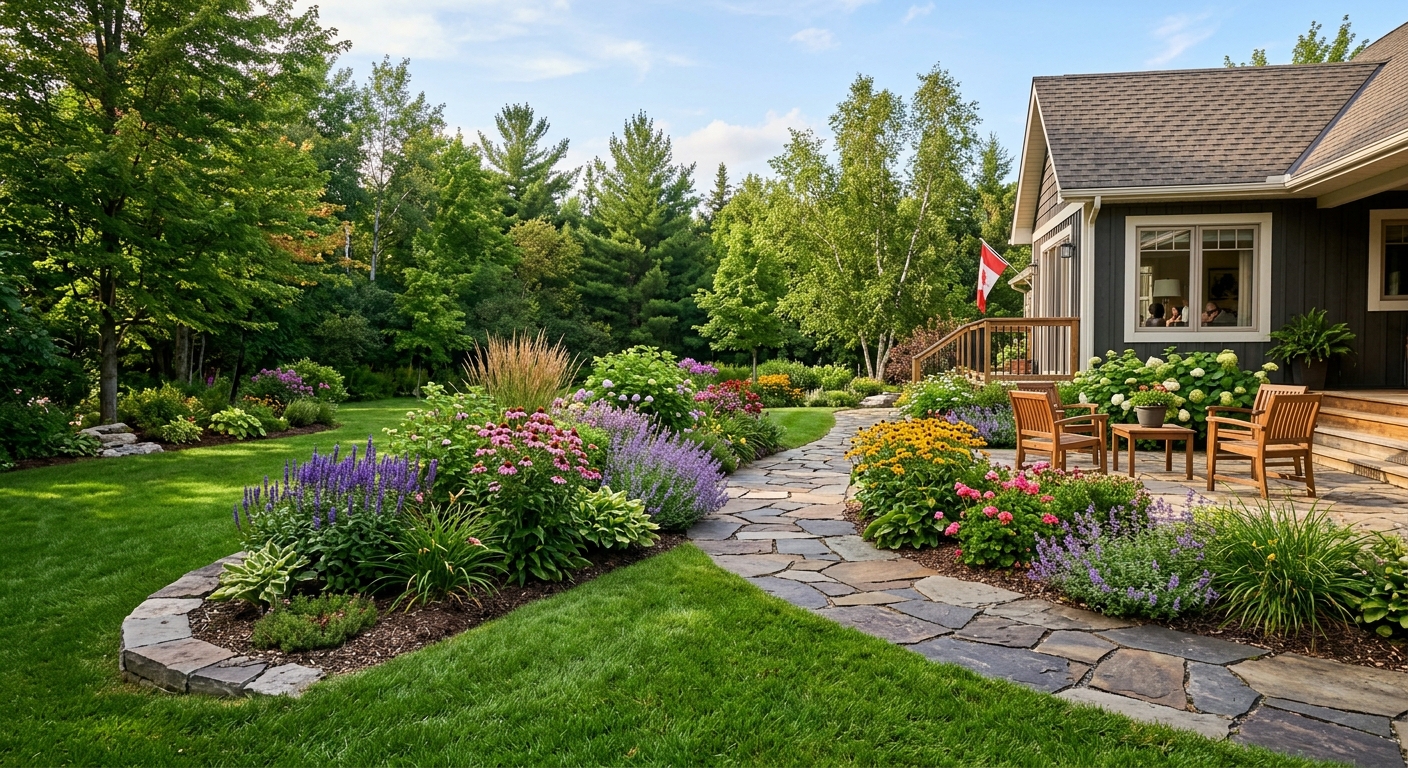
Landscaping options and costs in Altamont
Landscaping in Altamont starts with understanding your lot and the kind of curb appeal your household wants to invest in. In a small community of 1,064 people (Statistics Canada, 2021 Census), most properties are detached or have yard space that can actually support a full “front-to-back” plan—design, grading, planting, and hardscape—rather than just a few cosmetic upgrades. That matters for cost because full projects priced in the Lower Mainland–Southwest tier often include the foundational work homeowners only notice later (drainage correction, soil build-up, and proper compaction). In this region, contractors also benefit from the long growing season: last spring frost typically falls in early March to early April near the coast, and first fall frost can be as late as November. So softscape work can be scheduled more flexibly than in colder provinces, while structural work still needs to respect freeze–thaw cycles with deeper bases and good drainage to prevent frost heave and wall movement on sloped sites.
In Altamont’s area where demand tends to be especially strong—small neighbourhood pockets with older drainage patterns and more sloped yards off the main corridors—clients often want layered planting and functional hardscape to manage water pooling. That’s why quotes can land anywhere in the broader bands for landscape design & installation, sod/lawn, and retaining walls. Below is a quick comparison table to help you benchmark the quotes you’re likely to receive.
| Service |
Description |
Season |
Price Range |
| Full landscape design and installation |
Site visit, concept plan, planting & material schedule, grading/drainage coordination, softscape + hardscape build-out |
Spring–Fall (best balance of weather and plant availability) |
$5,000–$50,000 |
| Sod installation (supply, grade, lay, roll) |
Excavate & fine-grade, soil amendment where needed, sod delivery/laying, roll + first watering guidance |
Spring (cool, wet windows) and early Fall |
$2,000–$8,000 |
| Lawn seeding (grade, seed, starter fertilizer) |
Re-grade, seed selection, starter fertiliser, lightweight cover, and establishment watering plan |
Spring–Early Summer and early Fall |
$1,400–$4,500 |
| Interlocking patio or walkway |
Excavation, compacted base, edge restraints, bedding sand, pavers, finishing + cleanup |
Late Spring–Fall (avoid wettest winter weeks for best compaction) |
$10,000–$35,000 |
| Retaining wall (interlocking block) |
Layout, drainage layer (weeper + gravel), block installation, reinforcement where needed, and capstones |
Spring–Fall (structural work still needs drainage and compaction) |
$10,000–$80,000 |
| Tree and shrub planting |
Planting plan, staking (if required), amendments, mulch ring, and initial watering setup |
Spring–Fall (soft, cool periods) |
$1,000–$15,000 |
Prices are estimates only and vary by project scope, site access and material selection.
What affects the price of landscaping in Altamont
Even when two homeowners request “the same” landscaping, quotes in the Lower Mainland–Southwest can swing by 30–50%—and that’s normal across British Columbia because labour availability, material freight, and site conditions change from property to property. In coastal zones, contractors can use lush, layered palettes because winter damage risk is lower (zone 7–8). That tends to increase plant variety and labour time for detailed planting, but it also supports longer work windows. Compare that to Prairie regions (zone 2–4), where short frost-free windows push many clients toward drought-tolerant, low-maintenance designs and compressed construction schedules; in those areas, structural items like retaining wall bases often require more conservative planning for deep frost. Meanwhile, Southern Ontario (zone 5–6) typically faces a moderate growing season with irrigation pressure during dry spells, which can raise ongoing costs if drainage and soil structure aren’t planned.
In Altamont specifically, two things drive pricing fast: freeze–thaw management and water efficiency. Heavy-rainfall seasons mean a good drainage bed or French drain can add cost upfront, but it prevents foundation moisture and soggy soils that later kill lawns. On the other hand, a flat, well-drained lot can reduce grading time, keeping you closer to the lower end of the landscape design & installation band (for example, projects around $5,000–$50,000 range down toward the mid five-figures when hardscape is minimal). For lawns, sod generally costs more than seed; if you’re budgeting within the sod/lawn bands (about $2,000–$8,000 for typical installs), you’ll often see the “instant results” premium especially where grading is already acceptable.
Concrete local examples: (1) older yards with buried downspout leaders or clogged swales often need drainage correction before planting, which increases excavation and disposal; (2) sloped sites can require deeper, properly compacted retaining wall footings to stay stable through freeze–thaw cycles; (3) older soil may need topsoil and soil amendment to correct compaction, raising material and labour hours. These variables can easily move a project from “refresh” to “rebuild,” and that is where the 30–50% spread comes from.
| Price Factor |
Why It Matters |
Cost Impact |
| Yard size in sq ft — the primary cost driver for softscape |
More area means more soil prep, plant count, mulch, and labour hours |
Medium to high (often the biggest difference between quotes) |
| Grading and drainage work — slope corrections add significant cost |
Correct slopes prevent pooling and protect foundations |
High (can add days of labour) |
| Drainage bed or French drain installation |
Ensures water moves away from planting zones and hardscape |
High (excavation + gravel + tie-ins) |
| Plant material tier — native shrubs vs. ornamental vs. mature specimen trees |
Larger-caliper plants and premium ornamentals cost more and take longer to install |
Medium to high (specimen trees can move the budget quickly) |
| Hardscape vs. softscape ratio — walls and patios cost more per sq ft than lawn |
Pavers/blocks require base prep, compaction, and materials |
High (especially with retaining walls) |
| Irrigation system design and installation |
Drip and smart controllers improve efficiency but require layout, fittings, and testing |
Medium to high |
| Soil amendment and topsoil required |
Improves rooting, water retention balance, and long-term plant health |
Medium |
| Tree removal or stump grinding before new planting |
Clearing is messy, time-consuming, and may require hauling |
Medium to high (varies by access and debris) |
Permits & regulations in British Columbia
In British Columbia, most planting, sodding, and typical softscape work does not require a permit. The work homeowners most commonly schedule—new shrub beds, groundcovers, mulching, seeding, sod installation, and standard garden edging—usually falls under routine landscaping with no building permit. Where permits do become a factor is when you alter structural elements or drainage in a way that changes how water behaves across the lot.
For Altamont homeowners, the specific tasks that typically require a permit are retaining walls above a local threshold (commonly around 1.0 m in many municipalities). In those cases, expect a building permit and, sometimes, engineered drawings depending on height, soil conditions, and wall design. Also, changes to lot grading that affect drainage toward neighbouring properties or that impact storm sewer connections may trigger review requirements. Before anyone digs for planting holes or wall footings, confirm utility locates for safety.
Step-by-step verification (so you know your contractor is properly covered): (1) check the contractor’s British Columbia licence/registration details through the relevant online registry used by the province or the specific trade body, (2) request a certificate of insurance showing general liability with adequate limits and ensure it’s active for your job dates, and (3) confirm they have appropriate coverage for workers (WSIB/WCB) and can provide a clearance letter or proof upon request. Finally, review your scope for irrigation and water-use bylaws—while the driest restrictions are often discussed in the Interior, municipalities still focus on efficient irrigation and waste reduction.
Planning a landscape that thrives in Altamont's climate
To plan landscaping that thrives in Altamont, design with the local hardiness zone (typically 7–8 in the Lower Mainland–Southwest) and the region’s wet winter pattern in mind—rather than forcing plants to “fight” soggy or compacted soil. First, plant selection: choose native and zone-appropriate species that can handle cool, wet winters and recover in spring without constant winter protection. Second, sod versus seed: sod gives instant curb appeal but costs roughly 3–4 times more per sq ft than seeding because you’re paying for labour-intensive harvesting, transport, and laying. In our market, sod is usually best when your grade is already correct and drainage is stable.
Third, drainage and grading: in Lower Mainland–Southwest yards, pooling around foundations and under hardscape is the fastest way to create long-term maintenance. Aim to correct slopes early and install a drainage bed or French drain if low spots persist after rain. Fourth, hardscape base preparation: patios and interlocking paths must be built on properly compacted bases to survive freeze–thaw cycles. Even though coastal winters are milder, moisture movement through the ground can still lift poorly compacted edges or shift wall segments.
Finally, low-maintenance strategies: mulch (with weed control fabric where appropriate), layered groundcovers, and perennials reduce annual upkeep while supporting year-round structure. If you want a water-smart option, consider a rain-garden or xeriscape-inspired planting zones in parts of the yard that stay drier or drain quickly—this fits the coastal reality where watering is usually seasonal, not constant.
Where costs are justified: for example, if you’re choosing between sod and seed to fill a lawn area, spending within the sod band (often around $2,000–$8,000) can be worth it when you need quick results for a sale or when you already have proper grading. If your soil and grade still need attention, that’s where seed or a staged approach can be more cost-effective while you correct drainage first.
| Element |
Climate Consideration |
Maintenance Level |
Price Band |
| Sod lawn installation |
Best in cool, moist periods; requires stable grade and drainage |
Low to medium during establishment (water guidance needed) |
$2,000–$8,000 |
| Native perennial garden |
Zone-appropriate plants handle mild winters and wet springs better |
Low after the first season (mulch + occasional weeding) |
$3,000–$10,000 |
| Mulched shrub border |
Helps manage winter moisture and reduces weed pressure in wet months |
Low (light pruning + refresh mulch 1x per year) |
$1,500–$7,000 |
| Interlocking stone patio |
Needs proper base depth and compaction to reduce shifting in freeze–thaw |
Low (occasional leveling checks, weed control at joints) |
$10,000–$35,000 |
| Retaining wall (block) |
Drainage layer is critical in heavy rainfall areas; stable through cycles |
Low (mostly inspection after heavy storms) |
$10,000–$80,000 |
| Drip irrigation system |
Efficient for long cool summers and water-cost awareness; mitigates stress |
Medium (seasonal checks, controller programming) |
$2,500–$9,500 |
How to choose a landscaping contractor in Altamont
Choosing a contractor in Altamont means checking credentials early, not after you’ve signed. Start with British Columbia licensing and whether the company is legitimately set up for the work they’ll perform. Ask for their certificate of insurance and verify the policy is active for your project start and end dates; it should cover general liability for property damage and injury. For worker coverage, request proof of WSIB/WCB clearance or the appropriate coverage documentation—reputable crews can provide it without pressure. If a contractor hesitates or provides vague paperwork, that’s a red flag.
Then get 2–3 itemised written quotes. Look for a labour + materials breakdown (not only a lump-sum number), including excavation/haul-away, base materials, edging, drainage components, and topsoil/soil amendment quantities. Confirm what’s excluded: permits (if needed), demolition, disposal, utility locating, and whether an irrigation system is designed or just connected. Warranty matters too: ask for workmanship warranty length and whether it covers settlement or drainage failures, plus the product/manufacturer warranties for pavers, blocks, sod/seed inputs, and irrigation components. For payment schedule, never agree to more than 10–15% upfront; use staged payments tied to milestones and hold back until the job is complete and inspected. Finally, secure the timeline in writing with a start date and completion estimate.
- Ask for proof of BC licensing/registration relevant to the scope
- Request certificate of insurance (general liability) before signing
- Confirm WSIB/WCB coverage with a clearance letter or proof
- Get 2–3 itemised quotes with quantities and unit pricing
- Require a written scope: what’s included (drainage, disposal, topsoil)
- Verify whether permits are pulled and who pays (e.g., retaining wall threshold work)
- Check warranty details: workmanship length and coverage wording
- Ask if warranties are transferable to you as homeowner
- Set payment milestones; keep 10–15% holdback for final walk-through
- Confirm start date, weather contingency plan, and completion estimate
- Review site prep responsibilities: grading targets, compaction method, base depth
- Ask how they handle drainage pooling after the first major rainfall
Red flags I commonly see on Altamont jobs: (1) quotes that omit drainage or base preparation details, (2) “we’ll handle permits” with no clarification of who pulls them, (3) cash-only or vague payment terms, (4) no written warranty for workmanship, and (5) contractors who won’t provide insurance/coverage proof up front.
Frequently asked questions — landscaping in Altamont
Do I need a permit for a retaining wall in British Columbia?
In British Columbia, many landscaping tasks (planting, sodding, typical softscape) don’t require a permit, but retaining walls can. In many municipalities, a permit is commonly required when a retaining wall is above a threshold—often around 1.0 m—especially if the design depends on engineered structural considerations or specific site conditions. If you’re building a wall on a sloped yard in Altamont, the approval likelihood increases when drainage and foundation protection are involved. The key is to ask your contractor to confirm whether your wall height and design triggers a building permit and whether engineered drawings are needed. Before digging, ensure utility locates are completed and review drainage plans so water doesn’t get redirected toward neighbouring properties.
How do I improve drainage in my yard?
Drainage improvements in Altamont usually start with an honest look at where water actually goes after a heavy rain. If you’re seeing pooling near foundations or soggy areas where grass fails, the typical fix is a combination of re-grading (correct slopes so water moves away) and adding a drainage bed or French drain where water collects. Because Lower Mainland–Southwest winters can be wet, drainage bed design matters as much as pipe placement—your contractor should include gravel sizing, outlet/tie-in location, and a plan for how overflow will be managed during storms. If drainage is ignored, even good planting won’t last, and hardscape can settle. A staged approach can fit budgets: you might prioritize drainage and grading first, then follow with planting and turf within bands like $2,000–$8,000 for sod depending on size.
What is xeriscaping and does it suit Altamont?
Xeriscaping is a water-wise landscaping approach that uses drought-tolerant plants, smarter irrigation, mulch, and design techniques to reduce water consumption. In coastal British Columbia, including Altamont, you’re not planning for extreme drought the way you might in the Interior, but you can still use xeriscape principles to reduce waste, manage water costs, and maintain healthy beds during occasional irrigation limits or higher seasonal demand. A practical fit is using rain-garden zones, well-mulched shrub borders, and native perennials in areas that drain quickly. You can also pair drip irrigation with mulch and soil amendment to keep moisture where it’s needed without over-watering. In terms of budget, the “water-saving” part can be modest if you already have good grading—adding drip lines and smart controllers may land in the irrigation range (often several thousand dollars) rather than requiring a full hardscape rebuild.
How do I plan a low-maintenance yard?
A low-maintenance yard in Altamont comes from reducing recurring tasks: fewer lawn repairs, less weeding, and planting that naturally suits the local zone 7–8 conditions. Start by choosing native or zone-appropriate perennials and shrubs, grouping plants by water needs, and using mulch to cut weed pressure—especially important through wet seasons. Consider swapping part of the lawn for mulched shrub borders or groundcovers, then use sod only where you truly need turf function. Drainage and grading are foundational for low maintenance; if water pools, plants struggle and you’ll be troubleshooting constantly. For hardscape, prioritize properly compacted bases so patios and edges don’t shift over freeze–thaw cycles. If you’re comparing turf options, sod tends to be pricier (commonly within $2,000–$8,000 depending on area) but can reduce establishment time compared with seeding—so pick based on how quickly you need results and how good your grade already is.
How deep should a retaining-wall base be for local frost?
Base depth for a retaining wall should be set by the wall design and local site conditions, not guessed. Even though the Lower Mainland–Southwest has milder winters than colder provinces, freeze–thaw cycles still occur, and water movement through soils can contribute to frost heave if drainage and compaction aren’t correct. That’s why many contractors plan footings to extend below the effective frost penetration for the region and build a properly drained section using a gravel drainage layer and weeper system. In practice, the “right depth” depends on wall height, block system, soil bearing capacity, and whether the wall is reinforced. Your best move in Altamont is to ask the contractor to show the base/footing plan in writing (and engineering details if required by permit). If you’re budgeting, wall projects commonly sit in the larger hardscape tier like $10,000–$80,000, because correct base work is a major portion of the cost.
How much does professional landscape design cost?
Professional landscape design in Altamont is usually priced based on the scope: whether you need concept only, a detailed planting plan, irrigation layout, or full design-and-install coordination. In the Lower Mainland–Southwest, many homeowners view design as part of the total project, where landscape design & installation budgets often fall into the wider band around $5,000–$50,000 depending on hardscape size, drainage work, and how many plant layers are included. If your yard is relatively straightforward—clear grade, minimal drainage correction, and a smaller planting footprint—you can expect pricing toward the lower end of that range when hardscape is limited. If you need significant grading, drainage beds, and a retaining wall, design effort plus build complexity move the budget upward. Always ask for a clear written scope so you know what the designer includes (plant list, quantities, and construction notes) and what’s billed separately.