Landscaping options and costs in Boundary
In Boundary, British Columbia, homeowners usually have enough yard space to make landscaping a real long-term investment—especially in detached neighbourhoods where a typical property plot can support both softscape and hardscape upgrades. With Boundary’s population recorded at 1,585 people in the 2021 Census (Statistics Canada, 2021 Census), the local market is small, so contractor availability can tighten during the spring and early fall rush. That’s one reason quotes can swing more than people expect even when the scope looks similar on paper.
In the Lower Mainland–Southwest (plant hardiness zones 7–8), winters are mild and wet, and last spring frost tends to land from early March to early April near the coast—so you’ll often see planting and softscape work scheduled for a longer window than in harsher regions. At the same time, freeze–thaw cycles still matter for structural items like interlocking patios and retaining wall footings; bases need deeper excavation, proper drainage, and good compaction to reduce frost heave and wall movement on sloped sites. Neighbourhoods around the downtown Boundary area and older residential streets tend to be in higher demand because many yards are refreshed with layered planting, upgraded drainage, and curb-appeal patios.
The options below help you compare the most common scope packages—then you can tune your design to match your goals and budget in a way that fits zone 7–8 conditions.
| Service |
Description |
Season |
Price Range |
| Full landscape design and installation |
Site walk, concept + layout, grading/drainage plan, plant + hardscape install, and cleanup |
Mar–Jun, Sep–Nov (best scheduling windows) |
$5,500 – $48,000 |
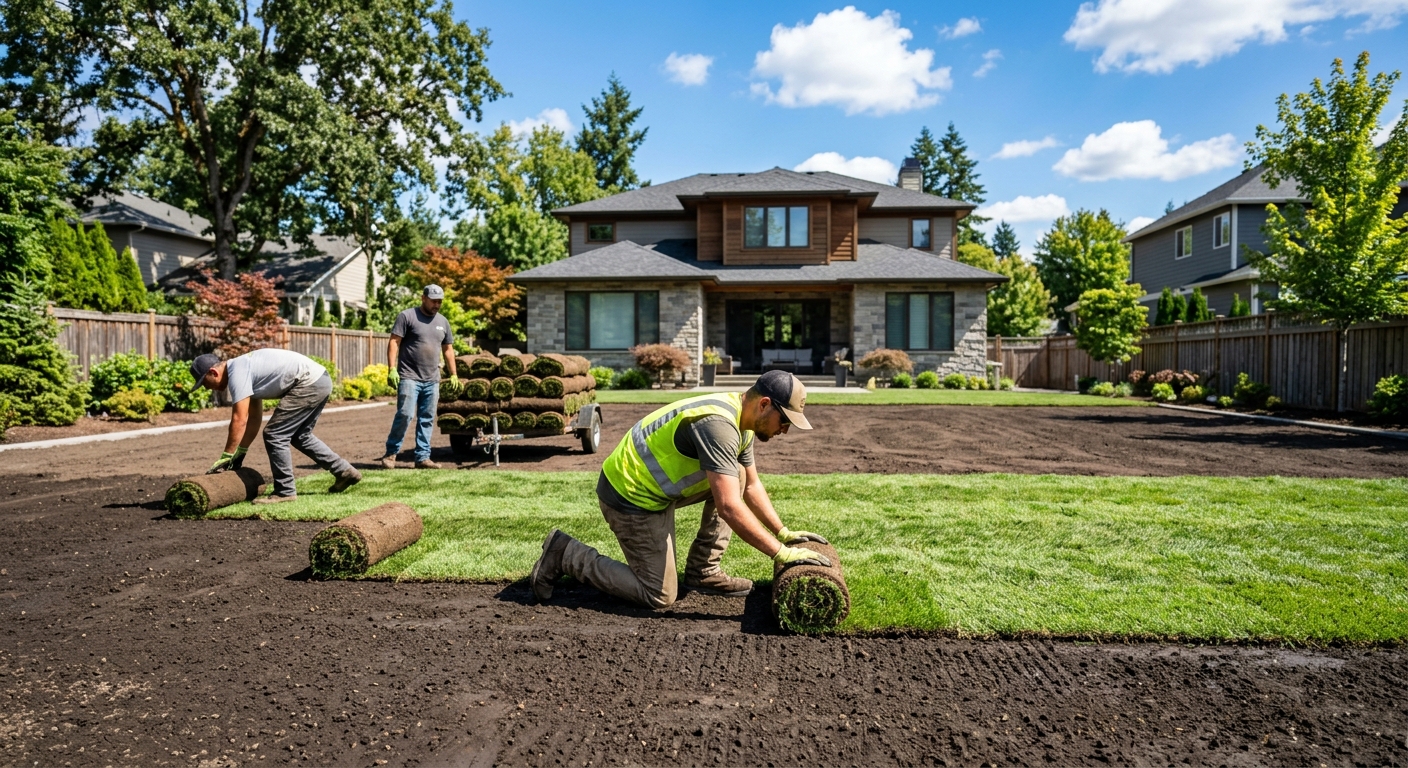
| Sod installation (supply, grade, lay, roll) |
Soil prep, topsoil/compost amendments, grading, turf supply, laying, rolling, and light watering setup |
Apr–May and Aug–Sep |
$2,500 – $8,500 |
| Lawn seeding (grade, seed, starter fertilizer) |
Rake/grade, seed + starter fertilizer, light mulch, and establishment watering plan |
Apr–May and Sep (when temps stabilize) |
$1,500 – $5,500 |
| Interlocking patio or walkway |
Excavation, base (compacted), edging, sand setting bed, pavers, slope to drain, and finishing |
Apr–Oct (with weather allowances) |
$12,000 – $55,000 |
| Retaining wall (interlocking block) |
Layout, excavation, compacted base, drainage gravel, weeping considerations (if required), wall build |
Apr–Sep |
$14,000 – $65,000 |
| Tree and shrub planting |
Plant layout, soil amendments, planting holes, staking as needed, mulch rings, and initial care |
Mar–Jun and Sep–Nov (avoid waterlogged weeks) |
$1,200 – $14,500 |
Prices are estimates only and vary by project scope, site access and material selection.
What affects the price of landscaping in Boundary
In Boundary, British Columbia, it’s common to see quotes for the “same” landscaping idea land 30–50% apart across the Lower Mainland–Southwest. The spread usually comes down to what’s included (or not), site conditions, and how contractors price risk around drainage, excavation, and access. Even though our region sits in plant hardiness zones 7–8, weather swings still affect labour scheduling, and that can change overall project cost—especially when crews are booked tightly between spring frost clearing and the fall window.
Climate and frost timing matter because they define both what grows and how long crews have for proper installation. In coastal BC, we have a long working and growing season, so layered planting palettes and evergreen structure are more achievable—but we still have to build patios and retaining walls to handle freeze–thaw cycles. Where Prairie regions (Zone 2–4) often require drought-tolerant, wind-hardy species and deeper scheduling precision, coastal BC can support more lush, layered designs; the trade-off is that heavy rain means drainage work is more frequently required than homeowners expect.
Two concrete examples that raise costs in Boundary: (1) a sloped yard that needs regrading can add substantial labour and disposal, pushing a simple patio from the lower end of hardscaping pricing toward the mid-range; (2) wet soil that requires a drainage bed or French drain can add material and excavation time, often narrowing the gap between a “plant-only” budget and a full landscape package. Conversely, small, level lots with easy truck access usually keep you closer to the softer part of the pricing bands—like staying within tree and garden planting ranges—rather than escalating into the full landscape design & installation band.
| Price Factor |
Why It Matters |
Cost Impact |
| Yard size in sq ft — the primary cost driver for softscape |
More area means more labour time, soil amendment, mulch, seed/sod, and material delivery |
Can swing the total by 20–60% depending on scope |
| Grading and drainage work — slope corrections add significant cost |
Proper slopes protect foundations and prevent pooling; regrading requires excavation + compaction |
Often adds several thousand dollars on uneven lots |
| Drainage bed or French drain installation |
Collected water needs somewhere to go; requires gravel, piping, outlet considerations, and correct falls |
Commonly a major driver in wet-season projects |
| Plant material tier — native shrubs vs. ornamental vs. mature specimen trees |
Mature specimens cost more and take more labour for sizing, staking, and proper root ball handling |
Can double the planting portion of the budget |
| Hardscape vs. softscape ratio — walls and patios cost more per sq ft than lawn |
Pavers, base materials, excavation depth, and labour intensity raise per-square-foot costs |
Shifts total toward the retaining wall & interlocking bands |
| Irrigation system design and installation |
Drip lines, zones, controllers, and layout time directly affect both upfront cost and long-term maintenance |
Adds budget, but reduces rework and water waste |
| Soil amendment and topsoil required |
Poor native soil may need compost, topsoil depth, and rebalancing for rooting |
Can add labour/materials quickly on larger lawns |
| Tree removal or stump grinding before new planting |
Removal changes the site condition, creates disposal needs, and affects future planting layout |
Often adds a clear, separate line item cost |
Permits & regulations in British Columbia
In British Columbia, most landscaping tasks like planting, sodding, and typical softscape installation generally do not require a permit. For Boundary homeowners, that usually means you can proceed with planting beds, mulch top-ups, seeding, sod laying, and standard walkway/patio builds without a permit—provided the work stays within typical landscaping scope and doesn’t alter drainage in a way that impacts neighbouring properties or storm connections.
Where permits often do come into play is with retaining walls above a height threshold (commonly around 1.0 m / 3.3 ft in many municipalities). Depending on the wall height and site conditions, a permit may be required and engineered drawings can be requested. Also watch for changes to lot grading that could redirect runoff toward neighbours or storm sewer connections—those situations may trigger an approval process. Before digging for planting holes or wall footings, ensure utility locates are obtained to avoid damaging buried services.
To verify a contractor in Boundary, request proof before work starts and check: (1) the contractor’s licence/registration status in the appropriate BC online registry (based on the trade category they perform); (2) liability insurance with the coverage limits shown and your project address listed or clearly referenced; and (3) work coverage such as WSBC/WCB (or the equivalent clearance proof they provide to confirm coverage for their workers). A legitimate contractor should send certificate of insurance and clearance documentation when you ask.
Planning a landscape that thrives in Boundary's climate
Planning for Boundary, British Columbia means working with zone 7–8 growing conditions and a wet winter pattern, while still respecting frost in the spring and fall shoulder months. Start with plant selection: choose native and zone-appropriate shrubs and perennials that can handle cool, damp winters with less winter protection, and that tolerate a period of reduced watering if restrictions ever tighten. For lawns, pick the establishment method that matches your timeline—sod gives instant curb appeal but costs more, while seeding is typically easier on your budget if you can manage establishment watering.
Next, focus on drainage and grading. In the Lower Mainland–Southwest, pooling water is a common cause of foundation moisture and plant stress. A properly graded yard and well-positioned drainage beds (where needed) often prevent problems that otherwise require rework later. For hardscape like patios and retaining walls, base preparation must consider freeze–thaw cycles; that means correct excavation depth, compaction, and slope to drain.
To keep annual upkeep down without losing curb appeal, use layered planting (groundcovers + mulch rings + perennial structure) rather than lots of bare soil. Mulch reduces splashback, improves moisture consistency, and suppresses weeds. If you want a low-water direction, consider a rain-garden in the lowest area of your property or xeriscape-style groupings (grasses, drought-tolerant perennials) supported by drip irrigation.
Example: if you’re deciding between sod and seed for a similar lawn area, sod often sits around the upper lawn band (for many projects in Boundary, roughly $2,500 – $8,500 depending on size and prep), while seeding may land closer to $1,500 – $5,500. The price difference is justified when you need quick results for a sale, or when you want a thicker starting surface to stabilize grades—otherwise, seeding plus good drainage and amendments can be the better value.
| Element |
Climate Consideration |
Maintenance Level |
Price Band |
| Sod lawn installation |
Works best in spring/fall cool periods; needs proper grade to avoid waterlogging |
Low after establishment; moderate watering early on |
$2,500 – $8,500 |
| Native perennial garden |
Zone-appropriate varieties handle cool wet winters; mulch protects roots |
Low to moderate (seasonal trimming/weeding) |
$1,200 – $7,500 |
| Mulched shrub border |
Layered shrubs reduce splash and erosion; good for rainy-season stability |
Low (top-ups and occasional pruning) |
$1,400 – $9,000 |
| Interlocking stone patio |
Requires correct base + slope to drain for wet winters and freeze–thaw durability |
Low (regular brushing/joint care) |
$12,000 – $55,000 |
| Retaining wall (block) |
Drainage gravel and correct foundation depth protect against movement |
Low (inspection after heavy rain) |
$14,000 – $65,000 |
| Drip irrigation system |
Helps use water efficiently during dry spells while reducing leaf disease risk |
Moderate (seasonal checks, winterization) |
$2,000 – $10,000 |
How to choose a landscaping contractor in Boundary
Choosing a landscaping contractor in Boundary, British Columbia is mainly about checking coverage, scope clarity, and how they handle the details that protect your property during wet winters and freeze–thaw periods. First, verify licensing/registration for the trade activities they perform in BC, then ask for current liability insurance (certificate of insurance) showing coverage limits that fit your project size. Next, confirm their workers’ coverage: request proof of WSBC/WCB clearance or equivalent documentation they can provide. A reputable contractor will hand over paperwork quickly—no pressure, no evasiveness.
Get 2–3 itemised written quotes. Ask for a breakdown that separates labour and materials, including soil/topsoil depth, drainage components (if any), base thickness under pavers, and the plant list with quantities and sizes. Don’t accept a vague “lump sum” quote without clear exclusions: what’s not included, who supplies mulch/sod, is disposal included, and will permits be handled if a retaining wall triggers requirements? Confirm whether utility locates are arranged before digging.
Also ask about warranty: workmanship warranty length, product/manufacturer warranty terms, and whether warranties are transferable to you as the homeowner. For payment, never pay more than about 10–15% upfront; hold a remaining amount until the job is complete and any punch-list items are finished. Finally, request a written start date and completion estimate—weather can cause delays, but the timeline should still be documented.
- Ask for trade licence/registration details and match them to the work in your scope.
- Request certificate of insurance and confirm the address/location is covered.
- Confirm WSBC/WCB clearance proof for their workers.
- Get itemised quotes (labour vs materials) and compare apples-to-apples.
- Require a plant list with sizes (e.g., container size) and quantities.
- Confirm topsoil/compost amendments and how much depth is included.
- For hardscape, insist on base specification (compaction + drainage slope).
- Clarify disposal, debris haul-away, and how old sod/soil is handled.
- Ask who coordinates utility locates and when they’re scheduled.
- Check warranty: workmanship duration + manufacturer warranty terms.
- Confirm payment schedule and keep a holdback until final cleanup/punch list.
- Get a written timeline with start and practical completion dates.
In Boundary, a few red flags to watch for: contractors who won’t provide insurance/coverage paperwork; quotes that omit drainage/grading details and then “discover” costs later; unclear plant substitutions or no written plant list; requesting large upfront payments beyond 10–15%; or refusing to put the scope, exclusions, and warranty terms in writing.
Frequently asked questions — landscaping in Boundary
What is the best grass type for a Boundary lawn?
For lawns in Boundary, British Columbia (zone 7–8, coastal wet winters), homeowners usually do best with a cool-season turf mix designed for shade tolerance and seasonal colour—often perennial ryegrass blends for faster establishment and strong wear. If your yard gets partial shade from trees or the house, choose a mix marketed for reduced disease pressure and better performance in cooler, moist conditions. Avoid “all-purpose” seed claims without a blend description, because long wet stretches can expose weak turf. Cost-wise, if you’re converting an area now, seeding typically sits around $1,500 – $5,500 for many Boundary projects depending on grading and lawn size, while sod is commonly priced higher. Your best type also depends on whether you can keep the lawn consistently moist during establishment.
When should I aerate and overseed my lawn in Boundary?
In Boundary, plan aeration and overseeding for the cool, active growing periods—generally early spring as temperatures begin to stabilize (around the spring shoulder window) or in early fall before sustained cold arrives. Because Lower Mainland–Southwest winters are mild but wet, the goal is to let seed germinate and roots settle without being submerged for long stretches. If your lawn is thinning due to thatch, aerate first, then overseed, and apply starter fertilizer lightly. If you’re dealing with compacted soil, aeration alone won’t fix drainage; pooled spots may require regrading or a drainage bed. Many homeowners find that simple overseeding is the most budget-friendly “maintenance pass,” compared with full sod replacement, which often starts around the higher band of $2,500 – $8,500 once prep and supply are included.
What trees grow best in Boundary's climate zone?
In Boundary’s zone 7–8 conditions, you have a good range of resilient broadleaf and conifer options—especially if you select varieties that match your site (sun/shade, wind exposure, and soil drainage). For many local yards, evergreens provide winter structure with lower leaf drop, while deciduous trees add seasonal colour and canopy shape in the long growing season. The most important factor is not only the species, but also proper planting depth, soil amendment, and watering in the first establishment year. If you have drainage issues (common on sloped or poorly graded yards), choose trees suited to your moisture conditions and address pooling first. Tree and shrub planting typically falls around $1,200 – $14,500 depending on quantities and whether you’re adding mature specimens versus smaller stock.
How much does sodding a yard cost in Boundary?
Sodding a yard in Boundary depends heavily on lawn size, soil prep, and whether you need grading corrections or additional topsoil. On many local projects, homeowners budget within roughly $2,500 – $8,500 for supply, grading, laying, and rolling—assuming normal access and straightforward subgrade conditions. If your yard has low spots that hold water, the sod may fail unless grading and drainage are corrected first, which can increase costs. Sodding is also typically done in spring or late summer/early fall when temperatures are cool enough for establishment. If you need a quick turnaround for curb appeal (for a listing or event), sod can be justified; if you’re flexible, seeding usually comes in at a lower cost band, often closer to $1,500 – $5,500 depending on prep.
How do I prevent weeds in my Boundary garden?
Weed prevention in Boundary is mostly about building a healthy planting bed from day one—especially in wet winters where weeds can germinate quickly. Start with proper site prep: remove existing weed roots, loosen compacted soil, and add compost/topsoil where needed so your plants establish dense coverage. Use a thick, consistent mulch layer (applied correctly around stems) to block light and reduce soil splash. Plant spacing matters: crowded, zone-appropriate plants shade the soil and limit weed growth. For edging, use a clean border so grass doesn’t creep into beds, and keep lawn/bed transitions trimmed. If you’re installing new borders, professional bed preparation is often folded into “tree and shrub planting” scopes around $1,200 – $14,500 depending on how extensive the bed is. Avoid “thin mulch” and random gaps—those become weed zones.
How do I design a low-water yard in Boundary?
A low-water yard design in Boundary, British Columbia works best by combining smart plant choices with irrigation efficiency. Even though coastal BC has wet winters, summer dry spells and water-cost pressures still push homeowners toward efficient systems. Use a layered approach: drought-tolerant perennials, groundcovers, and properly sized shrubs that cover soil quickly, plus mulch to reduce evaporation. Consider rain-garden areas in the lowest parts of the yard to capture and absorb runoff, then redirect irrigation to planting zones rather than spraying open turf. If you’re converting from a lawn-heavy layout, keep a smaller “amenity” turf area and replace the rest with mulch beds or hardy perennials. A drip irrigation system can be an upfront add-on but helps you avoid waste; pricing commonly sits within $2,000 – $10,000 depending on zones and layout. Always plan irrigation with controller scheduling so you’re not watering during naturally wet periods.