Landscaping options and costs in Chartwell
Chartwell homeowners typically have the space and motivation to invest in landscaping—especially in a community where detached homes are a common housing type, meaning many lots have enough yard area to justify layered planting beds, a patio, and a proper lawn. With a population of 1,383 (Statistics Canada, 2021 Census), local contractors often see strong demand for full-service projects around the neighbourhoods closest to the Trans-Canada Highway corridor, where curb appeal matters and homes are often set up for visible outdoor spaces.
In the Lower Mainland–Southwest (plant hardiness zones 7–8), you benefit from mild, wet winters and a long cool growing season. That usually helps keep labour availability steadier than in colder parts of British Columbia, and it supports richer, more lush designs compared with Prairie cities. However, contractors still price carefully for freeze–thaw impacts on hardscape bases and drainage—especially on sloped lots where water must be directed away from foundations. Softscape budgets can also rise as more homeowners choose efficient irrigation (drip lines and smart controllers) to protect lawns and beds during occasional watering constraints and rising water costs.
Below is a practical cost comparison so you can line up expectations before you request itemised proposals for your site.
| Service |
Description |
Season |
Price Range |
| Full landscape design and installation |
On-site assessment, design plan and planting layout, grading/drainage coordination, soil amendments, and installation of softscape and hardscape |
Year-round (best results late spring to early fall) |
$8,000–$45,000 |
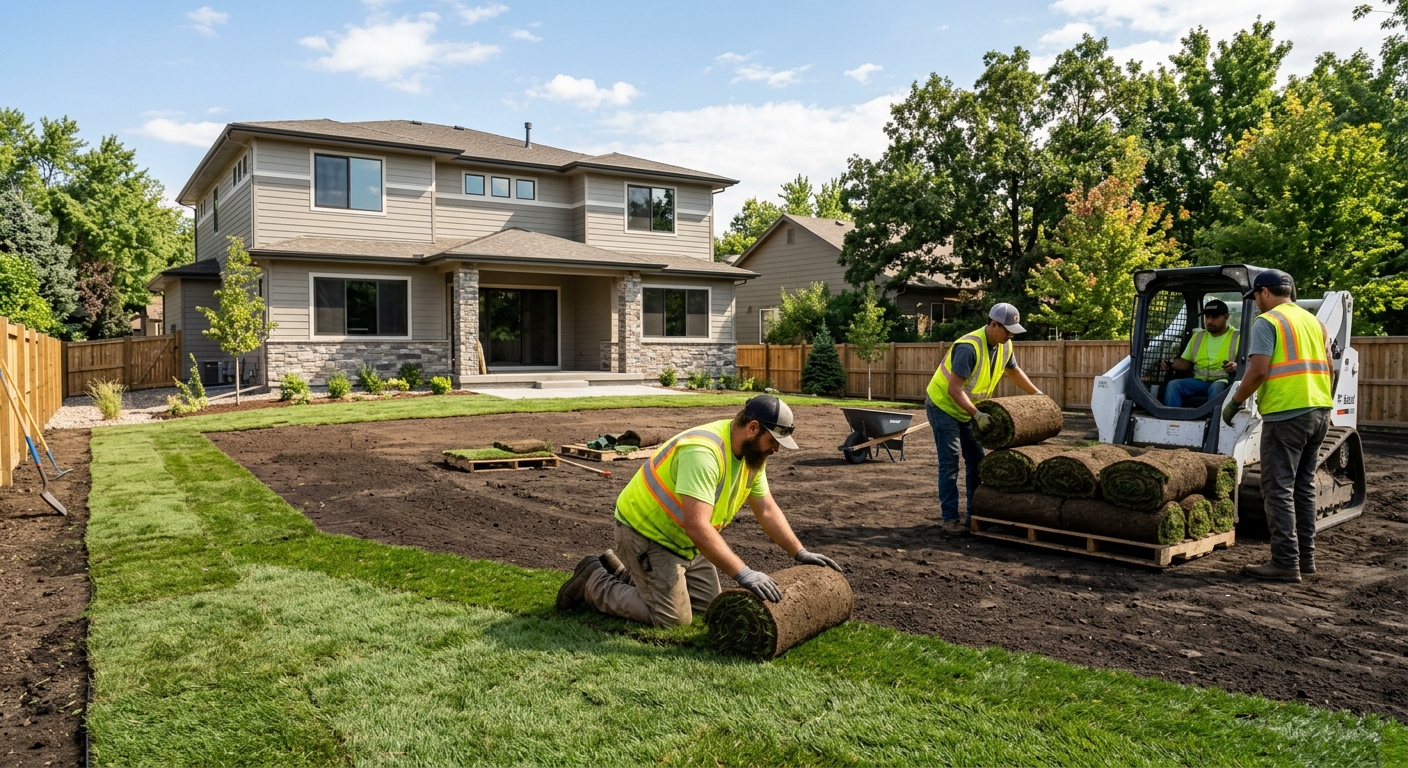
| Sod installation (supply, grade, lay, roll) |
Minor grading, rototilling where needed, topsoil, sod delivery and laying, rolling, starter fertiliser, first watering guidance |
Typically spring to early fall |
$3,500–$7,500 |
| Lawn seeding (grade, seed, starter fertilizer) |
Site preparation, raking/aeration where appropriate, seed and starter fertiliser, light topdressing, and establishment watering plan |
Best in fall; also late spring |
$1,800–$4,800 |
| Interlocking patio or walkway |
Excavation, compacted base and bedding sand, edge restraints, and interlocking stone installation |
Best late spring to fall (avoid saturated ground) |
$9,500–$45,000 |
| Retaining wall (interlocking block) |
Layout, excavation, drain tile and gravel backfill, geotextile where required, and block wall construction |
Best late spring to fall |
$16,000–$70,000 |
| Tree and shrub planting |
Planting layout, soil amendment, staking where required, and installation of shrubs/evergreens/ornamental trees |
Planting windows spring to fall |
$2,000–$13,500 |
Prices are estimates only and vary by project scope, site access and material selection.
What affects the price of landscaping in Chartwell
In Chartwell and across the Lower Mainland–Southwest, you can see the same landscaping scope swing by roughly 30–50% from one quote to another because pricing is driven by site complexity, material choices, and how much labour is spent on drainage, soil build-up, and finishing. Those variables are also influenced by regional factors: in coastal BC’s zones 7–8, contractors can build fuller planting palettes and keep working for a longer season than in colder Prairie regions (zones 2–4). Meanwhile, during short frost-free windows elsewhere, companies may price higher due to tighter scheduling and more risk. In dry parts of BC interior and in Alberta, irrigation design often becomes more expensive and drought-tolerant planting is favoured. Southern Ontario (zones 5–6) tends to have a moderate season with periodic summer dryness, shifting costs toward irrigation and weed control.
For Chartwell specifically, two examples commonly move the needle. First, grading and drainage work: correcting a slope so water sheds away from a foundation can add substantial labour and excavation time, which pushes projects toward the higher end of hardscaping bands (for example, interlocking patio work often sits around the $10,000–$45,000 band depending on base depth and drainage detailing). Second, plant material tier: switching from standard shrubs to larger, container-grown evergreens or adding a mature specimen tree increases costs because of truck access, handling, and extended soil preparation—often aligning with the upper end of tree and garden planting ($1,000–$15,000) when multiple sizes are used.
Also consider housing-stock age. Many Chartwell homes were landscaped with minimal drainage decades ago; replacing tired topsoil and rebuilding planting beds can turn “simple planting” into a soil-and-grading project. Even a few additional wheelbarrow loads of amended soil and proper topdressing can add to your budget, and on wet winters those materials need to be scheduled to avoid resettling.
| Price Factor |
Why It Matters |
Cost Impact |
| Yard size in sq ft — the primary cost driver for softscape |
More area means more labour time, more topsoil/soil amendments, and more plants or lawn coverage |
Often the biggest single variable; can shift budgets by $5,000+ on typical projects |
| Grading and drainage work — slope corrections add significant cost |
Proper fall and foundation protection require excavation, shaping, compaction, and sometimes rework |
Commonly adds $1,500–$10,000 depending on how far water is moving |
| Drainage bed or French drain installation |
Required when water pools, soils stay saturated, or downspouts can’t discharge safely |
Typically adds $2,500–$12,000+ based on length and outlet complexity |
| Plant material tier — native shrubs vs. ornamental vs. mature specimen trees |
Larger sizes and premium cultivars cost more and require more labour for handling and staking |
Can swing a planting budget by $1,000–$8,000 across similar bed layouts |
tr>
| Hardscape vs. softscape ratio — walls and patios cost more per sq ft than lawn |
Stone, base materials, labour, and finishing details drive unit costs higher for hardscape |
Mix changes can move total project price into different bands (e.g., $10,000 vs. $40,000+) |
| Irrigation system design and installation |
Drip lines, rotor heads, valves, and smart controllers protect beds and reduce waste |
Usually adds $1,000–$6,000; more if zones and backflow details increase |
| Soil amendment and topsoil required |
In wet coastal soils, you may need aeration, compost, and drainage-friendly amendments |
Commonly adds $500–$5,000 depending on how much rebuild is needed |
| Tree removal or stump grinding before new planting |
Clearing changes site conditions and can add disposal and equipment time |
Often adds $500–$4,000 per tree depending on size and access |
Permits & regulations in British Columbia
In British Columbia, most routine landscaping activities—like planting, sodding, and typical softscape work (mulch, new beds, and standard walkway installs)—usually do not require permits. That means you can commonly proceed with new sod or seed, shrub and tree planting, and general bed preparation without a formal permit process.
Permits do come into play for larger structural changes. Retaining walls above a typical height threshold—commonly around 1.0 m (3.3 ft) in many municipalities—often require a building permit, and sometimes engineered drawings depending on design and site conditions. Also, changes to lot grading that can affect drainage direction toward neighbouring properties or storm systems may trigger additional review. Before any digging, always arrange utility locates so you don’t hit buried services when installing irrigation lines, drainage beds, or wall footings.
To protect yourself as a homeowner in Chartwell, verify three things before work begins: contractor licensing, liability insurance, and workplace coverage. First, confirm the contractor’s business information and any applicable trade registration through online provincial/industry registries where listed. Second, request a current certificate of insurance (liability) and check that it covers landscaping/hardscape work and names you as an additional insured if offered. Third, ask for proof of workplace coverage (WSIB/WCB clearance where applicable) and keep the clearance letter on file. If a contractor can’t provide documents promptly, that’s a risk flag—especially with excavation, machinery, and stone work.
Planning a landscape that thrives in Chartwell's climate
In Chartwell’s plant hardiness zone 7–8, the goal is to work with rainfall, winter cool-downs, and the frost calendar—not fight them. Coastal BC generally stays wet enough to support lush growth, but standing water and foundation moisture are real problems when grading and drainage aren’t corrected. Start with plant selection: choose zone-appropriate, more dependable evergreen structure and long-blooming perennials, and favour species that handle wet winters with less fuss and less watering once established.
When deciding between sod and seed, weigh cost and timing. Sod gives instant visual results and faster functional lawn coverage, but it typically costs about 3–4 times more per sq ft than seeding once you include prep. A practical example: moving from a seeded lawn approach near the $1,800–$4,800 band to sod installation near the $3,500–$7,500 band can be justified when you need immediate usability for a yard, pets, or a family event timeline. If you can tolerate establishment time, seeding often stretches your budget further and reduces risk of drainage problems caused by improper sod prep.
Next, focus on drainage and grading. In the Lower Mainland–Southwest, pooling can happen after heavy rain; correct the fall so water moves away from your foundation and avoid cutting into downspout discharge without a plan. For patios and retaining walls, base preparation must account for freeze–thaw cycles: excavate deeper, compact correctly, and build in proper drainage to prevent frost heave and wall movement on sloped sites. Finally, add low-maintenance strategies like mulch, groundcovers, and layered perennial borders to reduce annual upkeep while keeping curb appeal year-round. If water costs or restrictions worry you, consider rain gardens and targeted drip irrigation for beds—those design choices help beds cope during drier stretches without killing lawn areas.
| Element |
Climate Consideration |
Maintenance Level |
Price Band |
| Sod lawn installation |
Fast establishment after cool-season planting windows; requires good drainage so it doesn’t stay saturated through winter |
Medium (initial watering and weed control during establishment) |
$3,500–$7,500 |
| Native perennial garden |
Resilient to coastal rainfall and damp winters; supports biodiversity and typically needs less winter protection |
Low to medium (seasonal pruning and light mulching) |
$2,000–$9,000 |
| Mulched shrub border |
Mulch moderates soil moisture and temperature and helps reduce weed pressure in wet-but-cool coastal seasons |
Low (top-up mulch and occasional shaping) |
$1,800–$7,500 |
| Interlocking stone patio |
Needs properly compacted base and correct slope to shed water during winter storms and freeze–thaw |
Low (sweeping and occasional joint sand refresh) |
$9,500–$45,000 |
| Retaining wall (block) |
Backfill and drainage detailing protect against water pressure during wet seasons and prevent frost-related movement |
Low (periodic inspection of drainage outlet and cap blocks) |
$16,000–$70,000 |
| Drip irrigation system |
Targets root zones efficiently in a region with variable rainfall; helps manage water use and occasional restrictions |
Medium (seasonal adjustments and controller updates) |
$1,000–$6,000 |
How to choose a landscaping contractor in Chartwell
Choosing a reliable contractor in British Columbia starts with proof, not promises. First, verify licensing and coverage. Ask for a current certificate of liability insurance and confirm the work described matches the coverage (especially excavation, equipment use, and hardscape). Next, request proof of workplace coverage (WSIB/WCB clearance, where applicable) so you know the contractor has an active clearance for workers. For licensing, use online registries/industry listings available publicly, and ensure the company name matches the quote and invoice. If the contractor can’t provide documents quickly, it’s a sign they may not manage risk properly.
Second, get 2–3 itemised written quotes. You want labour and material line items, not a single lump sum. Make sure the scope includes excavation depth, base material type, compaction method, drainage detailing, and disposal. Ask whether permits are included (where required for retaining walls), whether utility locates are booked, and whether topsoil/soil amendments are specified by volume or depth. For warranty, confirm the workmanship warranty length, whether it covers settlement or workmanship failures, and whether any product/manufacturer warranty transfers to you.
Third, agree on a sensible payment schedule: never pay more than 10–15% upfront. Hold back the final payment until the job is complete, cleaned up, and any seeding/sod establishment steps are explained.
Finally, demand a start date and a completion estimate in writing. In Chartwell, weather windows matter—crews may pause during the wettest weeks to protect base compaction and avoid resettling. Clear timelines reduce cost overruns and keep the project on track.
- Ask for itemised quotes (labour, materials, equipment, disposal) rather than lump sums.
- Confirm insurance: liability certificate date, coverage amount, and your address/project listed if possible.
- Request WSIB/WCB clearance letter (where applicable) before work starts.
- Check scope details: excavation depths, base course specs, and drainage grading direction.
- Verify whether utility locates are included before digging for irrigation or walls.
- Confirm seed/sod specs: grass type/cultivar and sod supplier grade when applicable.
- Ask how they manage saturated soil days (scheduling plan and compaction checks).
- Review topsoil and soil amendment depth/volume—no “allowance only” without numbers.
- Get a warranty statement in writing (workmanship and how defects are handled).
- Clarify disposal/haul-away: turf removal, excess soil, and packaging waste.
- Set a payment schedule with 10–15% maximum upfront and holdback until completion.
- Confirm communication cadence: site photos, progress milestones, and contact person.
Concrete red flags to watch for in Chartwell: (1) quotes that omit drainage/grading and only list plants, (2) no written warranty or vague “best effort” statements, (3) refusal to provide insurance or WSIB/WCB clearance documentation, (4) pressure to pay large upfront deposits, and (5) starting excavation without utility locates or a clear base/compaction plan.
Frequently asked questions — landscaping in Chartwell
How much does professional landscape design cost?
In Chartwell and the wider Lower Mainland–Southwest, landscape design can be priced as a standalone service or bundled into an install. If it’s standalone, expect a meaningful design fee when the plan includes grading/drainage concepts, planting layouts, and hardscape dimensions. Many homeowners keep budgets in mind by choosing design that aligns with your installation band—often starting from the general landscape design & installation range of $8,000–$45,000 and tightening the scope based on what you want built first (patio, beds, or lawn). Because Chartwell sits in plant hardiness zones 7–8, good designers will specify plants that handle wet winters and include drainage logic, which can prevent costly rework later.
How do I compare landscaping quotes?
Compare quotes in Chartwell by looking past the bottom line and verifying that scope is identical. Ask for an itemised breakdown: labour, excavation/base prep, soil amendment volumes, plant quantities/species, irrigation components, and disposal. For example, if one quote offers sod coverage, check what’s included in preparation; sod installation typically lands around $3,500–$7,500 depending on grading and access. Similarly, hardscape like patios or walkways can vary widely when base depths and drainage slopes differ. A fair comparison should specify measurable items (depths, lengths, square footage) rather than allowances like “as needed.”
How long does a landscaping project take in Chartwell?
Timelines in British Columbia’s Lower Mainland–Southwest are usually longer than in dry regions because crews may pause during the wettest stretches to protect compaction and prevent resettling. A straightforward shrub border refresh with mulch and small planting might be a day or two. Projects that include grading/drainage plus interlocking stone work typically take longer because base preparation requires correct compaction and time for materials to settle. Full landscape design and installation—especially when combining lawn, planting, and hardscape—can extend over several weeks depending on weather windows and material lead times. The key is that your schedule should be written with start date, weather contingency language, and a completion estimate.
What is the best grass type for a Chartwell lawn?
For Chartwell’s coastal climate (zones 7–8), many contractors use cool-season turf grasses that perform well in cool summers and wetter winters, especially when you manage drainage correctly. The “best” choice depends on sun exposure and whether you need durability for pets. If your goal is a fast, uniform lawn, sod is often selected with varieties suited for Lower Mainland conditions; if your goal is cost control and you can wait for establishment, seeding with the right cultivar can perform very well. Either way, your soil prep and weed control matter as much as the grass type. A reputable contractor should specify the turf variety (not just “seed” or “sod”) in the quote.
When should I aerate and overseed my lawn in Chartwell?
In Chartwell, plan aeration and overseeding around the growing seasons that suit cool-season lawns. Many homeowners do best with fall overseeding because temperatures cool down while moisture is more consistent, helping seedlings establish before winter. If you aerate, it should be followed by overseeding and proper watering guidance to support germination. If you’ve had persistent moss or compacted soil from heavy foot traffic, aeration helps reduce that problem. Because coastal BC can stay wet, avoid aerating when the ground is saturated—your contractor should wait for a workable drying window. If you’re comparing options, overseeding is generally more budget-friendly than full sod replacement, with lawn seeding commonly in the $1,800–$4,800 band for typical residential scopes.
What trees grow best in Chartwell's climate zone?
Chartwell’s zone 7–8 coastal conditions generally support a wide range of broadleaf trees, including many that handle mild winters well. The best species depends on your site: sun exposure, wind exposure, soil drainage, and whether you need a smaller ornamental shape or a larger canopy tree. Because Lower Mainland–Southwest yards are often affected by heavy rain and pooling risk, it’s wise to choose trees known for handling moisture without sitting in saturated soil for long periods. A good contractor will also consider mature size so you don’t get issues with fences, utilities, or future root impact. Tree and shrub planting for residential yards typically ranges around $2,000–$13,500, which is where many clients land when adding several shrubs plus one or two appropriately sized trees.