Landscaping options and costs in Seafair
Seafair homeowners typically have a lot to choose from, but the “right” landscaping solution comes down to how fast you want results, how much maintenance you’ll tolerate, and how your site handles water. In a community of about 16,070 people (Statistics Canada, 2021 Census), many households are in detached neighbourhoods with enough yard space to justify a full design-and-build—especially where mature trees, lawn edges, and planting beds need tying together for curb appeal.
In the Lower Mainland–Southwest, hardiness is typically in zones 7–8, with mild winters and long, cool summers. That supports lush, layered planting palettes and keeps more contractor time available for softscape than you’d see in Prairie cities. Costs still move, though: wet winter weeks and occasional heavy rain mean drainage work is crucial, and structural projects like patios and retaining walls must be built to manage freeze–thaw cycles. On sloped sites common around the Seafair area of Ladner-style lots and shoreline-adjacent properties, the base depth and compaction details that prevent frost heave and wall movement are where budgets can jump.
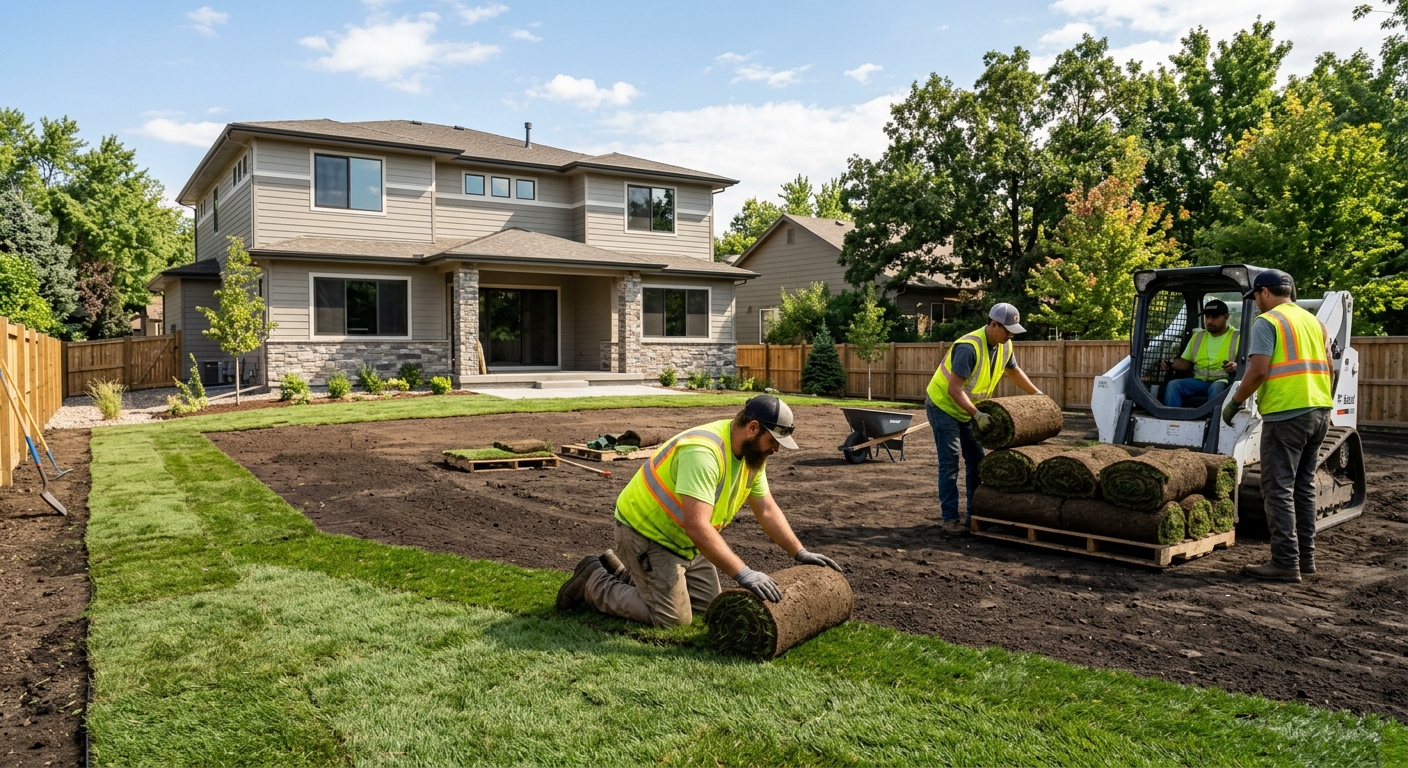
If you’re comparing options, it helps to anchor to realistic price bands. For example, a complete landscape design and installation can range from $5,000–$50,000, while sod installation often lands in the $2,000–$8,000 bracket depending on yard size and access. Next, use the table below to sanity-check your quotes before you book site visits.
| Service |
Description |
Season |
Price Range |
| Full landscape design and installation |
Consultation, design plan, grading/drainage coordination, planting beds, lawn/seed or sod, edging, and labour for full build |
Mar–Nov (peak May–Sep) |
$5,000–$50,000 |
| Sod installation (supply, grade, lay, roll) |
Soil prep, grading, weed control, sod delivery and installation, rolling, light topdressing as needed |
Mar–Nov |
$2,000–$8,000 |
| Lawn seeding (grade, seed, starter fertilizer) |
Topsoil/topdressing, raking, seeding, starter fertilizer, light cultipacking, initial watering guidance |
Apr–Jun and early Sep–Oct |
$1,200–$5,500 |
| Interlocking patio or walkway |
Excavation, compacted base, geotextile, interlocking pavers, sand setting bed, edging |
Mar–Nov |
$6,000–$40,000 |
| Retaining wall (interlocking block) |
Block wall layout, excavation, proper drainage/gravel behind wall, compaction, step-outs/caps if needed |
Apr–Nov |
$10,000–$80,000 |
| Tree and shrub planting |
Soil improvement, planting layout, staking as needed, watering plan, and mulching |
Apr–Jun and Sep–Oct |
$1,000–$15,000 |
Prices are estimates only and vary by project scope, site access and material selection.
What affects the price of landscaping in Seafair
The same landscaping job can vary by 30–50% across the Lower Mainland–Southwest and other parts of British Columbia because labour rates, site conditions, and material sourcing differ—then contractors price in risk (mud seasons, drainage complexity, and how much labour is required to avoid rework). In Seafair specifically, zone 7–8 conditions mean you can grow a wider range of broadleaf evergreens and long-blooming perennials, but you still pay attention to drainage because heavy rain can saturate soils for weeks.
Frost dates matter too. Coastal BC typically gets last spring frost from early March to early April and first fall frost around November, which supports a longer working and growing season than Prairie regions. That said, structural work still must account for freeze–thaw cycles: deeper bases, better compaction, and subdrainage details prevent frost heave and future settlement. Retaining walls often fall into the $10,000–$80,000 band when a contractor has to excavate below frost-influenced soils and install proper drainage behind the wall.
Two concrete examples from Seafair: (1) a sloped yard where we need grading correction and drainage re-route can add significant labour and equipment days, even if the visible planting area looks small; (2) choosing mature specimen trees increases cost because the root ball size, equipment time, and staking/watering setup rise quickly. If your home’s exterior is on older fill or compacted soil from past construction, soil amendment and topsoil may be required to support plant establishment—shifting a design from “pretty beds” into a full build.
Finally, irrigation design affects both upfront cost and long-term success. Drip with a smart controller often costs more than a basic timer, but it reduces the risk of waste and helps you tolerate occasional municipal water restrictions without losing lawn or bed performance. When you’re comparing quotes for a complete installation within the $5,000–$50,000 range, make sure each one matches drainage and irrigation expectations—not just plant lists.
| Price Factor |
Why It Matters |
Cost Impact |
| Yard size in sq ft — the primary cost driver for softscape |
More area means more topsoil, grading, seed/sod/plant quantities, and labour hours |
Higher square footage commonly increases total cost by 10–40% or more |
| Grading and drainage work — slope corrections add significant cost |
Pooling and foundation moisture drive excavation and re-compaction requirements |
Can add 20–60% depending on how far drainage must be re-routed |
| Drainage bed or French drain installation |
Subsurface drainage needs correct depth, gravel, and outlet connection |
Often increases hard/softscape budgets by thousands on affected yards |
| Plant material tier — native shrubs vs. ornamental vs. mature specimen trees |
Specimens cost more and require larger root balls and equipment |
Planting-only budgets may swing by 15–50% based on sizing |
| Hardscape vs. softscape ratio — walls and patios cost more per sq ft than lawn |
Pavers, base materials, and compaction are labour- and material-intensive |
Shifting 200 sq ft from lawn to patio can add several thousand dollars |
| Irrigation system design and installation |
Drip layout, zones, backflow prevention, and controller programming affect design |
May add 5–20% to the landscape total, but protects plants/lawn |
| Soil amendment and topsoil required |
Rock, clay, or compacted subgrade reduces rooting without proper improvement |
Can add material and disposal costs that aren’t obvious at estimate time |
| Tree removal or stump grinding before new planting |
Equipment time, haul-away, and disposal increase labour and schedule impacts |
Commonly adds a noticeable fixed cost before planting begins |
Permits & regulations in British Columbia
In British Columbia, most everyday landscaping tasks—like planting, sodding, and typical softscape work—usually don’t require a permit. The parts that commonly do require approvals are the “structural” elements and significant drainage/grade changes. For example, retaining walls above a municipal height threshold (often around 1.0 m, or 3.3 ft, in many areas) typically require a building permit and, in some cases, engineered drawings. Changes to lot grading that redirect drainage toward neighbouring properties or toward storm sewer connections can also trigger permit/approval requirements because drainage impacts can affect both runoff and foundation moisture. If your site needs a new downspout tie-in, regrading for slope stability, or a drain outlet change, get clarity before work starts.
Before any digging (plant holes, tree pits, or wall footings), confirm utility locates. Even a “small” planting project can hit underground services, and locates reduce the chance of costly delays or repairs.
To verify contractor credentials in Seafair/BC, do this step-by-step: (1) Ask for their trade licence details (if applicable for the scope) and confirm it through the online registry or the contractor’s posted certification information; (2) request a current certificate of insurance showing liability coverage and the effective dates—your best practice is to ensure you are named as an additional insured if your agreement requires it; (3) verify workers’ compensation coverage (WSIB/WCB coverage as applicable for the province) by requesting a clearance letter or proof of coverage. Finally, confirm the contractor’s understanding of local drainage expectations so your project doesn’t create water problems for adjoining properties.
Planning a landscape that thrives in Seafair's climate
Planning for Seafair means working with zone 7–8 plants and the Lower Mainland–Southwest’s wet, mild winters and cool summers—not fighting them. Start with plant selection: lean toward native and zone-appropriate species that handle seasonal rainfall and mild cold without constant protection. Then choose between sod and seed based on your timeline and budget. Sod gives instant visual coverage, but it costs about 3–4 times as much per square foot as seeding because you’re paying for harvested turf, delivery, and installation labour; it also still needs consistent early watering until roots knit into the soil.
Drainage and grading are the biggest success factors here. In the Lower Mainland–Southwest, pooling can happen even on “flat” yards after long rain. Correct grading and adding a drainage layer or French drain where needed helps prevent foundation moisture and reduces the risk of turf failure. For hardscape like patios and retaining walls, base preparation matters: excavation depth, geotextile, compacted base, and subdrainage should respect local freeze–thaw impacts. Even though coastal BC doesn’t freeze solid for months, frost movement and settlement problems still show up when bases are too shallow or compaction is inconsistent.
For low-maintenance design, use groundcovers, layered mulched beds, and long-blooming perennials to reduce weeding and mowing. Consider rain-garden pockets and xeriscape-style plantings in appropriate areas: keep more moisture-tolerant plants near downspouts and transitions, and place drought-tolerant varieties in zones that get less frequent irrigation. As a dollar example: if you have a small front lawn area and want it filled quickly, paying for sod can be justified—but for a budget-focused refresh, seeding is often the better value if you can tolerate waiting a season for full density. Many homeowners pair seeded turf with a well-designed mulched shrub border so the “instant payoff” goes where it matters most.
| Element |
Climate Consideration |
Maintenance Level |
Price Band |
| Sod lawn installation |
Needs early root establishment through wet-to-cool transitions; good grading prevents soft spots |
Low after establishment; higher watering/monitoring first 2–6 weeks |
$2,000–$8,000 |
| Native perennial garden |
Handles Pacific moisture patterns well; reduces winter losses with zone-appropriate species |
Low to moderate (mulch top-ups, light pruning) |
$3,000–$12,000 |
| Mulched shrub border |
Mulch insulates roots from temperature swings and helps soil stay evenly moist |
Low (weed barrier optional; seasonal mulch refresh) |
$2,500–$10,000 |
| Interlocking stone patio |
Base and drainage prevent movement during freeze–thaw cycles and winter runoff |
Low (occasional joint sand top-up, weed control) |
$6,000–$40,000 |
| Retaining wall (block) |
Proper compaction and drainage behind the wall protect against heave and settlement |
Low after build; periodic inspections for drainage outlet function |
$10,000–$80,000 |
| Drip irrigation system |
Efficient watering helps manage costs and supports planting through occasional restrictions |
Low (controller checks; seasonal maintenance) |
$1,500–$7,500 |
How to choose a landscaping contractor in Seafair
Choosing the right landscaping contractor in Seafair is less about flashy photos and more about proof: credentials, job clarity, and workmanship controls. Start by verifying British Columbia coverage and compliance for your project scope. Ask for their liability insurance certificate (confirm active dates and coverage limits). For workers’ compensation, request proof/clearance of coverage so you’re not exposed if an injury happens on your property. If your contractor also does trades that require specific certification for the work they’re performing, ask for the relevant trade licence information and confirm details via the appropriate online registry or credential documents they provide.
Next, get 2–3 itemised written quotes. You want labour and materials broken out (excavation, base materials, drainage components, plants, sod/seed, disposal), not a single lump sum. Review what’s excluded: disposal of excess soil, removal of existing lawn, permit pulling (if required for retaining walls above the local threshold), and whether irrigation is included or “by others.” Ask how they’ll protect landscaping during the rainy season and how they’ll handle muddy access days.
Warranty matters: request a workmanship warranty period and understand whether product warranties transfer to you for plants or materials. Confirm the payment schedule—never pay more than 10–15% upfront. Hold back a portion until key milestones are complete (final grade, inspection-ready drainage, and successful establishment periods where applicable). Finally, get a start date and completion estimate in writing, including weather contingency wording.
- Request proof of liability insurance with effective dates and coverage limits
- Verify workers’ compensation coverage with a clearance letter/proof
- Ask whether a permit is required for your retaining wall height and who pulls it
- Confirm utility locates are arranged before digging
- Get quotes with line items: labour, materials, base/drainage components, and disposal
- Require exact scope language for grading, drainage outlets, and downspout tie-ins
- Ask who supplies topsoil/topdressing and what quality/spec is used
- Confirm plant sizes (e.g., 2-gallon/5-gallon/height) and substitutions policy
- Check sod/seed type and whether seed rates match your sun/shade conditions
- Ask about compaction method and base thickness for patios/walkways
- Set a milestone-based payment plan (limit upfront; hold back until completion)
- Review warranty terms in writing: workmanship duration and what’s covered
Red flags in Seafair: a quote that doesn’t mention drainage/grading details for a wet yard, refusing to provide insurance/workers’ compensation proof, offering a “flat” price with no scope exclusions (especially disposal and permit handling), starting without a written schedule or clear start date, and pressuring you for large upfront payments (beyond about 10–15%).
Frequently asked questions — landscaping in Seafair
When should I aerate and overseed my lawn in Seafair?
In Seafair (Lower Mainland–Southwest), the sweet spot for aerating and overseeding is usually spring or early fall. For spring, plan around the period after the last spring frosts (often early March to early April near the coast) so the soil warms but before peak summer heat stresses young seedlings. For fall, aim for early September into early October—this aligns well with the longer growing season before first fall frost, which often doesn’t arrive until November. If your lawn is patchy, use aeration plus overseeding rather than relying on seeding alone.
Cost-wise, small overseeding jobs can be part of lawn renovation within the broader lawn budgets, and seeding projects often fall in the $1,200–$5,500 range depending on yard size and prep. A good contractor will specify seed type for your sun/shade and whether they’re applying starter fertilizer and light topdressing after seeding.
What trees grow best in Seafair's climate zone?
Seafair sits in the Lower Mainland–Southwest’s zone 7–8 conditions, so you can support a wide variety of hardy, lush trees with less winter burn risk than colder regions. In practice, many homeowners do well with broadleaf evergreens and mid-canopy shade trees that tolerate coastal moisture. Common picks we often see successful include ornamental crabapples for spring colour, Japanese maple varieties for layered curb appeal (site-specific), and larger shade trees like maples where space allows.
Site matters more than people expect: drainage, sun exposure, and how close roots are to downspouts or foundation footing will influence which trees thrive. If you’re planting multiple trees, many projects land in the $1,000–$15,000 band for tree and shrub planting, but mature specimens can push toward the higher end because of equipment and larger root balls. A good planting plan also accounts for staking and a watering rhythm for the first growing season.
How much does sodding a yard cost in Seafair?
Sodding costs in Seafair usually depend on yard size, soil prep, grading complexity, and access for delivery. For many typical residential projects, sod installation falls into the $2,000–$8,000 range, but the final number changes quickly if you need significant topsoil import, drainage corrections, or if the lawn area is irregular. Coastal BC’s wet seasons also mean timing matters: crews may avoid the wettest weeks to reduce soil disturbance and uneven settling.
If you’re deciding between sod and seeding, remember that sod is about speed and consistency—instant coverage—while seeding is value-focused but takes longer to densify. If you want a fast front-yard refresh after winter, sod can be worth it. If budget is the priority and you can wait for full coverage, seeding is often more economical within the $1,200–$5,500 lawn renovation range.
How do I prevent weeds in my Seafair garden?
Weed prevention starts before plants go in. In Seafair, where winter moisture can encourage growth, we focus on layered bed preparation: remove existing weed roots, loosen compacted soil, and then control weed germination with clean mulch depth and appropriate edging. A mulched shrub border is one of the most effective low-maintenance approaches because mulch blocks light, moderates soil temperature, and helps maintain even moisture—important in the Lower Mainland–Southwest’s cycles.
For established gardens, regular “edge trimming” along lawn-to-bed lines prevents creeping weeds from spreading. Don’t skimp on plant spacing: overcrowded plants create bare soil pockets, and bare soil becomes a weed invitation. Many Seafair homeowners invest in borders and bed builds that fit within $2,500–$10,000 depending on plant quantities and soil amendment. A contractor who includes proper topsoil/topdressing and a mulch plan will typically save you repeated labour later.
How do I design a low-water yard in Seafair?
Low-water doesn’t have to mean “no colour.” In Seafair and the Lower Mainland–Southwest, you design for efficiency: match plants to where water naturally lands, then reduce watering losses. Group plants by watering needs—moisture-tolerant species near downspouts or rain-garden areas, and drought-tolerant selections in sunnier or wind-exposed zones. Add a thick, maintained mulch layer to reduce evaporation and improve soil moisture retention during dry spells.
Even with generally milder conditions, water efficiency is valuable because municipal rules can tighten during drought in BC (and many homeowners want designs that tolerate restrictions without lawn die-off). A drip irrigation system with smart controls can help target water to roots rather than the whole lawn. Budget-wise, drip systems commonly land in the $1,500–$7,500 range depending on zones and complexity. Pair drip with groundcovers and long-blooming perennials so you’re not relying on frequent lawn irrigation for curb appeal.
How do I find a licensed landscaper in Seafair?
To find a qualified landscaper in Seafair (British Columbia), begin by requesting documentation and checking it yourself. Ask for their liability insurance certificate (confirm the effective dates) and proof of workers’ compensation coverage (a clearance letter or proof of coverage). For licensing, the right credential depends on the exact scope—softscape work often doesn’t require the same permits as structural work—but you should still ask whether the contractor is properly registered for their roles. A reputable contractor will provide clear, easy-to-read paperwork.
Then compare 2–3 itemised written quotes with labour and materials breakdowns. Make sure they address drainage/grading, topsoil quality, and whether permits are needed for features like retaining walls above the local threshold (often around 1.0 m). If the quote includes lawn work, it should be clear whether you’re comparing sod (commonly $2,000–$8,000) versus seeding (often $1,200–$5,500) and what’s included for prep and disposal.