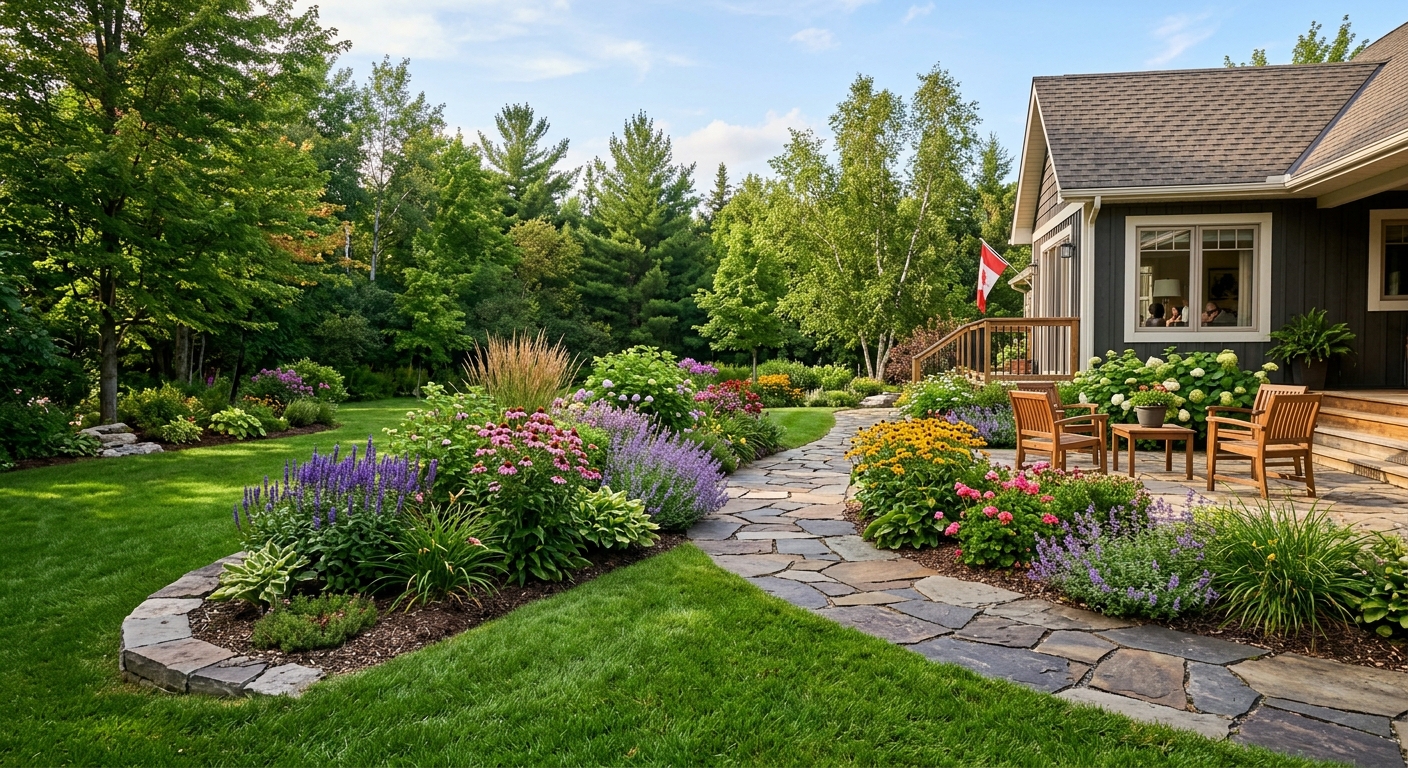
Landscaping options and costs in Denman Island Trust Area
In Denman Island Trust Area, homeowners typically fund landscaping improvements because yards add everyday comfort and value to the home—especially when there’s enough room to create layered planting beds and usable outdoor spaces. With a population of 1,165 (Statistics Canada, 2021 Census), the local contractor pool is smaller than major coastal cities, so demand can tighten during the spring build window. Property mix matters too: in many coastal neighbourhoods across the Lower Mainland–Southwest, single-detached homes are common, and that extra yard space encourages upgrades like patios, hedging, and full front-yard refreshes rather than minimal “patch and seed” jobs. (Statistics Canada, 2021 Census) The Lower Mainland–Southwest climate (plant hardiness zones 7–8) also plays a direct role in cost: mild, wet winters and cool, long summers extend the working and growing season, which often helps teams schedule more efficiently than in colder regions. At the same time, wet ground limits work in the rainiest stretches, and structural items—like patios, walkways, and retaining walls—must still be built to handle freeze–thaw cycles with proper drainage and compaction.
For many Denman Island homeowners, the most in-demand work is in the Denman Island village and nearby residential corridors where front-yard curb appeal and easy access paths matter. If your property has slope, drainage concerns, or older landscaping that’s been holding moisture, expect more labour for grading, drainage, and soil prep. Next, use the comparison table to align your expectations across common service types and budget ranges, from fast-impact lawn installs to complete design-and-build packages.
| Service |
Description |
Season |
Price Range |
| Full landscape design and installation |
Site walk, concept + layout, planting plan, grading notes, hardscape/softscape coordination, delivery, labour, and cleanup |
Mar to Nov (light work possible earlier/later when conditions allow) |
$5,000–$50,000 |
| Sod installation (supply, grade, lay, roll) |
Removal of existing turf (if needed), finish grading, soil/turf base prep, supply, lay, roll, starter fertilizer, and establishment watering guidance |
Apr to Oct (best results in cool shoulder months) |
$2,000–$8,000 |
| Lawn seeding (grade, seed, starter fertilizer) |
Light grading/raking, compost/topdressing, seed blend selection for coastal conditions, starter fertilizer, and protective mulching where appropriate |
Mar to Sep |
$800–$3,200 |
| Interlocking patio or walkway |
Excavation to depth, base (crushed rock), compacted sub-base, edge restraints, pavers, joints, and basic drainage tie-in where needed |
Apr to Oct (install timing depends on wet-weather windows) |
$10,000–$35,000 |
| Retaining wall (interlocking block) |
Layout, excavation, compacted base and drainage rock, geotextile, block installation, cap/steps if specified |
Apr to Oct |
$12,000–$60,000 |
| Tree and shrub planting |
Soil amendment, planting holes, staking/tying where needed, mulch rings, initial watering plan, and replacement guarantee terms |
Mar to Nov |
$1,000–$15,000 |
Prices are estimates only and vary by project scope, site access and material selection.
What affects the price of landscaping in Denman Island Trust Area
In Denman Island Trust Area, two quotes for the “same” landscaping job can easily differ by 30–50% across the Lower Mainland–Southwest and the wider coastal-to-interior mix because the drivers aren’t just materials—they’re labour productivity, site prep complexity, and how far contractors must go to deliver reliable long-term performance. In plant hardiness zones 7–8, design palettes can be lush and layered, but rain-soaked soil and drainage requirements still dictate how long a crew can work each week. By contrast, Prairie regions (Zone 2–4) typically face short growing seasons and wind-dry conditions, so clients often budget differently for drought-tolerant planting and faster, simplified installs. In coastal BC, the long growing season supports fuller planting plans, yet contractors still have to engineer drainage and compaction because foundation-adjacent water can become expensive. Water restrictions in the dry BC interior (and in Alberta) push irrigation designs toward efficiency; Southern Ontario often has a moderate season but still needs irrigation planning during summer dry spells.
Here are concrete examples that raise or lower cost on Denman Island. First, if your site has slope or persistent sogginess, grading and drainage work becomes a “structural” component—adding truckloads of base and changing the excavation footprint can move a walkway or retaining wall project into higher bands. Second, plant choices drive ongoing maintenance: going from smaller native shrubs to ornamental varieties or mature specimen trees changes both the labour time and material cost—pushing tree-and-garden budgets toward the upper end of the $1,000–$15,000 band. Third, soil prep and topsoil amendment can matter more than people expect in coastal rain: a thin base under sod can lead to patching, so contractors may price additional compost and base correction. For reference, a full design-and-install package often sits somewhere in the $5,000–$50,000 range, but projects that stay “softscape only” (no heavy structural excavation) can come in far lower.
| Price Factor |
Why It Matters |
Cost Impact |
| Yard size in sq ft — the primary cost driver for softscape |
More area means more material, more labour hours, and more time for prep and establishment |
Typically increases costs in near-linear steps; doubling area can add 70–110% depending on access and soil condition |
| Grading and drainage work — slope corrections add significant cost |
Lowering pooling, redirecting runoff, and creating stable grades affects excavation depth and hauling |
Commonly adds 15–40% to softscape and can add 10–25% to hardscape depending on how much base must be rebuilt |
| Drainage bed or French drain installation |
Coastal BC rainfall makes subsurface water management essential near foundations and down-slope yards |
Often a major variable; can add 20–60% to projects where water paths weren’t already handled |
| Plant material tier — native shrubs vs. ornamental vs. mature specimen trees |
Larger caliper and premium nursery stock cost more and take longer to plant and stabilize |
Can swing a planting scope by 25–80% even at similar bed sizes |
| Hardscape vs. softscape ratio — walls and patios cost more per sq ft than lawn |
Stone and block require excavation to depth, base layers, compaction, and edged restraints |
Shifts the job quickly into the retaining-wall/hardscape bands rather than the lawn bands |
| Irrigation system design and installation |
Drip, rotor placement, and controller programming improve survival in wet summers and help manage future water costs |
May add 10–30% for basic zones; more for smart controllers and larger coverage |
| Soil amendment and topsoil required |
Heavy rain can compact subgrades; good amendment improves rooting and reduces washouts |
Often adds 5–20% but can prevent expensive rework after establishment |
| Tree removal or stump grinding before new planting |
Extra equipment, disposal, and labour time affect schedule and site readiness |
Can add 10–50% depending on access, stump size, and debris hauling needs |
Permits & regulations in British Columbia
In British Columbia, planting, sodding, and most softscape work typically do not require a permit—so a new shrub border, mulch refresh, or lawn installation is generally straightforward from a approvals standpoint. The main exception homeowners run into is retaining walls above the local threshold height (commonly around 1.0 m in many municipalities). When a wall is high enough, it may require a building permit and, in some cases, engineered drawings to ensure stability. Another frequent approval trigger is changing lot grading or drainage patterns—especially if runoff will be redirected toward neighbouring properties or toward storm sewer connections.
For Denman Island Trust Area projects, start with this practical checklist: (1) confirm whether your retaining wall height triggers a building permit; (2) if you’re regrading, ask your contractor to document how drainage will be handled (swales, drains, and discharge points); and (3) before digging, ensure utility locates are completed so you don’t hit buried services. Also, even though Denman Island isn’t subject to the same strict summer watering bans seen in drier parts of BC Interior and Alberta, it’s still smart to follow BC water-use expectations and municipal rules—especially if you’re installing irrigation.
To verify a contractor in British Columbia, ask for three things and check them: (1) licence/registration information from the appropriate online registry; (2) a current certificate of insurance (general liability) showing coverage limits; and (3) proof of workers’ compensation coverage (WCB/clearance letter or equivalent documentation). Don’t rely on verbal confirmation—request the documents before work starts and ensure the named company matches the quote.
Planning a landscape that thrives in Denman Island Trust Area's climate
Planning for Denman Island Trust Area means designing with the realities of zones 7–8: wet winters, long cool seasons, and frost that arrives later in the year than in most of Canada. Start with plant selection. Choose zone-appropriate natives and coastal-tough perennials that establish reliably with less winter protection and less “rescue watering.” In practice, that reduces both your labour and your annual replanting risk after stormy wet periods. Next, decide between sod and seed. Sod delivers instant coverage and strong visual impact, but it costs about 3–4 times per sq ft compared with seeding because you’re paying for pre-grown turf plus faster labour to install and roll. If you have to look “complete” for an event or you’re reducing mud tracking quickly, sod can be worth it.
Drainage and grading are critical on Lower Mainland–Southwest sites. Even with mild temperatures, pooling can damage foundations, rot edges, and create patchy lawn. Make sure downspouts, swales, and soil levels are aligned so water moves away from structures. For hardscape like patios and walkways, base preparation must be done for local freeze–thaw conditions: proper depth, compacted crushed rock, and edge restraints keep pavers stable through seasonal movement.
For low-maintenance design, blend groundcovers, mulch, and long-blooming perennials. Consider rain-garden corners or a xeriscape-inspired section using drought-tolerant plants where you have access to efficient irrigation. Example: if a 300 sq ft lawn area costs about $2,000–$8,000 for sod at the installed end, seeding might come in closer to the lower hundreds-to-low-thousands—so seeding is often the better choice for “back-of-yard” areas that don’t need instant curb appeal.
| Element |
Climate Consideration |
Maintenance Level |
Price Band |
| Sod lawn installation |
Zones 7–8 support fast establishment, but wet soils mean timing matters to prevent slippage and uneven rooting |
Low short-term weekly watering until established; moderate mowing afterwards |
$2,000–$8,000 |
| Native perennial garden |
Long growing season supports layered, repeat-bloom planting and improved resilience in coastal moisture |
Low after year one (weeding and mulching mainly) |
$3,000–$12,000 |
| Mulched shrub border |
Mulch helps regulate soil moisture through cool wet winters and reduce weed pressure in spring |
Low to moderate (occasional topping up and light pruning) |
$2,000–$9,000 |
| Interlocking stone patio |
Drainage and base compaction protect against seasonal movement from coastal freeze–thaw cycles |
Low (sweep joints, occasional weed control in edges) |
$10,000–$35,000 |
| Retaining wall (block) |
Stable base depth and drainage rock are crucial on sloped coastal lots where water can migrate |
Low (inspection and keeping weep/drainage clear) |
$12,000–$60,000 |
| Drip irrigation system |
Efficient irrigation supports water-smart planting and reduces runoff during heavy rainfall windows |
Moderate (seasonal checks and winterization if needed) |
$1,500–$6,500 |
How to choose a landscaping contractor in Denman Island Trust Area
Choosing the right landscaping contractor in Denman Island Trust Area comes down to verifying credentials, insisting on itemised paperwork, and making sure the scope matches your expectations. In British Columbia, verify business standing and coverage up front: ask for proof of liability insurance (certificate of insurance), confirm workers’ compensation coverage (WCB clearance/coverage documentation), and check the relevant provincial licensing/registration details through the appropriate online registry. Also ask for a contactable reference list for similar hardscape-and-drainage work—because drainage failures usually show up later and become expensive to fix.
Get 2–3 quotes in writing and insist they’re itemised. Look for a labour + materials breakdown (not just a single lump sum), with clear lines for excavation, base materials, disposal, soil amendments, plant sizes, and irrigation (if included). Read the exclusions: is disposal of existing turf and debris included? Is permit pulling included where required (for example, for retaining walls above the local height threshold)? Does the quote include edge restraints, geotextile, and proper drainage rock? These details are often where “cheap” quotes diverge.
Warranty matters. Ask for workmanship warranty length and whether product/manufacturer warranties apply to specific plants or pavers, and whether warranties are transferable to you as the homeowner. For payment, don’t pay more than 10–15% upfront; hold back the final payment until the job is complete and cleaned. Finally, require a start date and realistic completion estimate in writing, accounting for wet-weather delays typical of the Lower Mainland–Southwest.
- Ask for and review their BC insurance certificate (liability) before work begins.
- Confirm workers’ compensation coverage and request the clearance/coverage letter documentation.
- Check the contractor’s registration/licence details via the appropriate online registry.
- Require itemised quotes (labour, materials, equipment, disposal, and taxes where applicable).
- Clarify what’s included for grading, topsoil depth, and soil amendment.
- Confirm drainage methods (French drain, daylighting, outlet protection) and where water will go.
- For patios/walkways, verify base build-up, compaction steps, and edge restraints.
- For retaining walls, ask about drainage rock, geotextile, weep holes, and cap options.
- Ensure irrigation design includes controller type and coverage map/zone explanation (if included).
- Ask for a planting list with plant sizes (e.g., caliper height/spread) and spacing assumptions.
- Get warranty terms in writing for workmanship and any plant/product guarantees.
- Use a payment schedule with a holdback until punch-list items are complete.
Red flags to watch for in Denman Island Trust Area: (1) quotes that won’t specify quantities (sq ft of base, depth of topsoil, number of plants, or drain footage); (2) payment requests exceeding 10–15% upfront without a written plan; (3) no proof of insurance or workers’ compensation coverage; (4) “we’ll handle permits” with no mention of what’s actually required for your wall height or grading changes; and (5) vague timelines that don’t account for wet-weather delays common on the island and surrounding coastal zones.
Frequently asked questions — landscaping in Denman Island Trust Area
How much does sodding a yard cost in Denman Island Trust Area?
Sodding in Denman Island Trust Area commonly lands in the $2,000–$8,000 range, depending on how many square feet you’re covering and how much prep is required. Contractors typically charge more when the existing lawn needs removal, significant grading corrections, or extra soil amendment to prevent uneven settling. Timing also matters: installing sod when soils are overly saturated can increase the risk of slips and patching. If you only need a small section (a front walk edge or repair band), costs can be lower, but if you’re replacing an entire lawn and addressing drainage, expect the project to push toward the upper part of the band. Ask your contractor to break down sod price, base/topsoil quantities, and labour for grading and rolling.
How do I prevent weeds in my Denman Island Trust Area garden?
Weed prevention works best when you address conditions before planting. In Denman Island Trust Area, the coastal moisture cycle means weeds often germinate fast in exposed, compacted soil—so start with good site prep: loosen and remove existing roots where practical, then add compost and properly finish-grade beds. Use 2–3 inches of mulch on shrub and perennial areas (not against plant crowns), and choose competitive plants for the site (native perennial mixes and groundcovers suited to zones 7–8). If you’re doing lawn conversions to beds, consider fabric only where appropriate and keep drainage in mind—fabric without drainage prep can trap water. Finally, schedule the first spring weeding pass and spot checks. This is often cheaper than trying to “spray and hope” after weeds are established.
How do I design a low-water yard in Denman Island Trust Area?
A low-water yard in British Columbia isn’t about eliminating water entirely—it’s about reducing waste and targeting irrigation where plants need it. In the Denman Island Trust Area, focus on zone-appropriate natives and perennials that can handle cool, wet winters, then use efficient irrigation such as drip rather than sprinklers. Pair that with smart design: group plants by water needs, avoid turf in awkward slopes, and add mulch to cut evaporation. You can also create rain-garden pockets or swales to absorb stormwater during heavy coastal rainfall and keep moisture where it helps. If you’re comparing budgets, note that sod can be $2,000–$8,000 for a lawn install, while a seed-based lawn or more bed area can reduce ongoing irrigation demand. Ask contractors for an irrigation zone plan and a controller that supports seasonal adjustments.
How do I find a licensed landscaper in Denman Island Trust Area?
In Denman Island Trust Area and across British Columbia, start by asking the contractor for documentation before you sign anything. Request a certificate of general liability insurance, and confirm workers’ compensation coverage (WCB clearance/coverage letter or equivalent). For licensing/registration, verify through the appropriate online registry for the trade/contracting category they claim—don’t rely on a brochure. Then compare quotes that list labour and materials separately so you can see what you’re actually buying. If you’re considering retaining walls or grading changes, ask what permits apply and whether they’ll help you navigate approval steps. A reputable contractor will answer clearly, provide written scope, and won’t pressure you to pay large deposits early.
How much does landscaping cost in Denman Island Trust Area?
Landscaping cost varies by how much of the yard you’re changing and whether you’re doing softscape only or mixing in structural elements. For Denman Island Trust Area, full design and installation commonly falls within the $5,000–$50,000 range depending on the scope—grading, drainage, patio/walkway, retaining wall, and plant tiers. If you’re focusing on lawn work, sod installs often sit in the $2,000–$8,000 band, while planting-only projects are typically within the $1,000–$15,000 range for tree and shrub work. Hardscape and retaining walls have wider variation because base depth, compaction, drainage rock, and excavation drive labour and material use. The best way to land accurately is to compare itemised quotes that show quantities (sq ft and linear feet), not just total numbers.
What plants thrive in Denman Island Trust Area's climate zone?
Denman Island Trust Area sits in coastal conditions suitable for plant hardiness zones 7–8, so you can generally grow broadleaf evergreens, long-blooming perennials, and many moisture-tolerant shrubs with reliable success—provided the site has proper drainage. Look for zone-appropriate native options and coastal performers suited to cool, wet winters and long growing seasons. A well-designed planting mix often combines evergreens for structure, perennials for seasonal colour, and groundcovers to reduce weed pressure. If your yard stays soggy, choose moisture-tolerant species and ensure grading directs water away from foundations. If you have drier or exposed spots, build those areas differently—mulch depth, soil amendment, and drip irrigation can make plants last through variability. Your contractor should propose a planting list with plant sizes and spacing so you can compare like-for-like.