Landscaping options and costs in Marlborough
Marlborough is a growing community on the Lower Mainland–Southwest side of British Columbia, and that matters for landscaping pricing because contractors can schedule projects around a long, cool growing season. With a population of 14,169 (Statistics Canada, 2021 Census), demand is steady for curb appeal refreshes—especially in neighbourhood pockets like the newer residential stretches near local arterial routes where homeowners want visible results fast. Also, Marlborough-area households increasingly invest in upgrades because detached and larger-lot properties typically have more usable yard space, so clients are more willing to budget for layered planting beds, edging, and functional hardscape.
In this region, plant hardiness zones 7–8 and mild, wet winters reduce winter-kill risk for broadleaf evergreens and long-blooming perennials. That lets designs look “full” sooner and supports more ambitious planting palettes than in drier or colder provinces. Labour availability can be a cost factor too: during spring and early fall, schedules tighten, and the same scope can price higher simply due to demand. Structural work like patios and retaining walls also carries Lower Mainland–Southwest-specific costs because freeze–thaw cycles drive the need for proper excavation, deeper bases, and drainage/compaction to prevent frost heave and wall movement on sloped lots.
Below is a practical price comparison for common Marlborough projects, so you can line up bids and spot when a contractor is proposing a more expensive (or more efficient) approach.
| Service |
Description |
Season |
Price Range |
| Full landscape design and installation |
Site visit, layout, planting plan, grading/drainage concept, material selection, then full buildout (softscape + hardscape where included) |
Year-round (peak spring/fall) |
$12,000–$45,000 |
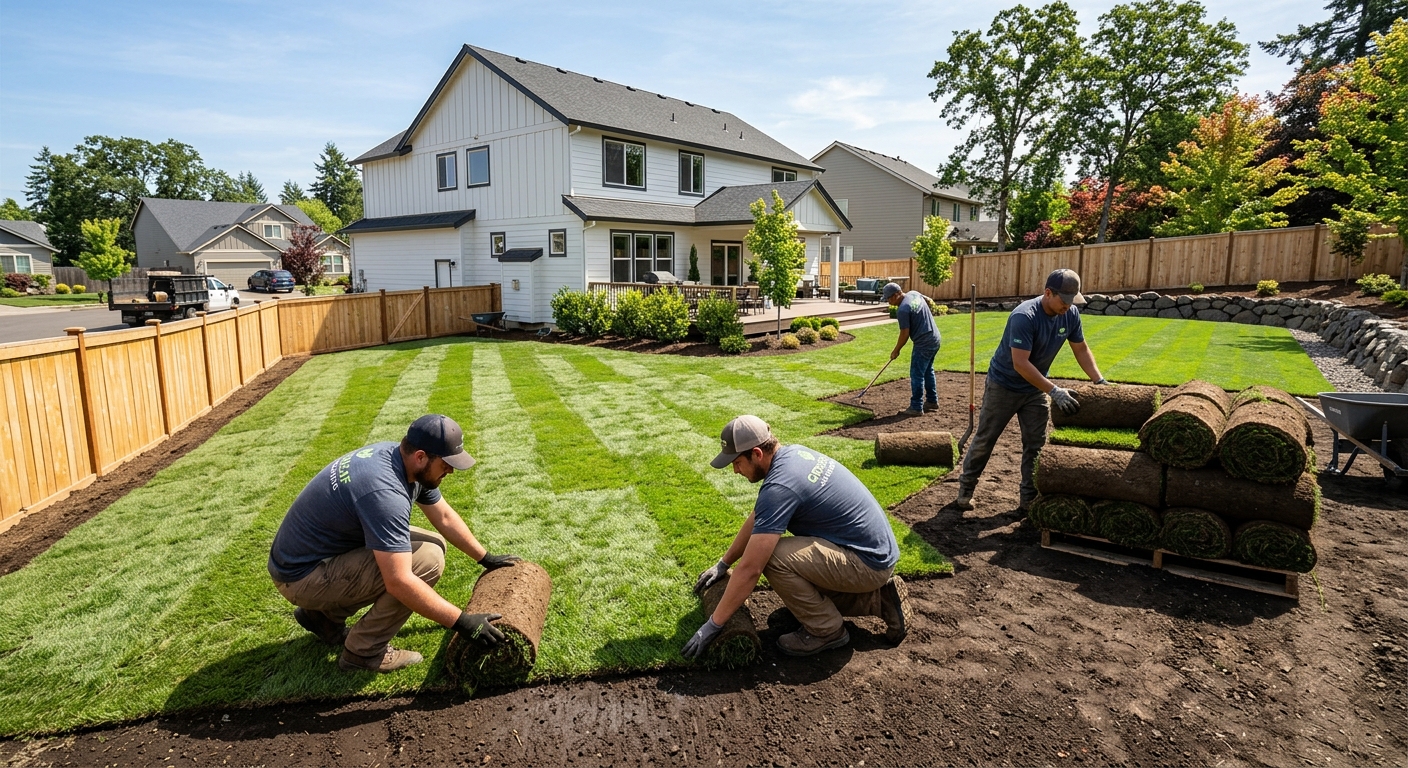
| Sod installation (supply, grade, lay, roll) |
Minor grading, topsoil placement (as needed), sod supply, prep, lay, roll, and initial watering guidance |
Late spring to early fall |
$3,500–$8,000 |
| Lawn seeding (grade, seed, starter fertilizer) |
Light grading, seed + starter fertilizer, raking/rolling, and establishment care |
Spring or early fall |
$2,000–$4,500 |
| Interlocking patio or walkway |
Excavation, base compaction, edging, interlocking stones/blocks, and finishing around borders |
Spring to fall (wet-weather planning in winter blocks) |
$12,000–$38,000 |
| Retaining wall (interlocking block) |
Excavate and compact base, wall block system, drainage gravel/weep considerations, backfill, and finishing |
Spring to fall |
$18,000–$60,000 |
| Tree and shrub planting |
Soil prep, amended backfill, staking as needed, planting layout, and initial mulch ring |
Spring to early fall |
$2,000–$12,000 |
Prices are estimates only and vary by project scope, site access and material selection.
What affects the price of landscaping in Marlborough
The same landscaping job in Marlborough can vary by 30–50% across the Lower Mainland–Southwest versus other British Columbia areas because site conditions, scheduling pressure, and how contractors manage risk (drainage, excavation depth, and material availability) differ. In coastal BC (typical zones 7–8), you can build layered, lush gardens with a longer working window because the ground rarely stays frozen for extended periods; this generally supports more plant variety, which can increase material choices. In contrast, Prairie regions with zone 2–4 conditions rely on drought-tolerant, wind-hardy species and shorter frost-free windows that can compress schedules and labour logistics; retaining wall bases still must reach below the frost line, which can elevate structural costs.
For Marlborough specifically, two dates drive cost planning: last spring frost in early March to early April near the coast, and the first fall frost often not until November. That means more work can happen outside the narrow window—yet wet weeks still slow excavation and compaction, particularly around grading and drainage. If your yard has standing water near a foundation, the contractor may need more earthwork and a drainage bed or French drain, pushing the project from the lower end of the $5,000–$50,000 design/install band toward the mid to upper range.
Concrete examples from local scopes: (1) Adding a 10–20 sq m swale correction or slope regrade usually increases labour and hauling, often moving softscape budgets upward; (2) switching from smaller nursery plants to a few mature specimen shrubs or a small ornamental tree can raise your tree and garden planting budget within the $1,000–$15,000 band quickly due to supply size and handling; (3) replacing a simple lawn renovation with an interlocking walkway or patio tends to cost more per square foot because base preparation and compaction are labour-intensive.
| Price Factor |
Why It Matters |
Cost Impact |
| Yard size in sq ft — the primary cost driver for softscape |
More area means more labour hours (prep, grading, planting) and more materials (soil, mulch, seed/sod) |
Often 20%–60% of total variation between quotes |
| Grading and drainage work — slope corrections add significant cost |
Lower Mainland–Southwest yards can pool if drainage is off; correcting slope requires extra excavation, backfill, and compaction |
Can add thousands depending on how far water needs to be redirected |
| Drainage bed or French drain installation |
Proper sub-surface drainage prevents foundation moisture and reduces long-term plant failures |
Common “surprise” item that can increase budgets substantially |
| Plant material tier — native shrubs vs. ornamental vs. mature specimen trees |
Larger caliper sizes and premium ornamentals cost more and require careful handling and staking |
Can shift planting costs from budget to premium quickly |
| Hardscape vs. softscape ratio — walls and patios cost more per sq ft than lawn |
Interlocking stones and retaining systems require excavation, base layers, and precise alignment |
Hardscapes often double or triple per-area cost vs lawn |
| Irrigation system design and installation |
Efficient irrigation (drip/smart controllers) protects plants and supports water-cost control |
Adds a material + labour line item that changes with complexity |
| Soil amendment and topsoil required |
Poor native soils need amendments for root establishment; in some sites, import is the only reliable fix |
Increases haul-off/import and material costs |
| Tree removal or stump grinding before new planting |
Removal affects root gaps, access, and disposal; stumps can block grading and planting bed lines |
Often significant and can affect schedule |
Permits & regulations in British Columbia
In British Columbia, most everyday landscape work—planting, sodding, and typical softscape installation—generally does not require a permit. Where permits come in is usually tied to retaining walls, substantial grading changes, and anything that may affect drainage pathways. For retaining walls, many municipalities require a building permit when the wall is above a common threshold of 1.0 m (3.3 ft), and some situations may also require engineered drawings depending on height, soil conditions, and the engineering approach. Also keep in mind: changes to lot grading that influence where water flows—especially if it redirects drainage toward neighbouring properties or storm sewer connections—can trigger approval requirements. Before any digging (plant holes, footer trenches, or wall footings), homeowners should ensure utility locates are called for to reduce hit-risk.
How you can verify contractor credentials in Marlborough, step-by-step:
- Licensing: check the contractor’s business details through the appropriate BC online registry listings (search their legal business name and any trades listed).
- Liability insurance: ask for a current certificate of insurance (COI) showing limits appropriate for landscape construction and that it names you as certificate holder if possible.
- Workers’ coverage (WSIB/WCB): request proof of workers’ compensation coverage; confirm it applies to the specific crew members doing excavation and hardscape work.
- Clearance letter (where applicable): if the contractor typically provides documentation for work sites, request what they provide and ensure it’s current.
- Verify before the first excavation: don’t wait until the job starts—document it in writing.
Finally, even though water restrictions are more strict in some drier parts of BC Interior and Alberta, BC homeowners should still confirm local irrigation and water-use bylaw expectations and design for efficiency (drip lines, smart timers), especially during hot, dry spells.
Planning a landscape that thrives in Marlborough's climate
Marlborough’s landscaping succeeds when you design around the Lower Mainland–Southwest reality: zone 7–8 planting options, mild/wet winters, and cool summers with frequent rain. Plant selection is the foundation. Choose native and zone-appropriate species—broadleaf evergreens, shade-tolerant groundcovers, and long-blooming perennials—that establish well without constant winter protection. That typically reduces labour spent on winter damage clean-up and replanting.
For lawn, decide between sod and seed based on your timeline and tolerance for establishment time. Sod gives instant results, but in this market it often costs about 3–4x more per sq ft than seeding once you account for supply and labour. If you can wait a season (and keep traffic off), seeding is often the better value. Where instant curb appeal matters—new curb frontage, staging before a sale—sod can be justified.
Drainage and grading are non-negotiable in the Lower Mainland–Southwest. Pooling near foundations leads to damp basements and root stress. We typically correct slopes so water sheds away from the home and toward a designed discharge point.
Hardscape needs base prep that respects freeze–thaw cycles. Even though coastal BC is milder, foundations and base layers still need proper compaction and depth to reduce frost heave and wall movement on sloped lots.
For low maintenance, combine mulch, groundcovers, and layered perennials. Consider a rain garden or xeriscape-style planting pockets—especially around downspouts—to manage water efficiently without turning the yard into a “dead” landscape. Example: if a 200 sq ft sod replacement is priced at the typical sod band (often roughly in the middle of the $3,500–$8,000 range depending on site prep), you can often achieve a larger area renovation by seeding and amending soil within the $2,000–$4,500 band—then invest the savings into improved drainage and a drip-ready bed layout.
| Element |
Climate Consideration |
Maintenance Level |
Price Band |
| Sod lawn installation |
Works best in late spring–early fall when soils are workable and establishment watering is manageable |
Low to moderate (monitoring first 2–4 weeks) |
$3,500–$8,000 |
| Native perennial garden |
Zone-appropriate species handle cool wet winters and spring growth with proper soil amendment and mulch |
Low (annual tidy-up; occasional weeding) |
$3,000–$10,000 |
| Mulched shrub border |
Good for managing wet seasons; mulch buffers root zone and reduces splash and weeds |
Low (2–3 visits/year for refresh and topping) |
$2,500–$9,000 |
| Interlocking stone patio |
Requires base preparation to handle freeze–thaw cycling and drainage under stones |
Low (sweep/clean; rare re-leveling) |
$12,000–$38,000 |
| Retaining wall (block) |
Backfill and drainage details prevent water pressure and frost-related movement |
Low (periodic inspection of joints/weep drainage) |
$18,000–$60,000 |
| Drip irrigation system |
Efficient in Marlborough’s shoulder seasons; supports smart controller scheduling for changing rainfall |
Moderate (seasonal tuning; controller updates) |
$1,800–$7,500 |
How to choose a landscaping contractor in Marlborough
Choosing the right landscaping contractor in Marlborough is mostly about proof and clarity. Start with British Columbia licensing and insurance: verify the business is properly registered for the work they’re advertising, and request a current certificate of liability insurance (COI). For workers’ coverage, ask how they’re covered for jobsite injuries—then confirm the details on documentation for workers’ compensation (WSIB/WCB). Don’t accept verbal confirmation; ask for the certificate number and coverage status, and keep a copy for your records.
Next, get 2–3 itemised written quotes rather than a single lump sum. A good quote breaks labour and materials into lines such as excavation, base material, drainage items, plants/sod/seed, edging, and disposal. It should also state what’s excluded: does it include permit pulling (if required), utility locate fees, dump fees, and removal of old sod or stump grinding?
Warranty matters too. Ask for the length of the workmanship warranty (and what “covered” means), plus the product/manufacturer warranty on materials where applicable. If products like irrigation controllers are warranty-managed by the manufacturer, confirm whether the warranty is transferable to you as the homeowner.
For payment, avoid large upfront deposits. A common best practice is keeping the first payment to about 10%–15%, then using a holdback until the job is complete and you’ve reviewed punch-list items. Finally, require a start date and estimated completion timeline in writing, and ensure scheduling accounts for wet-weather stoppages so you’re not surprised by delays.
- Confirm BC licensing/business registration details match the quote’s contractor name.
- Request COI for liability insurance and verify limits are appropriate.
- Ask for proof of workers’ compensation coverage (WSIB/WCB) and ensure it’s current.
- Insist on itemised pricing: materials vs labour, not just one total.
- Check what disposal/haul-off includes (soil, old turf, demolition).
- Verify grading targets: where will water go during heavy rain?
- Ask about base depth/compaction specs for patios and wall footings.
- Confirm plant quantities, sizes, and substitutions rules.
- Review irrigation design coverage (zones, controller, backflow if included).
- Confirm warranty terms in writing before signing.
- Use a payment schedule with a holdback until completion/punch-list.
- Get a written start date and completion estimate tied to weather conditions.
Red flags I’d treat seriously in Marlborough: (1) quotes that don’t specify drainage/grading assumptions; (2) “cheap” retaining wall pricing that omits drainage gravel/weep considerations; (3) no insurance documentation or refusal to provide COI/coverage proof; (4) lump-sum bids without itemisation for materials like block, base stone, or sod/seed; (5) requesting large upfront payments beyond 15% without a clear contract milestone breakdown.
Frequently asked questions — landscaping in Marlborough
What plants thrive in Marlborough's climate zone?
Marlborough sits in Lower Mainland–Southwest conditions that line up well with hardiness zones 7–8, so you can grow a wide palette with less winter loss than colder BC or Prairie climates. Homeowners commonly do well with broadleaf evergreens (for year-round structure), shade-tolerant groundcovers, and long-blooming perennials that handle cool, wet winters as long as drainage is correct. A key detail is soil and spacing: if you plant into compacted or poorly drained areas, even hardy species can struggle. In many yards, adding compost and using mulch rings improves winter consistency and reduces weed pressure. When you’re budgeting, typical tree and shrub planting scopes often fall in the $2,000–$12,000 band depending on how many shrubs you add and whether you include a small ornamental tree.
Sod vs seed — which is better for a Marlborough lawn?
For Marlborough lawns, the “better” choice depends on your timeline and traffic. Sod is the fastest route to curb appeal, especially if you want a finished look for visitors or a listing—however, it usually costs several times more per square foot than seeding when supply, prep, and installation labour are included. Seeding is often the more cost-effective option and can work very well in cool, moist shoulder seasons if the area is properly graded and kept from heavy foot traffic. As a practical comparison in this market tier, sod installation commonly lands in the $3,500–$8,000 range for typical backyard scopes, while lawn seeding often sits around $2,000–$4,500. If you have drainage issues, fix grading first; otherwise, both sod and seed can fail.
How much does a retaining wall cost in Marlborough?
Retaining wall pricing in Marlborough typically depends on height, length, soil conditions, access, and—most importantly—drainage design behind the wall. Even when the wall itself seems straightforward, excavation depth, base preparation, and drainage gravel/weep details can raise costs to protect against movement during freeze–thaw cycles. In local Lower Mainland–Southwest scopes, interlocking block retaining wall projects often come in around $18,000–$60,000. If the wall is above the common permit threshold (often about 1.0 m / 3.3 ft in many municipalities), you may also see additional time or costs for approvals and engineered considerations. Always ask the contractor to describe backfill, compaction, and how water will be managed—those details are what keep walls looking straight over the years.
When is the best time to landscape in Marlborough?
In Marlborough, you can usually plan landscaping with a longer season than colder parts of Canada because coastal BC rarely has long periods of frozen ground. That said, timing still affects labour productivity and plant establishment. In practice, spring (after early March to early April frost timing near the coast) and early fall are the most reliable windows for planting and lawn work. Wet winter weeks can slow excavation and compaction for patios and retaining wall bases, so many contractors avoid scheduling structural work when soil is saturated. For softscape, you generally want workable soil and consistent moisture—especially for sod installation and seeding germination. If you’re planning hardscape, plan around rain days and confirm the contractor’s weather policy. A well-timed job also helps protect your budget because it reduces the risk of rework after poor base preparation.
Do I need a permit for a retaining wall in British Columbia?
In British Columbia, many softscape tasks like planting and sodding typically don’t require permits, but retaining walls can. While the exact requirement depends on your municipality and wall details, a common trigger is when the wall height exceeds about 1.0 m (3.3 ft), which often brings building permit requirements and sometimes engineered drawings. Another common trigger is grading changes that affect drainage patterns—especially if water flow is altered toward neighbouring lots or storm connections. Before digging, make sure utility locates are completed as part of safe excavation practices. The safest path is to ask your contractor (and/or your municipality) whether your wall needs a permit and whether it’s included in the quote scope. If a contractor’s quote is “no permits needed” without checking wall height and grading impacts, ask more questions.
How do I improve drainage in my yard?
Improving drainage in a Marlborough yard usually starts with identifying where water collects and why—low spots, poor slope away from the home, compacted soil layers, or downspouts discharging incorrectly. The most reliable fixes are often grading adjustments and sub-surface drainage, such as adding a drainage bed or a French drain where water is moving but not being captured. In Lower Mainland–Southwest conditions, drainage matters because constant wetness can stress turf and plants, and it also helps protect foundations from moisture. Start with a simple plan: confirm your slope direction, keep topsoil from washing toward the house, and then upgrade the system if pooling persists. A good contractor will explain their approach during quoting. If drainage is a major issue, it may be one of the biggest budget drivers relative to just lawn seeding or basic planting.