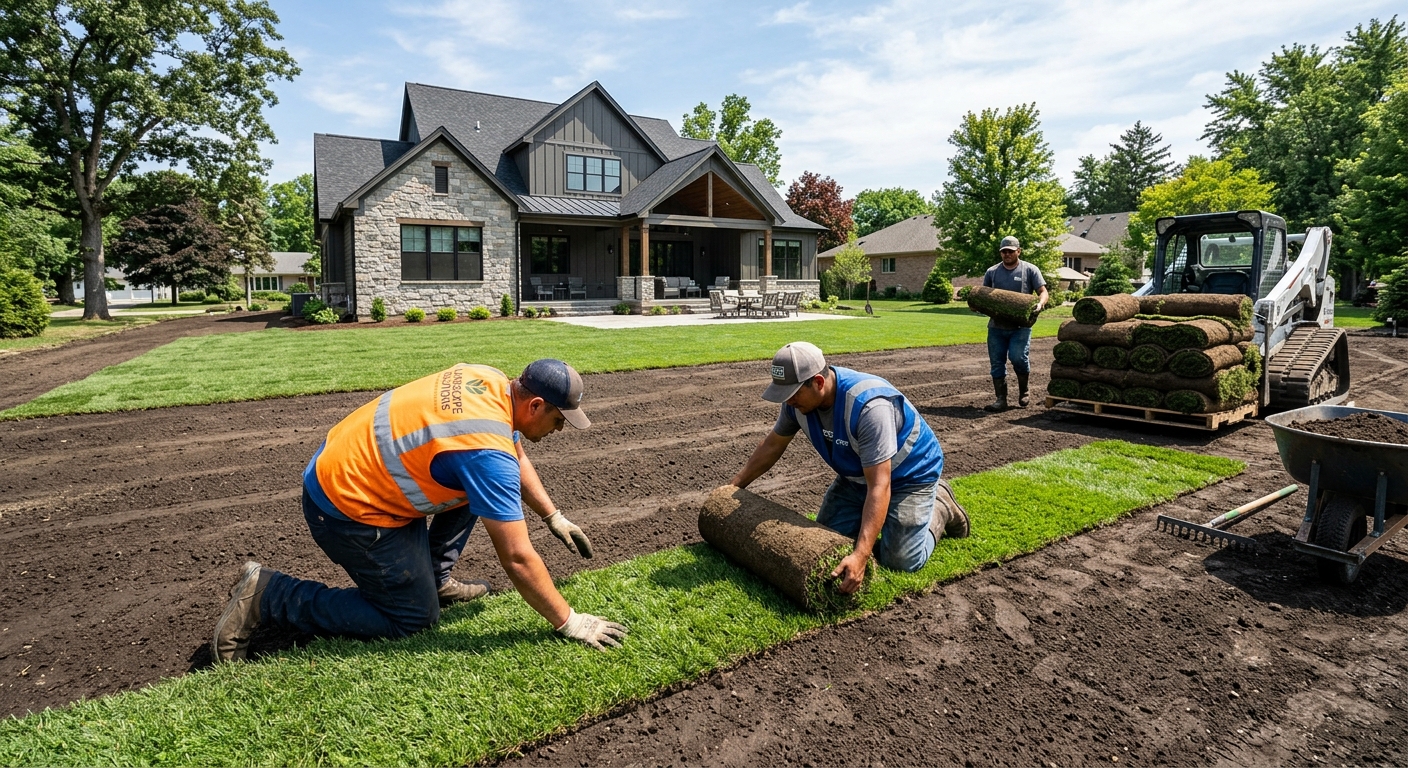
Landscaping options and costs in Forest Hills
Forest Hills, Ontario is where homeowners typically want a tidy curb appeal without fighting the seasons—and with a population of 6,238 (Statistics Canada, 2021 Census), local contractors often know the same neighbourhood yards and grading patterns year after year. Most properties here sit on family-sized lots, and detached home ownership creates a steady demand for front walks, patios, and spring planting. In the GTA, you’re usually balancing a plant-friendly growing window (roughly May through October) with deep winter frost and frequent freeze–thaw cycles that can shift stonework and heave shallow bases if they’re not built on the right granular depth and drainage design.
That climate reality drives cost: the more your plan includes hardscape—retaining walls, patios, steps—the more you’re paying for excavation, compacted bases, geogrid where required, and drainage provisions that protect both the wall and your foundation exposure. On the other hand, softscape like sod or planting can be faster to install, but Toronto’s clay/fill soils often still require topsoil import and soil amendment to get healthy roots. Labour availability also affects pricing; spring schedules are in high demand across nearby neighbourhoods, including the corridor around Elgin Mills Road and the larger Scarborough/Markham-side commuter belt where crews are working concurrently.
Use the table below as a practical starting point for budgeting common projects in Forest Hills, then we’ll break down what changes those numbers from quote to quote.
| Service |
Description |
Season |
Price Range |
| Full landscape design and installation |
On-site consult, layout, plant palette, grading/drainage coordination, hardscape/softscape installation |
Late spring to early fall (best results May–September) |
$8,000–$40,000 |
| Sod installation (supply, grade, lay, roll) |
Soil testing (basic), grading/leveling, topsoil, sod supply, laying, rolling and initial watering plan |
Late spring and early fall |
$2,500–$8,000 |
| Lawn seeding (grade, seed, starter fertilizer) |
Light grading, seed selection, starter fertilizer, seeding, light raking and protection |
Spring or early fall (weather-dependent) |
$1,200–$4,500 |
| Interlocking patio or walkway |
Excavation, compacted base, edging, interlocking stone, slope adjustments for drainage |
Spring to early fall |
$6,000–$30,000 |
| Retaining wall (interlocking block) |
Block wall build with proper base, geogrid/stone drainage where needed, and wall backfill |
Spring to early fall |
$8,500–$28,000 |
| Tree and shrub planting |
Planting layout, soil prep, amendments, staking (if required), watering plan |
Spring and fall |
$800–$6,000 |
Prices are estimates only and vary by project scope, site access and material selection.
What affects the price of landscaping in Forest Hills
In Forest Hills and across the Toronto area, you can see the same “type” of job priced 30–50% apart because the scope isn’t always equivalent. One quote may include proper drainage corrections, soil amendment, and edging; another may focus only on surface changes and assume the existing grade is “good enough.” Toronto-area clay and fill soils also mean more time on excavation and prep when contractors have to rework slope, protect buried utilities, or rebuild granular bases for concrete and interlocking. When freeze–thaw cycles hit, shallow or poorly compacted work costs more later—so conscientious builders price for the protection up front.
Plant hardiness and frost timing shape both what survives and the working season. Forest Hills sits in hardy zones 6a–7a, so many projects can run May to October, but we still schedule around temperature swings and precipitation. Prairie regions (Zone 2–4) often require drought-tolerant, wind-hardy species and a shorter working season; that can increase per-day costs and simplify palettes. Coastal BC (Zone 7–8) can support lush planting with a longer season, but heavy-rain drainage design is still critical. In Southern Ontario, you typically need irrigation planning for summer dry spells, but it’s less restrictive than dry BC interior water contexts.
Concrete examples from Forest Hills: (1) If your yard slopes toward a foundation or you’re seeing pooling after storms, adding a French drain or drainage bed can shift a “walkway-only” project into a higher scope; (2) If you want interlocking over unstable fill, we may need deeper base excavation and geogrid, which pushes patio costs toward the upper part of the $6,000–$30,000 band; (3) Switching from seeded lawn to sod can move your budget into the $2,500–$8,000 range faster because sod requires more materials and tighter installation conditions.
Housing stock plays a role too. Older properties often have buried weeping tile tie-ins, irregular subgrades, or mature roots that must be managed. Where tree or stump removal is needed before planting, labour and disposal time can add noticeable dollars before you even reach the “planting” line item.
| Price Factor |
Why It Matters |
Cost Impact |
| Yard size in sq ft — the primary cost driver for softscape |
More square footage means more labour hours, soil, seed/sod, and edging |
Often the single biggest variable; larger lawns shift you to upper bands |
| Grading and drainage work — slope corrections add significant cost |
Correcting slopes prevents pooling and reduces foundation moisture risk |
Can add major excavation/compaction time and increase quote by 10–30%+ |
| Drainage bed or French drain installation |
Intercepts subsurface water and routes it away from structures |
Frequently a high-impact line item; pushes hardscape/softscape bundles upward |
| Plant material tier — native shrubs vs. ornamental vs. mature specimen trees |
Mature stock costs more and needs careful handling and staking |
Budget can swing dramatically, even for the same overall “look” |
| Hardscape vs. softscape ratio — walls and patios cost more per sq ft than lawn |
Stone, base material, and compaction are labour- and material-intensive |
Greatest driver for projects that include patios/walkways/retaining walls |
| Irrigation system design and installation |
Proper layout prevents dry spots and protects roots |
Can add several thousand dollars depending on zones and heads |
| Soil amendment and topsoil required |
Clay and fill need structure and nutrients for root development |
Adds hauling, spreading, and sometimes geotechnical-style prep |
| Tree removal or stump grinding before new planting |
Root disruption and disposal affect time and site access |
Can be a noticeable jump before new plants go in |
Permits & regulations in Ontario
In Ontario, most planting and typical softscape work does not require a permit. That generally includes things like installing new sod or seeded lawns, planting trees and shrubs, adding mulch beds, building garden borders, and redoing walkways/patios that don’t require major grading changes. However, certain hardscape projects can trigger permit requirements—especially where structural elements or major drainage impacts are involved.
Retaining walls are the key “maybe.” In many Ontario municipalities, a building permit is commonly required when a retaining wall exceeds a threshold height—often around 1.0 m (3.3 ft)—and engineered drawings may be requested depending on conditions. Also, changes to lot grading that affect how water drains toward a neighbouring property or storm sewer connection can require approvals. Another practical step: always request utility locates before digging for planting holes or wall footings to avoid service strikes.
For your contractor verification in Forest Hills, you’ll want to check three things before the first shovel moves: (1) Ontario licence/registration (as applicable for their trade), by searching the relevant online contractor registry; (2) liability insurance—ask for a current certificate of insurance with your address listed as an insured project where possible; and (3) WSIB/WCB coverage—request proof of clearance or coverage status. A reputable landscaping company will provide these documents without pressure and will match the insurance dates to the project start and completion window.
Planning a landscape that thrives in Forest Hills's climate
Planning for Forest Hills means choosing plants and hardscape build details that respect Toronto’s hardiness range (zones 6a–7a), regular freeze–thaw cycles, and the realities of spring and fall weather. Start with plant selection: favour native and zone-appropriate perennials and woody shrubs that tolerate winter lows near –23 to –18°C and bounce back after late frosts. In practice, that reduces winter dieback and lowers watering needs. For lawn, the sod-versus-seed decision is also climate-driven. Sod gives fast, uniform coverage, but it’s most reliable when installed in cooler growth periods and when soil prep is done right. Seeding is more flexible and can work well in early fall—though you’ll need patience and consistent watering during germination.
Drainage and grading are the “make or break” items in Toronto. If water pools near foundations or along walkways, you can get recurring foundation moisture issues and shifting stone. Proper slope grading, a well-designed granular base, and—when needed—drainage beds or French drains help prevent frost heave and washouts. Hardscape success also depends on base prep to protect against movement during winter expansion.
For low-maintenance curb appeal, use groundcovers, thick mulched borders, and hardy perennials to crowd out weeds. Where you want water-wise options, consider a rain-garden or smart xeriscape-style areas: the goal isn’t “no plants,” it’s using drought-tolerant selections and designing where runoff is managed.
Here’s where cost differences are justified: if you need instant function for a family walkway, interlocking can fall in the $6,000–$30,000 band because excavation and base prep protect stability. If your priority is budget control and soil improvement first, seeding a lawn is usually less upfront than sod in the $2,500–$8,000 range, and you can upgrade plant beds later after you confirm drainage performance.
| Element |
Climate Consideration |
Maintenance Level |
Price Band |
| Sod lawn installation |
Best in spring or early fall; needs good soil prep to avoid winter thinning and spring wash |
Medium (watering establishment period; mowing) |
$2,500–$8,000 |
| Native perennial garden |
Zone-appropriate varieties handle cold snaps; mulch helps with freeze–thaw stress |
Low to medium (spring cleanup; occasional division) |
$1,500–$6,000 |
| Mulched shrub border |
Durable foundation planting tolerates winter and humid summers when spaced for airflow |
Low (weeding reduced; seasonal pruning) |
$1,200–$5,000 |
| Interlocking stone patio |
Requires compacted base and proper slope to resist frost heave and pooling |
Low (periodic joint sand top-ups) |
$6,000–$30,000 |
| Retaining wall (block) |
Backfill and drainage placement matter for freeze–thaw and hydrostatic pressure |
Low (visual inspections after heavy melt/storms) |
$8,500–$28,000 |
| Drip irrigation system |
More efficient for perennials/shrubs during summer dry spells; helps avoid overwatering sod |
Medium (winterisation and seasonal checks) |
$1,500–$6,500 |
How to choose a landscaping contractor in Forest Hills
Choosing a landscaping contractor in Forest Hills is mostly about verifying competence before you talk design. First, confirm licensing and insurance: ask for a current certificate of liability insurance (and ensure coverage dates align with your job window). For work coverage, request proof of WSIB/WCB status and, where available, a clearance letter for the company. If they can’t provide documents quickly, that’s a warning sign.
Next, don’t accept a single lump-sum number. Get 2–3 itemised written quotes that break out labour and materials: excavation and hauling, base materials, stone block quantities, topsoil/compost, plant list and sizes, irrigation components, and site protection/disposal. A good quote will also list assumptions—like whether they’re importing topsoil to a target depth, whether they include geogrid, and how drainage issues are addressed.
Read the scope line-by-line. Does the permit pull fall under their responsibilities (where required for a retaining wall above the common height threshold)? Is debris disposal included? Are you paying for seasonal labour staging (common in spring) or is it built into the timeline? Warranty matters too: ask for workmanship warranty length and whether it covers labour for settling, cracking, or plant replacement. Product/manufacturer warranties should be noted separately—and ask if they’re transferable to the homeowner.
Finally, payment schedule discipline protects you. Avoid paying more than 10–15% upfront for materials/booking. Hold back the remaining balance until the work is completed, cleaned up, and you’ve walked the site with the contractor. Get a start date and a completion estimate in writing so weather delays and material lead times are clearly managed.
- Ask for proof of liability insurance and confirm coverage dates match your project schedule.
- Request WSIB/WCB clearance (or proof of coverage) before work begins.
- Ensure quotes include disposal and site cleanup, not just installation.
- Confirm whether utility locates are arranged before digging.
- Verify base depth and compaction method in writing for patios/walkways/walls.
- Check whether geogrid is included where needed for stability.
- Make sure drainage/grading corrections are explicitly scoped (not “as needed”).
- Confirm plant sizes (e.g., 2-gallon/5-gallon, caliper size for trees) and replacement terms.
- Ask how topsoil and amendments will be sourced, delivered, and finished grade.
- Request warranty details: workmanship duration, what triggers a claim, and who responds.
- Confirm payment schedule and retainage/holdback expectations in writing.
- Get a written timeline with milestones and responsibility for weather-related rescheduling.
Concrete red flags in Forest Hills: vague quotes that omit base specs; contractors who won’t put insurance/WSIB proof in writing; “cash-only” or pressure to pay large deposits up front; skipping utility locates before digging; and no clear plan for drainage or freeze–thaw protection around patios and walls.
Frequently asked questions — landscaping in Forest Hills
When is the best time to landscape in Forest Hills?
The best window in Forest Hills is typically late spring through early fall, when soil is workable and plants establish quickly in Ontario’s zone 6a–7a conditions. Sod and seed both perform best when temperatures support new root growth; sod is usually installed in cooler, steadier weather rather than peak midsummer heat. Tree and shrub planting is often strongest in spring and fall, when stress is lower and watering needs can be managed with sensible schedules. For hardscape like patios and interlocking, we aim for months with stable ground temperatures so bases compact well and don’t freeze during construction. If you’re planning a full project, booking ahead is important—GTA crews get busy, and competing jobs can affect start dates.
Do I need a permit for a retaining wall in Ontario?
Often, yes—depending on the retaining wall height and how your municipality classifies the structure. In many parts of Ontario, a building permit is commonly required when a retaining wall exceeds around 1.0 m (3.3 ft), and engineered documentation may be requested in certain situations. Even if the wall is below that threshold, grading changes that affect how water flows toward neighbouring properties or connections to storm systems can also trigger approval requirements. For Forest Hills homeowners, the simplest approach is to ask your contractor to confirm whether your specific wall height and design will require a permit before construction. A reputable contractor should discuss it up front, not after excavation has started.
How do I improve drainage in my yard?
Drainage improvements usually start with understanding where water goes during heavy rain and spring melt. In Forest Hills, pooling around foundations and along walkways is a common trigger for work that goes beyond surface fixes. Typical solutions include regrading to direct flow away from structures, adding a drainage bed or French drain, and correcting downspout discharge so it isn’t overwhelming the same low spots. Soil type matters too—clay and fill can hold water, so we often combine drainage with proper base construction for any patio or wall. If you’re budgeting, drainage tied to a walkway/patio can shift the project toward the higher end of the $6,000–$30,000 band, because excavation and materials increase.
What is xeriscaping and does it suit Forest Hills?
Xeriscaping is water-wise landscaping that reduces irrigation through smart plant selection, soil improvements, and efficient layouts. In Forest Hills, it can suit parts of a yard—especially beds that dry out quickly or areas where you want to limit watering during summer dry spells. However, Ontario is not a dry climate, so the goal usually isn’t “no water,” but “use less and use it better.” A rain-garden approach is often a strong fit: it manages runoff, supports hardy plants, and reduces pooled water after storms. For lawns, sod or seed may still be appropriate in sunny areas, but you can surround them with mulched borders and zone-appropriate perennials to lower overall maintenance and watering demands.
How do I plan a low-maintenance yard?
A low-maintenance yard in Forest Hills comes from minimizing “repeat tasks” like frequent weeding, re-seeding bare patches, and correcting shifting edges. Start with drainage and grading so soil stays stable—otherwise plants struggle and stone can lift during freeze–thaw cycles. Then choose resilient, zone-appropriate native perennials and shrubs, spaced for airflow so they don’t need constant pruning. Use mulch depth consistently (and top up seasonally) to reduce weed pressure, and consider groundcovers that fill gaps naturally. For turf, sod gives a fast finish, while seeding can be more cost-effective if your grade is ready—your installer can help you decide what fits your schedule. If you want quick curb impact, a patio or walkway in the $6,000–$30,000 range can reduce mud and edging repairs, while planting beds handle the long-term look.
How deep should a retaining-wall base be for local frost?
There isn’t one “magic number” for every retaining wall because depth depends on wall height, soil conditions, and whether reinforcement (like geogrid) is used. That said, in Ontario—where freeze–thaw cycles are a major structural stress—retaining walls must be built on a properly prepared granular base with drainage backfill to reduce hydrostatic pressure. Your base depth should be designed to extend below the zone where frost movement can affect stability and compacted layers. For Forest Hills, the critical takeaway is that base spec should come from the contractor’s engineering/design approach for your wall height and site conditions, not from a guess. If your wall triggers permit requirements (commonly around 1.0 m/3.3 ft), the approved details should spell out base preparation requirements.