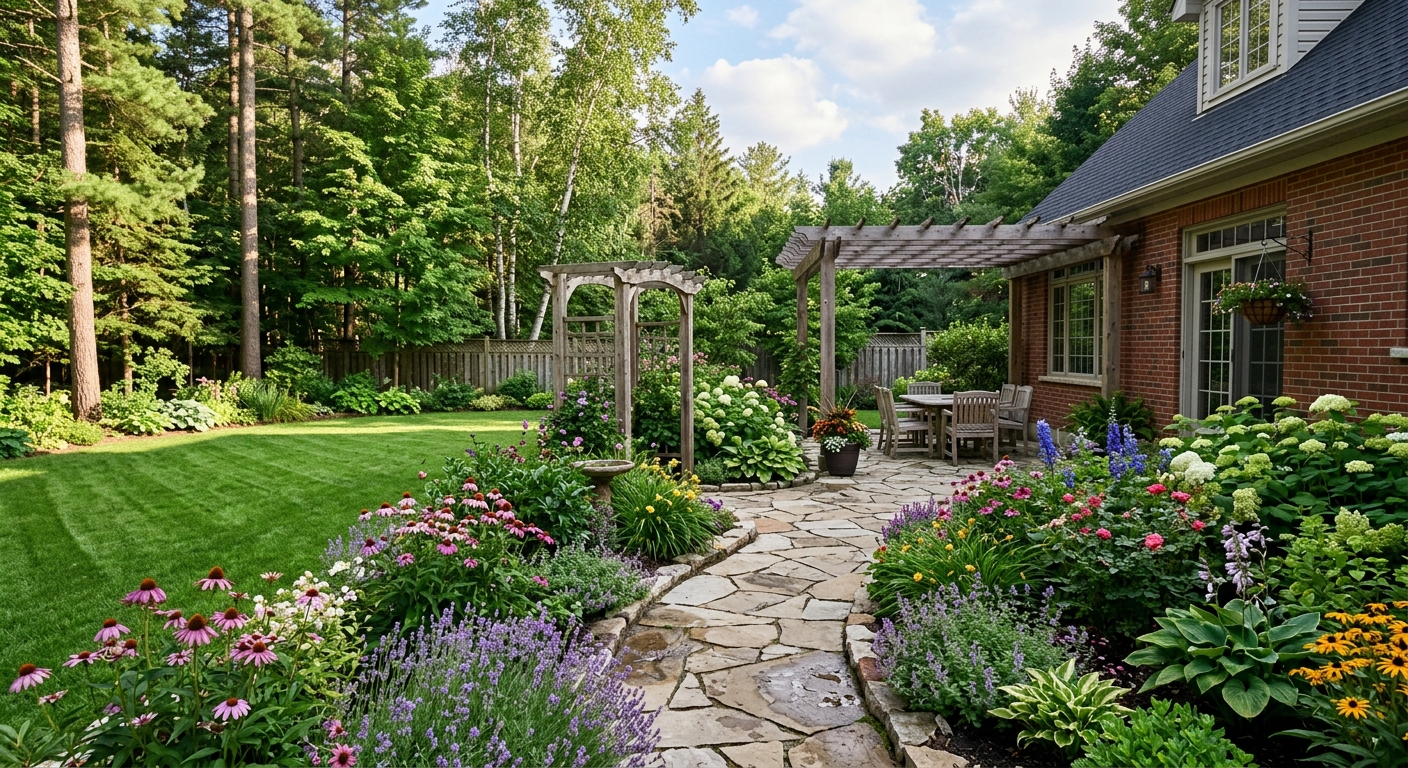
Landscaping options and costs in Parkdale
Parkdale homeowners often start with a short list of projects—new lawn, refreshed planting, or a patio—but the final scope can look very different from one yard to the next. One reason is that Parkdale’s housing profile supports renovation-minded owners; for context, the city’s population was reported as 1,404 in Parkdale (Statistics Canada, 2021 Census). In practice, detached and semi-detached properties with usable yard space are common enough that landscaping upgrades are a frequent way to improve curb appeal and privacy, especially around spring market season.
In the Toronto area, costs are shaped by climate and soil. We’re working in plant hardiness zones 6a–7a, with winter lows roughly between –23 to –18°C and repeated freeze–thaw cycles. That matters for everything from how we prepare a patio base to how deep we set retaining wall footings and geogrid. Local clay and fill soils can also require excavation, soil amendment, and sometimes subdrains to protect both softscape and hardscape. Labour availability is strongest during late spring through early fall, when the frost-free window (roughly May to October) allows reliable grading, compaction, and plant establishment. For that reason, work in and around the Parkdale Village area tends to book faster.
Below is a practical comparison of common landscaping options you’ll see in Parkdale quotes—use it as a baseline before you request a detailed, itemised estimate.
| Service |
Description |
Season |
Price Range |
| Full landscape design and installation |
Site visit, concept + layout, grading plan, plant selections, soil prep, softscape and hardscape installation as specified |
Spring–early fall |
$8,000–$40,000 |
| Sod installation (supply, grade, lay, roll) |
Remove/prepare existing turf, ensure base grade, supply and install sod, roll and initial watering plan |
Late spring–summer (best before peak heat) |
$2,500–$8,000 |
| Lawn seeding (grade, seed, starter fertilizer) |
Light grading or aeration as required, seed blend, starter fertilizer, tack/cover if needed |
Spring or early fall |
$1,500–$5,500 |
| Interlocking patio or walkway |
Excavation to depth, compacted granular base, edging, pavers (interlocking stone) and finishing |
Spring–early fall |
$6,000–$30,000 |
| Retaining wall (interlocking block) |
Wall layout, excavation, base aggregate, geogrid (as required), drainage layer, block installation |
Spring–early fall |
$6,000–$30,000 |
| Tree and shrub planting |
Soil amendment, planting holes, staking (if required), mulch ring, and establishment watering guidance |
Spring–fall |
$800–$6,000 |
Prices are estimates only and vary by project scope, site access and material selection.
What affects the price of landscaping in Parkdale
In Parkdale and the broader Toronto area, it’s common to see the “same” landscaping job priced 30–50% apart. The gap usually comes from differences in yard size, soil conditions, drainage complexity, and how much preparation contractors include (or exclude). Two quotes can also diverge because of plant and material tier: ornamental nursery stock and mature specimens cost more than native shrubs, and paver systems with higher base-depth specs cost more but reduce movement over freeze–thaw cycles.
Climate and frost dates directly influence both what’s installed and how long the working season allows. In Southern Ontario (zones 6a–7a), we have a moderate growing season, but Toronto’s winters bring deep frost and repeat freeze–thaw. That means retaining wall base depth, compacted granular layers, and drainage details can’t be “scaled back” without increasing long-term risk. By contrast, Prairie regions (zone 2–4) face shorter seasons and harsher freeze intensity, so designs often shift toward drought-tolerant, wind-hardy species and simpler palettes; coastal BC (zone 7–8) can sustain a longer planting window, but still needs strong drainage where rainfall is heavy. In dry interior BC and parts of Alberta, water-use constraints push irrigation choices toward drip and targeted watering—while in Parkdale we still design for summer dry spells, we typically don’t plan around the same level of restrictions.
Concrete examples from Parkdale: (1) A 6–8 cu. yd. excavation for clay fill and regrading can push a project toward the higher end of softscape budgets, while a flatter lot may land closer to a mid-range $8,000–$40,000 full-design project. (2) If your patio area needs deeper base prep to resist movement, interlocking work can drift from the lower $6,000–$30,000 band into the upper range—especially when drainage and edging are included. (3) If mature trees require root pruning or removal before planting, tree-and-shrub installation can increase beyond the typical $800–$6,000 band.
| Price Factor |
Why It Matters |
Cost Impact |
| Yard size in sq ft — the primary cost driver for softscape |
Lawn, beds, and topsoil/seed volume scale directly with area |
Often the biggest swing; smaller yards can be as much as 20–40% cheaper |
| Grading and drainage work — slope corrections add significant cost |
Proper slope prevents pooling and foundation moisture |
Can add major labour and equipment time; commonly shifts total cost by 15–30% |
| Drainage bed or French drain installation |
Clay and fill soils can hold water without added drainage |
Material + trenching costs add up quickly; frequently increases project by 10–25% |
| Plant material tier — native shrubs vs. ornamental vs. mature specimen trees |
Maturity level affects both price and establishment time |
Mature specimens can double the planting line item compared with smaller stock |
| Hardscape vs. softscape ratio — walls and patios cost more per sq ft than lawn |
Pavers, base materials, and proper excavation are labour-intensive |
Higher hardscape content pushes estimates toward the upper $6,000–$30,000 band |
| Irrigation system design and installation |
Toronto summers can stress grass and newly planted beds |
Simple hose bib + timer differs greatly from multi-zone irrigation |
| Soil amendment and topsoil required |
Clay improves slowly; plants need improved structure and nutrients |
Can add significant hauling and labour depending on how much import is needed |
| Tree removal or stump grinding before new planting |
Roots can interfere with grading and new beds |
Often adds a separate scope; can move the job up one pricing tier |
Permits & regulations in Ontario
In Ontario, most landscaping tasks—like planting shrubs, laying sod, seeding lawns, and installing standard softscape beds—typically do not require a building permit. The work is usually considered maintenance or typical property improvement. However, there are a few situations in Parkdale where permits (and sometimes engineering input) become necessary.
Work that typically DOES require a permit: retaining walls above the height threshold set by the local municipality (commonly around 1.0 m (3.3 ft)), especially when the wall supports soil and affects load conditions. Also, significant grading changes that impact drainage patterns—such as directing surface water toward a neighbouring property or tying into storm connections—may trigger approval requirements. If your plan involves altering drainage patterns near foundations or public drainage pathways, it’s worth verifying before equipment arrives.
Work that typically does NOT require a permit: tree and shrub planting, mulch/topsoil placement, standard sodding and seeding, and most interlocking patios/walkways when they don’t involve structural retaining elements or major drainage re-routing.
Before any digging for planting holes, drain lines, or retaining wall footings, ensure utility locates are completed. Then, when vetting contractors in Parkdale, verify: (1) Ontario licence credentials through the relevant contractor registration/consumer protection resources, (2) liability insurance with a certificate of insurance naming you as certificate holder where required, and (3) WSIB clearance (or the equivalent coverage confirmation) if the contractor is staffing workers on-site. Ask for documents before signing—good contractors have them ready.
Planning a landscape that thrives in Parkdale's climate
For Parkdale yards, the goal is to work with the local hardiness zone (6a–7a), typical Toronto precipitation patterns, and winter freeze–thaw behavior—not against them. Start with plant selection: choose native and zone-appropriate species that tolerate cold snaps and humid summers with less fuss. Where you want structure, focus on woody plants that can handle winter lows near –23 to –18°C, and pair them with perennials that re-emerge reliably in spring. That reduces winter die-back and lowers ongoing watering needs.
Next, decide between sod and seed. Sod gives instant visual results, but in the Toronto market it costs roughly 3–4x more per sq ft than seeding when you compare equivalent coverage. Sod can be justified when you need immediate curb appeal for an upcoming listing or when you’re restoring a high-traffic lawn area. If you’re budget-conscious and have patience, seeding in spring or early fall often makes more financial sense and still performs well when soil prep and starter fertilizer are done right.
Drainage and grading are where Toronto projects win or fail. Pooling near foundations or along downspouts quickly becomes foundation moisture risk, and freeze–thaw can exacerbate heaving. For hardscape like patios and retaining walls, base prep must respect frost behavior: proper excavation depth, compacted granular base, and drainage layers are non-negotiable.
To reduce annual upkeep, build low-maintenance design strategies: mulch rings, groundcovers between shrubs, and perennials that don’t demand constant re-planting. Rain gardens can help manage runoff in wetter seasons, and xeriscape-style borders (dry-tolerant planting zones with mulch and targeted irrigation) can be used strategically—especially where you want less lawn replacement. In a typical Parkdale decision, upgrading from seeding to sod might be worth it only if your timeline demands it; otherwise, that same budget can often fund improved drainage, which pays you back for years.
| Element |
Climate Consideration |
Maintenance Level |
Price Band |
| Sod lawn installation |
Instant cover helps during establishment in the May–October frost-free window; ensure watering through hot, humid weeks |
Medium (watering + early weed control) |
$2,500–$8,000 |
| Native perennial garden |
Zone-appropriate plants tolerate winter lows and summer humidity better than many non-local ornamentals |
Low–medium (spring pruning, seasonal mulching) |
$1,200–$6,000 |
| Mulched shrub border |
Mulch moderates soil temperature swings during freeze–thaw and helps retain moisture through summer dry spells |
Low (weeding and top-up mulch once or twice yearly) |
$800–$5,000 |
| Interlocking stone patio |
Proper base depth and drainage prevent movement under freeze–thaw cycles |
Low (occasional cleaning) |
$6,000–$30,000 |
| Retaining wall (block) |
Footings and drainage layer resist soil pressure and winter freeze expansion |
Low (periodic inspection for settling) |
$6,000–$30,000 |
| Drip irrigation system |
Targets watering to roots; helpful for beds during summer humidity and dry weeks |
Low (seasonal check and winter blowout if required) |
$1,500–$6,500 |
How to choose a landscaping contractor in Parkdale
Choosing the right contractor in Parkdale is mostly about verification and clarity. Start with Ontario compliance: ask whether the contractor carries liability insurance (and request the certificate of insurance). If they have employees on-site, confirm WSIB/WCB coverage and ask for clearance or proof of coverage status. For licensing/registration, check the contractor’s credentials using Ontario’s official contractor registration/consumer protection resources and compare the business name on the quote to the name on the insurance documents. If anything doesn’t match, request clarification before you sign.
Next, get 2–3 itemised written quotes rather than a single lump sum. A good estimate breaks down labour and materials: excavation and base prep, drainage work, stone quantities, fabric/stone filter, plant types and sizes, and haul-away/disposal. Read the exclusions: is disposal included? Is permit pulling included if required for a retaining wall above the typical ~1.0 m threshold? Are geotextile, geogrid, and proper drainage layers specified—or just implied?
Warranty matters. Ask for the workmanship warranty length, and confirm whether product warranties are from the manufacturer and whether they’re transferable to you as the owner. Payment schedules should be conservative—never more than about 10–15% upfront. Hold back the final portion until the job is complete and materials installed match the proposal.
Finally, insist on a timeline in writing: proposed start date and an estimated completion date, plus what weather conditions could delay work during Parkdale’s shoulder-season changes.
- Request a certificate of insurance and verify it’s current.
- Confirm WSIB/WCB clearance or proof of coverage before work begins.
- Ensure the quote uses your address and the exact scope (not “allowances” everywhere).
- Get an itemised breakdown for excavation, base materials, and drainage components.
- Ask whether geogrid/geotextile and a proper drainage layer are included for retaining walls.
- Confirm topsoil/soil amendment quantities and whether they’re documented by volume.
- Check if disposal/haul-away is included (old sod, debris, excess soil).
- Make sure plant lists specify genus/species and approximate sizes (e.g., caliper/heights).
- Ask what watering and establishment plan is included for sod and new planting.
- Clarify warranty: workmanship length and what it covers (settling, heaving, plant replacement).
- Keep retainage: never release the final payment until cleanup and punch-list items are done.
- Confirm schedule assumptions and the weather plan for Parkdale’s freeze–thaw shoulder periods.
Red flags in Parkdale: quotes that don’t specify base depth for patios or footings/drainage for walls; no proof of insurance or WSIB/WCB coverage; heavy reliance on vague “allowances” with no quantities; pressure to pay full upfront; and missing start/completion dates in writing or unwillingness to provide a written scope and warranty terms.
Frequently asked questions — landscaping in Parkdale
What plants thrive in Parkdale's climate zone?
Parkdale is in the Toronto-area range of plant hardiness zones 6a–7a, so the best performers are those that can tolerate winter lows around –23 to –18°C and rebound reliably after freeze–thaw. In practice, we lean on proven hardy shrubs and perennials with good winter structure: for example, native-style shrub borders (spirea-type forms, serviceberry-like options, and winter-robust deciduous choices) plus perennials that don’t mind spring frosts. You’ll also get better results when plants are sized correctly for the site conditions—sun vs. shade and wet vs. dry pockets—because drainage problems in clay soils can mimic “plant failure.” If you’re comparing costs, native perennial installations often fall toward the lower portion of the $800–$6,000 planting band, whereas ornamental or mature specimens push toward the upper end.
Sod vs seed — which is better for a Parkdale lawn?
It depends on your timeline and how much prep work your lawn needs. Sod gives instant coverage and is a great choice when you want a finished look quickly—typically in late spring or summer within the frost-free window (roughly May to October). However, sod costs more because you’re paying for the turf and handling: in Toronto-area pricing it’s commonly within the $2,500–$8,000 band for typical residential yards, and it can be about 3–4x the cost per sq ft compared with seeding. Seeding is more budget-friendly and works well in spring or early fall, but it requires good grading, starter fertilizer, and consistent watering until the lawn establishes. In Parkdale, where freeze–thaw can expose weak spots, seeding succeeds best when drainage and soil prep are addressed first.
How much does a retaining wall cost in Parkdale?
Retaining wall costs in Parkdale vary widely based on height, length, base preparation, and whether drainage is included. For interlocking block walls, many residential projects land in the $6,000–$30,000 range. The main reason estimates differ is foundation-level detail: clay and fill soils often need proper excavation depth, compacted base aggregate, geogrid (as required), and a drainage layer behind the wall to manage water pressure. If your wall needs more excavation or if access is tight (common in older Parkdale streets), labour can increase. If you want the most stable result through Toronto’s winter freeze–thaw cycles, choose quotes that specify drainage and base prep—not just block supply.
When is the best time to landscape in Parkdale?
For most Parkdale landscaping, the best window is late spring through early fall (roughly May to October), because the frost-free period supports reliable grading, compacting, and plant establishment. Sod and lawn restoration are usually best installed when the weather is warm enough to grow but not at peak drought stress—often late spring into early summer. Planting is flexible: trees and shrubs can be installed in spring or fall, with fall often reducing the watering demand. Hardscape like patios and walkways are typically done when the ground can be excavated and compacted without excessive moisture. Scheduling matters because Toronto shoulder seasons can bring rapid freeze–thaw transitions, and that’s when poor base preparation shows up as settling or heaving.
Do I need a permit for a retaining wall in Ontario?
In Ontario, permit needs depend on the wall’s height and how it affects the property. Retaining walls above a common threshold—often around 1.0 m (3.3 ft) in many municipalities—typically require a building permit, and sometimes engineered drawings depending on the situation. Also, changes to lot grading that affect drainage toward neighbouring properties or storm systems can trigger approval requirements. If your retaining wall is supporting soil to create a terraced yard, assume it may be reviewed. The safest approach in Parkdale is to ask your contractor whether they include permit pulling (where required) and to confirm the plan before excavation begins. A well-prepared contractor will also arrange proper utility locates before digging wall footings.
How do I improve drainage in my yard?
In Parkdale, drainage upgrades are often about managing runoff so water doesn’t pool near foundations and doesn’t freeze unexpectedly in winter. Start with observations: where does water collect after rain, and does it move toward your house or neighbour? Common solutions include regrading for proper slope, adding a drainage bed or French drain, and ensuring downspout discharge is handled correctly. Because Toronto-area clay and fill soils hold water, drainage work frequently becomes a cost driver in quotes; it can move a project toward the higher end of the $8,000–$40,000 full landscape band when excavation and soil amendment are significant. For best results, drainage should be paired with hardscape base prep (for patios/walks) so freeze–thaw doesn’t create heaving or soft spots.