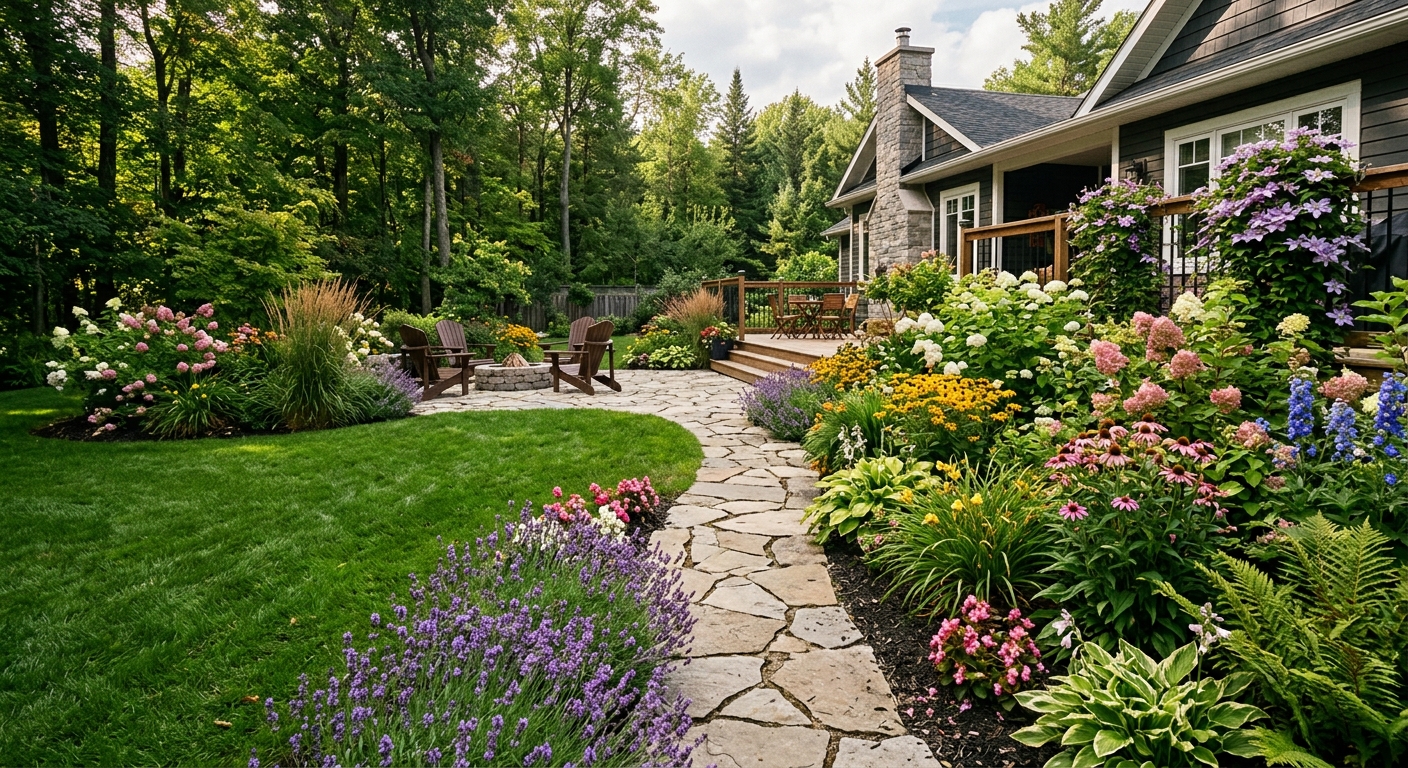
Landscaping options and costs in Goderich
Landscaping in Goderich is shaped by a practical mix of lake-influenced weather, cold winters, and a working season that typically starts in earnest after early-May frosts. With 65.6% of homes in the area being single-detached dwellings, many households have the yard space to invest in real changes—new lawn, walkways, and planting beds rather than just patchwork tidy-ups. And because 73.7% of homes were built before 1981, you’ll often see older grading patterns and compacted soils that need correction before sod, patios, or planting can settle properly.
In the Stratford–Bruce Peninsula region (plant hardiness zones 5b–6a), last spring frost is often in early May and the first fall frost is commonly in early October, giving a roughly 140–160-day window for installation and rooting. That frost timing can directly affect pricing: contractors need good base preparation and drainage detail for pavements and retaining walls to reduce freeze–thaw heaving. Labour availability also tightens during peak spring and early fall in Goderich and nearby areas, such as around the harbour and the West Street corridor, so booking earlier often helps secure competitive rates.
The most cost-effective path is usually to start with the right design and drainage plan, then choose where you want “instant results” (sod and interlocking) versus “slow-build value” (seed and phased planting). Use the table below as a realistic starting point when comparing quotes.
| Service |
Description |
Season |
Price Range |
| Full landscape design and installation |
Site walk, concept plan, layout, grading/drainage coordination, planting, lawn plan, and hardscape/softscape build-out (typical mid-range residential project) |
Late April–October (best planting window: May–September) |
$8,000–$35,000 |
| Sod installation (supply, grade, lay, roll) |
Topsoil/leveling, sod delivery and laying, rolling, and light start-up watering guidance |
May–September |
$1,500–$6,000 |
| Lawn seeding (grade, seed, starter fertilizer) |
Rake/till light prep, seed, starter fertilizer, and surface mulching where needed |
April/May or early September |
$700–$3,500 |
| Interlocking patio or walkway |
Excavation, compacted base, edge restraints, interlocking pavers, and finishing |
April–October |
$5,000–$25,000 |
| Retaining wall (interlocking block) |
Block retaining wall with proper base aggregate and drainage behind the wall |
May–October (freeze-thaw protection for base prep) |
$5,000–$30,000 |
| Tree and shrub planting |
Soil amendment, planting layout, staking (if required), and mulch installation |
May–September (and some fall planting where conditions allow) |
$800–$8,000 |
Prices are estimates only and vary by project scope, site access and material selection.
What affects the price of landscaping in Goderich
If two contractors are quoting “the same” landscaping job in the Stratford–Bruce Peninsula region, it can still swing by 30–50% because the price isn’t only in the plants and pavers—it’s in the unseen prep work (grading, drainage, soil structure, and how deeply bases must be built for frost). In Ontario, those differences often show up in how much labour goes into excavation, compaction, and drainage layers, and in whether the design accounts for how your yard drains during heavy rains and freeze–thaw cycles.
Climate and hardiness matter: in zones 5b–6a, early May frosts and early October frosts compress the installation window, which increases risk and can raise labour rates when crews are booked. Prairie cities (zones 2–4) typically need more drought- and wind-tolerant planting strategies because the growing season is shorter, and you may see higher emphasis on hardy, drought-tolerant species. Coastal BC (zones 7–8) has longer growing seasons and lush palettes, but cost can rise where heavy rainfall makes drainage systems non-negotiable. In Goderich specifically, the moderate Ontario season still includes periodic summer dry spells, so irrigation design and soil amendment can change both plant survival and the long-term upkeep.
Concrete examples from local sites: (1) a backyard with poor drainage may require a French drain and drainage bed before you can reliably install sod—this can move you from a “lawn-only” budget to a full mid-range build-out in the $8,000–$35,000 range. (2) Older lots (built before 1981) often have compacted fill; bringing in enough topsoil and compost can add hundreds to over a thousand dollars, but it can also prevent settling that would otherwise undermine patios and walls. (3) A retaining wall’s base and aggregate requirements—especially where frost and heaving risk exist—can push costs into the $5,000–$30,000 band depending on height, length, and how complex the drainage is behind the wall.
| Price Factor |
Why It Matters |
Cost Impact |
| Yard size in sq ft — the primary cost driver for softscape |
More area means more labour for prep, more sod/seed or mulch, and more materials |
Often the biggest swing; can account for the majority of the total |
| Grading and drainage work — slope corrections add significant cost |
Correcting slopes affects pooling, foundation moisture, and how long bases stay stable |
Commonly adds substantial labour and equipment time |
| Drainage bed or French drain installation |
Freeze–thaw stability depends on keeping water moving away from structures |
Can convert a small job into a mid-range project quickly |
| Plant material tier — native shrubs vs. ornamental vs. mature specimen trees |
Size, root ball weight, and planting time increase costs for mature specimens |
Medium-to-high impact depending on how many “feature” plants are included |
| Hardscape vs. softscape ratio — walls and patios cost more per sq ft than lawn |
Pavers and block walls require excavation, base materials, and precise installation |
Can dominate budgets even when the area looks small |
| Irrigation system design and installation |
Drip zones and smart controllers add upfront cost but improve survival and reduce waste |
Low-to-medium impact if simple; higher if trenching and multi-zone systems are needed |
| Soil amendment and topsoil required |
Compacted or poor native soil needs conditioning for root development and stable sod/seed |
Frequent add-on; can be modest or major depending on how much is required |
| Tree removal or stump grinding before new planting |
Disposal, equipment access, and stump grinding affect schedule and labour |
Can add several hundred to several thousand depending on complexity |
Permits & regulations in Ontario
In Ontario, most typical landscaping work—planting, sodding, and the majority of softscape tasks—usually does not require a building permit. However, in Goderich and across Ontario municipalities, retaining walls commonly cross into permit territory when they’re above a threshold (often about 1.0 m (3.3 ft), depending on the specific municipal rules and the risk profile of the project). If a proposed wall affects safety or alters how loads are held against soil, you should expect a permit request and sometimes engineering drawings for certain configurations.
Also watch for changes to lot grading. If your plan redirects drainage toward neighbouring properties, toward storm sewers, or significantly reshapes slopes, approval requirements can be triggered—especially where runoff paths change. And before any digging, ensure utility locates are completed so planting holes and wall footings don’t hit buried services.
How to verify a contractor’s Ontario compliance is straightforward: (1) check their business details and trade qualifications through the relevant online registry sources provided by the province and the contractor’s own documentation; (2) request certificate of insurance naming you as the certificate holder and confirm coverage limits for liability and property damage; (3) confirm WSIB/WCB coverage status—ask for a clearance letter or proof of account as applicable; and (4) if they’re pulling permits, ask for copies of submitted documents and permit numbers.
Planning a landscape that thrives in Goderich's climate
To get a yard that truly thrives in Goderich, plan around zone 5b–6a realities: the growing season is long enough for full installs, but the frost calendar means roots and structures must be ready before cold snaps. Start with plant selection—choose species that are zone-appropriate and reasonably drought-tolerant once established. In Goderich’s periodic summer dryness, native and hardy perennials with good mulch coverage often need less water than delicate ornamentals, and they handle winter better.
When deciding between sod and seeding, be honest about the trade-off. Sod gives instant visual results and faster ground cover, but it typically costs about 3–4x more per sq ft than seeding. Seeding takes longer to look “finished,” yet it can be a smart fit when you’re planning to refine grading first. A practical example: if a homeowner wants a 600 sq ft lawn area, moving from seeding to sod can add roughly $1,800–$4,500 to the project (depending on prep and the product). That’s often justified when you need quick curb appeal for sale timing, or when erosion control matters immediately. If you can wait through early establishment, seeding can deliver long-term value at lower cost.
Drainage and grading are non-negotiable in the Stratford–Bruce Peninsula. Pooling and foundation moisture are expensive to fix later. For patios and retaining walls, base preparation must be designed with freeze–thaw in mind—use proper aggregate layers and drainage outlets so water doesn’t sit under or behind hardscape.
Finally, use low-maintenance strategies: mulch (2–3 inches), groundcovers, and layered perennials reduce annual weed pressure. For a water-conscious approach, consider rain-garden features in downspout catchments or xeriscape-style planting zones that combine hardy grasses and shrubs—still tailored for Ontario winters, not imported “desert” mixes.
| Element |
Climate Consideration |
Maintenance Level |
Price Band |
| Sod lawn installation |
Install in May–September so roots establish before early October frosts; avoid late-season roll-out that heaves |
Medium (watering in establishment period, occasional weed control) |
$1,500–$6,000 |
| Native perennial garden |
Zone-appropriate plants reduce winter kill risk and can handle periodic summer dryness |
Low to medium (mulch refresh, spring cleanup) |
$800–$8,000 |
| Mulched shrub border |
Mulch moderates soil temperature during freeze–thaw and improves moisture retention |
Low (weeding reduced significantly once established) |
$800–$6,000 |
| Interlocking stone patio |
Needs correct base depth and drainage to resist movement from frost cycles |
Low (occasional cleaning and joint maintenance) |
$5,000–$25,000 |
| Retaining wall (block) |
Requires quality aggregate, proper base prep, and drainage behind the wall for stability |
Low (periodic inspection of drainage outlets) |
$5,000–$30,000 |
| Drip irrigation system |
Helps manage water during summer dry spells while protecting roots and reducing overspray on hardscape |
Low to medium (controller updates, seasonal start-up/off-season checks) |
$1,000–$5,000 |
How to choose a landscaping contractor in Goderich
Choosing the right contractor in Goderich starts with verifying credentials and the ability to execute a frost-resilient build. First, confirm insurance: request a current certificate of insurance (liability coverage, and ask if they carry coverage for property damage). Next, verify WSIB/WCB coverage—ask for a clearance letter or proof of account, and make sure the documentation matches the company name on the contract. Ontario requirements can vary by scope and staffing model, but you should never accept “we don’t do that” as an answer.
Then, get 2–3 itemised written quotes instead of one lump sum. Look for a labour + materials breakdown that clearly lists excavation, base materials, compaction, topsoil/compost, planting counts, and paver/block quantities. Carefully read what’s excluded: is disposal included? Is soil import allowance included or capped? Are utility locates included, and is trenching for drainage or irrigation part of the scope?
Warranty matters, especially for hardscape and grading. Ask for a workmanship warranty length and whether it covers settling, joint failure, or drainage performance issues. Product warranties are typically tied to the manufacturer (plants, sod, pavers), and you want to know if they’re transferable to you after purchase. Finally, payment schedule should be sensible: never pay more than 10–15% upfront, and hold back a portion until completion and cleanup.
- Provide a written start date and a realistic completion window in the contract.
- Carry proof of liability insurance (request the COI before work begins).
- Provide WSIB/WCB proof or clearance letter (as applicable to the company).
- Quote includes site prep details: excavation depth, base layers, and compaction method.
- Drainage plan is explicit (where water goes during storms and thaw).
- Materials list includes sod/seed type, paver/block model, and plant sizes/counts.
- Permit responsibility is clearly written (who pulls it, if required, and what’s included).
- Disposal and topsoil haul allowances are stated (and any overage rates are listed).
- Utilities locates confirmation is included before digging.
- Workmanship warranty is in writing with coverage specifics and timeline.
- Vegetation care guidance is included for the establishment period (watering schedule, mulch depth).
- Schedule accounts for frost risk (no unreliable late fall “rush installs” for structures).
Red flags in Goderich: (1) a quote that ignores drainage and grading while proposing sod or pavers; (2) refusing to show insurance/WSIB/WCB documentation; (3) “one price for everything” without itemized quantities and exclusions; (4) asking for large deposits beyond 10–15%; and (5) promising work through cold weather without addressing freeze–thaw risks for bases and soil.
Frequently asked questions — landscaping in Goderich
Sod vs seed — which is better for a Goderich lawn?
For many yards in Goderich, seeding wins on cost and flexibility, while sod wins on speed and instant curb appeal. If your soil needs work, seeding can still be a smart choice—provided you grade properly and use starter fertilizer. Sod is usually the better option when you want quick coverage for erosion control or you need the lawn to look complete soon (for example, a home sale). In terms of budget, sod installation often falls around $1,500–$6,000, while seeding typically costs less (often several hundred to a few thousand depending on preparation). In our zone 5b–6a conditions, either method can work best when done in May–September, with careful watering during establishment. If you have drainage issues, fix them first—otherwise even good seed or sod can thin out.
How much does a retaining wall cost in Goderich?
Retaining walls in Goderich commonly land in the $5,000–$30,000 range, and the difference usually comes down to wall length, height, excavation depth, and how complex the drainage behind the wall is. Freeze–thaw stability matters here: a proper base with high-quality aggregate and a drainage layer can raise your upfront budget but helps prevent movement. Older properties (many built before 1981) sometimes have less predictable backfill, which can increase labour and soil replacement. If you need a wall above the municipal threshold, permit requirements can also add time. Ask for a quote that states base prep details, drainage outlets, and whether backfill and compacting are included—those details are often where “cheap walls” fail.
When is the best time to landscape in Goderich?
In Goderich and the Stratford–Bruce Peninsula region, the practical window is driven by frost timing. Last spring frosts are often in early May, and the first fall frost commonly arrives in early October. That means most planting and turf work is best from May through September, when roots can establish before cold weather. Hardscape (patios and walkways) is typically safest from spring once soils are workable through summer, with careful base prep to reduce frost-related movement. If you’re doing sod, aim for May–September. For planting, you’ll get better success by avoiding very late-season installs when soil temperatures drop quickly. If your contractor proposes doing major base work right before hard frosts, ask how they’ll protect compaction and drainage layers.
Do I need a permit for a retaining wall in Ontario?
Often, yes—depending on height and the municipality’s rules. In Ontario, retaining walls above a threshold—commonly around 1.0 m (3.3 ft)—typically require a building permit and sometimes engineered documentation. Even if the wall is “just landscaping,” the reason is safety and how loads are held back by soil, especially with freeze–thaw pressure. Additionally, if the wall project changes grading or drainage paths, it may trigger more approvals. For your Goderich property, ask your contractor to confirm whether a permit is required before quoting schedule changes. A reputable contractor should be able to tell you who is responsible for pulling the permit (and what’s included in their scope).
How do I improve drainage in my yard?
Start by identifying where water goes during storms and thaw cycles—standing water near foundations is a common issue in older lots in Goderich. The most effective drainage improvement usually combines grading corrections with sub-surface solutions, such as a drainage bed or French drain installed to direct water away from structures. If you’re planning sod or interlocking soon, fix drainage first; otherwise you can end up paying again when new lawn thins or pavers settle. A good contractor will explain the drainage route and include it in the quote, not just “we’ll top dress.” In terms of cost, drainage work can be a turning point in a budget (it’s one reason a modest lawn project can move into a mid-range landscape install). If you’re unsure, ask for a simple drainage plan and site photo notes.
What is xeriscaping and does it suit Goderich?
Xeriscaping is a landscaping approach that reduces water use through plant selection, soil improvement, and efficient irrigation—often paired with mulch and smart zoning. In Goderich, it can suit many yards because Ontario still experiences periodic summer dryness, but it needs to be adapted to our winters and zone 5b–6a conditions. That means “xeriscape” here isn’t about desert plants; it’s about using cold-hardy, drought-tolerant natives and perennials, deep mulching, and good soil structure. Where appropriate, a rain-garden or downspout capture can complement drip irrigation. If your goal is lower ongoing watering bills, the added upfront work for proper planting design and possibly drip systems can be worth it. A simple improvement can be modest, but full installs vary widely depending on grading and hardscape needs.