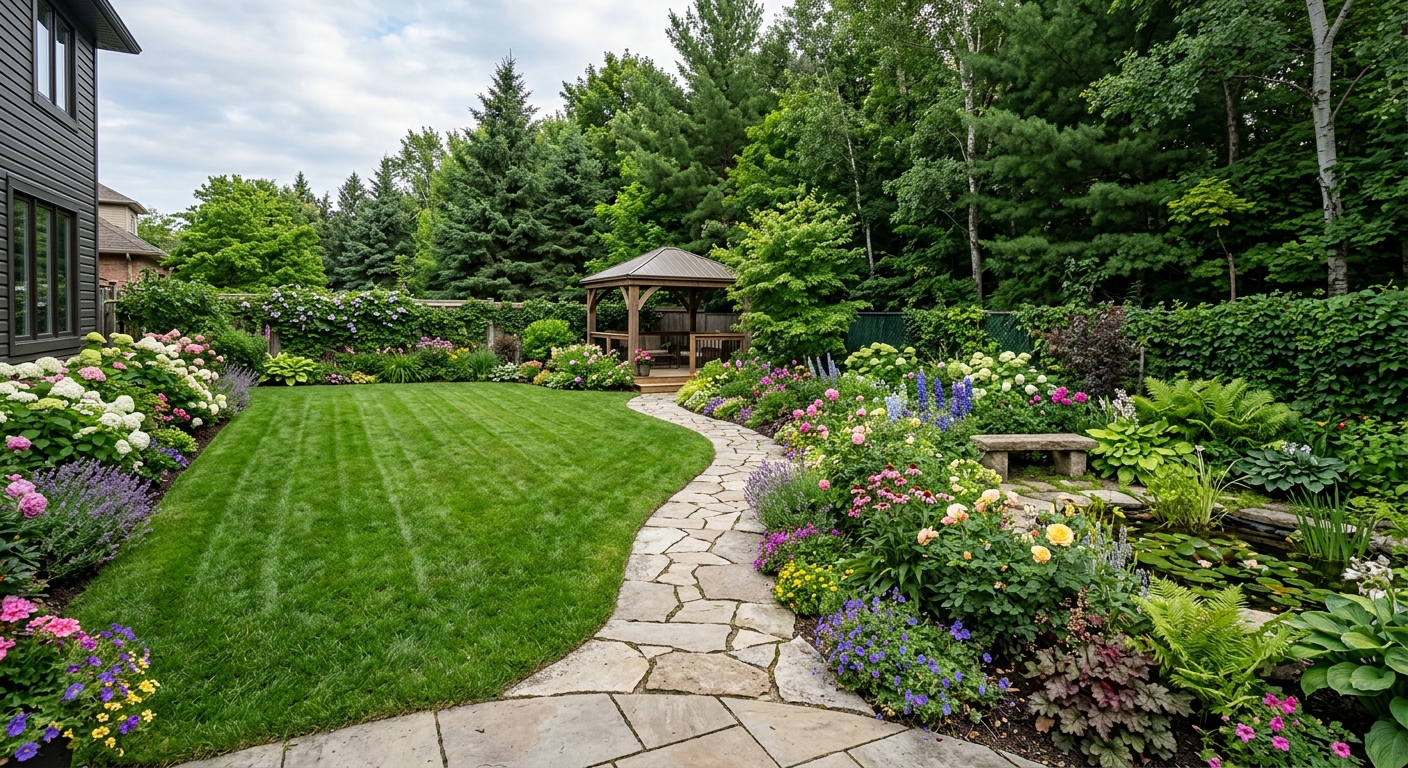
Landscaping options and costs in King East
King East, Ontario is where tidy cul-de-sacs and older neighbourhoods meet mature lots—so homeowners often want landscapes that look polished quickly, then hold up through Toronto’s freeze–thaw winters. With a local population of 2,040 (Statistics Canada, 2021 Census), there’s enough demand to keep crews busy, but not so much that you’ll always get immediate scheduling. In practice, many homeowners in King East are investing because detached and semi-detached properties typically offer yard space for planting beds, patios and drainage improvements—exactly the kind of “curb appeal + function” projects that raise both enjoyment and resale confidence.
Toronto-area landscaping costs are shaped by the climate and soil. The GTA largely falls in plant hardiness zones 6a–7a, with winter lows that can sit around –23 to –18°C and humid summers that encourage lush growth—but also stress plants and lawns. Freeze–thaw cycles drive structural prep costs: patios, steps and retaining walls need deeper, well-compacted granular bases and proper drainage so they don’t heave. Clay and fill soils can require excavation, soil amendment and sometimes subdrains, which is a common reason two “similar” yards come in at different totals.
If you’re seeing repeat work in the area, it’s often around the King City / Schomberg corridor—home to many larger lots that benefit from long-term planting plans and hardscape upgrades. Below is a practical cost comparison to help you line up scope and budget before you request quotes.
| Service |
Description |
Season |
Price Range |
| Full landscape design and installation |
Concept plan, plant layout, grading notes (if applicable), hardscape/softscape build, cleanup |
Spring to fall (often May–October) |
$8,000–$40,000 |
| Sod installation (supply, grade, lay, roll) |
Site prep, topsoil/fine grade correction, sod delivery and installation, initial watering guidance |
Late spring to early fall |
$2,500–$8,000 |
| Lawn seeding (grade, seed, starter fertilizer) |
Light regrade, seed selection, starter fertilizer, mulching (where needed), first-season care |
Spring and early fall |
$1,200–$6,500 |
| Interlocking patio or walkway |
Base excavation, compaction, geotextile/geogrid as needed, pavers/stone, edge restraints |
Spring to fall |
$6,000–$30,000 |
| Retaining wall (interlocking block) |
Wall layout, excavation, proper drainage behind wall, block installation and finishing |
Spring to early fall |
$6,000–$30,000 |
| Tree and shrub planting |
Planting, soil amendment, staking (if needed), mulching, initial watering plan |
Spring and fall (best success) |
$800–$6,000 |
Prices are estimates only and vary by project scope, site access and material selection.
What affects the price of landscaping in King East
In King East and across the Toronto area, it’s common to see quotes for the “same” landscaping scope vary by 30–50%. The biggest reason isn’t profit—it’s the unseen work: how much excavation is required in clay/fill soils, whether drainage needs fixing, and what it takes to build for freeze–thaw movement. Labour availability also shifts throughout the busy season, and paver/stone inventory can affect timelines and cost.
Just as importantly, local growing conditions define both what survives and when crews can work. The GTA’s plant hardiness zones 6a–7a mean we can use a wider palette than colder regions, but winter lows (near –23 to –18°C) still influence plant size, hardiness and protection strategies. Frost timing (roughly May to October as a practical frost-free window) sets the installation window. By comparison, Prairie regions (zone 2–4) face shorter seasons and frequent drought, which typically drives more drought-tolerant designs and a different plant palette; retaining wall footings there often need a different approach because of deeper freezing. Coastal BC may allow lush, broader planting palettes, but heavy rain makes drainage detailing essential; the dry BC interior often adds cost through drip irrigation and xeric plant selection. In southern Ontario, the “moderate” growing season still demands irrigation during summer dry spells, and turf establishment choices can move the needle within a typical $2,500–$8,000 sod band.
Two examples you’ll feel in King East: (1) upgrading a sloped front yard from water pooling to controlled flow often adds grading and drainage bed work before any patio goes in, increasing the project cost even when the visible pavers look similar; (2) replacing compacted fill with engineered soil layers and adding proper geotextile/geogrid for hardscapes can move a walkway from a “small job” into the $6,000–$30,000 hardscape band. If your home has older drainage patterns or clay subsoil, the foundation-protection aspect becomes a cost driver—often comparable to the difference between a basic refresh and a full landscape installation at $8,000–$40,000.
| Price Factor |
Why It Matters |
Cost Impact |
| Yard size in sq ft — the primary cost driver for softscape |
More area means more topsoil, amendments, seed/sod, labour hours and material delivery |
Small lots can be near the low end; larger lots commonly push totals toward the upper bands |
| Grading and drainage work — slope corrections add significant cost |
Toronto clay often needs re-contouring so water sheds away from foundations |
Can add substantial labour and machine time, often increasing the overall project by 20–40% |
| Drainage bed or French drain installation |
Reduces pooling, controls groundwater and protects hardscape stability |
Typically one of the larger “must-do” hidden items in wet sites |
| Plant material tier — native shrubs vs. ornamental vs. mature specimen trees |
Mature trees and premium ornamentals cost more and need careful handling |
Moves the job up quickly; swapping tiers can change totals by thousands |
| Hardscape vs. softscape ratio — walls and patios cost more per sq ft than lawn |
Pavers/stone require excavation depth, base, compaction and restraints |
Hardscape-heavy yards often land closer to the $6,000–$30,000 bands |
| Irrigation system design and installation |
Sprinklers need correct coverage; irrigation reduces summer stress and labour for turf care |
Can add meaningful cost but prevents patchy turf and plant loss |
| Soil amendment and topsoil required |
Improves rooting and drainage in clay/fill soils; affects long-term lawn/plant health |
Often increases cost after site testing or excavation reveals poor subgrade |
| Tree removal or stump grinding before new planting |
Access, equipment and disposal time add labour and sometimes multiple visits |
Can shift a planting-only quote upward into higher tree/shrub planting totals |
Permits & regulations in Ontario
In Ontario, most landscaping—such as planting beds, sodding, seeding, mulching and typical softscape work—generally does not require a permit. However, there are two big areas where permits may come into play in King East: (1) retaining walls above a height threshold (commonly around 1.0 m, or 3.3 ft, in many municipalities), and (2) work that changes lot grading and drainage patterns in a way that could affect neighbouring properties or how stormwater is managed. Because rules can vary by municipality and the exact scope, the safest approach is to confirm requirements with the local building department before construction starts.
Here’s how to verify your contractor’s work meets Ontario expectations. First, ask whether they will pull any required permits for retaining walls or grading changes and whether that cost is included. Second, make sure they arrange utility locates before digging—this applies to wall footings and planting holes, and it helps prevent service strikes. Third, confirm irrigation and water-use expectations with your area’s bylaw context; Toronto-area water planning often tightens during drought-like conditions (and even when restrictions aren’t severe, smart irrigation design protects plants and helps avoid waste).
To protect yourself as a homeowner: check the contractor’s Ontario business profile/licensing information online, request a current certificate of liability insurance naming you as additional insured where applicable, and ask for proof of WSIB/WCB coverage (or the appropriate coverage status for the company). Also request a clearance letter or account verification, and keep copies with your signed contract.
Planning a landscape that thrives in King East's climate
For King East yards, plan for the hardiness zone realities (zones 6a–7a) and the way Toronto soils behave during freeze–thaw cycles. The goal is not “fight the weather,” but build structure and planting layers that tolerate winter lows (often around –23 to –18°C), then handle humid summers without constant rework. Start with plant selection: choose zone-appropriate and, where feasible, native species that don’t require heavy winter protection or frequent watering. This reduces replacement risk and helps you keep long-term costs nearer the middle of typical project bands.
Next, choose sod versus seed based on your timeline and budget. Sod gives immediate visual results, but it costs roughly 3–4x per sq ft compared to seeding because you’re paying for harvested turf, delivery and intensive installation labour. Seeding is more budget-friendly and can be very effective for lawns that can be maintained through establishment, but it takes longer to look “finished.”
Drainage and grading matter in Toronto more than many homeowners expect. Proper slope away from the house, cleanout-safe drainage details, and correct base preparation for patios and retaining walls protect both foundations and hardscape stability. Finally, use low-maintenance strategies: mulch rings, groundcovers, and perennials with staggered bloom reduce annual upkeep while keeping curb appeal strong.
Where water efficiency matters, consider a rain garden in low spots or a xeriscape-style edge with drought-tolerant perennials and deep mulching—especially helpful if your yard has sunny, dry exposure. A simple dollar example: if sod installation for your front lawn pushes toward the $2,500–$8,000 band, switching part of the lawn to seed (or targeted sod only on high-visibility strips) can justify the added material cost where you need instant coverage, while keeping overall spend more controlled.
| Element |
Climate Consideration |
Maintenance Level |
Price Band |
| Sod lawn installation |
Fast establishment before heat and summer dry spells; requires good grading and starter watering in zone 6a–7a conditions |
Medium (water and monitor early) |
$2,500–$8,000 |
| Native perennial garden |
Winter-hardy structure for freeze–thaw; perennials re-emerge reliably with mulch protection |
Low to medium (weeding first year) |
$1,500–$7,000 |
| Mulched shrub border |
Helps moderate soil temperature and moisture through Toronto summers and winter freeze cycles |
Low (occasional topping up mulch) |
$800–$6,000 |
| Interlocking stone patio |
Needs correct base depth and drainage so joints don’t heave during winter cycles |
Low (periodic cleaning) |
$6,000–$30,000 |
| Retaining wall (block) |
Proper drainage behind the wall prevents freeze-driven movement and water pressure |
Low (annual inspection of weep holes and cap) |
$6,000–$30,000 |
| Drip irrigation system |
Supports targeted watering for perennials and young trees; useful during humid summers and dry spells |
Low (seasonal checks and winter blowout planning) |
$1,800–$7,500 |
How to choose a landscaping contractor in King East
Choosing a contractor carefully is one of the best ways to prevent budget surprises in King East. Start with Ontario compliance: ask for their Ontario business profile/licensing information (many homeowners check the online business registry), confirm their liability insurance certificate is current, and request proof of WSIB/WCB coverage. Where possible, ask for the account verification or clearance letter so you can be confident they’re properly covered for on-site work. If they can’t provide documents quickly, that’s a warning sign.
Next, insist on 2–3 itemised written quotes. You want a breakdown that separates labour and materials, not one lump sum. Look for clarity on what’s included: disposal (topsoil spoil and debris), geotextile/geogrid, edging, base depth, drainage connections, and whether a permit is required and included in the price. For retaining walls, ask specifically about drainage behind the wall (weep holes, drainage rock and filter fabric).
Warranty is where you protect your investment. Ask how long their workmanship warranty lasts, whether it covers settling or movement, and whether manufacturer warranties for materials (pavers, stone, sod) are transferable. Don’t rely on verbal promises—get it in writing.
Payment schedule matters: never pay more than 10–15% upfront. Hold back a portion until the site is cleaned, graded correctly, and walkways/patio edges are finished to spec. Finally, get a start date and a completion estimate in writing, including weather contingencies for the Toronto frost-free window.
- Request proof of Ontario licensing/business registration details and keep a copy
- Verify liability insurance is current and ask who is named on the certificate
- Confirm WSIB/WCB coverage status (account verification/clearance letter)
- Get 2–3 itemised quotes: labour + materials, with quantities
- Ask for base spec details (excavation depth, compaction, restraints)
- Confirm drainage scope: grading, downspout routing, French drain if needed
- Ensure disposal is included (excavated soil and construction debris)
- Check whether permits are included for retaining walls or grading changes
- Get the warranty terms in writing (workmanship + material/manufacturer)
- Use milestone payments; never exceed 10–15% upfront
- Require a written timeline with weather-based pauses
- Review site access plan (equipment paths, protection for driveways/sidewalks)
In King East, common red flags include: (1) refusing to provide insurance/WSIB/WCB documentation, (2) giving only a lump sum without explaining base, drainage or material specs, (3) “guaranteeing” exact completion dates without weather contingencies, (4) starting without confirming utility locates, and (5) demanding large upfront payments beyond 10–15%.
Frequently asked questions — landscaping in King East
How much does professional landscape design cost?
In King East, professional landscape design is usually priced based on the level of detail (concept only vs. full planting + construction-ready drawings) and how much of the yard is included. Many homeowners budget within the broader design-and-install range, especially when they also want contractors to build the plan. For context, full landscape design and installation commonly lands in the $8,000–$40,000 band in the Toronto area, and that’s often where design value shows up because it ties directly into materials, hardscape specs and plant selection for zones 6a–7a. If you only want design (no build), expect the cost to be lower than a turnkey project, but still reflect site measuring, drawings and plant lists.
How do I compare landscaping quotes?
To compare landscaping quotes in King East, don’t just look at the total—compare what’s actually included. Ask each bidder for an itemised breakdown: topsoil/soil amendment quantities, drainage/grading scope, base prep specifications for patios/walkways, plant quantities and whether they’re native or ornamental, and disposal. Compare season timing too: sod and seeding have different windows, and proper base work matters for freeze–thaw. If one quote is near the sod band of $2,500–$8,000 but skips grading correction or drainage beds, it may fail faster and become more expensive later. Similarly, compare hardscape base depth and compaction details—those are often the hidden cost drivers in the $6,000–$30,000 hardscaping range.
How long does a landscaping project take in King East?
Project timelines in King East usually depend on scope and weather, but most backyard landscapes can be completed within a few days to a few weeks once the season is underway (generally May–October). Sod and seeding are often fastest—sod installation is commonly a matter of days for typical lots, while seed requires establishment time before it looks fully “done.” Patios, walkways and retaining walls take longer because excavation, base build, and drainage details can’t be rushed, especially under freeze–thaw considerations. A full landscape at the $8,000–$40,000 level often includes multiple phases (site prep, drainage/grading, hardscape build, then planting and final soil top-up). Your contractor should provide a written start date, milestones and a weather plan.
What is the best grass type for a King East lawn?
For most King East lawns, homeowners do best with a cool-season turf suited to southern Ontario’s seasonal swings and winter freeze–thaw. In practice, that usually means perennial ryegrass blends and/or Kentucky bluegrass mixtures, because they balance colour, density and traffic tolerance. The “best” mix depends on how sunny the yard is, how you maintain it and whether drainage is solid. If your yard tends to stay wet or is compacted clay, the biggest improvement often comes from correcting grade and drainage before you pick a grass type. Costs also differ: if sod is chosen for instant coverage, it typically sits in the $2,500–$8,000 range, while seeding is usually a more budget-friendly alternative that trades instant look for longer establishment time.
When should I aerate and overseed my lawn in King East?
Aeration and overseeding in King East are typically timed for spring or early fall, aligned with the practical growing window (about May to October). Aerate when the grass is actively growing so it can fill in, and aim for mild weather that supports germination and rooting. Overseed after aeration for better seed-to-soil contact, and follow up with starter fertilizer and light top-dressing only if recommended for your soil conditions. If your lawn has recurring thinning because of compaction or drainage issues, aeration alone won’t solve it—grading and soil amendment are often the real fix in Toronto clay areas. If you’re considering a full lawn reset, compare whether it’s smarter to seed now or to budget for sod in the $2,500–$8,000 band for immediate results.
What trees grow best in King East's climate zone?
King East sits in a zone similar to the broader GTA zones 6a–7a, so many hardy, well-adapted deciduous trees do well when planted in properly amended soil and protected through the first few winters. Common successful choices include serviceberry (Amelanchier), red maple varieties suited to local conditions, and hardy ornamental options like crabapples. For a more structured look, homeowners also select trees that tolerate urban soils and clay, plus proper planting depth and staking only when needed. The best “tree” depends on your yard’s sunlight, wind exposure and whether drainage is adequate. If you’re planning a larger planting, the tree and shrub planting budget often sits in the $800–$6,000 band depending on quantity and plant size.