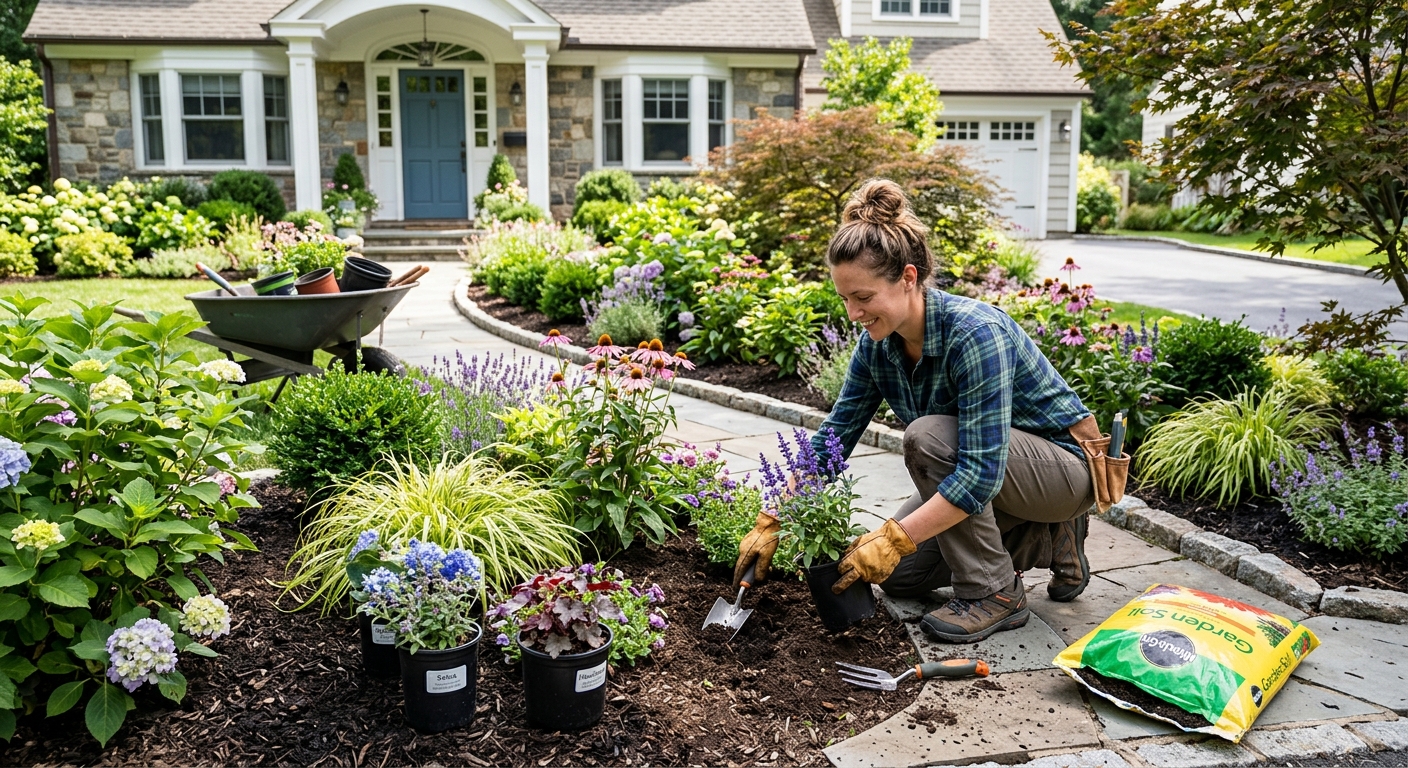
Landscaping options and costs in LaSalle
LaSalle, Ontario is a great place to upgrade curb appeal, especially because so many homes are owned and supported by long-term yard investment. With 91.4% of local households owning their homes (Statistics Canada, 2021 Census), and 84.4% of dwellings being single-detached homes—meaning most properties have real garden space—homeowners commonly budget for bigger projects like patios, new plantings, and drainage improvements. In Windsor–Sarnia, the climate typically supports a broad planting palette in Canadian plant hardiness zones 6b–7b, but contractors still price for freeze–thaw impacts, heavy clay soils in many areas, and the labour needed to build correct bases under patios and retaining walls. That’s why two neighbours can receive quotes that differ meaningfully even when they’re asking for “the same size” project: grading, soil conditions, and access (driveways, fencing, and distance to disposal) change labour and material needs.
In LaSalle, demand is especially steady around newer-growth pockets and established residential streets where homeowners often want faster “finished look” results—such as the area near rue Deziel and the broader Lakeshore corridor—because families want landscapes to mature quickly after construction. Typical contractor scheduling in Windsor–Sarnia is strongest from roughly May to October, with frost still shaping when we can safely dig for footings and drainage beds. With that context, the table below compares common landscaping scopes and the current local price bands.
| Service |
Description |
Season |
Price Range |
| Full landscape design and installation |
On-site visit, concept + layout, grading plan, plant + hardscape install (patio/walkways optional), soil prep, and irrigation/maintenance recommendations |
May–October |
$8,000–$35,000 |
| Sod installation (supply, grade, lay, roll) |
Site grading/low-spot correction, soil amendments, sod supply, rolling/edging, first watering and starter fertilizer |
Late April–October (best in spring/early fall) |
$2,500–$9,000 |
| Lawn seeding (grade, seed, starter fertilizer) |
Light topdressing, seed selection, starter fertilizer, coverage/rolling, and initial watering plan |
April–May or late August–September |
$1,500–$6,000 |
| Interlocking patio or walkway |
Base excavation, compacted stone, polymeric sand, edge restraint, joint stabilization, and clean finish |
May–October |
$6,000–$25,000 |
| Retaining wall (interlocking block) |
Engineered-style base prep (as required by height/conditions), drainage behind wall (weeping tiles/filter fabric), block installation |
May–October |
$6,000–$40,000 |
| Tree and shrub planting |
Soil amendment, planting, mulching, staking as needed, and watering plan (including seasonal checks) |
May–October |
$1,500–$10,000 |
Prices are estimates only and vary by project scope, site access and material selection.
What affects the price of landscaping in LaSalle
In Windsor–Sarnia and across Southern Ontario, quotes for the same general project can vary by 30–50% because the “real scope” often changes once we’re on site. Planting beds and lawns look simple, but grading, drainage, and soil structure usually decide how much base material, labour time, and rework are required. In zone 6b–7b, freeze–thaw cycles and late-season moisture still matter, so contractors can’t simply “build it up and hope.” By contrast, Prairie regions (Zone 2–4) face shorter growing seasons and harsher cold, which often pushes designs toward drought- and wind-tolerant species and more reliable establishment schedules; coastal British Columbia (Zone 7–8) can grow a larger palette and longer seasonally, but heavy rain demands strong drainage detailing. In LaSalle, the working window is typically May–October, yet irrigation needs rise during summer dry spells, especially with newly sodded lawns or new plant beds.
Concrete examples from LaSalle that raise costs: (1) heavy clay that holds water can require additional drainage work; adding a French drain or drainage bed can move a “softscape” job toward retaining-wall pricing territory. (2) Yard grading correction—fixing slope away from foundations or rebalancing runoff—can add several days of excavation and stone supply. (3) Older homes built before 1981 represent 31.6% of the housing stock (Statistics Canada, 2021 Census), and many of those properties have mature trees, older root systems, or undocumented drainage patterns that increase labour. Even with the same intended result, moving from a lawn seed job toward sod installation can change budgets quickly within the local bands—seed-and-establish projects often start around the lower end of the tree/garden planting and seeding ranges, while sod typically lands in the $2,500–$9,000 band depending on square footage and grading needs. Hardscape elements like patios and retaining walls also tend to land in the $6,000–$40,000 range when base preparation and drainage are included.
| Price Factor |
Why It Matters |
Cost Impact |
| Yard size in sq ft — the primary cost driver for softscape |
Materials (topsoil, mulch, seed/sod) and labour scale directly with area |
Low to very high; large lots can multiply total costs |
| Grading and drainage work — slope corrections add significant cost |
Prevents water pooling against foundations and reduces freeze–thaw damage |
Often increases budgets substantially versus a “flat yard” scenario |
| Drainage bed or French drain installation |
Improves soil structure and directs water away from walls/house |
Can shift a job from typical softscape pricing into hardscape-level totals |
| Plant material tier — native shrubs vs. ornamental vs. mature specimen trees |
Plant size and provenance affect supply cost, handling, and staking needs |
Moderate to high; mature specimens can dominate the material budget |
| Hardscape vs. softscape ratio — walls and patios cost more per sq ft than lawn |
Base excavation/stone and block/paver installation are labour-intensive |
High when adding patios, walkways, or retaining walls |
| Irrigation system design and installation |
Spray/drip selection must match soil type, plant height, and sun exposure |
Moderate; increases cost but improves survival and reduce callbacks |
| Soil amendment and topsoil required |
Heavy clay may need imported topsoil and targeted amendments for rooting |
Moderate; varies widely with starting soil quality and depth |
| Tree removal or stump grinding before new planting |
Access, root mass, and disposal determine labour hours and equipment needs |
Low to very high; can add days and specialized equipment |
Permits & regulations in Ontario
In Ontario, most planting, sodding, and typical softscape work (like mulch, seed, shrub beds, and walkway/patio installation) usually does not require a permit. The main permitting triggers for residential landscapes tend to be when you change structural elements or lot drainage in ways that affect neighbours or storm systems. In many Ontario municipalities, retaining walls over about 1.0 m (3.3 ft) typically require a building permit, and some cases may also call for engineered drawings depending on wall height, soil conditions, and how the wall is constructed.
Grading changes that alter how water drains—especially toward neighbouring properties or toward storm sewer connections—can also require approval. Before any digging (planting holes, footings, drainage bed trenches), confirm utility locates through the proper 811 process. If you’re adding an irrigation system, be mindful of local water-use bylaws; while those vary by authority and season, the general expectation is to limit unnecessary watering during restrictions.
To verify a contractor for LaSalle projects, start with their Ontario business profile/licence details (where applicable) and confirm they carry liability insurance and workers’ compensation coverage (WSIB/WCB). Then ask for a certificate of insurance showing coverage is active and adequate for landscaping work (including equipment and subcontractors). For contractor professionalism, request proof of clearance/coverage status before work begins; a legitimate company can provide documentation promptly. Finally, confirm who pulls any required permit, if applicable, and get that responsibility clearly stated in the contract.
Planning a landscape that thrives in LaSalle's climate
Planning for LaSalle means selecting plants and building details that work with zone 6b–7b conditions and the Windsor–Sarnia frost timeline—rather than fighting winter. Start with plant selection: choose zone-appropriate, hardy shrubs and perennials that tolerate our freeze–thaw cycles and don’t demand constant winter protection. Native and zone-appropriate species generally handle local winters better and can reduce watering once established. Next, decide sod vs. seed. Sod creates an instant, mature-looking lawn, but it costs roughly 3–4 times more per square foot than seeding when you compare typical project totals. In your case, that price difference can be justified if you need curb appeal quickly or you’re trying to prevent erosion on a freshly graded slope; otherwise, seeding is often the more cost-effective path to a healthy lawn.
Drainage and grading are the biggest “make-or-break” items in Windsor–Sarnia. Pooling water can lead to winter heaving and foundation moisture, particularly where clay soils hold water. When planning patio base and retaining walls, proper excavation, compacted base material, and drainage behind hardscape are essential to resist frost movement. For low maintenance, aim for groundcovers, mulched shrub borders, and perennials that repeat reliably—then limit annual upkeep by using mulch depth, edging, and weed-suppression where appropriate.
If you want water-smart upgrades, consider a rain garden in a low point of the yard, plus drip irrigation for shrubs and trees. Even without extreme xeriscaping, targeted irrigation reduces waste during summer dry spells while still keeping establishment on track. For a dollar example: if your lawn goal is 500 sq ft, seeding may land closer to the low-to-mid end of $2,500–$9,000 only when larger grading and sod-like prep are needed; a straightforward sod job of similar scope commonly lands in that sod band once supply, grading, and installation are included. Where the cost is not justified is when sod is installed on poor grade without correcting drainage—better to fix the slope first and then choose sod or seed.
| Element |
Climate Consideration |
Maintenance Level |
Price Band |
| Sod lawn installation |
Fast establishment before summer dry spells; needs correct grade to prevent pooling |
Low to moderate after establishment; higher watering during first weeks |
$2,500–$9,000 |
| Native perennial garden |
Zone-appropriate hardiness improves winter survival and reduces protection needs |
Low after year one; seasonal trimming and mulching |
$1,500–$10,000 |
| Mulched shrub border |
Mulch helps buffer soil temperature swings and supports consistent moisture |
Low; weed control and occasional pruning |
$1,500–$8,000 |
| Interlocking stone patio |
Base must be frost-resilient to limit heaving and joint failure |
Low; periodic joint replenishment and occasional cleaning |
$6,000–$25,000 |
| Retaining wall (block) |
Freeze–thaw demands stable base and drainage behind the wall |
Low; visual checks and vegetation management |
$6,000–$40,000 |
| Drip irrigation system |
Improves summer moisture control and reduces water use versus spray in many beds |
Moderate; seasonal start-up and winterization checks |
$1,200–$6,500 |
How to choose a landscaping contractor in LaSalle
Choosing the right contractor matters in LaSalle because the “hidden” costs—grading, drainage, base prep for hardscape, and soil amendments—are where quality shows up (or fails). First, verify coverage and credentials. For liability insurance, ask for a current certificate of insurance and confirm the coverage includes landscaping/hardscape activities and matches your job’s scope. For workers’ compensation, request proof of WSIB/WCB coverage (and clearance where applicable) so you’re not exposed if a worker is injured on your property. Then ask whether they use subcontractors; if they do, the company should confirm subcontractor coverage too.
Get 2–3 itemised written quotes, not just a lump sum. A good quote breaks down labour and materials (e.g., excavation, base stone, geotextile, pavers/blocks, drainage components, topsoil/compost, plant quantities, and disposal). Read the scope carefully: is permit pulling included if a retaining wall requires one? Is disposal/haul-away included? Are excavation spoils hauled, or only spread on site? Is irrigation included, and if so, where are the waterlines tied in?
Warranty is another deciding factor. Ask for the workmanship warranty length and what it covers (settlement, lifted pavers, block movement, plant replacement timeframe). Confirm whether product warranties are manufacturer-based and whether you can claim them directly. Payment schedule matters: never pay more than 10–15% upfront; hold back a portion until completion and cleanup are verified. Finally, demand a written timeline with a start date and realistic completion estimate, plus a weather contingency plan for frost or heavy rain delays.
- Provide a current COI (certificate of insurance) for liability and list job-site address.
- Show WSIB/WCB clearance/coverage proof before work starts.
- Use itemised quotes (quantities, unit prices, and labour line items).
- Spell out exclusions: disposal, topsoil depth, irrigation components, and re-grading scope.
- Confirm base specs for patios/walkways/retaining walls (stone type, depth, compaction method).
- Include drainage details (filter fabric, weeping tile, stone behind walls) where applicable.
- Ask who handles utility locates and where digging will occur.
- Request start/completion dates in writing, not just “weather permitting.”
- Set a payment schedule with limited upfront deposit (10–15%) and holdback.
- Review warranty terms in plain language (workmanship and plant replacement).
- Confirm cleanup responsibility and disposal/haul-away in the contract.
- Ask for references from similar LaSalle projects (sod + grading, retaining walls, or drainage).
Red flags to watch for: a quote that’s mostly non-specific (no quantities or base construction details), unwillingness to provide insurance/WSIB proof, no written warranty terms, change orders only communicated verbally, and “quick schedule” promises without a written weather contingency plan.
Frequently asked questions — landscaping in LaSalle
How much does landscaping cost in LaSalle?
In LaSalle, most homeowner projects land within the local Windsor–Sarnia price bands depending on how much grading, drainage, and hardscape you’re adding. A full landscape design and installation commonly falls around $8,000–$35,000 when plants, soil prep, and hardscape elements are included. For lawn upgrades, sod supply and installation often sits in $2,500–$9,000, while drainage-heavy grading can push total costs higher because excavation, stone, and labour increase. Retaining walls and other hardscaping are typically the biggest budget items; retaining walls can range up to $6,000–$40,000 when drainage behind the wall and proper base prep are included.
What plants thrive in LaSalle's climate zone?
LaSalle sits in Canadian plant hardiness zones 6b–7b, which means many reliable shrubs and perennials from Ontario do well when they’re selected for hardiness and planted in properly prepared soil. In practice, you’ll get better results by choosing zone-appropriate varieties (hardy enough for winter) and pairing them with correct spacing, mulching, and watering during establishment. Because many yards have clay soils, we often recommend amending planting areas to improve drainage at the root zone rather than relying on heavy soil alone. For homeowners, the “thriving” approach is usually a mix: sturdy native or hardy ornamentals for structure, plus perennials for colour—then groundcovers to reduce weeds. Contractors in LaSalle commonly plan around freeze–thaw and early spring start times, so you’ll see strong performance when planting happens in the May–October window.
Sod vs seed — which is better for a LaSalle lawn?
Both can work well in LaSalle, but the best choice depends on your timeline and your site conditions. Sod gives instant visual results and faster coverage, which is valuable if your yard is newly graded or prone to erosion. However, it’s typically more expensive than seeding and can land in the $2,500–$9,000 sod band once supply, grading, and installation are included. Seeding is usually the more budget-friendly option and can be excellent if you can manage consistent moisture during germination. If your grade is off or water pools, neither sod nor seed will perform long-term—fix drainage first. In Ontario’s Windsor–Sarnia climate, we generally see strong results when seeding is timed for spring or late summer and when sod is installed when the ground can be prepared and watered reliably through establishment.
How much does a retaining wall cost in LaSalle?
A retaining wall in LaSalle often costs more than homeowners expect because it’s not just the blocks—it’s the base, compaction, and drainage behind the wall that protect against freeze–thaw movement and water pressure. Interlocking block retaining walls commonly fall in the $6,000–$40,000 local range depending on wall height, length, accessibility, and soil conditions. If a site needs significant grading correction or additional drainage components (like filter fabric and weeping tile systems), budgets tend to move toward the higher end. Also remember that if the wall is above typical thresholds (commonly around 1.0 m in many Ontario municipalities), a building permit and possibly engineered details may apply—those steps can add time and cost. A good contractor will include drainage and base specs clearly in the quote.
When is the best time to landscape in LaSalle?
The best time for landscaping in LaSalle is typically May through October, because frost and soil temperatures limit excavation and installation early in the season. Spring and early fall are especially valuable for lawn work—sod and seeding both benefit from more consistent moisture and moderate temperatures. For planting shrubs and trees, May–October generally gives roots the time they need to establish before winter. For hardscaping like interlocking patios and retaining walls, you want dry enough conditions to build a stable, compacted base and complete drainage details before heavy freeze conditions. If you’re planning drainage corrections or wall base work, working in the main installation window reduces the risk of delays and helps ensure materials are installed properly. For most homeowners, scheduling early summer work is a smart way to secure availability.
Do I need a permit for a retaining wall in Ontario?
In Ontario, permit requirements for retaining walls depend on height and how the wall is engineered and constructed in your municipality, but it’s common that retaining walls above about 1.0 m (3.3 ft) require a building permit. Some cases may also need engineered drawings, especially if site conditions are complex (soil variability, required stability for larger walls, or significant grade changes). Softscape work like planting and typical sod installation usually does not require a permit. You should also consider that changes to lot grading affecting drainage toward neighbouring properties or drainage connections can trigger approvals. For any digging, ensure utility locates are done before installing footings or drainage lines. The safest approach is to ask your LaSalle contractor to confirm the permit pathway for your specific wall height and site plan in the written proposal.