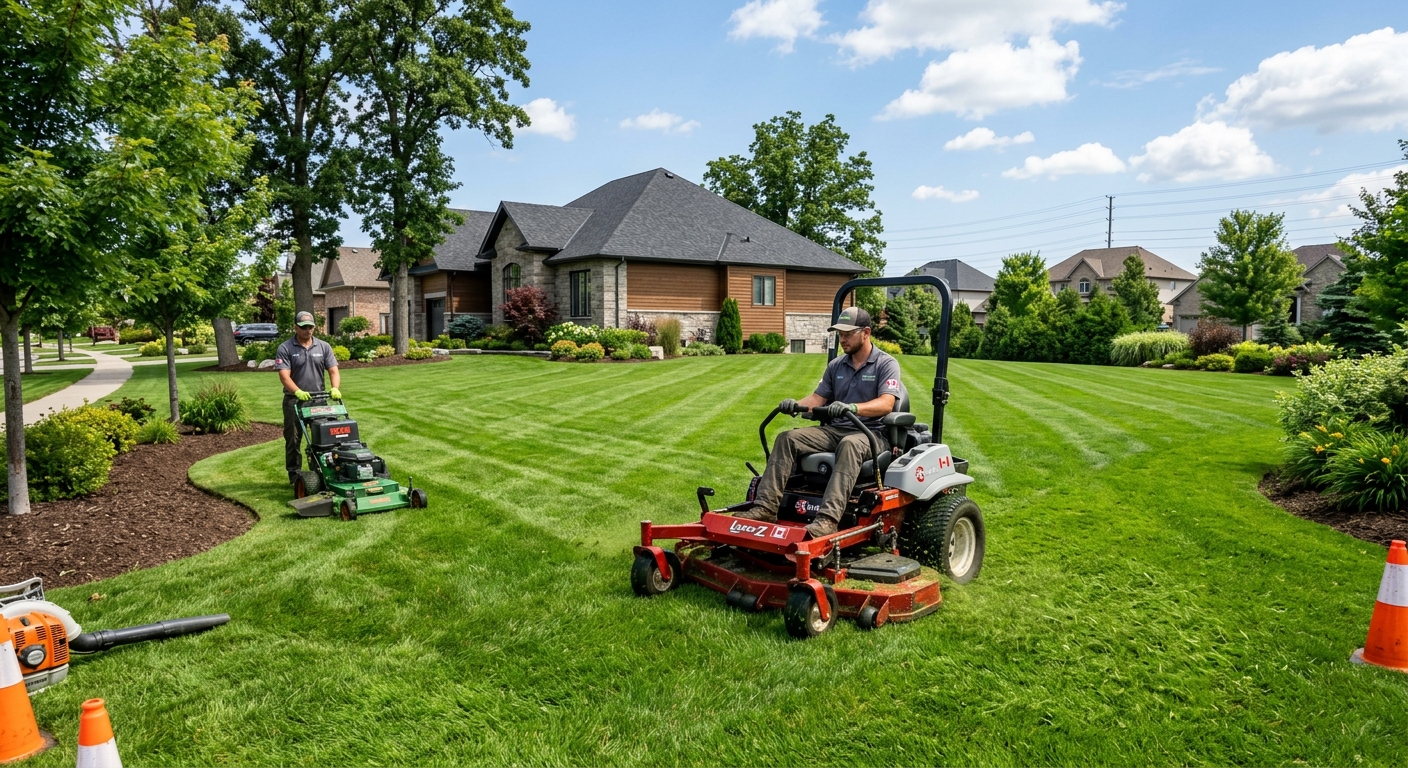
Landscaping options and costs in Little Current
Little Current homeowners can choose from simple refreshes to full front-yard makeovers, but your costs will largely depend on the size of the property and how much of the work is softscape versus hardscape. With a population of 2,156 (Statistics Canada, 2021 Census), the local contractor pool is smaller than Toronto proper, so scheduling and site-day availability can affect turnarounds and final pricing. Also, many homes are set up like family properties with room for yards and gardens—an ownership pattern that typically makes landscaping improvements a priority during re-sodding, spring curb-appeal updates, or after long driveway/grade adjustments.
In the Toronto region, landscaping pricing is shaped first by climate and soil: hardiness zones around 6a–7a mean we can build durable planting palettes, but crews still work within a frost-free stretch that’s roughly May to October. Freeze–thaw cycling and drainage needs add labour to patios, steps, and retaining walls because bases must be compacted and properly drained. In many local clay/fill conditions, we may need excavation, soil amendment, and sometimes subdrains to protect both hardscape and foundation edges, which increases material haul and labour time compared with milder climates.
Demand is especially steady in neighbourhoods close to the waterfront and main residential corridors—where homeowners often want improved drainage, cleaner lines, and plants that look good after winter storms. Once you’ve picked your direction, it helps to compare typical budget bands across common projects below.
| Service |
Description |
Season |
Price Range |
| Full landscape design and installation |
On-site consult, concept layout, planting plan, grading/drainage coordination, and installation of chosen softscape + hardscape |
Spring to early fall (best window for plant establishment and stone compaction) |
$8,000–$40,000 |
| Sod installation (supply, grade, lay, roll) |
Re-grade, topsoil or base prep as needed, sod supply, lay pattern, rolling, and initial watering setup |
Late spring to early fall |
$2,500–$8,000 |
| Lawn seeding (grade, seed, starter fertilizer) |
Light grading, seed selection, starter fertilizer, seeding, light raking, and establishment watering guidance |
Spring (cooler weeks) or early fall |
$1,500–$5,000 |
| Interlocking patio or walkway |
Excavation, compaction, granular base, geotextile/geogrid where required, interlocking stone + edge restraint |
Late spring to fall (concrete/stone base work depends on weather) |
$6,000–$25,000 |
| Retaining wall (interlocking block) |
Wall layout, excavation and base depth prep, drainage gravel, cap stones, and proper tie-in to grade |
Spring to early fall |
$6,000–$30,000 |
| Tree and shrub planting |
Plant sourcing, soil amendments, staking as needed, mulching, and planting layout for spacing/structure |
Spring and fall (or mild winter planting where practical) |
$800–$6,000 |
Prices are estimates only and vary by project scope, site access and material selection.
What affects the price of landscaping in Little Current
In Little Current and the wider Toronto-area market, two homeowners can receive quotes that differ by 30–50% for what sounds like the “same” landscaping job. The biggest drivers are (1) how much excavation and drainage correction is hidden under the surface, and (2) how labour-intensive the build is for the freeze–thaw season we get in southern Ontario. Even when designs are similar, different contractors price risk differently—particularly around soil conditions, base depth, and how much time is needed for proper compacted granular layers.
Climate and hardiness zone matter because they set both plant choices and the workable installation window. Toronto-area planting (around zones 6a–7a) is more forgiving than Prairie regions (zone 2–4), where shorter growing seasons and drought push designs toward simpler palettes and drought-tolerant, wind-hardy plants; in contrast, coastal BC can support lush, broadleaf structure. Still, Ontario has its own cost reality: freeze–thaw cycles demand deeper bases and better drainage for retaining walls, patios, and steps. In the dry interior of BC or Alberta, irrigation design is constrained by restrictions—often requiring drip and xeric planting—whereas southern Ontario typically relies on seasonal watering plans for establishment during summer dry spells.
Concrete examples that commonly raise costs in Little Current: (a) a clay yard that holds water near a foundation may require re-grading plus a French drain bed; (b) a small retaining wall on a slope may look “easy,” but the base excavation and drainage gravel can quickly push budgets toward the $6,000–$30,000 band; and (c) mature specimen trees with larger root balls can move a planting project from the $800–$6,000 range into higher material and handling time.
Finally, housing age and site conditions influence pricing. Older lots often have legacy fill, compacted lawn, and buried drainage issues; when we’re correcting grade and adding topsoil/soil amendment, the scope can shift noticeably even if the visible plants stay the same.
| Price Factor |
Why It Matters |
Cost Impact |
| Yard size in sq ft — the primary cost driver for softscape |
More area changes materials (sod/seed/topsoil) and crew time for prep, hauling, and installation |
Often the biggest swing factor—can move a project by thousands |
| Grading and drainage work — slope corrections add significant cost |
Pooling and foundation runoff require re-contouring so water moves away safely |
Commonly adds major labour + equipment days |
| Drainage bed or French drain installation |
French drains need excavation depth, perforated pipe, gravel wrap, and proper discharge |
Can push a “lawn job” into full landscape scope |
| Plant material tier — native shrubs vs. ornamental vs. mature specimen trees |
Larger plants cost more and require careful handling, staking, and sometimes root-ball excavation |
Material pricing and labour increase noticeably with size |
| Hardscape vs. softscape ratio — walls and patios cost more per sq ft than lawn |
Stone patios, steps, and retaining walls require base build-up and compaction layers |
Higher per-sq-ft budgets and more sub-systems (edging, caps, drainage) |
| Irrigation system design and installation |
Sprinkler/drip layouts must support establishment watering and avoid wasting water |
Adds equipment + materials; complexity drives the range |
| Soil amendment and topsoil required |
Local clay and fill often need correction for root growth and drainage |
Increases supply, spreading, and grading time |
| Tree removal or stump grinding before new planting |
Stumps block grading and planting; removal can require separate equipment and disposal |
Usually adds a separate cost line item and schedule time |
Permits & regulations in Ontario
For most homeowner landscaping in Ontario, planting, sodding, and typical softscape work do not require a permit. That includes adding shrubs, perennials, mulching beds, topdressing lawns, seeding, and installing garden edging. The two areas that commonly cross into “permit territory” are retaining walls over a height threshold (typically 1.0 m / 3.3 ft in many Ontario municipalities) and any grading changes that materially affect drainage—especially if you’re redirecting water toward a neighbouring property or modifying how surface water connects to municipal storm systems.
In Little Current, the safest approach is to verify the scope early. Step one: ask your contractor whether they are proposing a retaining wall build that exceeds the local threshold and whether they plan to obtain permits before construction. Step two: confirm utility locates are performed before any digging for planting holes, drainage pipes, or wall footings. Step three: confirm any irrigation installation follows local water-use rules (particularly important during summer drought periods—this matters across Ontario even when restrictions are less visible than in the dry interior western regions).
To verify contractor compliance in Ontario, ask for three documents and check they’re current: (1) proof of Ontario business/licence for the work they’re doing (use the public provincial/industry registry search your contractor references), (2) liability insurance certificate showing adequate limits for landscaping/hardscape operations, and (3) WSIB/WCB clearance for the company and trades involved. If the contractor hesitates or provides outdated certificates, treat that as a warning sign and request updated paperwork in writing before work begins.
Planning a landscape that thrives in Little Current's climate
To build a yard that thrives in Little Current, plan around what southern Ontario actually does to plants and structures: winter cold around zones 6a–7a, spring frost risk, summer humidity, and freeze–thaw impacts on stone and block. Start with plant selection. Choose zone-appropriate and, where possible, Ontario-native plants that can handle our winter lows and bounce back after snow-melt swings; they’ll typically require less watering and less winter protection than marginal choices. For lawn, decide between sod and seed based on your timeline and budget: sod gives instant coverage but costs roughly 3–4x per sq ft compared with seeding, because you’re paying for turf supply and thicker installation logistics.
Drainage and grading are the make-or-break details in Toronto-area clay and fill soils. If you get pooling after rain, or water runs toward the foundation, even great plants won’t stay healthy. For patios and retaining walls, base preparation needs to be built for the local frost line behaviour—adequate depth, proper compaction, and drainage layers reduce shifting and heaving. Low-maintenance design strategies also matter: use mulch consistently, repeat a smaller set of hardy perennials, and add groundcovers to reduce bare soil.
When water use is a concern, consider a rain garden or simple runoff-to-beds concept instead of trying to force thirsty plants into wet spots. A practical cost example: if you’re trying to repair 500 sq ft of lawn, seeding is often the better value to hit a budget; but if you need immediate curb appeal before summer events, paying more for sod can be justified because it establishes coverage right away—especially when you pair it with proper grade correction so the new turf doesn’t stay soggy.
| Element |
Climate Consideration |
Maintenance Level |
Price Band |
| Sod lawn installation |
Needs good base prep for freeze–thaw stability; establishment watering is critical during warm stretches |
Medium (initial watering and first-season care) |
$2,500–$8,000 |
| Native perennial garden |
More resilient to Ontario winters; can handle summer humidity with less fuss once established |
Low to medium (spring cleanup and occasional weeding) |
$1,500–$6,000 |
| Mulched shrub border |
Mulch buffers temperature swings and helps reduce winter heaving around roots |
Low (seasonal pruning and topping mulch) |
$800–$4,500 |
| Interlocking stone patio |
Requires compacted granular base and drainage so freeze–thaw doesn’t lift or shift stones |
Low (weeding edges, occasional joint sand refresh) |
$6,000–$25,000 |
| Retaining wall (block) |
Needs drainage gravel behind the wall and base prep suited for frost movement |
Low (periodic inspection of drainage and wall line) |
$6,000–$30,000 |
| Drip irrigation system |
Supports efficient watering for beds; helps avoid over-wetting clay in shoulder seasons |
Medium (seasonal adjustments and winterization) |
$1,500–$6,000 |
How to choose a landscaping contractor in Little Current
When you hire a landscaping contractor in Little Current, verify compliance before you sign anything. For Ontario licensing, ask for their business information and proof of coverage appropriate to their trade scope; for liability insurance, request a current certificate of insurance showing landscaping/hardscape operations. Next, confirm WSIB/WCB coverage by asking for clearance documentation for the company and ensuring subcontractors are covered as well—don’t accept verbal assurance. You should be able to see dates, policy numbers, and coverage limits on the documents provided.
Then, get 2–3 itemised written quotes. The best quotes break labour and materials separately: excavation, soil/topsoil, base/gravel, drainage components, stone products, plant sizes, and delivery/disposal. Avoid “lump sum only” bids because landscaping scopes change when drainage issues appear.
Read the exclusions carefully: is permit pulling included if a retaining wall requires it, is disposal of excess soil and waste included, and who supplies topsoil/soil amendment? Ask for the workmanship warranty length and what it covers (settlement, base issues, workmanship defects) and whether it’s transferable to future owners. For payment scheduling, never pay more than 10–15% upfront; hold back the remainder until the job is complete and deficiencies are corrected. Finally, request a written start date, a realistic completion estimate, and key milestone dates (e.g., after rough grading, after drainage, then final planting/stone).
- Proof of current liability insurance (certificate available)
- WSIB/WCB clearance for the contractor and any listed subs
- Itemised quote with quantities (sq ft, linear ft) for materials
- Clear scope for grading/drainage, including where water will go
- Base build-up specs for patios/walls (depth and compaction layers)
- Separate line items for disposal/hauling and soil imports
- Plant list with common/Latin names and approximate plant sizes
- Warranty details: workmanship term + what’s excluded
- Product/manufacturer warranty documentation where applicable
- Payment schedule with a 10–15% maximum deposit
- Written start date and completion timeline
- Site protection plan (erosion control, protection of existing lawns/edges)
Red flags in Little Current: contractors who won’t provide proof of insurance or WSIB/WCB; quotes without drainage/grading detail (especially for clay lots); pressure for large upfront payments; vague warranty terms (“we’ll fix it” with no duration/conditions); and no written timeline or scope exclusions, leaving you to pay change orders after excavation begins.
Frequently asked questions — landscaping in Little Current
What is xeriscaping and does it suit Little Current?
Xeriscaping is a low-water approach that uses drought-tolerant plants, mulch, and smart soil preparation so the yard needs less summer irrigation. In Little Current/Ontario, it can absolutely work—especially for beds along driveway edges or in spots that dry out quickly after grading—but it should be designed around our actual conditions. In many southern Ontario yards we still get periodic summer dry spells, yet winters and spring rains are also a factor, so you don’t want “zero-humidity” plant choices that look great but struggle after winter. A good compromise is a rain-garden style bed where runoff lands, mixed with native perennials and thicker mulch. If you’re comparing budgets, many homeowners start with a plant-focused approach that can fall within the $800–$6,000 tree and shrub planting band, then add irrigation only where beds truly need it.
How do I plan a low-maintenance yard?
A low-maintenance yard in Little Current starts with fewer, hardier planting choices and better soil and drainage. Begin by choosing zone-appropriate shrubs and perennials for our Toronto-area hardiness band (around 6a–7a) so you’re not constantly replacing winter-damaged plants. Use mulch to suppress weeds and moderate soil temperature swings, and consider groundcovers to reduce bare soil. Next, address grading: if water pools or constantly runs toward the house, even low-maintenance plants will struggle. For lawn, decide whether you need instant coverage—sod typically costs around the $2,500–$8,000 band—versus seeding, which can be less costly and lower input over time. Finally, keep your design simple: repeating plant groupings, clean edging, and a clear maintenance path (spring cleanup, occasional pruning, and topping mulch once a year) will keep your yard looking sharp without taking over your weekends.
How deep should a retaining-wall base be for local frost?
For retaining walls in Little Current, the “right depth” depends on wall height, soil type, and whether you’re building on clay/fill or native ground. In southern Ontario, freeze–thaw is the reason proper base preparation matters: if the base isn’t compacted and drained correctly, walls can settle or bow over time. As a rule, contractors design the base with enough thickness for a compacted granular layer and include drainage gravel behind the wall so hydrostatic pressure doesn’t build up. If a wall exceeds the local permit threshold (commonly around 1.0 m / 3.3 ft in many municipalities), you’ll typically need permitting and possibly engineering, which will specify footing/base requirements more precisely. Because every site’s frost and drainage conditions differ, ask your contractor to provide the wall section details (base layers, drainage, and compaction approach) in writing before excavation.
How much does professional landscape design cost?
In the Toronto region market serving Little Current, professional landscape design is often priced as part of the overall installation budget, especially for projects that include grading, planting plans, and hardscape coordination. For full projects, budgets commonly fall within the $8,000–$40,000 range when design is bundled with installation—this reflects not just drawings, but also the labour planning and build sequencing required for drainage, stone bases, and plant selection. If you’re only looking for concept design, the cost can be lower, but you should confirm whether plant lists, layout revisions, and construction drawings are included. The best way to compare value is to ask for a scope that states what the designer delivers (site plan, planting plan, materials assumptions, and revisions), and then see how it aligns with the installation quote.
How do I compare landscaping quotes?
To compare landscaping quotes fairly in Little Current, start by ensuring each quote includes the same scope—especially grading and drainage. Many price differences come from what’s excluded: disposal of excess soil, topsoil/soil amendment quantities, drainage components, geotextile/geogrid use, and base depth/compaction details for patios and walls. Ask for an itemised breakdown (labour and materials) and quantities like sq ft, linear ft, and plant sizes. Confirm whether permits are included when needed (for example, some retaining-wall projects above the common 1.0 m threshold may require permits) and who is responsible for utility locates. Also compare timelines and warranty terms, not just the total number. If one quote lands near the low end of a band like $6,000–$30,000 for retaining walls, make sure the base build, drainage gravel, and wall caps are truly comparable.
How long does a landscaping project take in Little Current?
The duration in Little Current depends on season, weather, and how complex the site conditions are. Softscape-only updates can move faster, while projects involving excavation, subdrains, and hardscape base builds need more time for compaction, drainage setup, and curing/setting windows. Typically, a partial refresh (planting beds and mulching) may be scheduled within days, while sod and grading projects can take longer because of prep, base correction, and establishment watering requirements. Full landscape design and installation projects are usually staged: first rough grading/drainage, then hardscape base and stone/block work, then planting and top-dressing. In southern Ontario, plan for the fact that installation is most reliable during the warmer May to October stretch; rain and early frosts can affect completion dates. Your contractor should provide a written start date, completion estimate, and milestone schedule so you can see what happens each week.