Landscaping options and costs in Markham
Markham homeowners have a lot of choices, but pricing follows predictable patterns. With a large share of owner-occupied homes in the city—90,545 homeowner households, about 81.7% of all households—many projects are investment-minded, especially where yards support family time and resale appeal. It also helps that single-detached houses make up 56.2% of dwellings, which typically means more frontage and yard area to design, soften, and maintain. Because of that demand, you’ll often find contractors are busiest in spring and early fall, particularly in areas like Unionville and along the corridor toward Markham Road, where mature lots and older neighbourhoods drive upgrades.
In the Toronto region, landscape costs are shaped by climate and soils: we sit in hardiness zones 6a–7a, so we can plant a wider palette than in Prairie regions, but we still deal with deep winter frost and frequent freeze–thaw cycles. That affects both plant selection and hardscape structure. It also means basements of retaining walls, patio bases, and walkway foundations need deeper granular layers, proper drainage, and sometimes subdrains—labour and material items that can raise the mid-range of the budget. On top of that, Markham has a mix of older housing stock; with 18.5% of homes built before 1981, many properties have settled grades or older drainage patterns that require correction during landscaping. All of those factors influence how quickly costs move from a simple “refresh” toward a full backyard rebuild—so comparing scope is essential as you review the options below.
| Service |
Description |
Season |
Price Range |
| Full landscape design and installation |
On-site visit, layout, plant list/specs, grading concept, soil prep, softscape + hardscape installation, cleanup |
Spring to early fall |
$8,000–$40,000 |
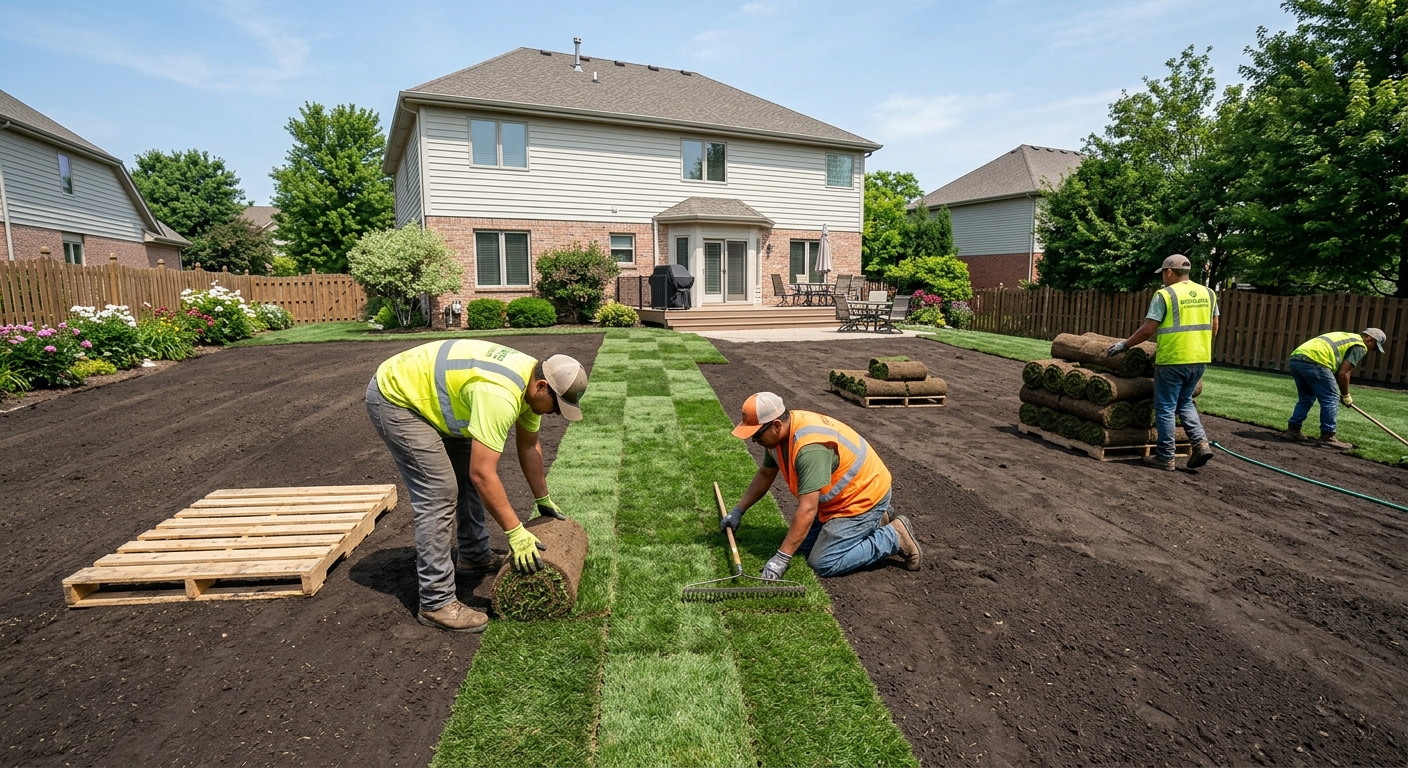
| Sod installation (supply, grade, lay, roll) |
Re-grade as needed, topsoil or amendment, weed control (where specified), sod delivery and placement, rolling and initial watering |
Late spring to early fall (best before first frosts) |
$2,500–$8,000 |
| Lawn seeding (grade, seed, starter fertilizer) |
Light grading, seed blend, starter fertilizer, raking, and watering plan for establishment |
Spring or early fall |
$1,000–$5,000 |
| Interlocking patio or walkway |
Base excavation, compacted granular base, bedding sand, pavers, edging, jointing sand, basic drainage considerations |
Spring to fall |
$6,000–$25,000 |
| Retaining wall (interlocking block) |
Wall layout, excavation, reinforced base/gravel layers, drainage provisions (weep holes/stone), geogrid as required, block installation |
Spring to fall |
$6,000–$30,000 |
| Tree and shrub planting |
Soil prep, planting pits, amendments, staking (if required), mulch rings, and an installation watering plan |
Spring and fall (plus select container installs) |
$800–$6,000 |
Prices are estimates only and vary by project scope, site access and material selection.
What affects the price of landscaping in Markham
Two homeowners in the same Markham neighbourhood can receive quotes that differ by 30–50% for “the same” job because landscaping is rarely identical once you account for yard conditions and how contractors build for Toronto’s freeze–thaw season. Labour rates and availability also matter: spring schedules can be tight, and crews may prioritize larger installs—especially around patios, retaining walls, and major sod removals—when everyone wants the work done before summer heat.
Climate and planting timelines influence what can be installed and how we protect it. In Southern Ontario’s zone 5–6 range, the working window is typically May to October, with frosts pushing work earlier or later depending on weather. The plant hardiness zone and frost dates determine both what survives and when we can reliably plant without losses. Prairie regions (zone 2–4) face shorter seasons and drought/wind pressure, which changes plant palettes and often drives simpler layouts; and for retaining walls there, the base depth typically needs to reach below the frost line. Coastal BC (zone 7–8) supports longer growing seasons and lush palettes, but drainage still has to be done right in heavy-rain municipalities. By contrast, the GTA has frequent freeze–thaw cycles, and that structural reality affects budgets for hardscaping base prep. When contractors price a patio or walkway, they’re not just quoting surface materials; they’re quoting excavation, compacted granular base, and drainage details that keep joints from failing and edges from heaving.
Here are a few common Markham cost swings. First, correcting slope and drainage toward a basement foundation can add $1,500–$5,000+ in grading and soil work. Second, older lots (including many pre-1981 homes) may have compacted fill and unstable subgrade, which can require soil amendment, geogrid, or even a French drain before sod or interlocking goes down—pushing projects toward the higher end of the $6,000–$30,000 retaining wall range. Third, choosing ornamental or mature specimen trees can move a planting budget toward the $800–$6,000 band, while using a native shrub tier typically keeps costs steadier for a larger area.
| Price Factor |
Why It Matters |
Cost Impact |
| Yard size in sq ft — the primary cost driver for softscape |
Most labour and materials scale with area (topsoil, sod/seed, mulch, edging) |
Often the biggest swing factor; small yards may still require minimum crew hours |
| Grading and drainage work — slope corrections add significant cost |
Toronto-area soils and freeze–thaw demand proper pitch away from foundations |
Can add several thousand dollars when major re-sloping is required |
| Drainage bed or French drain installation |
Controls water pooling and reduces freeze–thaw heave under patios/walks |
Raises cost materially due to excavation depth, pipe, stone, and tie-ins |
| Plant material tier — native shrubs vs. ornamental vs. mature specimen trees |
Pricing jumps with size, root ball weight, and transplant difficulty |
Can shift a planting project across the $800–$6,000 band |
| Hardscape vs. softscape ratio — walls and patios cost more per sq ft than lawn |
Pavers/blocks require deeper bases, compaction, and edging and jointing |
High hardscape % can move the job toward the upper portion of local bands |
| Irrigation system design and installation |
Includes water supply checks, routing, sprinkler layout, and sometimes backflow considerations |
Adds cost but improves survival in establishment year and in hot weeks |
| Soil amendment and topsoil required |
Clay and fill may need aeration, compost, and structured topsoil depth |
Can increase delivery and labour, especially for larger beds or re-grade |
| Tree removal or stump grinding before new planting |
Impacts access, disposal, and sometimes replacement layout |
Can add a notable line item before planting can begin |
Permits & regulations in Ontario
In Ontario, most planting, sodding, and softscape work typically does not require a permit. That includes tasks like laying sod, installing topsoil for gardens, planting trees/shrubs, and building walkways or garden beds that don’t change lot grading in a regulated way. The work that more often DOES require a permit is retaining wall construction above the local height threshold—commonly around 1.0 m (3.3 ft) in many municipalities—because the structure can affect safety and drainage. In addition, major changes to lot grading that alter how water drains (especially toward neighbouring properties or storm connections) may trigger review or approval.
No matter the permit requirement, start with utility locates: call to have underground services marked before you dig holes for trees, install irrigation, or excavate for wall footings and French drains. For contractors, confirm they handle any required permits and submit documentation if the project needs them.
To protect yourself in Markham, verify a contractor’s Ontario licence (where applicable to their trade scope), liability insurance, and WSIB/WCB coverage for workers. How to check: (1) ask for a current certificate of insurance and confirm it matches your job address and includes sufficient liability coverage; (2) request proof of WSIB/WCB coverage and clearance letter details from the contractor (not just a verbal claim); and (3) confirm their credentials through the relevant Ontario directories and the company’s own written paperwork provided with the quote. Then keep those copies with your contract—before work begins.
Planning a landscape that thrives in Markham's climate
Planning for Markham means designing with Toronto-area hardiness, precipitation patterns, and freeze–thaw behaviour in mind—rather than fighting it. In zone 6a–7a conditions, choose native and zone-appropriate species that tolerate winter lows and won’t need constant replacement. A strong approach is pairing structure (small trees, layered shrubs) with resilient perennials and groundcovers that hold soil in freeze–thaw seasons. Aim to reduce watering burden by grouping plants by water needs—rather than scattering everything across the yard.
For turf, sod gives instant visual payoff, but it costs more per square foot than seeding. In practice, sod can be roughly 3–4x the installed cost of seeding because you’re buying turf rolls plus installation labour. If you need fast curb appeal for a listing or a major event, sod is worth the spend; if you can wait for establishment, seeding is the budget-smart option. Either way, a good seed-to-soil contact and consistent watering (especially during early summer dry spells) is what makes lawns survive Ontario’s shoulder seasons.
Drainage and grading are critical in the Toronto market. Pooling water around foundations leads to maintenance problems—so we establish proper slope, and when needed, we add a drainage bed or French drain before pavers go down. For hardscape, patio and wall bases must be prepared for the frost line reality: deeper, well-compacted granular layers and proper geotextile/geogrid where soils are unstable help prevent heaving and shifting.
Low-maintenance design strategies keep things looking sharp with less annual upkeep: mulch rings, seasonal perennials that “start strong” and “finish tidy,” and groundcovers that suppress weeds. If you want to reduce irrigation further, consider rain-garden sections or xeriscape-inspired borders with drought-tolerant plants (still Ontario-hardy) paired with drip irrigation for establishment control.
Example: on a typical backyard refresh, choosing sod across a large footprint can push you toward the $2,500–$8,000 sod band, while seeding a portion of the lawn while investing in drainage and mulch beds may deliver similar curb appeal for less—especially if grading work is already needed for foundation safety.
| Element |
Climate Consideration |
Maintenance Level |
Price Band |
| Sod lawn installation |
Establishes quickly during May–October; needs protection through cold snaps while roots knit in |
Medium in year one (watering schedule + light top-dressing) |
$2,500–$8,000 |
| Native perennial garden |
Winter-hardy stems and deep-rooted plants handle freeze–thaw better than soft varieties |
Low to medium (spring clean-up, occasional weeding) |
$1,200–$6,000 |
| Mulched shrub border |
Mulch improves soil temperature swings and reduces moisture stress in hot, humid summers |
Low (mulch refresh and pruning once or twice annually) |
$800–$4,500 |
| Interlocking stone patio |
Base prep and drainage control freeze–thaw movement and keep joints tight |
Low (occasional joint sand top-up) |
$6,000–$25,000 |
| Retaining wall (block) |
Proper footing depth and drainage behind the wall reduce washout and heave |
Low (inspection for drainage flow) |
$6,000–$30,000 |
| Drip irrigation system |
Supports deep watering without waste during Ontario dry spells; helps plants through establishment |
Low after set-up (seasonal adjustments) |
$1,000–$6,000 |
How to choose a landscaping contractor in Markham
Choosing the right contractor in Markham starts with proof, not promises. First, verify Ontario licensing and coverage appropriate to the work scope. Ask for (and keep copies of) their liability insurance certificate and their WSIB/WCB coverage clearance information so you’re not left responsible if a worker is injured. Where to look: the insurance certificate should show the policy is active, include your job site where relevant, and list coverage limits; the WSIB/WCB clearance should be current at the time of contracting. If the contractor subcontracts parts of the job (excavation, concrete, irrigation), ask who holds coverage for each trade.
Next, get 2–3 itemised written quotes—ideally with a line-by-line breakdown for labour and materials rather than a lump sum. For example, a sod quote should specify grade prep, sod type, weed-control approach, disposal (if applicable), and what happens if drainage issues prevent proper establishment. Confirm whether permits (when needed), utility locates, and disposal are included. Also ask for what’s excluded: tree removal, stump grinding, subdrain tie-ins, and additional topsoil beyond a stated allowance.
Warranty matters. Ask for (1) workmanship warranty length and what it covers (settlement, heaving, soil replacement), (2) manufacturer warranties for products, and (3) whether warranties transfer to you if you sell the home. Keep the payment schedule conservative: never pay more than 10–15% upfront, and use a holdback until completion and cleanup are verified. Finally, insist on a start date and a realistic completion estimate in writing—weather and freeze–thaw can shift timelines, but the contractor should communicate those risks clearly.
- Provide a written scope with measurements (sq ft/linear ft) and materials specified by type/size
- Show proof of liability insurance and WSIB/WCB clearance before work starts
- List whether utility locates are requested and who pays
- Confirm excavation/disposal inclusions (e.g., excess soil removal vs haul-away credit)
- Clarify base specs for patio/walk (thickness, compaction method) and wall drainage provisions
- State topsoil/top-up allowances and what happens if you need more material
- Verify that slope/grading will direct water away from the foundation
- Include an irrigation plan (if part of the quote) with zones, heads/lines, and winter shut-down expectations
- Provide a plant list with quantities and minimum sizes (not just “assorted shrubs”)
- Check warranty terms in writing for workmanship and product coverage
- Use progressive payments: small deposit, then payments after inspection milestones
- Match start date to acceptable planting/window weather and discuss how cold snaps are handled
Concrete red flags I see in Markham: quotes that only list a total price with no measurements, promises of “no excavation required” for patios/walls where frost stability is needed, refusal to provide insurance/WSIB/WCB documentation, vague plant lists with no sizes/quantities, and payment requests that exceed 10–15% upfront without signed milestones.
Frequently asked questions — landscaping in Markham
How much does professional landscape design cost?
In Markham, professional landscape design is commonly priced as a design-only fee or rolled into the installation contract. A detailed plan with grading concepts and a plant schedule typically costs enough that most homeowners treat it as part of the overall project budget—especially when they’re moving from a basic refresh into a patio, retaining wall, or full backyard transformation. As a reference point for the broader install side, design + installation projects are often quoted in the $8,000–$40,000 range depending on scope and hardscape amount. Given Markham’s mix of older lots (18.5% of homes built before 1981) and the freeze–thaw realities around Toronto foundations, good design time can prevent expensive rework later. If you want, share your yard size and whether water pools near the house, and I can tell you what budget tier is most realistic.
How do I compare landscaping quotes?
To compare landscaping quotes in Markham fairly, insist on itemised line items and like-for-like scope. One quote might look cheaper because it excludes drainage fixes, granular base depth, disposal, or irrigation rough-in—those items can easily explain a 30–50% difference for similar end results. Ask each contractor to list: exact sq ft/linear ft, base thickness and compaction approach for interlocking, wall drainage provisions, soil/topsoil allowances, and planting sizes/quantities. Compare installation assumptions too: whether grading directs water away from your foundation and whether utility locates are included. For turf, compare sod type and coverage area against seeding specifications; sod installs commonly land in the $2,500–$8,000 band, while seeding is usually less. Finally, confirm permits and warranty terms in writing before choosing.
How long does a landscaping project take in Markham?
Most Markham landscaping timelines depend on weather, site access, and how much hardscape or excavation is included. Generally, planting-only projects can be completed in a day to a few days, while sod or seeding is often measured in days for installation plus longer for establishment (it still needs careful watering after install). Interlocking patios and walkways can take about 1–3 weeks from initial excavation to final base, pavers, edging, and cleanup—longer if drainage work is required. Retaining walls typically run longer because excavation, base build, and drainage components need time, plus correct curing/compaction cycles. Toronto-area freeze–thaw cycles mean we avoid rushing deep work near cold snaps. A practical rule: ask for a written start date and a calendar estimate, and plan for a contingency if temperatures drop unexpectedly.
What is the best grass type for a Markham lawn?
For Markham, many homeowners are happiest with cool-season lawn grasses because the Toronto region has cold winters and warm, often humid summers. The “best” choice depends on sun exposure and foot traffic, but a blend that’s suited to Ontario climates is usually the right path for durable lawns. If you’re starting fresh, sod can provide immediate coverage while seeds establish over time; sod projects often fall within the $2,500–$8,000 band, while seeding is typically lower cost. Regardless of grass type, the real determinant of success is soil prep, proper grading, and consistent watering during establishment (especially in late spring and early summer dry spells). If your yard has drainage issues or stays wet, address that first—otherwise even the best seed or sod will struggle through freeze–thaw cycles and pooling.
When should I aerate and overseed my lawn in Markham?
In Markham, the best window for aeration and overseeding is typically spring after the ground warms and before the heat peaks, or in early fall when temperatures cool but grass can still recover before hard frosts. Exact timing depends on your lawn health and whether you’ve had winter kill or compaction. If your goal is a thicker lawn, overseeding works best when you’ve aerated to relieve compaction and improved seed-to-soil contact. It’s also important to consider watering: newly seeded areas need steady moisture, and Toronto summers can swing from humid to unexpectedly dry. For older properties built before 1981, compacted fill or drainage pockets can make aeration results inconsistent—so if you see persistent bare spots or damp low areas, you may need grading or drainage adjustments along with overseeding.
What trees grow best in Markham's climate zone?
Markham sits in hardiness zones 6a–7a, so many common Ontario-friendly trees perform well when planted in suitable soil and positioned correctly for sunlight and mature size. In practice, the “best” trees are those matched to your yard conditions—moisture, wind exposure, and how close you are to structures or sidewalks. Many homeowners choose hardy, adaptable options like serviceberry, small ornamental trees suited to residential scale, or larger shade trees where there’s room for mature spread. If you want a low-fuss, long-term result, focus on healthy root structure and correct planting depth—rather than only the species name. Also factor in Markham’s typical freeze–thaw winters: planting in spring or fall and staking/still-watering guidance for the first season improves survival. For budgeting, tree and shrub planting is commonly quoted in the $800–$6,000 range, with mature specimens costing more.