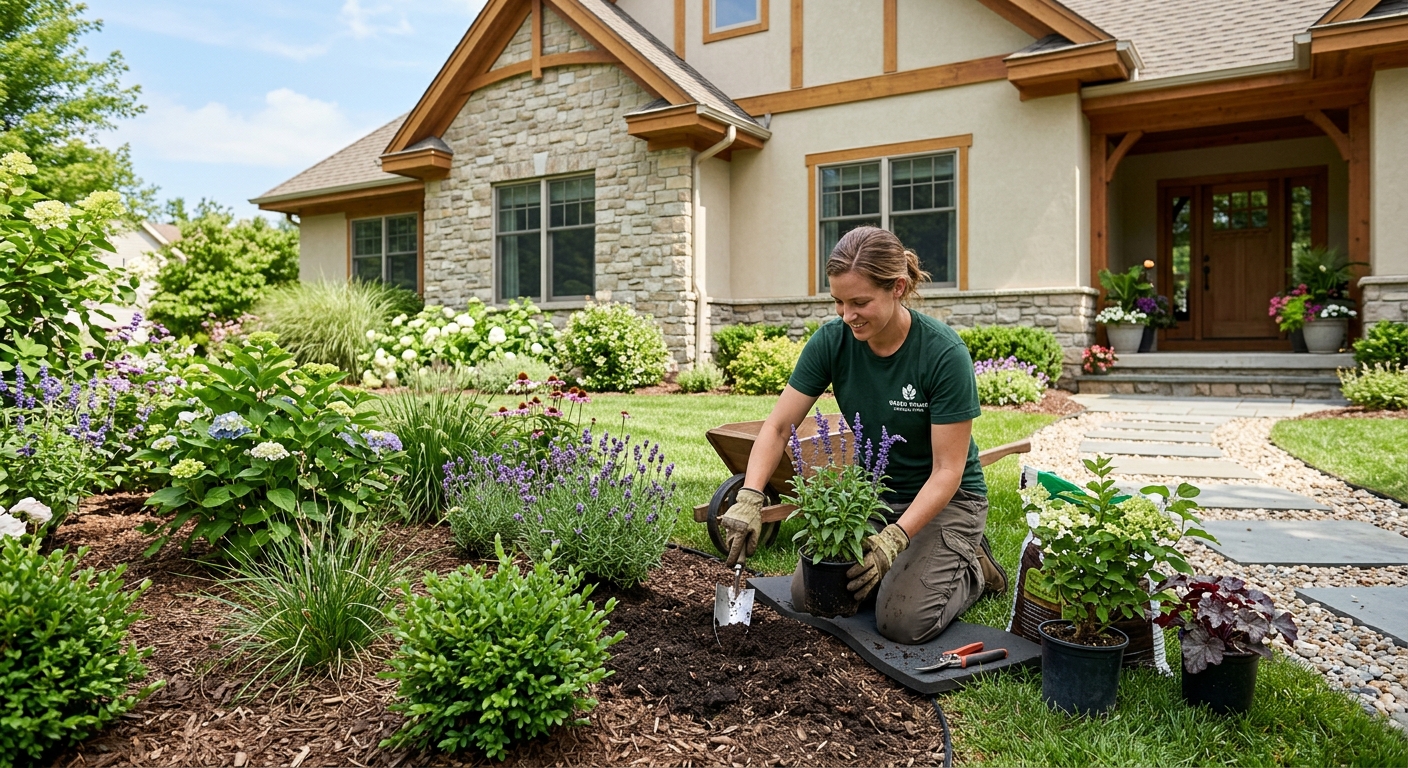
Landscaping options and costs in Hawkesbury
Landscaping in Hawkesbury can transform how you use your yard and how your home performs through Ottawa’s freeze–thaw winters. With Hawkesbury having 10,194 residents and 2,615 homeowner households (Statistics Canada, 2021 Census), there’s real homeowner demand for practical upgrades—especially on single-detached properties, where yards are typically bigger and owners are more inclined to invest in long-term improvements. Roughly 35.8% of dwellings are single-detached homes (Statistics Canada, 2021 Census), which is why we see steady work for interlocking patios, grading fixes, and shrub/tree plantings around neighbourhoods like Stewart Park / the eastern residential streets, where properties often have established driveways and mature trees that need careful soil and drainage planning.
In the Ottawa area, costs are strongly shaped by a genuine winter and a pronounced freeze–thaw cycle. That weather means patios, steps, and retaining walls need deep, well-compacted granular bases and proper drainage to avoid heaving and settlement. The working window is also tighter than milder regions—our main soil and planting season is roughly May to October (and concrete/interlock base work depends on ground conditions), so labour availability can tighten during peak weeks. The result is that two “similar-looking” projects can land far apart in price when one includes drainage correction and soil amendment, while the other assumes the existing base is sound. Use the table below as a realistic starting point before you compare quotes.
| Service |
Description |
Season |
Price Range |
| Full landscape design and installation |
Consultation, site measurements, plant/softscape layout, grading plan, soil/topsoil, hardscape/planting installation, cleanup |
May to October |
$12,000–$45,000 |
| Sod installation (supply, grade, lay, roll) |
Minor grading, soil prep, sod supply, lay/roll, start-up watering plan |
May to early October (weather dependent) |
$3,000–$7,500 |
| Lawn seeding (grade, seed, starter fertilizer) |
Grading/leveling, seed selection, starter fertilizer, light raking and straw/cover if needed |
Spring to early fall |
$1,500–$5,500 |
| Interlocking patio or walkway |
Base excavation, granular base and compaction, edging, sand setting bed, pavers, jointing |
May to October |
$6,000–$22,000 |
| Retaining wall (interlocking block) |
Excavation, drainage gravel/weep system (if needed), geotextile, reinforced base, blocks, capstone/finish |
May to October |
$8,000–$28,000 |
| Tree and shrub planting |
Soil amendment, planting layout, spacing, staking where required, mulch rings/beds, first-season watering guidance |
Spring and fall (best); summer with watering plan |
$1,200–$9,500 |
Prices are estimates only and vary by project scope, site access and material selection.
What affects the price of landscaping in Hawkesbury
Even when homeowners in Hawkesbury request the “same” landscaping scope, quotes can differ by 30–50% across Ottawa and Ontario because the hidden variables—soil condition, drainage needs, access, and the amount of real prep—aren’t always visible at the walk-through. In a freeze–thaw climate (hardiness zones 4b–5a), your frost calendar and the local working window also dictate how contractors stage work, which influences labour scheduling and crew availability. That matters because good installation here isn’t just cosmetic; it’s structural. For example, a sod job that includes proper grading and sub-base improvements will price differently than a simple lay-and-go approach.
Plant choices and seasonal timing also swing budgets. In Prairie regions (Zone 2–4), the short growing season and dryness push costs toward drought- and wind-hardy species and specialized preparation. Coastal BC (Zone 7–8) can support a longer planting season, but heavy rain means drainage systems and base details still cost money—just in different ways. In southern Ontario (Zone 5–6, like Hawkesbury), we’re in the middle: there’s a moderate season, but summer dry spells can still drive irrigation design, while spring can saturate clay soils. That’s why a lawn repair after winter can be as much about drainage correction as seed or sod.
Two common Hawkesbury cost examples: (1) a “flat” backyard that actually slopes toward a foundation can add $1,500–$6,000 for grading and drainage bed work, even before plants are ordered; (2) mature clay-rich ground that needs topsoil and amendment can add $1,000–$4,000 depending on how much area is impacted. If your project shifts from simple planting to full-yard work, that’s where budgets often move into the $12,000–$45,000 range for comprehensive installs, versus smaller refreshes that may stay closer to the $1,500–$8,500 band for lawn-focused projects.
| Price Factor |
Why It Matters |
Cost Impact |
| Yard size in sq ft — the primary cost driver for softscape |
Softscape quantities (seed/sod, mulch, topsoil) scale directly with coverage area |
Often the biggest swing; can change total cost by thousands |
| Grading and drainage work — slope corrections add significant cost |
Freeze–thaw punishes poor drainage; corrected slopes protect patios, walls and foundations |
Can add roughly $1,500–$6,000 for typical corrections |
| Drainage bed or French drain installation |
Clay soils hold water; drains prevent pooling and frost heave |
Often a mid-project “upgrade” that adds $2,000–$10,000 |
| Plant material tier — native shrubs vs. ornamental vs. mature specimen trees |
Size, hardiness, and labour to install bigger stock drives price |
Can shift planting budgets by $500–$5,000+ |
| Hardscape vs. softscape ratio — walls and patios cost more per sq ft than lawn |
Pavers and retaining systems require excavation, base materials and compaction |
High impact; patios/walls can move totals into $6,000–$28,000 territory |
| Irrigation system design and installation |
Zones, heads, wiring/timing and winterization labour add complexity |
Typical add-on of $2,000–$8,000 depending on coverage |
| Soil amendment and topsoil required |
Clay-rich soils often need aeration and amendment for roots and drainage balance |
Commonly $1,000–$4,000 for many mid-size areas |
| Tree removal or stump grinding before new planting |
Extra machinery time and disposal/cleanup affect labour and scheduling |
Can add $800–$4,000 depending on size and access |
Permits & regulations in Ontario
In Ontario, most routine landscape work—such as planting, sodding, seeding, mulch installation, and most softscape upgrades—typically does not require a permit. Where permitting commonly becomes necessary is with retaining walls above the local threshold (often 1.0 m in many Ontario municipalities), especially when engineering documentation may be required. Another area that can trigger approval is significant lot grading that changes how water flows, particularly if it redirects drainage toward neighbouring properties or alters connections to storm services.
Before anyone starts digging in Hawkesbury, the smart step is to request utility locates so you can dig safely for planting holes, drain trenches, and wall footings. Call before excavation and treat locates as mandatory groundwork for any crew.
To verify a contractor’s Ontario credentials and protection, follow a simple process: (1) Ontario licence/registration: check the contractor’s business registration information through Ontario’s public listings or their posted number (and confirm the exact scope they’re doing—landscape construction versus general contracting); (2) liability insurance: request a current certificate of insurance naming you as the certificate holder if required—confirm coverage limits and effective dates; (3) WSIB/WCB coverage: ask for clearance/coverage confirmation for workers who will be on site. A reputable contractor in Hawkesbury will provide these documents quickly and in writing. This is especially important for heavier work like excavation, block walls, and interlocking bases where the risk of damage and site incidents increases.
Planning a landscape that thrives in Hawkesbury's climate
To plan a yard that thrives in Hawkesbury, think “work with the climate,” not against it. We’re in a cold, continental zone with hardiness zone 4b–5a, humid summers, and a freeze–thaw cycle that stresses anything built on the surface—especially lawns, patios, steps, and retaining walls. Start with plant selection: choose hardy, zone-appropriate trees, shrubs, and perennials that can handle winter cold with less watering and fewer winter-protection measures. For borders and foundations, native and locally adapted options typically establish better and reduce repeat replacement costs.
For turf, compare sod versus seed realistically. Sod gives instant curb appeal, but in our market it usually costs about 3–4x per sq ft more than seeding when you factor in prep and materials. That difference is justified when you need quick results (new home handover, event timing, or heavy erosion where bare ground can’t sit). Otherwise, seeding is often the smarter long-term value—especially when your grading and weed control are done right.
Drainage and grading are the make-or-break items in Ottawa-area clay soils. Pooling water can lead to foundation moisture, persistent soggy ground, and lawn failures. For hardscape, base preparation must reach the frost-affected depth: deep, well-compacted granular layers and correct slope away from your home help prevent heaving. Finally, low-maintenance design strategies reduce annual labour: mulched beds, groundcovers, durable perennials, and a clear seasonal upkeep plan (weeding schedule, pruning windows, and mulch refresh timing).
If you want a water-smart option, consider a small rain garden or targeted xeriscaping-style planting in the driest edges of the yard. In Hawkesbury, you generally don’t face extreme water bans like parts of the BC interior, but smart stormwater capture can still lower irrigation needs and improve how the yard behaves after spring rains. As an example, spending extra on grading and a proper base can move a patio project into the $6,000–$22,000 band, but it protects your investment over multiple winters—often a better deal than replacing a settling surface every few years.
| Element |
Climate Consideration |
Maintenance Level |
Price Band |
| Sod lawn installation |
Needs proper drainage and stable soil prep to avoid spring saturation and winter root stress |
Medium (watering establishment; later mowing and spot repair) |
$3,000–$7,500 |
| Native perennial garden |
Hardy plants handle zone winters; mulch helps regulate freeze–thaw movement |
Low to medium (spring cleanup, occasional dividing) |
$1,500–$6,500 |
| Mulched shrub border |
Compacted clay benefits from amended planting zones; mulch reduces moisture swings |
Low (mulch top-ups and periodic pruning) |
$1,200–$5,500 |
| Interlocking stone patio |
Requires deep base and slope for frost protection and drainage away from house |
Low (occasional joint sand top-up and weed control) |
$6,000–$22,000 |
| Retaining wall (block) |
Needs engineered-style base/gravel drainage to prevent hydrostatic pressure and heave |
Low (inspection for movement; minor re-tamping if needed) |
$8,000–$28,000 |
| Drip irrigation system |
Winterize and zone timing; delivers water efficiently during warm season |
Medium (seasonal checks, filter maintenance) |
$2,000–$8,000 |
How to choose a landscaping contractor in Hawkesbury
Choosing the right contractor matters in Hawkesbury because good installation here depends on prep work—excavation, drainage, and frost-aware bases—not just plant selection. Start by verifying coverage. Ask for liability insurance (current certificate of insurance) and confirm the coverage dates and limits. For workers, request proof of WSIB/WCB coverage and a clearance/coverage confirmation letter (or documentation that shows the company accounts for workplace coverage). Next, verify business status and that the contractor is licensed/registered for the work they’re performing under Ontario requirements—confirm the exact scope, especially if they’re doing excavation, concrete, or wall systems.
Then get 2–3 itemised written quotes. The quotes should separate labour and materials, list quantities (paver area, base depth, drainage length, topsoil/compost volume), and state exactly what’s included. Scope clarity protects you from “change order surprises,” especially with drainage and soil amendment. Read for inclusions such as permit pull (if applicable), disposal of excavated material, erosion control, and whether pricing assumes clean, accessible yards. Warranties should be in writing: ask for the workmanship warranty length, whether it’s transferable if you sell your home, and how product warranties are handled for plants and hardscape components.
Payment schedule matters: never pay more than 10–15% upfront, and keep a holdback until completion and final cleanup. Finally, require a written timeline with a start date and a realistic completion estimate, considering the May to October working window and weather delays.
- Provides COI (certificate of insurance) for liability and confirms project effective dates.
- Shows WSIB/WCB clearance or equivalent coverage documentation for workers.
- Gives a written itemised quote with quantities, not just lump sum totals.
- Lists exclusions clearly (e.g., removal of existing trees, disposal, extra base correction).
- Includes a drainage plan if the yard slopes toward the house or shows pooling.
- Specifies base construction details for patios/walkways/walls (granular layers and compaction).
- Provides a plant list (common and botanical names) with quantities and sizes.
- Confirms how irrigation—if included—will be winterized and tested before freeze.
- Has a written workmanship warranty and product warranty details.
- Respects a low upfront payment (10–15%) and uses milestone-based billing.
- Includes a disposal/haul-away method for soil and excavation waste.
- Arranges a site visit to verify access, gate width, and how materials will be delivered.
Red flags I watch for in Hawkesbury: a quote that’s suspiciously low because it assumes “no base work” for hardscapes; refusal to provide insurance/WSIB proof; vague scope language like “we’ll fix it as we go”; pressuring homeowners for large upfront deposits; and no written timeline or warranty terms. If any of these show up, pause and request clarification or choose another contractor.
Frequently asked questions — landscaping in Hawkesbury
How much does a retaining wall cost in Hawkesbury?
In Hawkesbury, a retaining wall built with interlocking block typically lands in the $8,000–$28,000 range for most homeowner projects, depending on wall height, length, excavation difficulty, and whether drainage is properly included. The freeze–thaw cycle here makes the drainage system especially important—walls need proper backfill gravel and drainage to avoid pressure build-up. If your site has clay soils that hold water, expect more prep and base work. For a tighter, straightforward wall with good access, you may be closer to the lower portion; for longer runs, corner layouts, or poor access that increases labour and machinery time, pricing climbs quickly. Always ask for an itemised quote that shows base depth, drainage components, and block/finish selections so you can compare apples to apples. (Statistics Canada, 2021 Census)
When is the best time to landscape in Hawkesbury?
For Hawkesbury and the Ottawa area, the main window for most landscaping installation is roughly May to October, because the ground needs to be workable for excavation, soil prep, and granular base construction. Interlocking patios, walkways, and retaining wall base work should be scheduled during stretches when weather supports compaction and curing—trying to force these tasks during wet periods often leads to poor base performance. Planting can be done in spring and fall for best root establishment; summer planting is possible but requires a strong watering plan and mulching to manage humid heat. Sod is best when soil is warm and the schedule allows consistent establishment watering. If you’re doing a full yard project, booking early helps secure labour during peak weeks and reduces the risk of finishing work later in the season when plants may not establish fully.
Do I need a permit for a retaining wall in Ontario?
In Ontario, many standard softscape tasks (planting, sodding, seeding, mulch) generally don’t require permits, but retaining walls may. The trigger is often wall height—commonly around 1.0 m in many Ontario municipalities—where permitting and sometimes engineering documentation can be required. Changes to lot grading that affect drainage direction or storm service connection can also require approval. The best approach for Hawkesbury homeowners is to ask your contractor to confirm whether your specific wall height and design falls under the local permitting threshold before excavation starts. Regardless of permitting, call for utility locates before digging footings or drainage trenches. When a contractor tells you “permits aren’t needed” without checking, I treat that as a major red flag.
How do I improve drainage in my yard?
Start by observing where water goes after heavy rain or snowmelt. In Hawkesbury’s clay-prone soils and freeze–thaw climate, drainage issues often show up as soggy lawn patches, pooling near foundations, or repeated lawn failure in the same area. The most effective fixes usually combine grading correction with a drainage feature: a French drain or drainage bed tied to an approved outlet, plus reworked slopes so surface water doesn’t run toward your home. If you’re adding hardscape, include proper sub-base drainage design so patios and walkways don’t trap water. Budget varies widely, but it’s common for drainage improvements to add material and labour that can move the project into the mid-range bands—similar projects that include drainage and base corrections often land beyond simple lawn installs (for example, beyond $1,500–$8,500 lawn work). A good contractor should show a drainage plan during the quote, not just “we’ll add some gravel.”
What is xeriscaping and does it suit Hawkesbury?
Xeriscaping is a design approach that reduces irrigation needs by using drought-tolerant plants, efficient mulching, and smart layout—often pairing plants with similar water needs. In Hawkesbury, it can work well, especially for sunny edges, slopes, and areas where you want fewer watering hours. While we don’t typically face the strict domestic water restrictions seen in some dryer interior regions of Canada, irrigation still costs money and overwatering can worsen clay-related issues. The key is to pair “less water” plants with good drainage and soil amendments; otherwise, they can struggle in persistently wet pockets. Xeriscaping-style planting can be layered with hardy zone-appropriate shrubs and perennials, using mulch and groundcovers to reduce evaporation. If your goal is curb appeal without high maintenance, xeriscaping elements can complement a traditional lawn (for example, keeping turf in usable areas and using low-water beds elsewhere).
How do I plan a low-maintenance yard?
A low-maintenance yard plan in Hawkesbury usually starts with reducing “high-effort” surfaces and focusing on durable, hardy plants that suit zone 4b–5a conditions. Choose native and zone-appropriate shrubs/perennials, use mulch to suppress weeds and buffer soil temperature, and group plants by sunlight and moisture so they need less intervention. For turf, decide whether sod or seeding makes sense: sod gives instant results but costs more (often landing in the $3,000–$7,500 band for many homeowner installs), while seeding is a lower-cost pathway if grading is done correctly. Build low-maintenance structure into the yard: interlocking walkways and patios with proper base prep prevent settlement and repeat repairs through winter freeze–thaw. Finally, design for seasonal cleanup—easy access for pruning, no overly fussy plant species, and a simple watering strategy during establishment. If your home is older (many are built before 1981), verify drainage around foundations first, because addressing that early prevents recurring landscaping “failures.” (Statistics Canada, 2021 Census)