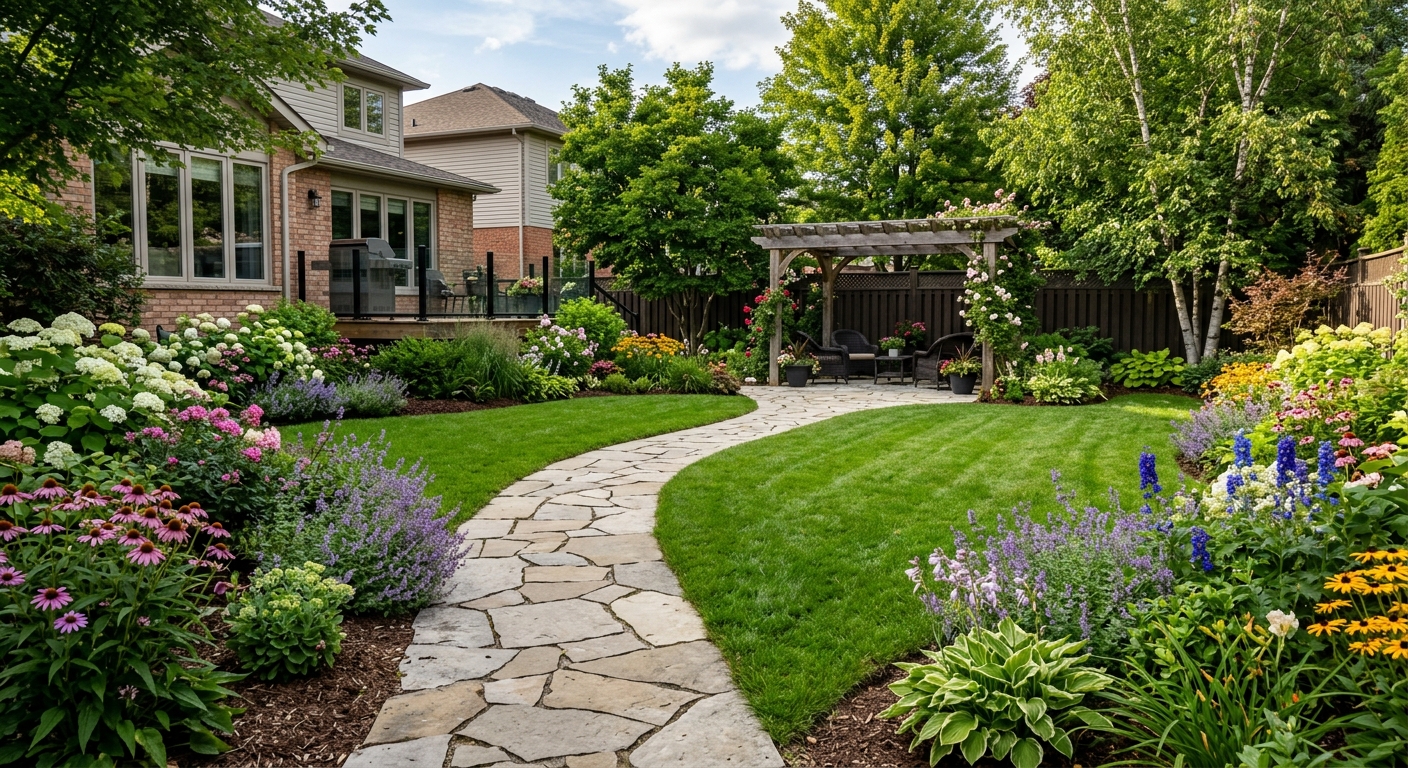
Landscaping options and costs in Stoney Creek
Stoney Creek homeowners usually start with a simple goal—upgrade curb appeal or fix drainage—and then compare several landscaping options side-by-side. With 76,382 residents in 2021 (Statistics Canada, 2021 Census), the area has steady demand for trades, and you’ll see landscaping crews active in established neighbourhood pockets where yards are mature and lot lines are defined. Many homes here are detached or semi-detached, which often means more ground to work with and a stronger incentive to invest in improvements that protect foundations and add value.
Pricing in the Hamilton–Niagara Peninsula is shaped by our planting window and our winter realities. We sit mostly in plant hardiness zones 6b–7a, with frost-free growing typically stretching from late April/early May to mid–October. That solid season supports a wide palette of shrubs, ornamental grasses and deciduous trees, but freeze–thaw and winter wind still influence base depth, drainage, and the durability of patios and retaining walls. You’ll also notice costs are affected by excavation conditions—mixed glacial soils in this region can require more labour for clean base prep and proper aggregate compaction.
In Stoney Creek, trade demand is especially strong around the older, established areas near “Westcliffe” and “Binbrook Road” corridors, where homeowners frequently renovate front yards, add walkways, or improve slope drainage. To help you benchmark quotes, the table below compares common scope items and realistic Stoney Creek price ranges.
| Service |
Description |
Season |
Price Range |
| Full landscape design and installation |
Site visit, grading/drainage plan, plantings, soil/topsoil, hardscape (if included), and installation |
Late April/May to October (softscape); hardscape base prep often spans May–September |
$10,000–$45,000 |
| Sod installation (supply, grade, lay, roll) |
Remove existing grass/debris, final grade, add topsoil/loam as needed, lay sod, roll and initial watering |
Mid-May to late August (best results before heat stress) |
$3,500–$9,000 |
| Lawn seeding (grade, seed, starter fertilizer) |
Light grading, seed blend selection, starter fertilizer, seed-to-soil contact, first mow scheduling |
April/May or early fall (weather-dependent) |
$1,000–$4,500 |
| Interlocking patio or walkway |
Excavate, compacted base, edge restraints, stone pavers, setting bed, jointing sand |
May to September (best for scheduling and curing) |
$6,000–$25,000 |
| Retaining wall (interlocking block) |
Block retaining system with proper backfill, drainage stone, geotextile and wall base |
May to September (freeze–thaw managed by base design) |
$8,000–$30,000 |
| Tree and shrub planting |
Soil prep, amendments, planting, staking (if required), mulching and establishment watering plan |
Spring and early fall (most reliable for rooting) |
$800–$4,000 |
Prices are estimates only and vary by project scope, site access and material selection.
What affects the price of landscaping in Stoney Creek
Even when two homeowners request the “same” landscaping job in Stoney Creek, quotes across the Hamilton–Niagara Peninsula can land 30–50% apart. The difference usually isn’t the design—it’s the site conditions and how contractors handle frost, drainage and access. In southern Ontario, labour and equipment time are the big drivers, and every extra hour of excavation or base prep shows up quickly. That’s why you’ll sometimes see a patio or wall priced near the lower end of the $40–$150 per sq ft hardscaping band, while other quotes land much higher once drainage work and heavier base build-up are required.
Our hardiness zone (6b–7a) and local frost timing influence both plant survival and the working season. A practical working window—late April/early May through mid–October—helps keep softscape schedules predictable, but freeze–thaw still pushes the need for proper base depth for patios and retaining walls. This is one reason retaining-wall base design in southern Ontario often costs more than in milder climates: footings and drainage layers must be installed correctly to prevent movement.
To illustrate, a lawn conversion can look “simple,” yet sod can be a major cost jump versus seeding. If you’re comparing options, seeding may fall around the lower band (often ~$1,000–$4,500 for a typical Stoney Creek install) while sod is commonly closer to $3,500–$9,000 for similar yard sizes—because sod involves heavier material logistics and tighter handling requirements. Another local driver: older properties can have buried debris, compacted soil, or foundation-adjacent grading that requires rework before planting. In practice, that can add days of labour and more topsoil/aggregate.
Overall, Stoney Creek’s demand for reliable winterization means more time spent on drainage beds, edging restraints and establishment plans—especially in neighbourhoods where yards were shaped decades ago and now need regrading to keep water from pooling.
| Price Factor |
Why It Matters |
Cost Impact |
| Yard size in sq ft — the primary cost driver for softscape |
Lawn, planting beds and soil/topsoil quantities scale directly with area |
Often the biggest swing; can change total cost by 25–60% depending on acreage |
| Grading and drainage work — slope corrections add significant cost |
Improper slope causes pooling and foundation moisture; fix requires excavation and re-compaction |
Commonly adds a major labour and equipment line item (up to tens of thousands on larger yards) |
| Drainage bed or French drain installation |
Freeze–thaw performance depends on correct stone, geotextile, and discharge routing |
Typically increases hardscape/softscape totals by a noticeable margin (can double a “simple” project) |
| Plant material tier — native shrubs vs. ornamental vs. mature specimen trees |
Size at planting and transplant risk drive material price and installation time |
Mature trees and premium ornamentals can shift planting budgets by several hundred to thousands |
| Hardscape vs. softscape ratio — walls and patios cost more per sq ft than lawn |
Pavers and block systems require excavation, base aggregates and compaction |
Hardscape-heavy designs tend to move budgets toward the mid-to-upper bands (e.g., patios/walkways and retaining walls) |
| Irrigation system design and installation |
Prevents establishment failure in summer dry spells; requires layout, trenching and equipment |
Can add a substantial line item, especially with multiple zones and timers |
| Soil amendment and topsoil required |
Mixed glacial soils may need correction to support roots and reduce settling |
Additional haul/placement can raise costs even when plant count stays the same |
| Tree removal or stump grinding before new planting |
Debris removal and stump grinding impact schedule, disposal and soil prep |
Often pushes projects upward by several hundred to several thousand depending on stump size/access |
Permits & regulations in Ontario
In Ontario, most landscaping—planting, sodding and typical softscape work—does not require a building permit. For Stoney Creek homeowners, the key exception is retaining walls above the local height threshold, which is commonly around 1.0 m (3.3 ft) in many municipalities. When a wall exceeds that threshold, you may need a building permit and sometimes engineered drawings to confirm stability and drainage.
Another area that can trigger approvals is any change to lot grading that affects drainage toward neighbouring properties or changes how water discharges to a storm sewer connection. Even when the goal is “better drainage,” contractors should verify whether approval is required before reshaping slopes near foundations, swales or municipal drainage infrastructure.
Before digging for planting holes, French drains, or wall footings, utility locates are essential. Call to have buried utilities marked so you don’t damage service lines—this is a practical requirement before excavation begins.
To verify an Ontario contractor is legit, start with their business information and credentials: (1) check the contractor’s registration/licensing information via the appropriate provincial registry or licensing body referenced in their documentation, (2) request a certificate of insurance showing general liability coverage, and (3) confirm WSIB/WCB coverage (clearance letter or proof) before work starts. Ask for copies and confirm the policy is current; if they can’t provide them, treat it as a serious scheduling and financial risk.
Planning a landscape that thrives in Stoney Creek's climate
Planning for Stoney Creek means designing around zone 6b–7a growth habits and a frost calendar that demands careful base prep. The biggest wins come from choosing plants that are zone-appropriate and managing drainage and soil so freeze–thaw doesn’t heave pavements or keep roots too wet. In the Hamilton–Niagara Peninsula market, reliable crews also build their schedules around late April/early May through mid–October, which affects when sod can be installed and when planting should be completed for best root establishment.
For plant selection, prioritize native and hardy shrubs, ornamental grasses and perennials that tolerate our winter wind and spring freeze–thaw. Where you want instant visual impact, sod works—but it’s typically about 3–4x the per sq ft cost of seeding in many southern Ontario comparisons because it’s heavier material and needs careful laying and early watering. Example: if you’re looking at a 500 sq ft lawn patch, seeding might land closer to the lower band (often roughly ~$1,000–$4,500 total for many typical backyard scopes), while sod can push toward the higher band (commonly ~$3,500–$9,000 depending on site and access). In that case, sod is justified when you need a quick finished look, kids/dogs use the yard immediately, or you’re correcting traffic-worn areas.
Drainage and grading are non-negotiable here. Pooling after spring thaw can raise foundation moisture and harm plants, so slope corrections, drainage beds and downspout management should be part of the plan. For hardscape, build patio and retaining-wall bases to handle frost depth and consistent compaction. Finish with low-maintenance strategies—mulched borders, groundcovers, and well-placed perennials—so your yard looks full without excessive summer upkeep. If you’re dealing with dry patches or variable watering, consider rain-garden style planting pockets or drought-tolerant groundcovers to reduce stress in summer dry spells without sacrificing curb appeal.
| Element |
Climate Consideration |
Maintenance Level |
Price Band |
| Sod lawn installation |
Needs reliable establishment before hot, dry stretches; avoid heavy use right after laying |
Medium (watering management first season) |
$3,500–$9,000 |
| Native perennial garden |
Better winter resilience with zone-appropriate species; more tolerant of freeze–thaw cycles |
Low to medium (spring cleanup and occasional weeding) |
$1,500–$6,000 |
| Mulched shrub border |
Mulch buffers soil temperature swings and helps moderate spring moisture |
Low (top-up mulch and light pruning) |
$1,200–$5,000 |
| Interlocking stone patio |
Proper base depth and drainage prevent settling and movement through freeze–thaw |
Low (periodic joint sand/spot repairs) |
$6,000–$25,000 |
| Retaining wall (block) |
Requires backfill and drainage stone so water doesn’t build pressure behind the wall |
Low (inspection and minor maintenance) |
$8,000–$30,000 |
| Drip irrigation system |
Helps during our summer dry spells and improves establishment efficiency |
Medium (seasonal adjustments, timer checks) |
$2,000–$8,000 |
How to choose a landscaping contractor in Stoney Creek
Choosing a contractor in Stoney Creek is mostly about verification and clarity. Start by confirming Ontario coverage before anyone touches your property: ask for a valid certificate of insurance (general liability) and proof of WSIB/WCB coverage. How to check: (1) look for a certificate that lists your contractor’s legal name and policy expiry date, (2) request WSIB/WCB clearance or documentation showing the company is insured for workers, and (3) verify licensing/registration details that the contractor should provide for their trade category. If a contractor won’t supply documents, don’t proceed—this is where homeowners take on unnecessary risk.
Next, get 2–3 itemised written quotes. You want labour and materials broken out (for example: excavation/haul, base aggregate, geotextile, block/paver supply, planting materials, topsoil, disposal). Avoid quotes that are only a single lump sum because they hide exclusions like site restoration, subgrade correction, or whether drainage work is included. Confirm disposal: will they remove spoils and unused materials off-site, or is the burden on you?
Warranty matters too. Ask for a workmanship warranty length in writing, plus what product warranties cover (and whether they’re tied to the purchaser/installation). If you’re installing a retaining wall or patio, workmanship warranties are especially important because freeze–thaw movement can reveal issues after several seasons.
Finally, payment scheduling should be conservative. In most residential projects, never pay more than 10–15% upfront; hold back a portion until the job is complete and clean. Get the start date and estimated completion window in writing, with weather contingencies noted.
- Request proof of general liability insurance and verify expiry dates.
- Confirm WSIB/WCB coverage and ask for a clearance letter or equivalent proof.
- Ask whether permits are required for your specific retaining wall height and drainage changes.
- Get an itemised quote with labour and materials (no “we’ll figure it out later” allowances).
- Confirm exactly what grading/drainage scope is included (slope correction, French drain, discharge route).
- Ask who supplies topsoil/loam and how much (in cubic yards) is planned for your site.
- Clarify disposal: where spoils go, and whether hauling is included in the price.
- Confirm base build details for patios/walkways (compaction, aggregate type, thickness).
- For retaining walls, verify geotextile, backfill, and drainage stone are included.
- Ask for a workmanship warranty in writing and what triggers service.
- Use a conservative payment schedule: 10–15% upfront max, holdback until completion.
- Request a written start/completion timeline with weather delay language.
In Stoney Creek, red flags include contractors who (1) can’t produce insurance/WSIB proof, (2) quote patios or walls without explaining base thickness and drainage layers, (3) offer sod/seeding without a watering or mowing plan for the first season, (4) demand large upfront payments, or (5) provide a non-itemised estimate that makes drainage/disposal sound “optional” until after excavation.
Frequently asked questions — landscaping in Stoney Creek
What plants thrive in Stoney Creek's climate zone?
Stoney Creek sits mostly in plant hardiness zone 6b–7a, so the best performers are hardy, winter-resilient plants that can handle spring freeze–thaw and winter wind. In practice, contractors often recommend a mix of native or locally proven shrubs (like hardy viburnums and serviceberry), ornamental grasses that re-emerge reliably, and perennials such as coneflower and black-eyed Susan-style varieties that establish well with mulch. For trees, deciduous options that suit southern Ontario and handle our freeze–thaw cycle are usually safer bets than tender species. If you’re planning planting near foundations or shaded spots, ask for a site-specific soil and drainage assessment—Stoney Creek yards can vary a lot, and “same zone” plants still struggle in soggy low areas. As a budget reference, many Stoney Creek homeowners spend roughly $800–$4,000 on tree and shrub planting depending on plant size and quantity.
Sod vs seed — which is better for a Stoney Creek lawn?
Both work in Stoney Creek, but the better choice depends on timing and how quickly you want results. Sod gives instant coverage, which is ideal if your yard needs to be usable right away or if you’re patching uneven areas. It also reduces erosion risk during early establishment. The trade-off is cost and early maintenance: sod often lands in the higher band (commonly about $3,500–$9,000 for typical residential scopes), while seeding usually fits the lower band (often about $1,000–$4,500). Seeding can be more economical and works well if you can commit to watering consistency during germination and follow-up mowing. In southern Ontario, seed success also depends on spring and early-summer weather swings—freeze–thaw thawing followed by a dry spell can make germination trickier. If your goal is speed and you can manage watering, sod usually wins; if budget is the priority and you can wait for full coverage, seeding is often the smarter path.
How much does a retaining wall cost in Stoney Creek?
Retaining wall pricing in Stoney Creek depends on height, length, excavation complexity, and whether drainage behind the wall (like a proper drainage stone zone) is included. As a realistic benchmark, many projects for an interlocking block retaining wall commonly land around $8,000–$30,000 in this area. The cost can move upward when there’s extra grading to correct slopes, hard-to-access yards that require more labour, or when you need proper base preparation and drainage design to prevent freeze–thaw movement. Walls also get more expensive if there’s tree removal or stump grinding before the wall work begins. If you’re comparing quotes, ask each contractor to list materials and drainage components, not just the block price. A “cheap” wall that skips drainage stone or backfill specification can fail early, which usually ends up costing far more after repairs.
When is the best time to landscape in Stoney Creek?
In Stoney Creek, the most reliable window is late April/early May through mid–October, largely because our frost-free period supports rooting and installation. Spring is ideal for tree and shrub planting and for patio/walkway scheduling once soil is workable. Summer installations are best when irrigation and watering plans are ready—heat and dry spells can stress newly planted material. Fall is also a strong time for planting because soil temperatures remain favourable while watering demands can be more manageable. For sod, timing matters: contractors typically install mid-May to late August for best establishment results. For hardscape base work, crews often prefer May–September so materials can compact properly and settle without interruptions. If winter prep is important, plan finishing touches and planting before sustained cool-down, especially to allow roots to settle before deeper freeze conditions.
Do I need a permit for a retaining wall in Ontario?
Often you do, but it depends on the retaining wall height and how the work affects lot grading and drainage. In Ontario, planting and most softscape work generally doesn’t require a permit, but retaining walls above a common threshold—typically around 1.0 m (3.3 ft) in many municipalities—often trigger a building permit and sometimes engineered drawings. Additionally, changes to grading that influence drainage toward neighbouring properties or storm sewer connections may require approval. For Stoney Creek homeowners, the safest approach is to confirm the intended wall height and drainage plan before excavation. Your contractor should tell you whether permits are expected, and the quote should specify whether they’re included. Don’t rely on “we’ve done it before” without paperwork—verify with your contractor’s documentation and ask what they plan to submit.
How do I improve drainage in my yard?
In Stoney Creek, drainage improvements usually focus on correcting slope, managing surface water, and protecting foundation-adjacent soils through spring thaw and freeze–thaw cycles. Start by identifying where water actually goes during heavy rain and melt events—downspouts, low pockets, and areas near foundations are common culprits. Typical contractor solutions include regrading to move water away from structures, installing a drainage bed or French drain with proper stone and geotextile, and adding a discharge route that doesn’t push water onto a neighbour’s property. If you’re installing a patio or wall, drainage layers and base preparation are crucial; without them, freeze–thaw can lead to settling and movement. For homeowners budgeting this work, drainage-related items often push a project toward the middle of the hardscape/installation bands rather than the lowest end. If you’re unsure, ask for a site plan and a clear explanation of how water will be routed after the work—photos and measurements help.