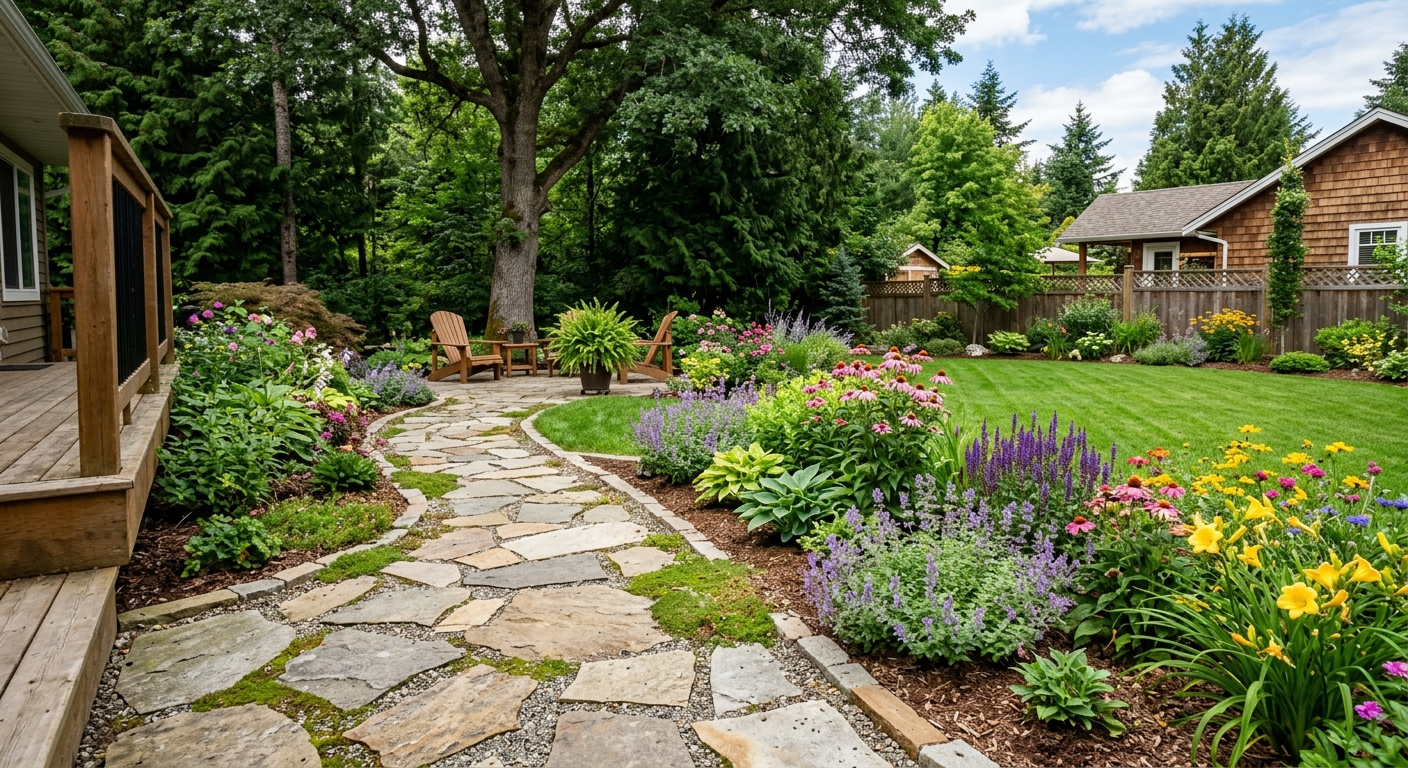
Landscaping options and costs in Barrhead
Barrhead homeowners typically have a few clear landscaping paths: refresh what you have, build a hardscape focal point, or redesign the entire yard for better drainage and curb appeal. In Barrhead, 68.9% of dwellings are single-detached homes, so many projects start with meaningful yard space—and with 65.1% of households owning their homes (Statistics Canada, 2021 Census), investment in longer-term, maintenance-light landscaping is common. That said, the Edmonton economic region’s short prairie growing season, freeze-thaw cycles, and generally drier conditions shape both what contractors recommend and what projects cost.
Labour availability and timing matter in Barrhead. Softscape (sod, planting, mulching) is typically scheduled around soil conditions, while hardscape work depends on achieving stable base prep below the frost line. Freeze-thaw also means retaining walls, patios, and walkway subgrades need the right excavation depth, compaction, and drainage—otherwise you may see heaving, settlement, or water pooling soon after thaw cycles.
Contractors often see especially high demand in the downtown Barrhead / main-street corridor area where mature trees and older lots meet higher traffic for curb appeal upgrades. From there, most homeowners decide between full-service design & installation, a lawn-focused refresh, or a hardscape-led plan. Use the comparison table below to estimate common ranges, then match the scope to your yard’s size, access, and soil conditions.
| Service |
Description |
Season |
Price Range |
| Full landscape design and installation |
Site visit, layout, grading/drainage plan, planting, topsoil, sod/seeding, and selected hardscape (patio/walkway and/or wall) delivered as a single coordinated project |
Late spring to early fall |
$8,000–$45,000 |
| Sod installation (supply, grade, lay, roll) |
Light regrading as needed, supply and install sod, starter fertilizer, rolling/levelling, and establishment watering guidance |
May to August |
$3,000–$8,000 |
| Lawn seeding (grade, seed, starter fertilizer) |
Grading touch-ups, seed selection suited to prairie conditions, starter fertilizer, seeding, and light rolling; assumes weeds aren’t already established at a high level |
April to early June (or late summer overseeding) |
$2,200–$6,000 |
| Interlocking patio or walkway |
Excavation, compacted base, stone, edging, interlocking stone installation, and joint sand; typical updates include improved drainage at transitions |
May to September |
$10,000–$28,000 |
| Retaining wall (interlocking block) |
Block wall with proper base depth, geotextile, drainage gravel, perforated drain (where appropriate), and backfill/compaction |
May to September |
$45–$120 |
| Tree and shrub planting |
Zone-appropriate plants, soil amendments, planting layout, staking for trees where needed, and initial watering plan |
May to June and September |
$500–$5,000 |
Prices are estimates only and vary by project scope, site access and material selection.
What affects the price of landscaping in Barrhead
Even when you’re comparing “the same job” in Barrhead, Edmonton-region quotes can vary by about 30–50% because yards aren’t standard. One crew may price based on clean, level access; another may need extra hauling, tree handling, deeper excavation for frost-safe base prep, or more soil remediation to get drainage working. The plant hardiness zone and frost timing also dictate both what grows and what can be installed safely in Alberta. In prairie settings typically around Zone 2–4, plants must tolerate winter lows and wind, and softscape establishment depends on quick, reliable watering during the short season. For retaining work, the wall base often must be planned to extend below the frost-impacted movement zone, which increases excavation and material quantities.
By contrast, coastal BC markets (Zone 7–8) can support longer growing periods and lush palettes, but they still pay careful attention to drainage where rainfall is high. In drier interior regions, irrigation design is commonly more efficient (and that can add cost upfront). Southern Ontario (Zone 5–6) usually has a more moderate season, but summer dry spells still require irrigation or hardy turf choices. In Barrhead, the practical outcome is that contractors may offer drought-tolerant, wind-hardy planting palettes and recommend drainage fixes alongside lawn work.
Concrete examples that shift costs in Barrhead: (1) A 600–800 sq ft yard with poor topsoil may push sod work toward the higher end of $3,000–$8,000 once topsoil and levelling are included. (2) A small retaining wall that needs proper drainage gravel and a weeping/perforated drain can move from a “simple block” estimate to hardscape pricing closer to the $45–$120 per-square-foot range when excavation, geotextile, and compaction are properly accounted for. Finally, older home lots (with 53.4% of homes built before 1981 in the profile, Statistics Canada, 2021 Census) often have mature trees, older drainage patterns, and more uneven grading—each adds labour and base preparation dollars.
| Price Factor |
Why It Matters |
Cost Impact |
| Yard size in sq ft — the primary cost driver for softscape |
More area means more labour hours, more topsoil/top-dressing, and more sod/seed or plant material |
Can shift total cost by 20–60% depending on turf vs planting coverage |
| Grading and drainage work — slope corrections add significant cost |
Prairie freeze-thaw punishes low spots; even minor regrading can require larger excavation and haul-away |
Often the biggest variable after site access; can increase budgets by 10–40% |
| Drainage bed or French drain installation |
Targets foundation moisture and wet zones; requires trenching depth, gravel, pipe, and tie-ins |
Frequently adds several thousand dollars on complex lots |
| Plant material tier — native shrubs vs. ornamental vs. mature specimen trees |
Mature plants cost more upfront and require more handling/staking/soil preparation |
Can double planting-line items versus native, smaller stock |
| Hardscape vs. softscape ratio — walls and patios cost more per sq ft than lawn |
Block, stone, edging, base, and compaction are material- and labour-intensive |
Higher hardscape percentage pushes projects toward the top of design/install ranges |
| Irrigation system design and installation |
In establishment years, efficient watering improves survival rates; zone control reduces waste |
Adds cost but can prevent rework; often increases budgets by 5–20% |
| Soil amendment and topsoil required |
Compaction, poor drainage, and low nutrient levels require amendments for healthy rooting |
Commonly adds hundreds to thousands depending on volume needed |
| Tree removal or stump grinding before new planting |
Roots and stumps affect excavation and can delay base prep and planting |
Can be a major swing factor; sometimes adds substantial labour and disposal |
Permits & regulations in Alberta
In Alberta, most landscaping and planting work does not require a permit. That typically includes: sodding and lawn seeding, planting trees/shrubs, mulching, and building small softscape features like garden beds. Many interlocking patio and walkway projects also usually proceed without a permit, as long as you’re not changing drainage in a way that impacts neighbours or municipal servicing.
Where permits can come into play is retaining work and changes to lot drainage. Retaining walls above a common threshold of about 1.0 m (3.3 ft) in many municipalities often require a building permit, and sometimes engineered drawings depending on height, soil conditions, and design. Also, altering lot grading that changes runoff direction—especially toward a neighbouring property or into storm sewer connections—may trigger approval requirements. Before any digging (plant holes, drain trenches, or wall footings), ensure you request utility locates so you don’t hit buried power, telecom, gas, or water lines.
For Barrhead homeowners verifying a contractor’s Alberta standing, follow a simple checklist: (1) confirm the contractor’s Alberta licence status (and trade credentials if applicable) through the appropriate online registry or professional listing they provide; (2) request a current certificate of insurance for general liability—make sure it lists your address/project as applicable; (3) confirm WSIB/WCB coverage for workers (ask for proof/clearance letter) so you’re not exposed if injuries happen; and (4) ask for written confirmation that any required permit steps (if triggered) will be handled before construction begins.
Planning a landscape that thrives in Barrhead's climate
Planning for Barrhead’s climate means choosing plants and building systems that handle winter lows, spring thaw, and summer moisture stress—rather than assuming the lawn or borders will “figure it out” over time. Barrhead typically aligns with prairie hardiness realities where wind exposure and short growing seasons are common. Start with plant selection: favour native and zone-appropriate shrubs, grasses, and perennials that can survive cold and return reliably without heavy winter protection. Next, think about sod vs. seed. Sod gives instant coverage but costs more and still depends on watering and correct grading to establish roots. Seeding is usually cheaper, but it needs consistent moisture during germination and more patience for full density.
Drainage and grading are critical in the Edmonton market. Pooling after snowmelt or heavy rains is more than cosmetic—it increases foundation moisture risk and stresses roots. For patios and retaining walls, base preparation must account for freeze-thaw movement; correct excavation depth, compaction, geotextile, and drainage gravel reduce settlement and heaving.
Low-maintenance design strategies can still look high-end: mulch layers around shrubs, groundcovers, and perennials that form seasonal structure. If your lot has wetter spots, consider a rain-garden style planting pocket or a planned drainage swale paired with drought-tolerant species at the edges.
Where the money is justified: upgrading from seeding to sod may be worth it if you need rapid curb appeal and you can commit to establishment watering—especially for high-visibility front yards. If your budget is tight, you can often stretch dollars by combining seeding for turf with a $500–$5,000 planting plan for stronger structure, rather than raising everything at once.
| Element |
Climate Consideration |
Maintenance Level |
Price Band |
| Sod lawn installation |
Best for short prairie seasons when correct grading and establishment watering are available; freeze-thaw can heave thin or poorly compacted bases |
Medium during first season; lower after rooting |
$3,000–$8,000 |
| Native perennial garden |
Durable species handle cold snaps and prairie winds; deeper roots improve resilience through moisture stress |
Low to medium (weed control and annual tidy-ups) |
$1,200–$4,000 |
| Mulched shrub border |
Mulch moderates temperature swings and reduces surface moisture loss; choose hardy shrubs suited to local zone realities |
Low (replenish mulch and light shaping) |
$1,000–$3,500 |
| Interlocking stone patio |
Requires frost-safe base prep and proper drainage at transitions to prevent movement and settling |
Low (occasional joint sand/top-level checks) |
$10,000–$28,000 |
| Retaining wall (block) |
Base depth and drainage gravel are essential against freeze-thaw and hydrostatic pressure behind the wall |
Low once built correctly; repairs are costly |
$45–$120 |
| Drip irrigation system |
Efficient watering supports establishment during prairie dry spells; reduce waste with zoning and winter-ready drainage plan |
Low after setup; seasonal adjustments required |
$1,500–$6,000 |
How to choose a landscaping contractor in Barrhead
Choosing a contractor in Barrhead is mostly about verification and clarity. First, verify Alberta licensing and insurance: ask for their liability insurance certificate and confirm the policy is current and covers the scope being performed at your address. For workers, request proof of WSIB/WCB clearance so you know workers are covered. How to check each: (1) licence/credential status—look for the contractor number or trade credentials on their website/profile and any posted licence documentation; confirm it matches the legal business name on the quote; (2) certificate of insurance—review the expiry date and coverage limits and ensure the certificate matches the contractor’s business entity; (3) WSIB/WCB—ask for clearance documentation and confirm the project site is covered during the work period.
Next, get 2–3 itemised written quotes (not one lump sum). You want labour and materials clearly broken down: excavation, base materials, stone/block supply, plant material tiers, delivery/hauling, disposal, topsoil and amendments, and any drainage work. Read the scope carefully for exclusions: is demolition included, is yard restoration included, and is permit pulling included if the project triggers it (for example, certain taller retaining walls)? Also clarify disposal—dump fees and haul-away are often overlooked.
Warranty matters. Ask for workmanship warranty length for grading/hardscape and confirm the product/manufacturer warranties for materials (such as block systems or sod seed mixes). Find out if warranties are transferable when you sell your home. For payment, avoid large upfront sums; typically keep upfront payment to about 10–15% and use a holdback until completion and final walkthrough. Insist on a written start date and completion estimate tied to weather dependencies.
- Use the same written scope in each quote so comparisons are real (not “apples vs oranges”).
- Ask for an itemised breakdown of excavation depth and base build-up for patios/walkways and wall footings.
- Confirm whether sod is supplied and installed as one package (and what sod variety is proposed).
- Request a grading/drainage plan description—especially where water runs toward the foundation.
- Verify plant availability timelines for your install window in Barrhead (spring vs fall).
- Check the insurance certificate expiry date and that the business name matches the quote.
- Request WSIB/WCB clearance/proof before work starts.
- Confirm disposal is included (brush, stumps, excess soil, and packaging).
- Ask who does utility locates if digging is required; confirm it’s included or your responsibility.
- Ensure warranty terms are written and specific about what is covered (materials vs workmanship vs labour).
- Hold back part of the payment until final grading, cleanup, and defect walk-through are complete.
- Get communication expectations in writing: site contact, daily hours, and change order process.
Red flags to watch for in Barrhead: contractors who won’t provide itemised quotes; quotes that omit drainage/base prep details; pushing large upfront payments without a holdback; vague warranty language (“we’ll fix it” with no time period or written terms); and difficulty providing insurance/WSIB/WCB proof before signing a contract.
Frequently asked questions — landscaping in Barrhead
How do I prevent weeds in my Barrhead garden?
Weed prevention in Barrhead starts before plants go in. First, remove existing weeds thoroughly (including roots where possible) and correct soil conditions so your desirable plants can compete. For borders, use a weed-suppressing layer properly (geotextile or a thick mulch system), then keep mulch depth consistent—typically enough to block light but not bury plant crowns. Choose zone-appropriate species that fill in rather than leaving bare soil. If you’re planting into older lots (many homes in Barrhead are from before 1981, Statistics Canada, 2021 Census), expect compacted or uneven soil that encourages weeds unless it’s amended and loosened. For established gardens, plan on one early-season maintenance pass after the first thaw, before weeds set seed. If you’re doing new turf, sod or seeding won’t fully “solve” weeds unless the base is level, edges are trimmed, and competing weeds are controlled during establishment.
How do I design a low-water yard in Barrhead?
A low-water design in Alberta’s Edmonton region is mostly about reducing evaporation, improving soil, and using drought-tolerant choices—then watering efficiently during establishment. Start with grading so water reaches intended beds instead of running off. Add 2–3 inches of quality mulch in shrub and perennial zones to reduce surface moisture loss, and group plants by water needs. For turf, consider whether sod is necessary everywhere; seeding can be more budget-friendly, and you can blend in hardy groundcovers for areas where lawn struggles. When irrigation is used, drip irrigation or targeted soak hoses usually outperform overhead systems for watering effectiveness. In Barrhead specifically, your freeze-thaw cycle means you also want a winter-friendly irrigation plan (blowout/seasonal shut-down). Budget-wise, many homeowners choose an overall landscape plan in the $8,000–$45,000 range when they need grading plus planting structure, while a lighter refresh can start with targeted shrubs and perennials within $500–$5,000. The key is that “low-water” is a design approach, not a single product.
How do I find a licensed landscaper in Barrhead?
Start by asking the contractor for proof of their Alberta coverage and credentials before signing anything. In Barrhead, you want three things ready to review: (1) licensing/trade credentials if applicable—confirm the business name matches the quote and contract; (2) liability insurance—request a current certificate of insurance and check expiry dates and project coverage; and (3) WSIB/WCB proof (clearance letter or documentation) so you’re protected if a worker is injured during construction. Then, get 2–3 itemised written quotes so you can compare base depth, materials, and labour line by line. Look for scope clarity: is disposal included, is topsoil included, and are utility locates handled? Finally, verify warranty terms in writing and confirm payment schedule details (avoid large upfront payments). If a contractor won’t provide insurance/WSIB/WCB documents or provides vague scopes, treat it as a risk—especially for projects that involve excavation for drainage or hardscape base prep.
How much does landscaping cost in Barrhead?
Landscaping cost in Barrhead depends mainly on yard size, grading/drainage needs, and how much hardscape you add. For many homeowners, a full design and installation budget commonly lands in the $8,000–$45,000 range, particularly when it includes drainage corrections, topsoil, planting, and coordination of multiple trades/materials. If your project is focused on the lawn only, sod installation often falls in the $3,000–$8,000 band for typical residential lots, while seeding can be lower depending on area and preparation. Retaining walls are priced differently than lawns: interlocking block work is often quoted based on wall run and square-foot style units, and budgeting commonly references a $45–$120 range per unit depending on height, drainage requirements, and excavation depth. Tree and shrub planting can be budgeted around $500–$5,000 for smaller to mid-size upgrades. For accurate pricing in Barrhead, the contractor should inspect your soil and drainage patterns because freeze-thaw makes foundation-adjacent water issues more expensive to fix later.
What plants thrive in Barrhead's climate zone?
In Barrhead, you’ll get the best results with plants chosen for prairie conditions: cold tolerance, wind resilience, and the ability to handle short growing seasons. Homeowners typically do well with zone-appropriate shrubs and perennials, including native species that establish faster and require less intensive care. For trees, focus on hardy varieties suitable for Alberta conditions and your specific site exposure (full sun vs partial shade). If your yard has drainage issues, plant selection should match the micro-site—upland areas can use drought-tolerant choices, while wetter pockets need plants that handle periodic moisture. Because Barrhead’s freeze-thaw cycles can stress shallow roots, avoid overly delicate ornamentals that need constant winter protection. Also, older lots may have more compacted soil, which makes soil amendment and spacing important for plant survival. A good local contractor will recommend plant palettes that look good through the season while still being realistic for irrigation and winter care.
Sod vs seed — which is better for a Barrhead lawn?
For Barrhead lawns, sod is usually the better choice if you want quick, reliable coverage and you can commit to establishment watering right away. Sod installation commonly budgets around $3,000–$8,000 depending on area and grading. It’s also forgiving when you need the lawn to look complete quickly, for example in a front-yard curb-appeal refresh. Seeding, by contrast, can be more cost-effective and flexible, but it requires a good seedbed, consistent moisture for germination, and more time before the lawn reaches full density. Freeze-thaw can expose weak spots if grading or soil contact isn’t right, so preparation is critical either way. If you have areas where water pools after snowmelt, fix drainage first—otherwise both sod and seed can struggle. In many Edmonton-region yards, a combined strategy works: seed or repair low-traffic areas, and use sod only where visual impact is highest.