Landscaping options and costs in Capilano
Capilano homeowners often start with one goal—make the front yard look intentional—then quickly discover the real cost drivers: base preparation depth, drainage, and plant selection for Alberta’s prairie conditions. With a small local population of 2,683 (Statistics Canada, 2021 Census), Capilano properties tend to be set up for owner-involvement: every detached home offers meaningful yard space to improve, and that owner motivation typically translates into earlier decisions on hardscape, irrigation, and planting upgrades. In the broader Calgary economic region, landscaping labour and material availability can still feel competitive, but pricing responds strongly to how late-winter freezes and early autumn cold snaps affect what crews can physically install.
In Calgary’s Prairie hardiness zones 3–4, freeze–thaw cycles are severe. That means retaining walls, patios, and walkways need deep, well-compacted bases plus drainage to prevent heaving and premature settlement. Compared with coastal mild zones, you’ll generally pay for cold-hardy, drought-tolerant species and wind protection, and you’ll also spend time designing efficient irrigation (or proving it isn’t necessary). Contractors may have tighter scheduling windows when soil is workable and when municipalities are active on locate/inspection coordination, so spring and early fall can price higher due to demand.
In Capilano, demand is especially strong around the older, more established pockets where homeowners refresh front entrances, add interlocking paths, and upgrade drainage near foundations—these projects are common in the Capilano neighbourhood area where lot grades and mature trees often create site-specific grading challenges. From there, the easiest way to compare options is to look at typical scopes side-by-side in the table below.
| Service |
Description |
Season |
Price Range |
| Full landscape design and installation |
Site walk, grading/drainage concept, planting plan, hardscape, topsoil, mulch, and installation |
Spring to early fall |
$8,500–$45,000 |
| Sod installation (supply, grade, lay, roll) |
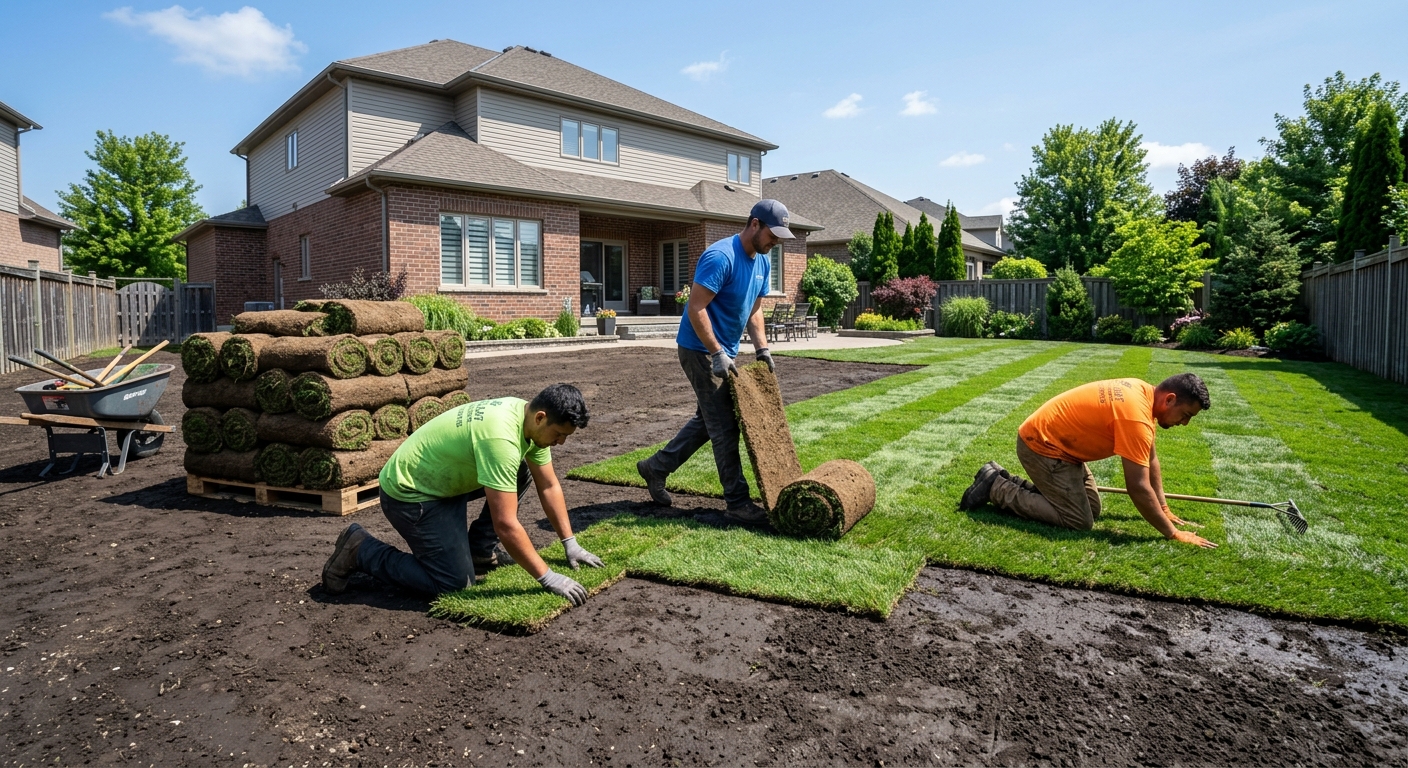
Minor grade/leveling, soil prep, sod supply, laying, rolling, and first watering strategy |
Late spring to early fall |
$3,000–$6,000 |
| Lawn seeding (grade, seed, starter fertilizer) |
Light grading, seed selection, starter fertilizer, overseed/patching as needed |
Spring or early fall |
$1,500–$3,800 |
| Interlocking patio or walkway |
Excavation, compacted base, edging, interlocking stones, and drainage considerations |
Spring to fall |
$8,500–$28,000 |
| Retaining wall (interlocking block) |
Block wall layout, engineered/stabilized base where required, backfill and drainage materials |
Spring to early fall |
$10,000–$40,000 |
| Tree and shrub planting |
Soil amendment, planting holes, staking, mulch rings, and initial care setup |
Spring or fall |
$1,200–$14,000 |
Prices are estimates only and vary by project scope, site access and material selection.
What affects the price of landscaping in Capilano
In Capilano and the wider Calgary area, two quotes for the same “look” can differ by 30–50% because contractors price the hidden work differently: grading depth, drainage complexity, excavation logistics, and what it really costs to ensure freeze–thaw resistance. In zones 3–4, the shortened working season and late-spring frosts mean crews must wait for workable ground, then move quickly when conditions allow. That reality can shift labour allocation, equipment scheduling, and even the availability of specific plant sizes when installers are booking ahead.
Zone-appropriate planting also matters. Southern Alberta’s shorter season demands cold-hardy, drought-tolerant species and strong wind structure; that often increases upfront planning time but reduces long-term replacement. Retaining walls and hardscape also require base prep that reaches below the frost line influence—so excavation and compaction aren’t optional. By contrast, in coastal mild climates you can get away with a longer growing season and broader palettes, but you still need excellent drainage in heavy-rainfall areas; in the dry interior, irrigation design can become the cost driver. Alberta’s prairie conditions sit between these extremes: you may still face water-day restrictions occasionally, so efficient zoning and soil improvement can push costs upward even when you’re choosing a lower-water design.
Concrete examples in Capilano: (1) A front walk with a compacted sub-base can cost materially more than a cosmetic “lift-and-relay” if the old base is unstable—expect a move from the lower interlocking band toward the higher end of $8,500–$28,000 when drainage and base rebuild are required. (2) Converting a thin lawn to a thicker stand using sod often jumps budgets into the higher sod band ($3,000–$6,000) because soil prep and establishment care are intensive. (3) On older housing lots, grading corrections near foundations can add excavation, drainage rock, and topsoil loads—small areas can still land in the mid five-figure range once combined with planting and a compacted base, consistent with Calgary’s typical comprehensive project pricing patterns.
| Price Factor |
Why It Matters |
Cost Impact |
| Yard size in sq ft — the primary cost driver for softscape |
Larger areas require more labour-hours for prep, materials, and establishment watering |
Often the biggest single swing in price; can add thousands quickly |
| Grading and drainage work — slope corrections add significant cost |
Fixing run-off patterns prevents foundation moisture and reduces pooling |
Can push a project from “typical” into the higher end of landscape bands |
| Drainage bed or French drain installation |
Freeze–thaw-resistant drainage lowers heaving risk behind walls and near walks |
Commonly adds meaningful excavation and rock costs |
| Plant material tier — native shrubs vs. ornamental vs. mature specimen trees |
Mature trees cost more and require extra labour for handling and proper planting depth |
Shifts budgets toward the upper tree/shrub band |
| Hardscape vs. softscape ratio — walls and patios cost more per sq ft than lawn |
Hardscape demands excavation, bases, edging, and stone setting |
More hardscape usually increases total project cost faster than adding turf |
| Irrigation system design and installation |
Drip or zoned sprinkler systems must be winter-ready and correctly placed |
Can add substantial cost but often prevents rework and plant loss |
| Soil amendment and topsoil required |
Improved soil supports root establishment and stabilizes bedding for landscaping |
Transport and import can raise costs even on small lots |
| Tree removal or stump grinding before new planting |
Access, stump size, and disposal affect labour and equipment use |
May add thousands and can delay installation start dates |
Permits & regulations in Alberta
In Alberta, most everyday softscape work in Capilano—like planting trees and shrubs, sodding, mulching, and seeding—typically does not require a permit. However, retaining walls can trigger permitting depending on height and local requirements; as a practical rule of thumb, walls above about 1.0 m (3.3 ft) often require a building permit in many municipalities, and some situations require engineered support details. Also, if you’re changing lot grading in a way that affects drainage to a neighbouring property or directs water toward storm sewer connections, approvals may be required because drainage impacts neighbouring rights and can affect site stability.
No matter the scope, always plan utility locates before digging post holes, trenching for drains, or installing wall footings. Even for small landscaping holes, calling for locates is the safe, standard approach to prevent service strikes. Water rules can also matter: confirm any irrigation bylaw timing and restrictions during dry periods.
To verify an Alberta contractor properly, start by checking their company licensing status through the appropriate provincial registry (where available) and ensure the business is clearly identified on your quote and invoices. Ask for a current certificate of liability insurance naming you as an additional insured if applicable. For worker coverage, request proof of WSIB/WCB coverage (or appropriate exemption documentation if they qualify). Lastly, ask for a clearance letter or verification that their account is in good standing where provided by their coverage provider—these documents should be current at the time of quoting, not outdated PDFs from last year.
Planning a landscape that thrives in Capilano's climate
Planning in Capilano means working with Alberta’s hardiness zone 3–4 realities: late spring frosts, early fall cold snaps, and the severe freeze–thaw cycles that test bases under patios and walkways. Start with plant selection—choose native or proven cold-hardy species suited to prairie conditions so they establish quickly and tolerate wind and winter drying. Avoid building your yard on “pretty-but-soft” plants that look great for one season and then struggle through winter. For soil and establishment, prioritize compost/topsoil where needed and plan mulch for moisture retention and temperature stability.
Sod versus seed is a common decision point. Sod delivers instant curb impact, but in the Calgary market it often costs roughly 3–4x per sq ft compared with seeding because you’re paying for turf supply and the higher establishment logistics. Seeding can be the better value if you’re patient; if you need fast results (selling, events, or kids using the yard), the higher upfront investment can be justified—especially when drainage is already handled and the soil is properly prepared. As an example, a typical lawn project might land near $1,500–$3,800 for seeding and then move toward the higher end near $3,000–$6,000 when you select sod and invest in thicker preparation for quick coverage.
Next, drainage and grading. In Calgary, pooling near foundations can mean long-term moisture problems, so sloped grading and drainage improvements are often the difference between a yard that survives and one that heaves or settles. For hardscape, base preparation must be deep and well-compacted to perform through frost movement. Finally, low-maintenance design strategies—groundcovers, mulch, perennials, and strategically placed shrubs—reduce annual upkeep without sacrificing visual richness.
Where water management matters, consider xeriscape or a rain-garden-style low area that captures roof run-off and seasonal melt. In Alberta, the aim isn’t “no water,” it’s smarter watering: efficient irrigation zoning, soil amendment, and plants that can handle dry stretches between cycles.
| Element |
Climate Consideration |
Maintenance Level |
Price Band |
| Sod lawn installation |
Requires consistent establishment while late frosts and chinooks shift drying; proper base and watering schedule are critical |
Medium (first season is the busy one) |
$3,000–$6,000 |
| Native perennial garden |
Better winter resilience and wind tolerance in Zone 3–4; deeper roots handle dry spells |
Low to medium (spring clean-up, occasional weed control) |
$1,800–$8,000 |
| Mulched shrub border |
Mulch buffers freeze–thaw and moderates soil moisture; select shrubs proven in Calgary conditions |
Low (mulch refresh and seasonal shaping) |
$1,500–$7,500 |
| Interlocking stone patio |
Needs deep, compacted base and correct slope to prevent heaving and water pooling in freeze cycles |
Low (occasional cleaning) |
$8,500–$28,000 |
| Retaining wall (block) |
Backfill + drainage are essential to manage water pressure and reduce movement during thaw |
Low to medium (inspections after first winter) |
$10,000–$40,000 |
| Drip irrigation system |
Zoned, winter-ready irrigation supports drought-tolerant planting with efficient watering |
Medium (seasonal checks and winterization) |
$1,500–$6,500 |
How to choose a landscaping contractor in Capilano
Choosing a contractor in Capilano is mostly about verification and clarity. First, confirm Alberta licensing where applicable for the work type, and require proof of liability insurance before any excavation starts. Ask for the certificate of insurance and confirm the coverage limits are appropriate for landscaping work (especially if they’re operating equipment near your house). Next, verify WSIB/WCB coverage: request a current clearance letter or proof of account in good standing from their coverage provider. If they’re subcontracting, make sure the subcontractor’s coverage is confirmed too—your quote should list who is doing what, not just a single company name.
Then, get 2–3 itemised written quotes. You want a breakdown of labour versus materials (stones, block, sod/seed, soil/topsoil, drainage rock, mulch, and irrigation components), plus quantities and unit rates where possible. Avoid “lump sum only” quotes that don’t explain what’s included—especially disposal (haul-away), permit pulls (if required), locate fees, and the extent of grading and base compaction. Read the scope line-by-line: what’s excluded can become your extra cost.
Warranty matters. Ask for a workmanship warranty length in writing and confirm the product/manufacturer warranties for paving, block, sod/seed, and irrigation components. Also ask whether warranties are transferable if you sell the home—this can matter to buyers in Calgary-region real estate markets. For payment schedule, never approve more than 10–15% upfront; hold a portion until the final inspection and cleanup are completed. Finally, insist on a written timeline with a start date and completion estimate that accounts for weather and freeze–thaw ground conditions.
- Certificate of liability insurance provided before work begins
- WSIB/WCB clearance letter or proof of good standing
- Itemised quote with quantities, unit pricing, and material specs
- Clear scope for grading, compacted base depth, and drainage inclusions
- Utility locate included (or proof it will be called before digging)
- Disposal/haul-away specified (topsoil, rubble, and old turf)
- Permit responsibility stated explicitly for any retaining wall work
- Landscape warranty documented (workmanship plus key materials)
- Start date and weather contingency plan in the proposal
- Payment schedule capped at 10–15% upfront with holdback at completion
- Communication plan (who answers site questions and how changes are approved)
- References or local project photos that match freeze–thaw hardscape conditions
Common red flags in Capilano include: quotes that don’t mention drainage or base preparation depth, refusing to itemise labour/materials, asking for large upfront payments (well above 10–15%), no written timeline or warranty details, and “we’ll handle everything” promises that don’t specify whether permits or locates are included.
Frequently asked questions — landscaping in Capilano
How much does professional landscape design cost?
In Capilano, professional landscape design is commonly charged as a separate line item or bundled into a larger installation package, depending on the contractor. For full backyard or front-yard renovations, many homeowners find the design component is effectively “paid back” when they proceed with installation, especially when grading, drainage, and irrigation are part of the plan. If you’re only doing a planting refresh, you may still want a planting plan and a basic site layout so you don’t waste money on plants that won’t thrive in Zone 3–4 wind and winter conditions. As a planning reference, a full landscape design and installation typically lands in the broader range of $8,500–$45,000, with design scope varying by how detailed the drawings and planting list need to be. (Statistics Canada, 2021 Census) notes Capilano’s small local population at 2,683, and with fewer local crews rotating through smaller neighbourhoods, design coordination can also influence the final cost.
How do I compare landscaping quotes?
When comparing landscaping quotes in Alberta, don’t just compare totals—compare scope. Ask each contractor to itemise labour and materials, including quantities (stone area, wall length, sq ft of sod/seed, cubic yards of topsoil, and drainage materials). For Calgary freeze–thaw performance, insist they explain the base build-up for patios and walkways, and what they’re doing for drainage (slope corrections, drainage rock, or French drain where needed). Also check whether disposal/haul-away is included and whether permits are the contractor’s responsibility for any retaining wall that may exceed the typical ~1.0 m threshold in many municipalities. A practical approach: if one quote is near $8,500–$28,000 for interlocking and the other is lower, the difference is usually missing excavation depth, base prep, or drainage. If a company can’t clearly explain those items, it’s hard to trust the price.
How long does a landscaping project take in Capilano?
Project duration in Capilano depends mainly on how much excavation, grading, and base preparation is required—plus weather and freeze–thaw conditions. In early spring and shoulder seasons, crews often wait for workable soil, which can extend timelines even if labour is available. Softscape-only planting jobs (mulch, shrubs, and perennials) can often be completed faster—sometimes within a few days to a week—while hardscape projects require more curing/settling time for bases and proper install sequencing. A typical interlocking patio or walkway may take about 1–2 weeks including prep and completion, while retaining walls can take longer due to excavation, block placement, backfill, and drainage integration. For full landscape renovations—design plus grading, hardscape, irrigation, and planting—many Calgary-region projects land in the mid five-figure range and often take several weeks. If you’re planning around a specific date, ask for a written schedule with weather contingencies.
What is the best grass type for a Capilano lawn?
For Capilano and the Calgary area (Zone 3–4 conditions), most lawns perform best with cool-season grasses that tolerate winter and summer temperature swings. Homeowners typically do well with blends that include turf types proven in Alberta winters, plus seed that matches local heat and drought cycles. In practice, the “best” option depends on whether you want sod for instant cover or seed for patching and full reseeding. Sod is often chosen when families want fast usability, while seeding works well when you can manage establishment through Calgary’s spring winds and late freezes. If you’re choosing between options, seeding budgets often start around $1,500–$3,800, while sod projects commonly sit higher around $3,000–$6,000, partly because sod requires careful establishment. A reputable contractor will base the recommendation on sun exposure, drainage, and foot traffic patterns—not just what’s “most popular.”
When should I aerate and overseed my lawn in Capilano?
In Capilano, the timing is about letting the grass recover before cold stress. Aerate and overseed in early spring once the ground is workable (but before heat spikes) or in early fall when temperatures are cooling and grass can still establish roots. The goal is to avoid overseeding right before a hard cold snap, because new seedlings can struggle if freeze–thaw cycles hit too aggressively. After aeration, top-dress lightly (if your contractor recommends it) and use starter fertiliser appropriate for cool-season lawns. Overseeding works best when your soil is not compacted and drainage issues are addressed—otherwise seed sits where roots can’t penetrate. If you’re seeing thinning from shade or pooling, fix drainage and grading first; then seed. In Alberta, contractors often recommend a consistent approach rather than repeated aggressive treatments. If your lawn is very bare or uneven, sod may be faster, but seeding often offers better value and can fit budgets like $1,500–$3,800 depending on area and prep.
What trees grow best in Capilano's climate zone?
For Capilano in Alberta’s prairie zone 3–4 environment, the “best” trees are typically cold-hardy, wind-tolerant species that can handle winter drying and freeze–thaw stresses. Many homeowners do well with trees such as hardy spruce types (depending on the exact site), and other proven cold-tolerant deciduous options used across the Calgary region. Location matters: near south-facing walls you’ll get more heat but also faster thaw, and low areas can hold moisture longer. Planting should account for soil improvement and correct hole depth so roots establish before the first deep cold. Also consider spacing from hardscape and foundations—root systems and drainage patterns need clear room to prevent future heaving or moisture issues. A contractor should recommend trees based on sun exposure and wind exposure, not just zone labels. If you’re budgeting for a small tree and supporting shrubs, many projects fall into the tree and shrub planting range of $1,200–$14,000, depending on whether you’re adding a single specimen or a fuller layered border.