Landscaping options and costs in Lamont
Lamont homeowners typically start with practical upgrades—because 73.0% of dwellings in the broader Lamont housing mix are single-detached homes, most properties have enough yard space to justify real landscape work (not just small touch-ups). With 77.2% of households owning their homes (Statistics Canada, 2021 Census), many projects are planned for long-term curb appeal and lower maintenance rather than short-lived “quick fixes.” In 2024–2025, we’re also seeing more demand for structured outdoor living areas along the main service corridors around Lamont’s core residential areas, where yards can be shaped for wind exposure and better snow management.
In the Camrose–Drumheller economic region, the Prairie climate strongly influences both what gets installed and how much it costs. Most areas sit around plant hardiness zone 3b, with winter lows often in the -37°C to -34°C range. That means excavation, retaining wall builds, and planting are concentrated into a shorter spring thaw-to-early-fall window, and labour/equipment scheduling can raise costs if multiple crews are booked at once. Severe freeze–thaw cycles also make drainage and base prep non-negotiable for patios and steps, which increases hardscaping scope and material needs. For a comparable yard in a milder or longer-season market, you’d usually see a wider planting palette and longer work season—here, we price around the reality of frost depth, wind, and drought-tolerant design.
Below is a practical comparison of common services Lamont homeowners request, along with the current city-tier price bands to help you budget before you contact contractors.
| Service |
Description |
Season |
Price Range |
| Full landscape design and installation |
Site walk, layout, plant + material selection, grading/drainage plan, labour for planting and hardscape, cleanup |
Spring to early fall (typically) |
$8,000–$35,000 |
| Sod installation (supply, grade, lay, roll) |
Minor grading, soil prep, sod supply and installation, rolling and initial watering setup |
Late spring to summer (when ground is workable) |
$1,200–$6,500 |
| Lawn seeding (grade, seed, starter fertilizer) |
Soil grading, seed blend application, starter fertiliser, light raking/rolling |
Spring or early fall (cooler temps) |
$600–$3,200 |
| Interlocking patio or walkway |
Base excavation, geotextile, compacted granular base, pavers, edging and joint sand |
Spring to early fall (weather-dependent) |
$3,500–$18,000 |
| Retaining wall (interlocking block) |
Excavation, wall base to frost considerations, blocks/anchors (as needed), drainage gravel, weeping control |
Spring to early fall (proper curing/dry conditions) |
$6,000–$38,000 |
| Tree and shrub planting |
Soil conditioning, planting, staking (if required), mulch ring, first-season watering guidance |
Spring and early fall (often best plant window) |
$900–$9,500 |
Prices are estimates only and vary by project scope, site access and material selection.
What affects the price of landscaping in Lamont
In Lamont, it’s common to see quotes for the “same” landscaping concept vary by 30–50% across the Camrose–Drumheller area and wider Alberta. The reasons usually come down to scope clarity, soil conditions, and how much of the work is truly required for Prairie performance. In a zone 3b setting, frost timing and the short effective season change both what can be installed and what must be built with extra protection. In Camrose–Drumheller, we often design for wind exposure and drought-tolerant planting because winter exposure and summer drying can stress softer species. Also, retaining wall and step/patio base depth must reach below frost-affected layers—if a contractor under-builds the base, costs shift to future repairs.
By contrast, coastal BC (zone 7–8) typically allows a longer growing window and lush planting palettes, but it demands careful drainage in heavy-rainfall conditions—so their cost drivers look different. Dry interior BC markets often emphasize drip systems and xeriscape layouts due to stricter water restrictions, while southern Ontario (zone 5–6) has a more moderate season and different irrigation demand patterns during summer dry spells. For Lamont homeowners, the Prairie reality is that hardscape and drainage details can push projects into the $3,000–$60,000 retaining-wall and hardscaping band, even when the visible work seems straightforward.
Two concrete local examples: (1) If your yard is older—many homes were built before 1981 in this area (53.7%)—you’re more likely to have compacted soils, uneven settling, or outdated drainage patterns that add grading time. (2) If the site needs drainage correction and a proper base (geotextile + granular layers), that can move a patio from a near-minimum build to something closer to the upper end of the hardscape band. As a budgeting reference, a basic lawn upgrade might land in the $600–$3,200 seeding range, while sod for the same footprint can jump meaningfully because it’s faster but more material-intensive.
| Price Factor |
Why It Matters |
Cost Impact |
| Yard size in sq ft — the primary cost driver for softscape |
More square footage means more labour hours, topsoil, seed/sod, mulch, and plant material |
Small yards can be near the low end; larger lots often move you toward mid-to-upper bands |
| Grading and drainage work — slope corrections add significant cost |
Prairie soils and freeze–thaw cycles magnify drainage problems; corrected slopes reduce pooling and foundation moisture |
Can add thousands to a project, especially on uneven or low-lying sites |
| Drainage bed or French drain installation |
Basins, weeping tiles, gravel trenches and clean-out access are required for long-term performance |
Moderate-to-high add-on depending on distance, trench depth and tie-ins |
| Plant material tier — native shrubs vs. ornamental vs. mature specimen trees |
Zone-appropriate native/ hardy species cost less and establish faster; mature specimens cost more and require careful handling |
Can swing planting budgets widely, especially for larger trees |
| Hardscape vs. softscape ratio — walls and patios cost more per sq ft than lawn |
Pavers/blocks require excavation, compacted base, edging and additional labour to prevent movement |
Increasing hardscape typically pushes projects toward the retaining wall & hardscaping band |
| Irrigation system design and installation |
Even water-conscious designs need correct emitter spacing and freeze-safe plumbing strategy |
Often a major variable in spring and summer schedules |
| Soil amendment and topsoil required |
Poor subgrade increases failure risk for sod/seed and can reduce plant survival |
Adds cost when hauled-in topsoil, compost and amendments are needed |
| Tree removal or stump grinding before new planting |
Root systems and stumps change excavation planning and can delay installation |
Can add both labour and equipment time |
Permits & regulations in Alberta
For most routine landscaping work in Alberta, you typically do not need a permit: planting new trees and shrubs, seeding or sodding a lawn, and most softscape installations (like garden bed mulching, topdressing and typical walkway/patio work on private property) are generally handled as private improvements. Where permits commonly come into play is with retaining walls above local thresholds—often around 1.0 m (3.3 ft) in many Alberta municipalities—because the structure can affect neighbouring properties and drainage, and may require engineering. Also consider grading changes: if you plan significant lot grading that alters drainage toward neighbouring properties or ties into storm sewer connections, approval requirements can be triggered.
Before any digging in Lamont, require utility locates. Even planting holes can hit shallow lines, and wall footings go deeper—locates reduce risk and liability. For water-use policies, check Alberta irrigation and local water-use bylaws (especially if drought conditions tighten restrictions in the wider interior Prairie region). Prairie winters and freeze–thaw cycles also make drainage design essential; a contractor should explain how runoff is directed so the work doesn’t create spring pooling.
To verify your contractor: (1) confirm they’re licensed/registered where applicable for the work type through Alberta’s online resources; (2) ask for liability insurance with certificate details matching the legal entity on your contract; (3) confirm WSIB/WCB coverage (or the correct Alberta equivalent status) via documentation they can provide. Then ask for a clearance letter or account proof if they operate under a registered program—don’t accept “we’re insured” without the certificate number and dates.
Planning a landscape that thrives in Lamont's climate
Planning for Lamont starts with working with the yard’s climate realities—rather than trying to grow lush, water-hungry features that don’t suit zone 3b. Choose hardy, zone-appropriate plants and focus on winter structure: wind-tolerant shrubs, deep-rooted perennials, and species that can handle cold snaps without constant protection. In a Prairie calendar, you’ll usually get the best establishment when you plant in spring or early fall, and design for dry spells so you’re not watering constantly.
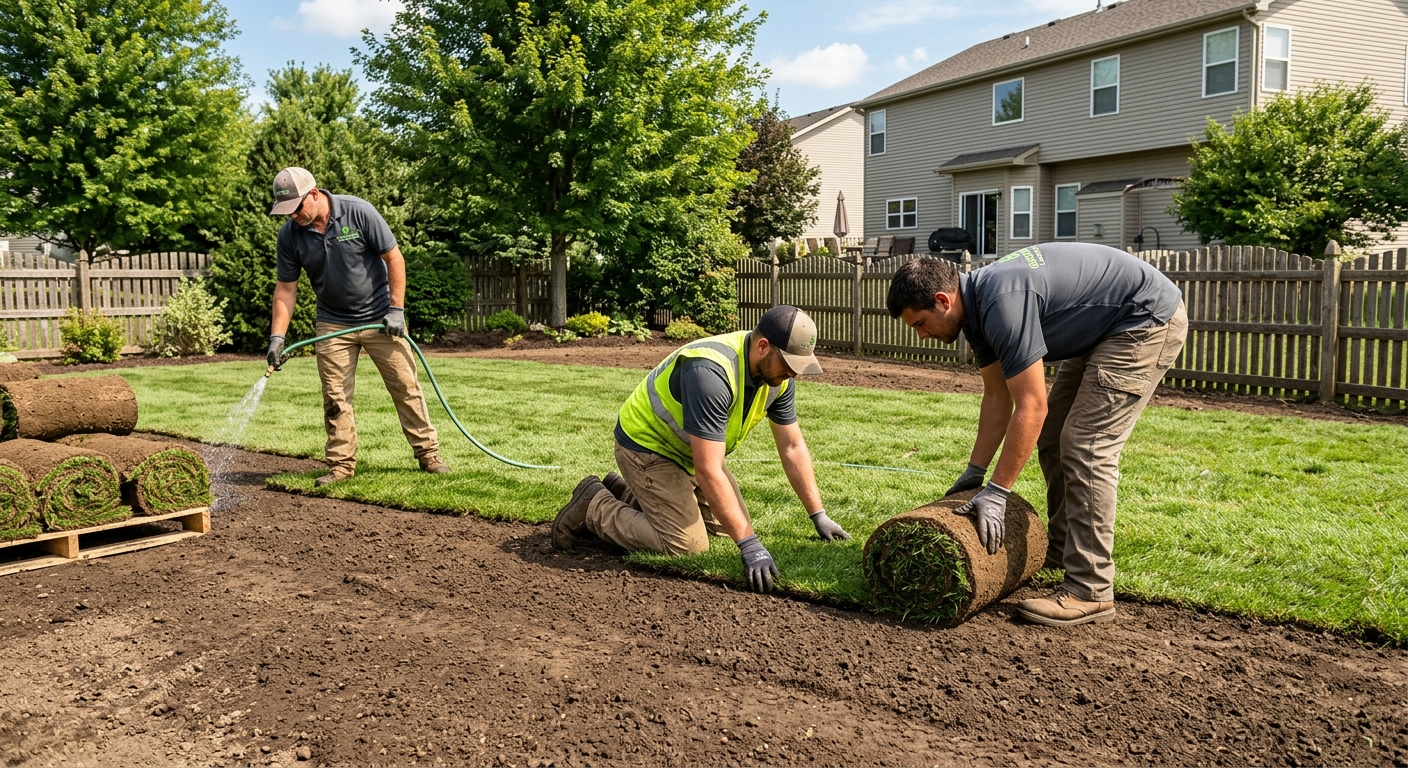
Sod vs. seed is the most common decision point. Sod gives instant visual coverage, but it’s materially more expensive: sod installation in Lamont often lands in the $1,200–$6,500 range for typical footprints, while seeding with grading and starter fertilizer commonly fits $600–$3,200. That difference can be justified when you need quick curb appeal (selling readiness, pet/kids use right away) or when seed establishment risk is high due to soil compaction. Otherwise, seeding is a cost-effective Prairie approach—if the grading and seed-to-soil contact are done well.
Drainage and grading are critical in Camrose–Drumheller because spring melt plus freeze–thaw can cause pooling and foundation moisture. Even a “nice” bed can fail if runoff is directed the wrong way. For patios and retaining walls, base prep matters: excavate, use geotextile where appropriate, compact granular layers, and ensure wall/drainage components are built to account for frost-affected soils.
For low maintenance, rely on mulched shrub borders, groundcovers, and repeatable perennial groupings rather than constant re-planting. Xeriscape-style designs still look intentional here—think drought-tolerant shrubs, efficient drip lines, and mulch to slow evaporation. A rain garden can also be a smart Prairie feature if it’s designed to infiltrate safely and not overwhelm the foundation drainage path.
| Element |
Climate Consideration |
Maintenance Level |
Price Band |
| Sod lawn installation |
Fast establishment in a short season; needs strong initial watering plan before winter |
Low-to-moderate (first season care matters) |
$1,200–$6,500 |
| Native perennial garden |
Hardy planting for zone 3b; better winter resilience and drought tolerance |
Low (mulch top-ups, seasonal pruning) |
$900–$6,000 |
| Mulched shrub border |
Wind-tolerant, deep-rooted shrubs; mulch buffers freeze–thaw stress |
Low-to-moderate |
$700–$4,800 |
| Interlocking stone patio |
Freeze–thaw-resistant base, proper edging and drainage slope away from the house |
Low (occasional joint sand/top-up) |
$3,500–$18,000 |
| Retaining wall (block) |
Built with frost-aware base and drainage gravel to prevent heave/failure |
Low (periodic inspection for movement/drainage) |
$6,000–$38,000 |
| Drip irrigation system |
Freeze-safe routing and water-efficient emitter placement for drought seasons |
Moderate (seasonal start/stop and inspections) |
$1,200–$7,500 |
How to choose a landscaping contractor in Lamont
Start by verifying the contractor you’re hiring is set up to work safely and legally in Alberta. Ask for (and confirm) liability insurance—the certificate should show the policy holder and effective dates, and match the company name on your contract. Next, confirm WSIB/WCB coverage for their workers (and subcontractors, if applicable). Finally, make sure they’re properly registered/licensed for the scope they’re proposing in Alberta.
Then get 2–3 itemised written quotes. “Lump sum” quotes without a labour + material breakdown are hard to compare. You want line items like excavation, hauling/disposal, base material, geotextile, pavers/blocks, and planting quantities (trees/shrubs counts and sizes). A well-prepared quote also clarifies what’s excluded: topsoil haul-in, disposal fees, rock removal, stump grinding, irrigation tie-ins, permit handling (if a wall triggers permitting), and restoration of grass after drainage work.
Warranty matters in Prairie conditions. Ask for the workmanship warranty length and whether the product/manufacturer warranty applies to the actual materials installed (pavers/blocks/sod/seed mixes). Also ask if warranties are transferable if you sell the home. Payment schedule should be conservative—never more than about 10–15% upfront; keep a holdback until the job is complete and punch items are corrected. Get the timeline in writing with a start date and completion estimate, because spring thaw schedules can shift.
- Provide an itemised quote with quantities (sq ft, linear feet, plant counts, tree size/girth).
- Include a drainage and grading plan when slopes or pooling are present.
- Confirm whether disposal/hauling is included or billed separately.
- Ask who pulls utilities locates (and ensure locates are done before digging).
- Verify liability insurance and WCB/WSIB clearance for the project dates.
- Request the workmanship warranty in writing (not just “we stand behind it”).
- Confirm if paver/block systems include base and joint specifications for freeze–thaw.
- Check whether the quote includes edging, geotextile, compacted base and drainage gravel for walls.
- Be clear about irrigation scope: design, install, timer/programming and freeze-safe shutoff.
- Ask how they manage spring weather delays and what triggers re-scheduling.
- Look for a realistic timeline that matches Lamont’s thaw-to-early-fall window.
- Require a written contract with scope, exclusions, start/completion dates, and payment milestones.
In Lamont, red flags include: contractors who won’t put drainage/base details in writing, quotes that don’t mention disposal or excavation limits, promises of sod/seed timelines that ignore thaw/weather realities, vague warranty language (“lifetime” without terms), and requests for large upfront payments (well beyond 10–15%) with no holdback for punch-list completion.
Frequently asked questions — landscaping in Lamont
Sod vs seed — which is better for a Lamont lawn?
In Lamont (and the Camrose–Drumheller region), both sod and seed can work, but the best choice depends on your timing and how much risk you can tolerate during a short Prairie season. Seed is usually the better budget option because seeding with grading and starter fertiliser commonly falls around $600–$3,200 for typical areas. Sod costs more—often $1,200–$6,500—but it gives instant coverage and can be worth it if you need the lawn usable quickly for pets or kids, or if your soil is ready for strong establishment. Whichever you choose, insist on proper grading, good seed-to-soil contact (for seed), and an initial watering plan so roots establish before winter.
How much does a retaining wall cost in Lamont?
Retaining wall pricing in Lamont depends mainly on wall height, length, soil conditions, and how much drainage work is required behind the wall. In Prairie freeze–thaw conditions, you also need the base built to the right depth and included drainage gravel/weeping control, which prevents movement and future failure. For an interlocking block retaining wall, many projects land in the $6,000–$38,000 range. If your site needs significant grading, extra excavation, or a drainage bed tie-in, that can push toward the upper end. Getting an itemised quote with excavation, base build-up, and drainage components will help you compare bids fairly.
When is the best time to landscape in Lamont?
For most installs in Lamont, spring thaw to early fall is the realistic window. Planting is often best in spring and early fall because the ground temperature supports root establishment while summers can dry out quickly on the Prairies. Hardscape (patios, walkways) and retaining walls are weather-sensitive: base work needs workable ground, and block work needs appropriate curing/dry conditions. If you’re scheduling sod, late spring through summer tends to work best when the ground is stable and you can water consistently. Plan your schedule around thaw dates—if the crew arrives too early, base compaction and excavation can be inconsistent, which increases repair risk.
Do I need a permit for a retaining wall in Alberta?
Often, yes—retaining walls that exceed a local height threshold commonly require a building permit in Alberta, and many municipalities look at around 1.0 m (3.3 ft) as a typical trigger (exact threshold can vary by municipality). Smaller landscape work like planting and lawn sodding generally does not require permits. The safest approach in Lamont is to ask the contractor to confirm whether your specific wall height and design requires permitting, and whether engineering drawings are needed. Also note: if your project involves meaningful lot grading that affects drainage toward neighbouring properties or storm connections, that can create additional approval needs.
How do I improve drainage in my yard?
In Lamont, drainage improvements usually start with figuring out where water pools after rain and spring melt. Look for downspouts discharging onto low spots, grading that slopes toward the foundation, and compacted soil layers that don’t infiltrate well. A contractor may recommend re-grading (correcting the slope), adding a drainage bed or French drain, and tying into an appropriate outlet with proper weeping control. Because freeze–thaw is severe in the region, drainage work often costs more than homeowners expect—yet it prevents foundation moisture issues and lawn failure. A good quote should explain the flow direction and include geotextile/gravel where needed.
What is xeriscaping and does it suit Lamont?
Xeriscaping is landscaping designed to reduce water use by selecting drought-tolerant plants, using efficient irrigation (like drip), and building soil health with mulch/groundcovers to slow evaporation. In Lamont, it can suit your yard well because Prairie summers can dry out and winter exposure limits what survives long term. The goal isn’t to create a “rock-only” yard—it’s to create a resilient, attractive design that doesn’t rely on constant watering. Many Lamont homeowners do best with a mixed approach: hardy shrubs/perennials, a mulched border, and targeted drip irrigation for new plantings and high-sun areas. If you’re budgeting, xeriscape-style designs often pair well with seeding ($600–$3,200) rather than full sod, since less lawn typically means lower ongoing water demand.