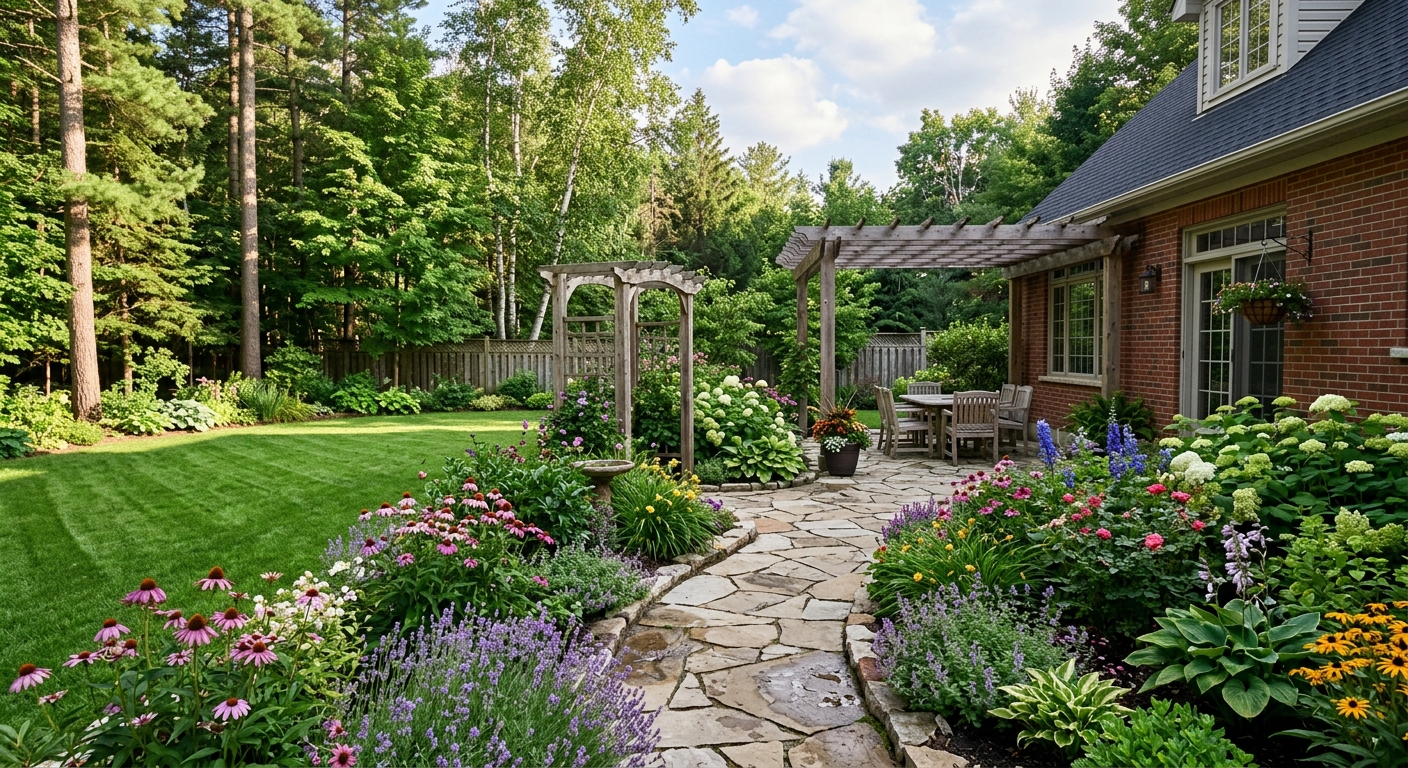
Landscaping options and costs in Skyview Ranch
Skyview Ranch, Alberta is a great place to upgrade your curb appeal, but the yard has to be built for Calgary’s Prairie winters, freeze–thaw cycles, and short working season. With Skyview Ranch holding about 12,870 people (Statistics Canada, 2021 Census), there’s enough housing turnover to keep installers busy—especially when neighbours start landscaping at the same time in spring. Many homes in the Calgary region are newer subdivisions with driveways, grading, and utility work still evolving, so landscape projects often include more site prep than owners expect. That’s one reason quotes can feel “spread out” even when you choose the same style.
In Prairie plant hardiness zones 3–4, late-spring frosts and early fall cold snaps affect what we can plant and when. Freeze–thaw can heave poorly compacted bases, so patios, walkways, and retaining wall footings usually require deeper, well-compacted drainage layers. Labour is also a real cost driver in the Calgary market; local projects that roll grading, hardscape, planting, and irrigation together often land in the mid five-figures.
We also see extra demand in established pockets around new collector roads where access is easier for excavators and material deliveries. In Skyview Ranch, that typically means neighbourhoods near busier corridors like around the main transit routes.
Below are common landscaping scopes and realistic ranges you can use to compare quotes, before you move into a detailed plan.
| Service |
Description |
Season |
Price Range |
| Full landscape design and installation |
Site walk, grading plan, drainage review, planting plan, irrigation layout (if needed), base prep, hardscape, and plant installation |
Apr–Oct (most efficient May–Sep) |
$5,000–$50,000 |
| Sod installation (supply, grade, lay, roll) |
Topsoil/grade correction, soil prep, sod supply, lay, roll, starter fertilizer, first watering plan |
May–Jun or Aug–Sep |
$1,500–$6,000 |
| Lawn seeding (grade, seed, starter fertilizer) |
Minor grading touch-ups, seed blend, starter fertilizer, light raking and watering plan |
Apr–Jun or late Aug (weather dependent) |
$750–$3,000 |
| Interlocking patio or walkway |
Excavation to frost-depth consideration, compacted base, edging, interlock pavers, sand setting bed, leveling |
Apr–Oct |
$8,000–$40,000 |
| Retaining wall (interlocking block) |
Block system, drainage gravel/weep provisions, geogrid (if required), compaction, leveling and finishing |
Apr–Oct |
$10,000–$35,000 |
| Tree and shrub planting |
Soil improvement, dig/install, staking (if needed), mulching, root ball protection, initial watering guidance |
May–Jun or Sep |
$800–$15,000 |
Prices are estimates only and vary by project scope, site access and material selection.
What affects the price of landscaping in Skyview Ranch
In Skyview Ranch and across Calgary, the same “basic” landscaping idea can swing by 30–50% because Prairie site conditions are rarely identical from lot to lot. Your yard’s size and shape matter, but so do hidden variables: how much grading is needed, whether drainage must be rebuilt, and how deep the base has to go to handle severe freeze–thaw. Labour also moves with demand—when multiple neighbourhoods start mid-May, crews are booked, and scheduling can push costs up.
Hardiness zones 3–4 and Calgary’s frost calendar shape both the plant palette and the work season. Cold-hardy, drought-tolerant species cost differently than fast-growing “pretty now” stock, and winter survival often means choosing stronger genetics and better root systems. Base prep is even more decisive: for walkways and patios, inadequate depth or poor drainage can lead to heaving, which forces rework.
To contrast, coastal BC’s long, mild growing season (and lush planting palettes) allows more time for establishment, but heavy-rainfall sites still need excellent drainage design. The BC interior’s water restrictions push drip irrigation and xeriscaping; Southern Alberta is also semi-arid and may have periodic watering limits, so Smart controllers, zoned systems, and soil improvement can affect your irrigation budget. In southern Ontario (zones 5–6), the season is steadier and turf often gets installed sooner, but irrigation is commonly needed during mid-summer dry spells.
Concrete examples from Skyview Ranch: (1) two identical 500 sq ft lawns can differ widely if one lot has compacted subsoil that needs aeration and topsoil replacement—this can shift you toward the higher end of the $1,500–$6,000 sod band. (2) A single retaining wall may look modest, but when frost-depth excavation and drainage gravel are added, you may move from the lower end of typical $8,000–$40,000 hardscape ranges into mid five-figures once grading and base prep are included.
Housing age also plays a role: newer infill lots can have fresh grading and still-active settlement, which means contractors may recommend additional base stabilization and more conservative planting times—adding cost now to reduce failures later.
| Price Factor |
Why It Matters |
Cost Impact |
| Yard size in sq ft — the primary cost driver for softscape |
More area means more labour hours, more soil/seed/sod, and more edging and cleanup |
Often drives the widest variation: small front yards can be near $1,500–$3,000 sod/seed, while larger lots quickly exceed typical bands |
| Grading and drainage work — slope corrections add significant cost |
Calgary’s pooling or down-slope runoff can affect foundations and turf; correcting it takes excavation and re-contouring |
Can add thousands, frequently pushing whole-project budgets toward the mid five-figure range |
| Drainage bed or French drain installation |
French drains reduce water pressure under patios/walls and improve long-term stability |
Usually a meaningful add-on, especially when required under pavers or near downspouts |
| Plant material tier — native shrubs vs. ornamental vs. mature specimen trees |
Hardiness and size matter; larger mature specimens cost more and require better handling |
Tree & shrub planting can vary from the lower end of $800–$15,000 into higher totals depending on specimen size |
| Hardscape vs. softscape ratio — walls and patios cost more per sq ft than lawn |
Interlock, block, and base layers are labour- and material-intensive |
A patio that’s “just bigger” can move you within or beyond the $8,000–$40,000 hardscaping band |
| Irrigation system design and installation |
Zoned watering, head selection, and controller programming are needed for efficient coverage |
Typically raises costs more than owners expect when trenching is required |
| Soil amendment and topsoil required |
Prairie soils can be compacted or thin; healthy lawns and plant roots need improved structure |
Can shift a project toward the higher end of sod and full-install ranges |
| Tree removal or stump grinding before new planting |
Removal adds equipment time and disposal; roots can complicate excavation |
Commonly increases project cost substantially, especially near walkways or foundations |
Permits & regulations in Alberta
In Alberta, most landscaping work you can picture as “softscape” typically does not require a permit. Planting, sodding, and the majority of garden updates (mulching, seeding, adding shrubs/perennials, installing many freestanding garden edging systems) are generally handled as construction-on-your-lot activities without a permit.
The work that often does require a permit is retaining wall construction above the local height threshold—commonly around 1.0 m (3.3 ft) in many municipalities—because wall systems can affect structural safety and drainage. Some municipalities may also require engineered drawings for larger or taller walls, walls with significant surcharge loads, or complex site conditions. Another area that can trigger approval is changing lot grading in a way that redirects drainage toward a neighbouring property or into or around storm sewer connections.
Before any digging (for planting holes, irrigation trenches, or wall footings), call utility locates. Even if the area “looks clear,” utilities can run under lawns and walkways. Also, confirm local irrigation and water-use rules for your season—while Alberta has its own bylaws, Alberta homeowners can still face watering limits during drought or high-demand periods, and contractors often schedule around those restrictions.
To verify a Skyview Ranch contractor: (1) check the contractor’s licensing/registration where applicable through Alberta’s online listings; (2) request a certificate of liability insurance showing adequate coverage for landscaping/commercial work; (3) confirm WSIB/WCB coverage status through the contractor’s documentation or clearance/registration proof; (4) ensure the quote includes responsibilities for locates, disposal, and any required permits (if the scope triggers them).
Planning a landscape that thrives in Skyview Ranch's climate
Designing in Skyview Ranch means working with Calgary’s zone 3–4 reality: limited frost-free time, frequent freeze–thaw, chinook-driven swings, and semi-arid conditions. Start with plant selection that matches the hardiness zone and your sun/wind exposure—native and zone-appropriate shrubs and perennials typically establish better and need less winter protection than tender ornamentals. Then plan for soil and drainage: Calgary yards need grading that sheds water away from foundations so you don’t get pooling, soggy turf, or waterlogged bases under patios.
Sod versus seed is one of the biggest decision points. Sod gives instant visual results but costs roughly 3–4x more per sq ft than seeding in most Calgary installs, and it still needs proper prep to survive the freeze–thaw season. For example, if you’re debating a 500 sq ft front lawn, a seeding approach might land near the lower band of lawn seeding totals, while sod usually pushes you toward the higher end of the sod range—so the price difference is justified when you want immediate curb appeal for resale timing or when you can’t wait for gradual establishment.
Hardscape should be built for stability: patio and walkway bases must be excavated and compacted to the depth required for local conditions, with proper drainage layers to reduce heaving. If you’re considering xeriscape or a rain-garden style feature, pair it with drip irrigation where needed (or use smart zoned watering) and include soil amendment so it can handle drought stretches and sudden spring melt.
Finally, low-maintenance design wins in Alberta. Use mulched shrub borders, groundcovers, and perennials to reduce bare soil, then layer textures so your yard stays attractive without constant weeding and re-seeding.
| Element |
Climate Consideration |
Maintenance Level |
Price Band |
| Sod lawn installation |
Needs solid soil prep and drainage to survive freeze–thaw; best when installed in suitable shoulder seasons |
Moderate (watering/monitoring early, then mowing) |
$1,500–$6,000 |
| Native perennial garden |
Zone-appropriate plants improve winter survival and handle dry spells better than tender ornamentals |
Low to moderate (spring cleanup, occasional weeding) |
$1,200–$7,500 |
| Mulched shrub border |
Mulch buffers temperature swings and helps manage moisture around roots during Calgary’s freeze/thaw cycles |
Low (refresh mulch 1–2x/year, light pruning) |
$800–$6,000 |
| Interlocking stone patio |
Base depth, compaction, and drainage determine long-term performance under Alberta frost |
Low (periodic cleaning and joint sand checks) |
$8,000–$40,000 |
| Retaining wall (block) |
Requires proper drainage gravel and stable base below frost-depth influence to prevent movement |
Low (visual inspections; minor repairs if settling occurs) |
$10,000–$35,000 |
| Drip irrigation system |
Zoned drip reduces waste and supports drought-tolerant planting strategies with water-efficiency |
Moderate (seasonal checks and winterization) |
$2,000–$12,000 |
How to choose a landscaping contractor in Skyview Ranch
Choosing the right contractor in Skyview Ranch starts with proof, not promises. First, verify Alberta licensing/registration where applicable for the type of work they perform, and ask for a current certificate of liability insurance that lists the correct legal entity and includes landscaping activities. Next, confirm WSIB/WCB coverage—don’t rely on verbal statements. Request a clearance letter or documented proof that their coverage is active for the people working on your site.
Second, get 2–3 itemised written quotes that show labour and materials separately. Look for breakdowns for excavation and compaction, base materials, pavers/block, topsoil/soil amendment, plant quantities, and irrigation components (heads, controller, valves, and trenching). Avoid lump-sum quotes that don’t state what’s included. Confirm whether disposal is included, whether the contractor will do utility locates coordination, and whether permits (where required for taller retaining walls or drainage-altering work) are pulled and by whom.
Third, scrutinize warranty terms. A good workmanship warranty is clear on length and what it covers (settlement, joint failure, plant replacement policy for winter kill where applicable). Ask about product/manufacturer warranties and whether they’re transferable to you.
Fourth, payment scheduling matters: never pay more than 10–15% upfront. Hold back a portion until the job is complete and any remaining items (final grading, cleanup, walkthrough fixes) are done. Finally, request a start date and completion estimate in writing, and ask how they manage spring weather and frost-related scheduling changes.
- Confirm Alberta licensing/registration relevant to their work type
- Request certificate of liability insurance and verify coverage limits
- Ask for WSIB/WCB clearance or proof of active coverage
- Get itemised quotes (labour vs materials) for each scope
- Check what’s excluded: disposal, top-up topsoil, pruning, winterization
- Ask who handles utility locate coordination before digging
- Verify base build details (depth, compaction method, drainage layers)
- Ensure irrigation scope includes controller type, zoning, and winterization plan
- Ask for plant list specifics: quantities, sizes, and hardiness suitability
- Confirm warranty length for workmanship and the plant replacement policy
- Review payment schedule—limit upfront and set a completion holdback
- Get the timeline in writing with an agreed site-prep date
In Skyview Ranch, red flags include: vague quotes with no base/drainage details, contractors who won’t provide insurance/WSIB/WCB proof, “rock-bottom” pricing that leaves out compaction or drainage gravel, plans that schedule planting too late for frost risk, and pressure to pay large deposits before any materials are staged or site prep is complete.
Frequently asked questions — landscaping in Skyview Ranch
How do I prevent weeds in my Skyview Ranch garden?
Weed prevention in Skyview Ranch starts before planting: clear existing weeds thoroughly, then address soil contact and bare gaps. For shrub and perennial areas, we recommend a weed-suppressing layer under mulch, plus a thick, consistent mulch depth to reduce light reaching weed seeds. Edging is also key—when grass overgrows beds, weeds move in fast, especially after thaw cycles. If you’re installing new beds, ask your contractor to include soil improvement and a proper weed barrier strategy instead of relying on mulch alone. Finally, plan on one spring cleanup pass and a spot-weeding approach in late May/early June so weeds don’t set seed. These steps can keep a bed looking clean without escalating maintenance costs over time.
How do I design a low-water yard in Skyview Ranch?
For a low-water yard in Alberta’s zone 3–4, focus on plant selection and irrigation efficiency—not just “less watering.” Choose drought-tolerant, cold-hardy species suited to Calgary’s wind and dry stretches, then group plants by water needs so you don’t overwater everything. Add mulch (and refresh it) to reduce evaporation and moderate soil temperature during Alberta freeze–thaw. Where turf isn’t essential, replace high-water lawn areas with native perennial beds or groundcovers. If you keep lawn, seed or sod with proper soil prep helps roots develop faster and reduces runoff. A drip or zoned irrigation design typically costs extra up front, but it prevents wasting water on non-target areas. Budget planning helps: many full yard updates land inside the $5,000–$50,000 full-install range depending on how much irrigation and hardscape you include.
How do I find a licensed landscaper in Skyview Ranch?
Start by asking for proof—don’t accept only a brochure. For a Skyview Ranch landscaping contractor, confirm their Alberta licensing/registration where applicable for the work they perform, and request a current certificate of liability insurance that covers landscaping activities on your property. Next, check WSIB/WCB status: ask for a clearance letter or documented proof that their coverage is active for workers who will be on site. These documents protect you if there’s an injury or a property incident. Then compare quotes: you want itemised scope and material lists, not just a single number. If you’re adding a retaining wall above the local permit threshold (often around 1.0 m), ask whether they handle permit requirements. A credible contractor will explain what requires approval and what typically does not.
How much does landscaping cost in Skyview Ranch?
Landscaping cost in Skyview Ranch depends heavily on site prep, grading/drainage, and how much hardscape and irrigation you include. For many homeowners, a full design-and-install project falls within the $5,000–$50,000 band. If your scope is more limited, sod installs commonly land around $1,500–$6,000, while tree and shrub planting often starts in the $800–$15,000 range depending on quantities and sizes. Interlocking patios, walkways, and retaining walls can reach $8,000–$40,000 as base preparation and materials scale up. In Calgary’s freeze–thaw conditions, base depth and drainage are not “nice to have,” so quotes can differ when one contractor includes French drain work or proper compaction and another doesn’t.
What plants thrive in Skyview Ranch's climate zone?
In Alberta’s Calgary area (plant hardiness zones 3–4), the best-performing plants are typically cold-hardy, wind-tough, and suited to semi-arid conditions. Look for native shrubs and perennials that can handle winter exposure and short establishment windows in spring. In borders, choose a mix of structure plants (shrubs), repeat bloomers (perennials), and grasses/groundcovers for texture and weed suppression. Mulch and soil amendment help roots survive temperature swings created by freeze–thaw. If you’re aiming for curb appeal with lower watering, prioritize plants that are drought-tolerant once established and that don’t require constant summer watering. A good contractor should provide a plant list with quantities and sizes and explain which varieties are chosen specifically for Alberta winters rather than general “zone” labels alone.
Sod vs seed — which is better for a Skyview Ranch lawn?
In Skyview Ranch, sod is better if you want fast results and immediate curb appeal, but it requires excellent grading and soil prep to survive Alberta’s freeze–thaw. Seeding is often more budget-friendly and can be a smart choice when you’re patient with establishment. The trade-off is timeline: sod greens up quickly, while seeding needs time to germinate, root in, and thicken. Cost matters too—sod commonly ranges from $1,500–$6,000 for typical installs, while seeding is often materially lower because you’re paying for seed, top dressing, and prep rather than turf roll. If your yard has drainage issues, fix those first in either case; otherwise, you’ll pay twice due to patchy coverage and weed pressure.