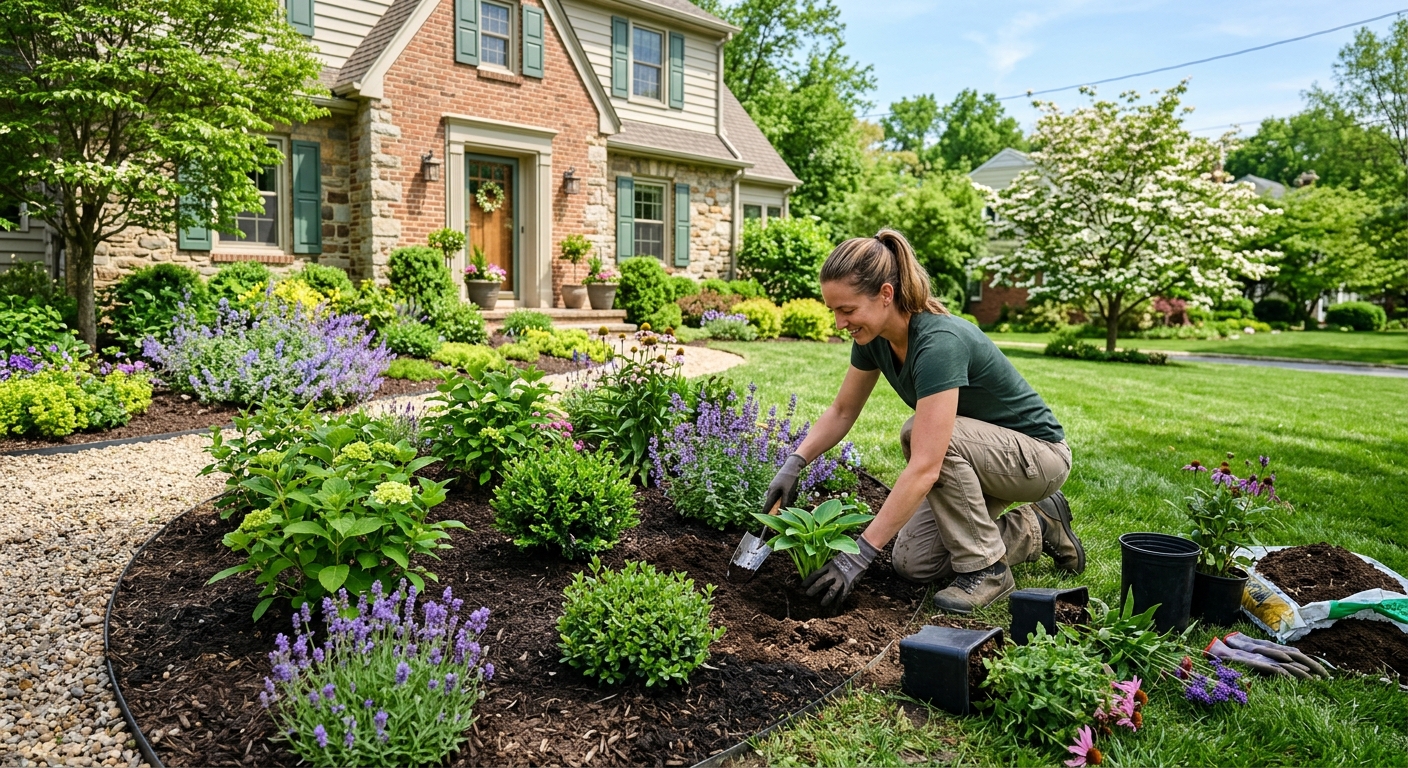
Landscaping options and costs in Laurier Heights
In Laurier Heights, Alberta, homeowners typically invest in their yard because each detached property comes with real outdoor space to enjoy—an especially common priority in a community with a population of 2,648 residents (Statistics Canada, 2021 Census). That said, the cost of improving your landscaping can swing widely depending on what you’re upgrading: softscape only (plants and turf) costs far less than hardscape + deep base prep, and Calgary’s winter-and-spring freeze–thaw cycle forces contractors to build for stability, not just appearance.
Calgary sits in Prairie plant hardiness zones 3–4, with late-spring frosts and early fall cold snaps that tighten the working season. Severe freeze–thaw also means retaining walls, patios, and walkways need deep, well-compacted bases and correct drainage, otherwise you can see heaving, settlement, or water migration toward foundations. Labour availability can be a factor too: during short “good weather” windows, crews are booked out, which can affect schedule and add pressure to overall pricing.
In Laurier Heights and nearby pockets like the broader NW Calgary family of communities where lot grading and drainage upgrades are common, demand is especially strong for front-yard curb appeal (paths, patios, and shrub borders) and for winter-ready designs that reduce maintenance. With that in mind, here are the typical options and realistic price bands—so you can compare contractor quotes apples-to-apples—starting with the full-project approach below.
| Service |
Description |
Season |
Price Range |
| Full landscape design and installation |
Site walk, grading/drainage plan, planting + turf, hardscape, and irrigation where needed |
Late spring to early fall (weather dependent) |
$5,000–$50,000 |
| Sod installation (supply, grade, lay, roll) |
Base prep, proper compaction, topsoil/topdressing as needed, install and roll |
Best in spring and early fall |
$1,500–$6,000 |
| Lawn seeding (grade, seed, starter fertilizer) |
Light grading, soil conditioning, seed application, starter fertilizer, initial care plan |
Spring or early fall |
$800–$3,500 |
| Interlocking patio or walkway |
Excavation, compacted base, edging, and interlocking stone installation |
Late spring to fall |
$8,000–$40,000 |
| Retaining wall (interlocking block) |
Block wall, drainage behind wall, compacted granular base |
Summer for best build conditions |
$10,000–$35,000 |
| Tree and shrub planting |
Soil loosening/amendment, planting, staking (if needed), mulch and initial watering plan |
Spring and early fall |
$800–$15,000 |
Prices are estimates only and vary by project scope, site access and material selection.
What affects the price of landscaping in Laurier Heights
Even for the “same” landscaping job, quotes in Calgary and across Alberta can differ by 30–50% because the invisible work—grading depth, drainage details, soil conditioning, and how crews sequence the site—changes the true cost. In a zone 3–4 environment, the plant list is only part of the story. Late frosts and early cold snaps shorten the window for planting and turf establishment, so contractors may need more conservative scheduling, and that affects labour allocation. Meanwhile, freeze–thaw cycles drive required base depth for hardscape and retaining work to reach below the frost line.
Prairie regions like Laurier Heights (Zone 3–4) require cold-hardy, drought-tolerant species and wind-protection strategies, which can reduce long-term watering and replacements—but you still pay for quality soil prep. Compare that to coastal BC (Zone 7–8), where planting choices look lush due to longer growing seasons, but heavy rainfall makes drainage design the key cost driver. In the BC interior, water restrictions typically push drip irrigation and xeriscaping design; in southern Alberta, you’ll often see smart controllers and zoned irrigation rather than high-water turf. Southern Ontario (Zone 5–6) usually has a more moderate growing season, with irrigation costs concentrated in summer dry spells.
Here are a few concrete Laurier Heights examples that raise or lower cost. First, if your yard is uneven and needs slope corrections for surface drainage, grading can push a project toward the higher end of the full landscape band—moving you closer to a mid five-figure outcome rather than a smaller softscape-only budget. Second, deep base prep for an interlocking patio or walkway is labour- and equipment-intensive; that’s why hardscape options often start around the $8,000 range and climb quickly with expansion or base complexity. Third, mature trees and larger caliper shrubs can shift the “planting” budget into the upper $15,000 band, but they can also be worth it when you need instant screening.
| Price Factor |
Why It Matters |
Cost Impact |
| Yard size in sq ft — the primary cost driver for softscape |
More area means more turf material, base prep, and labour hours |
Large yards can double or triple the budget even with similar materials |
| Grading and drainage work — slope corrections add significant cost |
Fixing runoff and preventing pooling protects foundations and walkability |
Often adds thousands when regrading is required beyond light top-up |
| Drainage bed or French drain installation |
Improves water movement during spring melt and intense rain events |
Can add a mid five-figure segment to a smaller project depending on length/depth |
| Plant material tier — native shrubs vs. ornamental vs. mature specimen trees |
Larger or more ornamental plants cost more up front and require more handling |
“Specimen” sizing can raise planting from low thousands to the upper band |
| Hardscape vs. softscape ratio — walls and patios cost more per sq ft than lawn |
Hardscape requires excavation, compacted base, and precise installation |
High hardscape budgets often align closer to the $8,000–$40,000 range |
| Irrigation system design and installation |
Zone-based coverage and freeze protection add components and labour |
Can materially increase full landscape totals, especially with smart controllers |
| Soil amendment and topsoil required |
Improves rooting and helps turf/plant establishment after freeze–thaw |
Heavy amendment needs add hauling and spreading labour |
| Tree removal or stump grinding before new planting |
Access, disposal, and site restoration are extra work |
Frequently adds an extra several hundred to several thousand depending on scope |
Permits & regulations in Alberta
In Alberta, most planting, sodding, and typical softscape work does not require a permit. For Laurier Heights homeowners, you usually can proceed with work like seed/sod installation, shrub and tree planting, mulching, and standard walkway improvements without a formal permit—as long as you’re not significantly altering the drainage pattern or disturbing utility-serviced areas.
The work that does commonly require a permit is retaining-wall construction above the height threshold used by many municipalities—typically around 1.0 m (3.3 ft)—and larger or complex walls may also require engineered drawings. Changes to lot grading that redirect surface water toward neighbouring properties or storm connections can also trigger approval requirements, because municipalities are focused on drainage impacts during spring melt and heavy rain. Before any digging (for tree holes, fence footings, drainage trenches, or wall footings), contractors should call for utility locates so you don’t hit buried services.
To verify your contractor in Laurier Heights, ask for three documents and check them before work starts: (1) Alberta licence information (where applicable for landscaping trades/business registrations) and the company’s ability to legally perform the work; (2) liability insurance with your job listed as covered, and confirm it hasn’t expired; and (3) WSIB/WCB coverage (workers’ compensation clearance letter or equivalent proof). Look for these on the contractor’s website paperwork page, in the quote package, and/or in the certificates they provide at your first site visit. If they won’t provide documentation, consider it a major red flag.
Planning a landscape that thrives in Laurier Heights's climate
Planning a yard that performs in Laurier Heights means designing for zone 3–4 reality: cold winters, late spring frosts, and the freeze–thaw cycles that test everything from lawns to patio bases. Start with plant selection. Choose native and proven hardy species so you’re not constantly replanting after winter dieback. Pair them with wind-tolerant layouts—especially for evergreens on exposed lots—so you reduce stress and winter burn.
For turf, compare sod vs. seed strategically. Sod gives instant curb appeal, but it’s typically 3–4x more per sq ft than seeding, and it still needs proper base prep and consistent early watering. If your goal is “green now,” sod can be worth it; if your timeline is more flexible, seeding and soil amendment is often the smarter value. As a dollar example, stepping up from seeding to sod commonly moves a lawn project toward the $1,500–$6,000 range instead of a lower seeding budget—just make sure the grading and drainage are correct, or you’ll pay again.
Drainage and grading are non-negotiable in Calgary. Surface pooling and foundation moisture are common failure points when slopes are wrong or when downspouts and grading aren’t coordinated. For hardscape, ensure your patio or walkway base has the correct depth, granular layers, and compaction so it can handle frost movement without cracking or shifting.
Finally, design for low maintenance: mulch rings, groundcovers, and layered perennials reduce annual upkeep. Consider xeriscape or a rain-garden style swale where feasible—especially in areas that receive runoff—so the water goes somewhere useful instead of soaking foundations. Done right, you’ll spend less on seasonal repairs and more on long-term performance.
| Element |
Climate Consideration |
Maintenance Level |
Price Band |
| Sod lawn installation |
Cold-hardiness varies by cultivar; needs correct base and early watering during short spring windows |
Medium (watering/first-season establishment) |
$1,500–$6,000 |
| Native perennial garden |
Zone-appropriate plants handle winter stress better and recover after freeze–thaw |
Low to medium (spring cleanup, occasional weeding) |
$2,000–$8,000 |
| Mulched shrub border |
Mulch moderates soil temperature and helps with moisture retention through dry spells |
Low (refresh mulch yearly, light pruning) |
$1,800–$10,000 |
| Interlocking stone patio |
Requires deep, compacted base and proper drainage to prevent heaving |
Low (occasional joint sand/top dressing) |
$8,000–$40,000 |
| Retaining wall (block) |
Needs engineered-style drainage behind the wall and a base that sits below frost movement |
Low (periodic inspection) |
$10,000–$35,000 |
| Drip irrigation system |
Zoned, freeze-protected irrigation improves efficiency during short warm periods |
Low (seasonal checks and winter shut-down) |
$2,000–$12,000 |
How to choose a landscaping contractor in Laurier Heights
Choosing the right contractor in Laurier Heights starts with documentation and process. For Alberta coverage, confirm three items before signing: (1) liability insurance (request a certificate and verify the policy is active and the work is covered); (2) WSIB/WCB coverage for workers (ask for a clearance letter or proof of account standing); and (3) any applicable business/contractor registration evidence required to perform the scope. Don’t accept “we’re covered” verbally—ask to see certificates. If a contractor can’t provide current paperwork promptly, keep moving.
Next, get 2–3 itemised written quotes. You want a labour + materials breakdown (not a single lump sum), with line items for excavation/base prep, soil/topsoil or amendments, stone/block, plant quantities/sizes, irrigation components, and disposal. Read the scope carefully: is permit pulling included where required (for example, some retaining walls), is disposal/hauling included, and are temporary protection measures part of the job? Also ask about warranty terms: workmanship warranty length, whether product/manufacturer warranties apply, and if warranties are transferable to you as the homeowner.
Payment scheduling matters. Never pay more than 10–15% upfront. Use a holdback until the job is complete and inspected (especially at key stages like base completion, drainage verification, and final plant establishment steps). Finally, require a timeline: a start date and realistic completion estimate in writing, tied to weather conditions in Calgary’s freeze–thaw season.
- Provide current liability insurance certificate before the site visit is scheduled.
- Provide WSIB/WCB clearance letter or equivalent proof.
- Give itemised pricing (labour vs materials, with quantities and unit rates).
- Confirm base prep depth and drainage approach in writing for patios/walls.
- List exact sod seed mix, plant sizes, and mulch specification.
- State whether disposal/haul-away is included for excavated material.
- Clarify who calls for utility locates before digging.
- Define warranty: workmanship start date, length, and what’s covered.
- Confirm winter work limitations (freeze conditions) and how schedule impacts you.
- Request a detailed payment schedule in the contract (no large deposits).
- Ask for photos of similar Laurier Heights-type projects and references.
- Make sure irrigation design includes freeze protection and zoned coverage.
Concrete red flags I see around Calgary landscaping: a contractor who won’t itemise labour/materials, missing or expired insurance/WSIB paperwork, no clear explanation of drainage and base requirements (especially for patios/walkways), vague warranty language (“guaranteed” with no term or coverage), and pushing for large deposits (more than 10–15%) before any groundwork starts.
Frequently asked questions — landscaping in Laurier Heights
How much does sodding a yard cost in Laurier Heights?
Sodding costs in Laurier Heights typically land in the $1,500–$6,000 range for most residential front and back yards, depending on area and how much base prep is required. If your existing grade is uneven or drainage needs adjustment, you can pay more because turf fails faster when water pools during spring melt and freezes again after late frosts. Many homeowners choose sod when they want instant curb appeal, but sod still requires the same fundamentals: proper compaction, correct topsoil depth, and early-season watering. If you’re currently comparing quotes, ask contractors to break out topsoil/conditioning labour versus actual sod supply and installation so you’re comparing like-for-like.
How do I prevent weeds in my Laurier Heights garden?
Weed control in Laurier Heights starts before planting. Begin with proper site prep: remove perennial weeds (roots included), loosen compacted soil, and correct drainage so plants establish quickly and shade the soil. For shrub borders, use a consistent mulch layer (not thin patches) over fabric only if your contractor’s plan fits the plantings—mulch itself is the long-term weed suppressor, especially in Alberta’s dry-wet swings. Install edging so mulch stays where it belongs and so lawn infiltration doesn’t create a weed bridge. For active beds, plan for an initial “flush and cleanup” after planting and again after the first freeze–thaw cycles. This isn’t about chemicals—it’s about getting your spacing, soil health, and coverage right.
How do I design a low-water yard in Laurier Heights?
A low-water yard in Laurier Heights works best with zone-appropriate, drought-tolerant choices and smart watering habits. Start by reducing thirsty turf: consider seeding in sections instead of full sod where timing allows, and shift more area to native perennial gardens and mulched shrub borders. Use drip irrigation or targeted soaker lines for beds, paired with zoned controllers so only the areas that need water run during short warm periods. In Calgary, freeze protection is essential—irrigation should be designed and winterized so lines don’t split in cold snaps. If your contractor is proposing high-water turf everywhere, ask how they’ll manage drainage, wind exposure, and watering schedule during periodic restrictions and dry spells.
How do I find a licensed landscaper in Laurier Heights?
For Laurier Heights homeowners, the safest path is to screen contractors using documentation and process. Ask for their current liability insurance certificate and WSIB/WCB clearance letter (or proof of coverage) before the quote is final. Confirm any applicable Alberta licensing/registration evidence for the business and ensure their staff are covered for site work. Then require itemised written quotes: labour + materials breakdown, including base prep, disposal, and any drainage components. Check that the scope explains what they’re doing under the ground—especially for patios, walkways, and retaining walls where base depth and drainage affect longevity. Finally, verify warranties in writing and confirm payment terms: keep deposits at roughly 10–15% and hold back until completion. This combination is usually more reliable than relying on word-of-mouth alone.
How much does landscaping cost in Laurier Heights?
Landscaping costs in Laurier Heights often fall into the mid five-figure range once you include grading, hardscape, planting, and irrigation—especially if you’re correcting drainage or building a more complex yard. For example, interlocking patios and walkways frequently align with the $8,000–$40,000 band depending on size and base requirements. Planting projects alone commonly come in around the $800–$15,000 band when you’re adding trees, shrubs, and a mulched border. If you’re looking at a full makeover with design and installation, many homeowners budget within the $5,000–$50,000 range based on scope and access. The biggest swing factors are site grading depth, drainage solutions, and how many sq ft are going hardscape versus softscape.
What plants thrive in Laurier Heights's climate zone?
In Laurier Heights (Prairie hardiness zone 3–4), the best performers are cold-hardy, wind-tolerant plants that can handle freeze–thaw cycles and brief warm seasons. Homeowners typically do well with native perennial options and hardy shrubs that are built for Alberta winters, along with trees known to establish reliably after cold snaps. The right pick also depends on your yard’s microclimate: wind-exposed edges need tougher choices, and low spots that hold moisture need plants suited to wetter conditions or a drainage fix first. When reviewing contractor plant lists, ask what species are recommended specifically for zone 3–4 and whether they’re drought-tolerant once established. A good installer will also explain winter protection and initial watering strategy so plants root before the weather turns.